The corkscrew hazel, Corylus avellana ‘Contorta’, is a shrub people buy for its winter outline. Once the leaves drop, every branch twists and loops like a stretched-out spring, and in February it hangs with yellow catkins. So it’s a shock when you look at it in late autumn and find a few long, ramrod-straight rods shooting up through the middle. Nothing has gone wrong with the curls. Those straight stems are a different plant.
Where the straight shoots come from
Most corkscrew hazels sold in garden centres are grafted. The twisted variety sits on the roots of an ordinary common hazel, because the contorted form is slow and weak-rooted on its own. Common hazel is one of the most vigorous suckering shrubs there is: left alone, it throws up new stems from the base and the roots every year. That is how hazel coppice works.
On a grafted corkscrew hazel, those vigorous stems carry the rootstock’s genes, not the twisted ones. They grow straight, fast and upright, and their leaves are flat and smooth instead of crinkled and curled. The rootstock is still alive and still doing what hazel does.
It’s the same problem as suckers on a grafted rose: the plant you bought is only the top part, and the roots underneath want to grow their own plant.
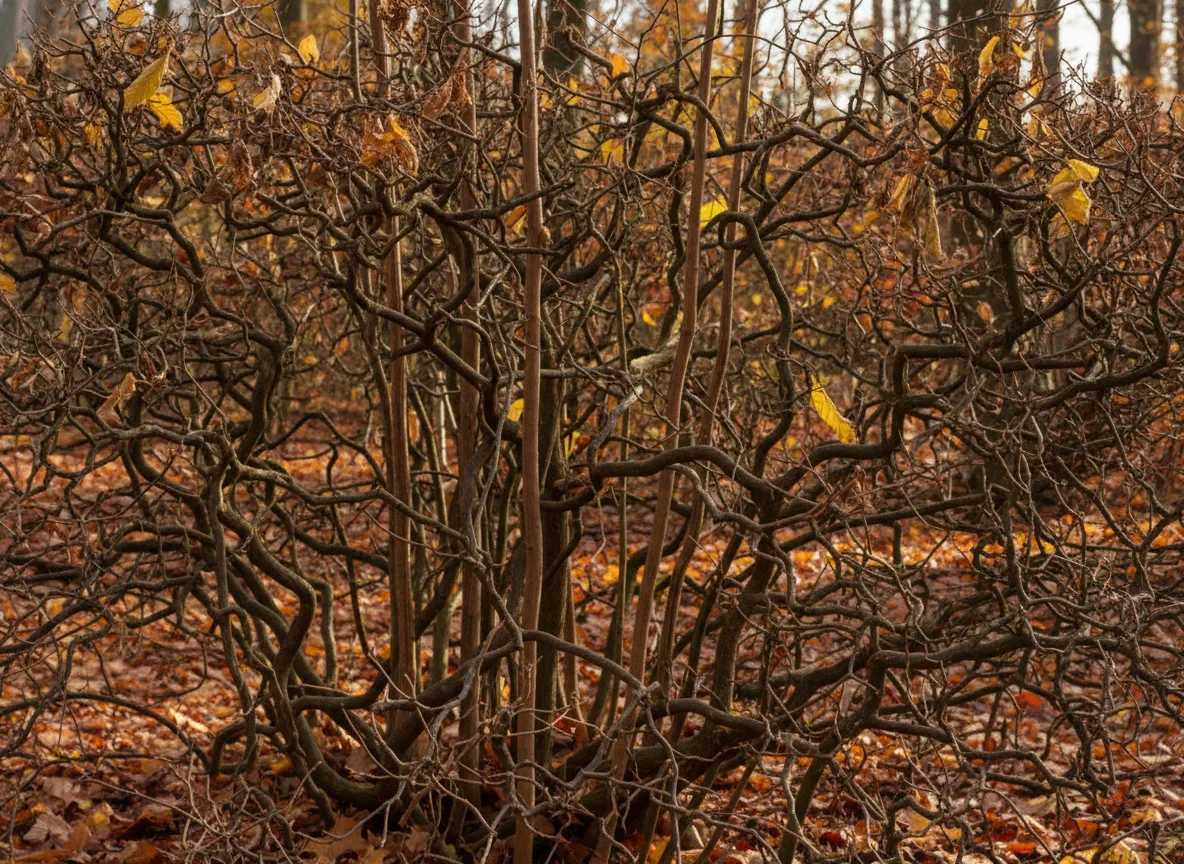 Corkscrew hazel branches and stems are visible after leaves have fallen in late October — AI-generated illustration
Why late October is the time to look
In summer the straight stems hide among the leaves, and a dense, leafy shrub makes it hard to see where each shoot starts. Once the leaves turn yellow and drop, from late October into November, the whole structure is on show. The curled branches and the straight rods stand out against each other, and you can follow each straight one down to where it comes from.
It also suits the plant. Hazel is dormant from leaf fall until the catkins open, so removing wood now causes no sap loss and the plant won’t push soft new growth into winter. The small, tight catkins for February are already sitting on the twisted branches, so you can see exactly which wood to leave alone.
If you find suckers in summer, take them out then. Don’t wait for autumn just because it’s the tidier time. Leaf fall is simply when you’re most likely to spot the ones you missed.
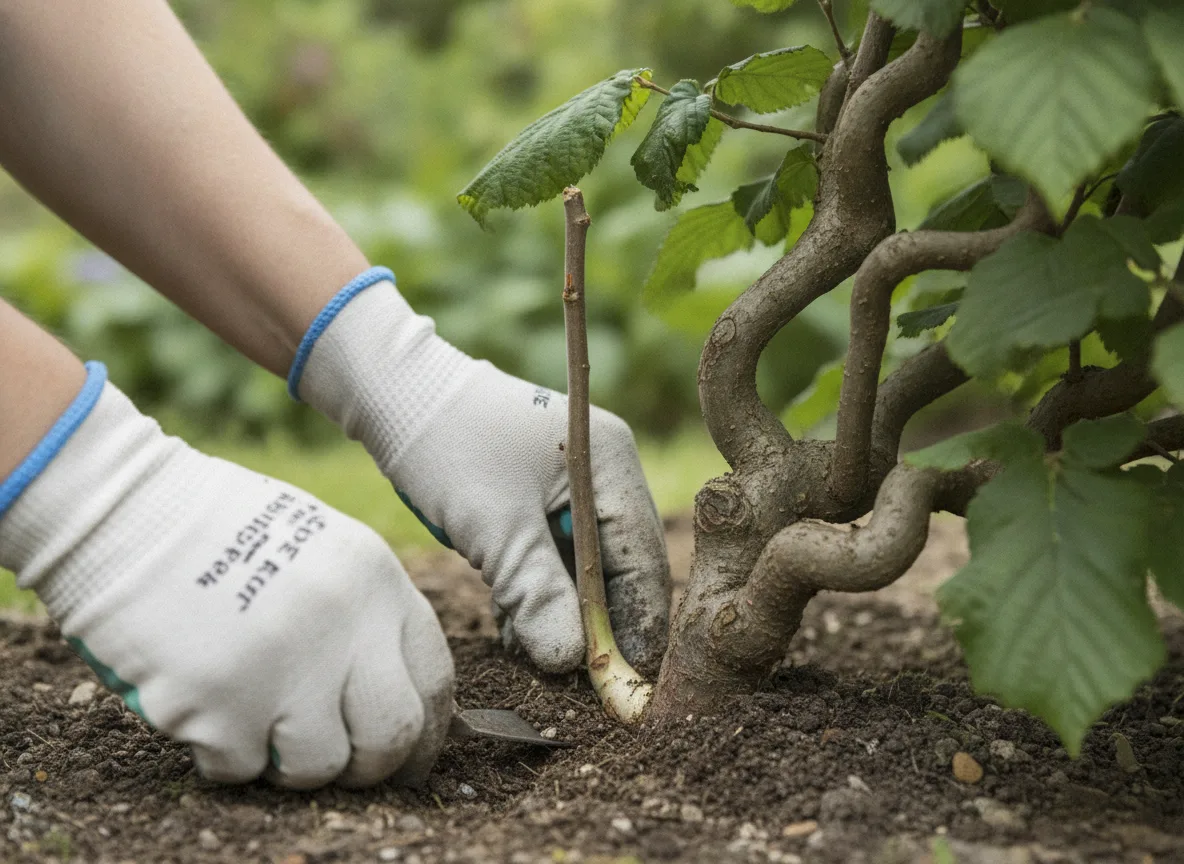 Gloved hands scrape soil from the base of a corkscrew hazel sucker — AI-generated illustration
How to remove a sucker properly
The aim is to take the sucker off at its point of origin, not at ground level. Cutting a sucker off at the soil surface leaves a stub full of dormant buds, and each of those buds can come back as two or three new straight shoots next spring.
- Trace it down. Scrape the soil away from the base of the straight shoot with a trowel or your fingers until you find where it joins the root or the old stem below the graft.
- Pull or tear it off if you can. Grip the shoot low and pull it sharply downwards and away. Tearing it off removes the bud cluster at its base, which a cut leaves behind. Young suckers come away easily.
- Cut flush if it won’t tear. On thicker, older suckers, use clean secateurs or a pruning saw and cut tight to the root or stem it grows from, leaving no stub.
- Put the soil back and firm it down.
Check whether the shoot really starts below the graft. The graft union usually sits a hand’s width or so above the soil, as a slight swelling or change in bark. Anything from below that point is rootstock. A straight stem from above it is rare, but if one appears, it’s a reversion, and it goes too, cut back to the twisted branch it grew from.
What happens if you leave them
Rootstock shoots grow far faster than the contorted top. In two or three seasons a few straight rods become a thicket, shading the curls and taking the lion’s share of water and food from the roots. The twisted top slowly weakens, and in neglected gardens it eventually dies out altogether, leaving an ordinary hazel bush where your corkscrew used to be.
It’s the same takeover you see when an all-green shoot on a variegated shrub is left to grow: the more vigorous growth always wins unless you remove it.
If the straight stems already outnumber the curls, don’t take them all out in one go on a weak plant. Remove the biggest ones this winter and the rest next autumn, so the twisted top isn’t left suddenly exposed and short of leaves to feed it.
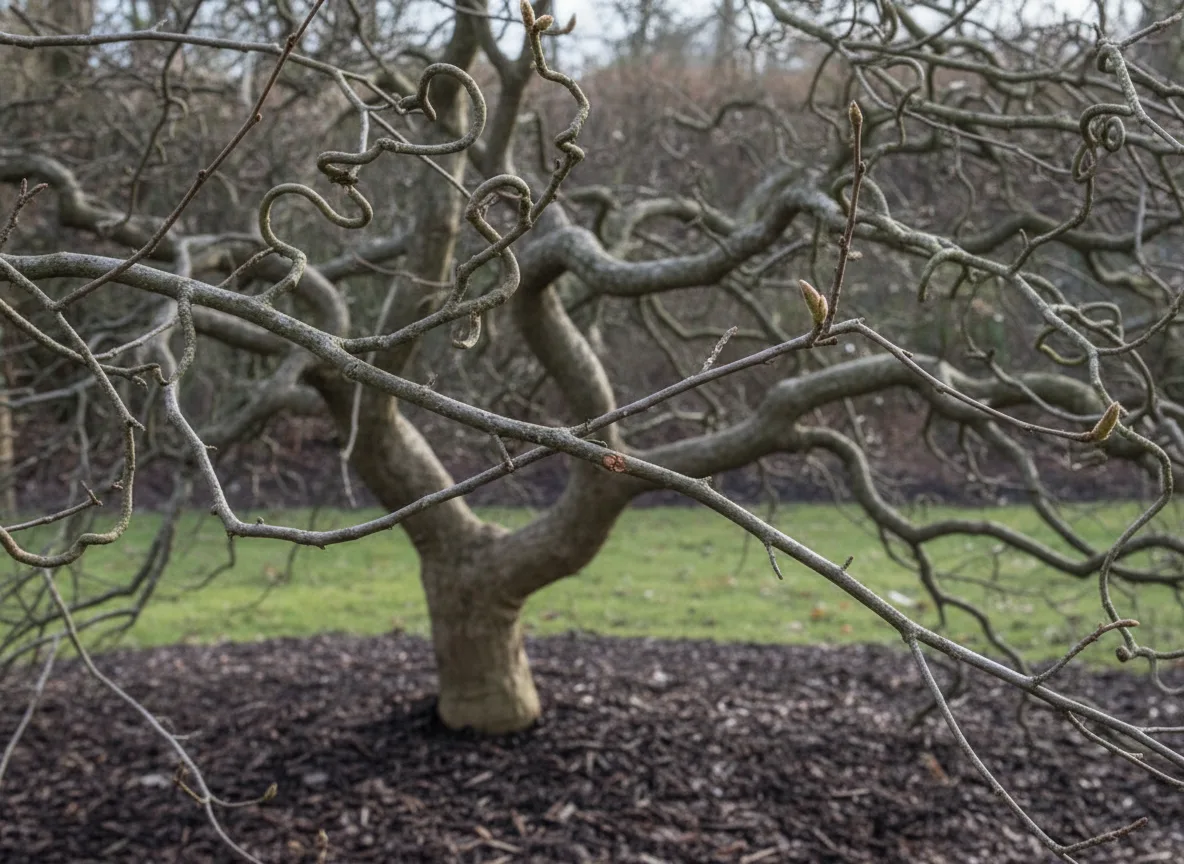 A corkscrew hazel tree with its twisted branches and mulched base — AI-generated illustration
What else (not) to prune on a corkscrew hazel
The twisted branches need very little cutting. A light hand keeps the shape that you bought it for.
- Dead, damaged and crossing stems can come out in late winter, cut back to a healthy branch.
- Don’t shorten the curly branches all over. Each cut triggers straighter, more upright regrowth, and the shrub loses its loose, spiralling outline.
- Keep the graft above the mulch. If soil or mulch piles up over the graft union, you can no longer tell rootstock shoots from twisted ones at a glance.
The twisted stems you do remove are worth keeping. They last for years in vases and wreaths. Straight sucker wood is a different matter: don’t add it to the pile for hardwood cuttings: you’d only be growing more ordinary hazel.
Own-root plants don’t sucker the same way
Some corkscrew hazels are now grown from micropropagated plants on their own roots. On those, everything from the base is twisted, so any new shoot is welcome. If your plant has never produced a straight stem and the bark is the same from the soil up, it may be one of these. If you’re unsure, follow the rule of thumb: crinkled leaves and curled stems stay, flat leaves and straight stems go.
Cresco tracks your plants’ pruning windows by local weather, so a reminder lands when the leaves are down and the suckers are easy to see. You can add your corkscrew hazel in the app and get the next check-up on your list.