First, be sure you have to
A peony is the opposite of most things in the border. It doesn’t want dividing every few years — left alone, a herbaceous peony will flower more freely each season and can sit in the same spot for fifty years or more, outliving the gardener who planted it. So before you reach for the fork, be honest about why.
There are really only two good reasons to lift one in autumn. The first is that it’s stopped flowering well — fewer, smaller blooms year on year, or a fat, healthy-looking clump that throws leaf and almost no bud. The second is that you simply need it somewhere else: a border being rebuilt, a shrub that’s grown over it, a move you can’t avoid.
If neither applies, leave it be. A peony that’s flowering happily gains nothing from being disturbed, and every time you lift one you set its display back by a year or two while it re-roots. Disturbance is the cost, not the cure.
 Brown peony foliage frames a window overlooking a frosty garden — AI-generated illustration
The window: after the foliage dies down
The moment to move or divide a peony is early to mid autumn — roughly late September into November — once the leaves have yellowed and collapsed but before the ground turns cold and sodden.
The reasoning is all about roots. In autumn the soil is still holding summer’s warmth, the plant has shut down its top growth, and its energy has drained back into those fleshy storage roots. Lift it now and it puts what’s left of the season into settling in and making new root, so it’s anchored and ready to push in spring. Do the same job in spring and you catch the plant just as it’s trying to flower — it sulks, and you lose that year’s show for nothing.
So the order of events is: let the foliage die back naturally, cut the spent stems down close to the ground, and then lift. Don’t chop a peony down while it’s still green and working — you’d be throwing away the very sugars it’s trying to bank for next year.
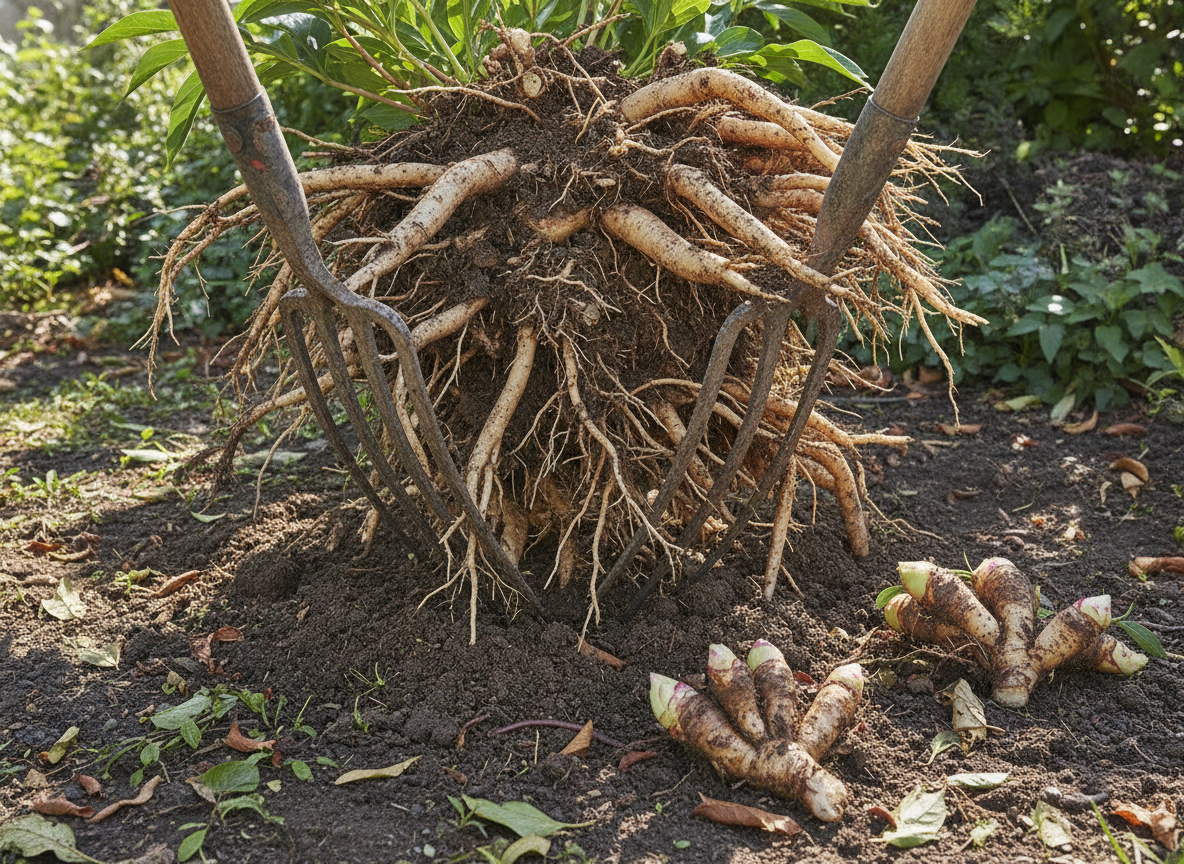 Peony plant with exposed roots being split by garden forks — AI-generated illustration
Lifting and splitting the crown
Pick a mild day when the soil is moist but not waterlogged. Water the plant well the evening before if it’s been dry, so the roots come up with soil clinging to them.
- Lift the whole clump. Dig a wide circle a good spade’s width clear of the crown and lever the whole root system out. Peony roots are brittle and run deeper than you expect — go in close and you’ll snap off the best of them.
- Wash or shake off the soil. You need to see the crown to divide it well. A quick rinse with the hose reveals the pink or white growth buds — the “eyes” — sitting on top of the fleshy roots.
- Cut, don’t tear. With a clean, sharp knife, cut the crown into sections. Each division wants three to five plump eyes and a decent fist of storage root to feed them. A single lonely eye may survive, but it’ll take an age to build into anything.
- Bin the tired middle. Cut away any soft, dark or rotten root and discard the woody, exhausted heart. Keep only firm, pale, healthy sections.
Don’t be squeamish about it. A peony looks alarming split apart on the bench, but each clean-cut piece with its own eyes and roots is a whole new plant in waiting.
Planting depth: the part that decides everything
This is where more peonies are lost to non-flowering than to any pest, disease or weather. Get everything else slightly wrong and the plant forgives you. Get the depth wrong and it will grow lush leaf and refuse to bloom, sometimes for years, sometimes forever.
The rule is simple and worth tattooing on the trowel: the eyes sit just below the surface — no more than 2.5 to 5cm (1–2in) deep. On heavy clay, plant towards the shallow end of that; on light, free-draining soil you can go to the deeper end. Any deeper than about 5cm and the buds can’t feel the winter cold they need to trigger flowering, and you get a leafy, sulking plant.
Dig a generous hole, work in some garden compost at the base, and set the division so the topmost eyes end up a bare inch under the finished soil level. It’s the single most common mistake with peonies — people tuck the crown in “safely” deep the way they would a shrub, and quietly guarantee themselves no flowers. Shallow is right.
Firm the soil gently, water it in, and mark the spot so you don’t spear the dormant crown with a fork over winter.
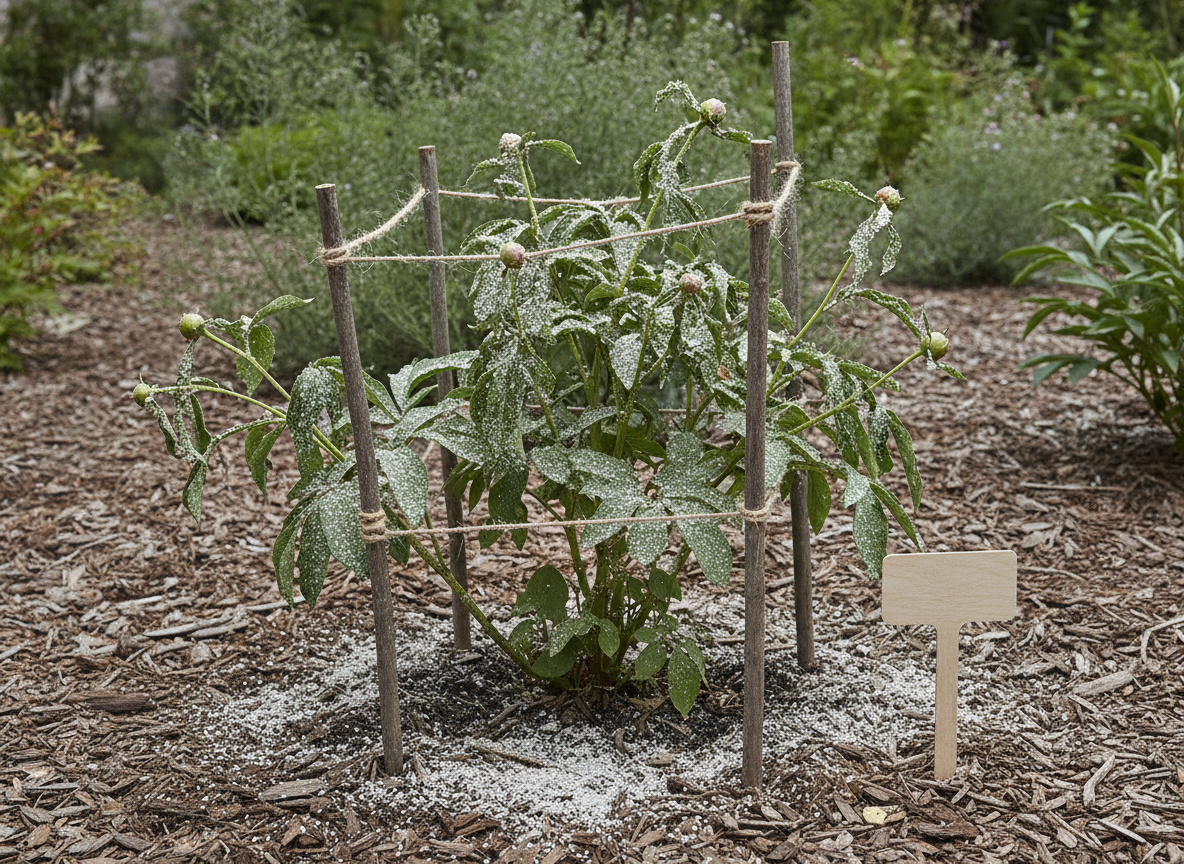 Young peony plant supported by stakes in a garden bed — AI-generated illustration
Aftercare, and the patience it asks for
A newly moved or divided peony needs almost nothing — and nothing is mostly what you should give it. Water through any dry spells in its first autumn and the following summer while the roots take hold. Mulch lightly with compost or leaf mould in a ring around the crown, never heaped over it, or you’ve effectively planted it too deep again. Skip the high-nitrogen feed; it only pushes soft leaf at the expense of bud.
Then wait. This is the hard part. A disturbed peony commonly takes two to three years to return to full flower — the first spring may give you a few blooms or none, the second a handful, the third the proper show. That silence isn’t failure; it’s the plant rebuilding its root before it spends anything on flowers. Resist the urge to dig it up “to check” — that just resets the clock.
If you’re moving a clump that was flowering well and only needs relocating, keep it in one piece rather than dividing — a bigger crown re-establishes faster and skips much of that waiting.
Tree and Itoh peonies are different
One caveat before you start splitting everything called a peony. Tree peonies (the woody, shrubby ones) are almost always grafted onto a nurse root, and they don’t lift and divide like the herbaceous kind — treat them as shrubs and leave the crown alone. Itoh (intersectional) peonies can be divided much like herbaceous ones, but their crowns are tougher and woodier, so you’ll need a saw rather than a knife and even more patience afterwards.
For the ordinary herbaceous border peony, though, autumn division is a genuine two-for-one: you rescue a tired clump and come away with extra plants, as long as you keep the crown shallow and let it take its time. It’s the same principle behind lifting and splitting any tired perennial clump in early autumn — just with a longer memory and a shorter fuse for being buried.
Cresco tracks the right dividing, planting and pruning window for every plant in your garden, so you know which clumps to lift this month and which to leave well alone — peonies very much included.