The one prune most people skip — and the flowers they lose for it
Everyone remembers the summer cut. The whips are shooting everywhere in July, the plant looks feral, and shortening it back feels like the obvious job. The winter cut is quieter. The wisteria is bare, dormant, apparently doing nothing, and it’s cold out — so the secateurs stay in the shed. That skipped January cut is the single most common reason a well-grown wisteria still disappoints in May.
The two are a pair, not alternatives. The summer shortening to five or six leaves slows the plant down and starts ripening the wood. The winter cut is what finishes the spur — it takes those half-formed stubs and reduces them to two or three fat flower buds, so every bit of the plant’s spring energy is aimed at flowering instead of leafing. Do the summer cut alone and the spurs drift longer and leggier each year; do both, year after year, and you build the tight, knuckled spur system that makes an old wisteria drip with racemes.
There’s a second reason winter is the better of the two windows for the serious tidy-up: you can see what you’re doing. With the leaves off, the whole framework is laid bare — every crossing stem, every congested spur, every whip the summer pass missed. Nothing is hidden behind foliage. This is the prune where you set the plant’s shape for the year.
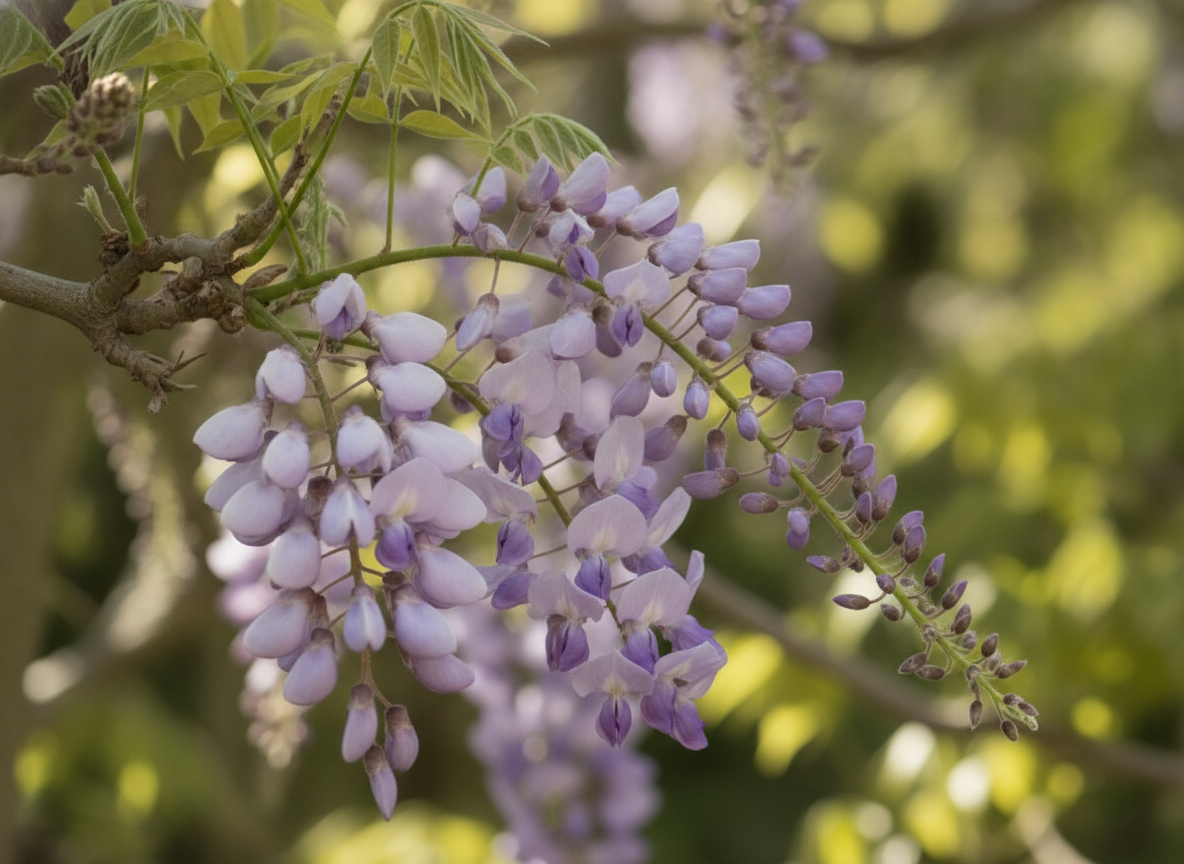 AI-generated illustration
Fat and round, or slim and pointed? Read the buds first
The whole winter cut hinges on one skill: telling a flower bud from a leaf bud. On bare wood in January the difference is easy to see once you know to look.
- Flower buds are fat, rounded and plump — they sit a little proud of the stem, almost swollen, and they’re clustered along the short stubby spurs off the main framework.
- Leaf (growth) buds are slim, flat and pointed — they lie closer to the stem and run along this year’s longer, whippier growth.
You are cutting towards the fat buds and away from the pointed ones. When you shorten a summer-pruned stub back to “two or three buds,” you mean two or three of the plump, rounded flower buds near the base. Leave those; remove everything beyond them. Get this right and you can more or less predict May’s display in January by counting the fat buds you’ve kept.
If you can’t yet tell them apart on your own plant, look at the base of the spurs where they join the old framework — the swollen buds there are almost always flower buds, because that’s where a mature wisteria flowers from.
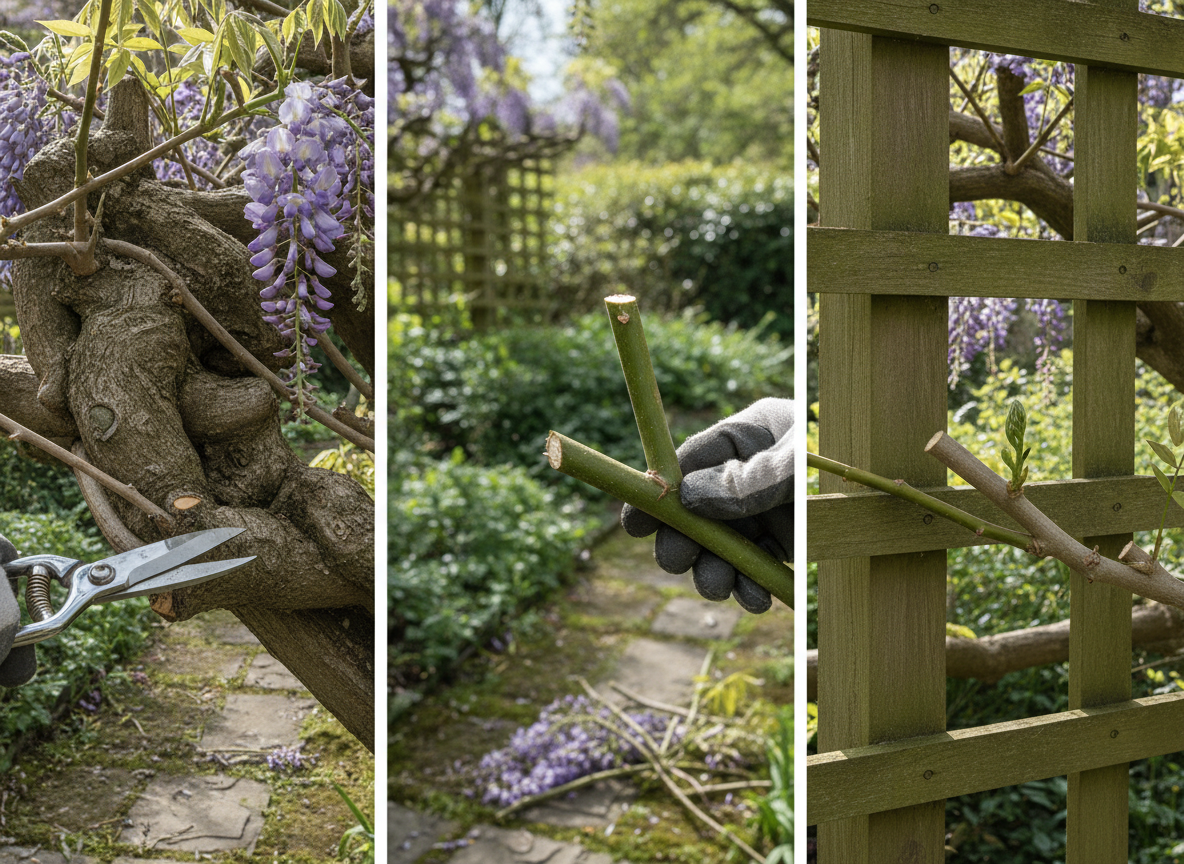 A close-up triptych illustrating pruning a wisteria vine — AI-generated illustration
The cut, step by step
Winter pruning is faster than summer’s rolling job — it’s one pass over a leafless, visible plant. You’ll want sharp secateurs for the stubs and loppers for anything older and thicker.
- Work along the framework, spur by spur. Find each stub you shortened in summer — the short lengths of last year’s growth coming off the main branches.
- Cut each one back to two or three buds, to within about 2.5 to 5 cm of the older wood — a short stub carrying just those buds. Cut cleanly, about a centimetre above a bud, on a slight angle away from it.
- Catch the whips summer missed. Any long, thin growth that escaped the summer pass — or grew after it — gets the same treatment now: back to two or three buds from the framework.
- Thin congested, overlapping spurs. Where old spurs have branched into a crowded knuckle, take out the weakest and oldest to leave a few strong, well-spaced buds. Crowded spurs shade each other and flower poorly.
- Keep only the leaders you still need. If you’re extending the plant along a wall or pergola, select one strong, well-placed shoot per direction, tie it in along its support, and leave it unpruned. Everything else is a flowering spur, not a leader.
- Remove suckers and rootstock growth at the base, the same hard rule as with rose suckers — anything from below the graft or straight out of the ground belongs to the wild rootstock and steals energy.
When you step back, the plant should look almost startlingly bare: a clean framework studded with short spurs, each tipped with two or three fat buds. That spareness is the point. Every one of those buds is now a raceme in waiting.
When to make the cut — and why timing the buds matters
The window is winter proper: January and February, when the plant is fully dormant and leafless but before the buds start to swell and break in early spring. That’s the sweet spot the RHS points to, and there’s a reason it’s narrow at both ends.
Cut too early — say in a mild November before the plant has properly shut down — and a warm spell can push soft regrowth that then gets frosted. Cut too late — once the buds are swelling and greening up in March — and you risk knocking off the very flower buds you spent all winter protecting, plus the plant may “bleed” sap from fresh cuts. January into February threads between the two: the plant is deep enough asleep to take the cut cleanly, and close enough to spring that the reduced spurs go straight into flowering.
Unlike the summer cut, timing here is genuinely about the calendar and the buds rather than the growth. Wait for a dry, still, frost-free day if you can — clean cuts on dry wood heal better — and get the whole plant done in one pass while the framework is easy to read.
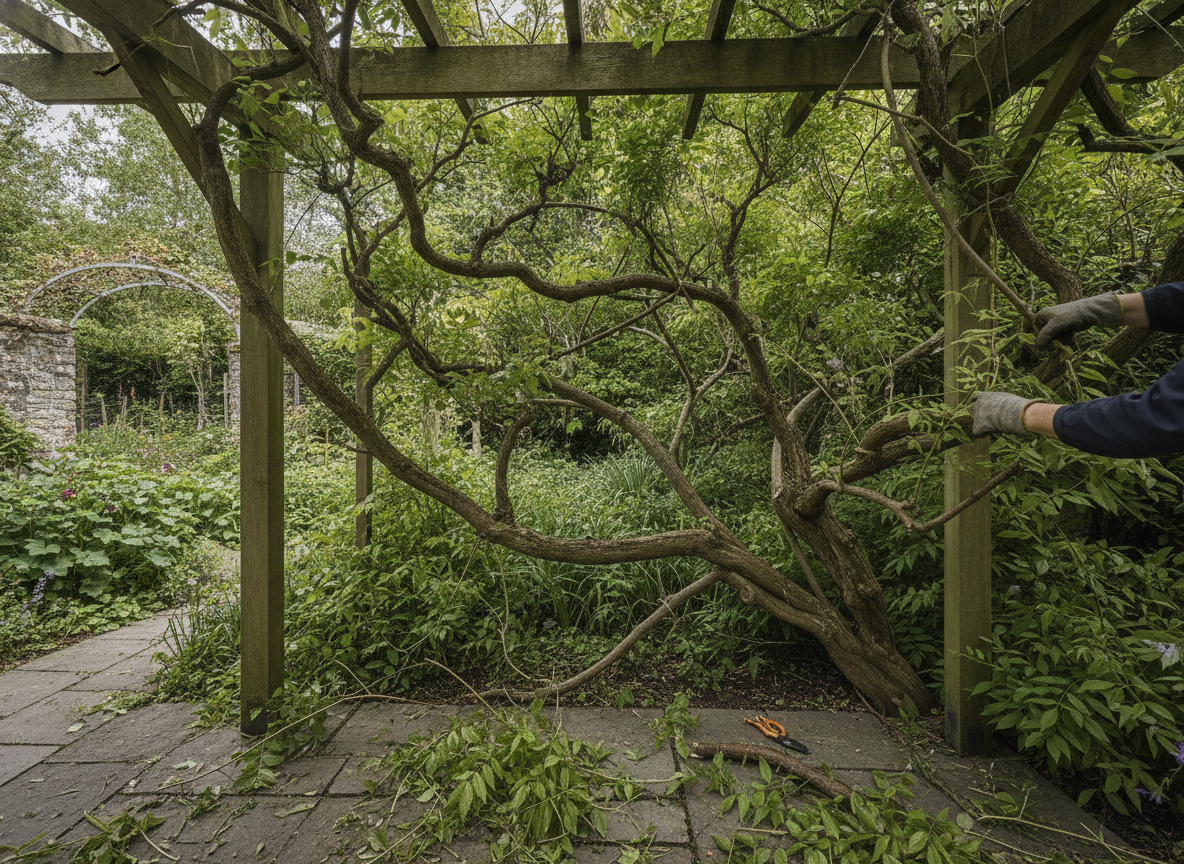 A person prunes a neglected wisteria on a wooden arbor in a garden — AI-generated illustration
Restoring a neglected, all-leaf wisteria
If you’ve inherited a wisteria that’s never been pruned — a great green tangle that flowers thinly, if at all — winter is when you rescue it. The leafless framework is the only time you can actually see the mess well enough to fix it.
Work in stages rather than butchering it all at once:
- Find the framework first. Trace the main structural stems you want to keep — the ones that cover the wall, pergola or arch in the shape you want. Everything else is a candidate for removal.
- Cut out the tangle. Remove dead, damaged and crossing stems, and any thin whippy growth snaking through the middle with no support. This alone opens the plant up dramatically.
- Shorten what’s left to spurs. Reduce the remaining side growth to two or three buds off the framework, exactly as on a well-kept plant.
- Spread hard renovation over two or three winters. If you need to cut thick old wood right back to reshape the plant, do it in stages across successive winters rather than removing everything in one go — a wholesale hard cut can throw the plant into a sulk of leafy regrowth and no flowers.
One caution before you blame the pruning: a wisteria that has never flowered may simply be too young. Seed-grown plants can take a decade or more to reach flowering age, and even grafted ones often sulk for a few years after planting. If yours is young and you’re pruning correctly, the fix is patience, not a harder cut.
The winter-prune mistakes that cost you May
- Skipping it because the plant looks “done for the year.” Bare and dormant is not finished — it’s exactly when the flowering spurs are set up. A summer-only prune leaves the spurs half-made.
- Cutting to pointed buds instead of fat ones. Shorten to two or three of the plump, rounded flower buds. Cut back to slim pointed leaf buds and you’ve kept growth, not flowers.
- Hacking into the old framework. The thick structural wood carries the spurs. Reduce the side growth, not the branches that hold it all up.
- Leaving it until March. Once the buds swell, every cut risks removing flower buds and sets the plant bleeding. If you’re late, prune lightly or wait — don’t crash through swelling buds.
- Feeding with high-nitrogen fertiliser. Nitrogen drives leaf, not flower. If you feed, use a high-potassium feed such as sulphate of potash in spring — the same principle that governs the whole two-prune system.
Let Cresco remember both cuts for you
The hard part of wisteria was never the cut — it’s that there are two of them, six months apart, and the winter one falls in the dead of the year when nothing in the garden is shouting for attention. Miss it, and you’ve quietly given up next spring’s flowers.
That’s the exact problem Cresco is built to solve. Tell it you’ve got a wisteria and it will nudge you when the summer shortening cut is due and again when the winter spur-prune window opens — timed to your own location and season, not a generic “February.” If you’d rather garden by feel than by calendar, see how Cresco tracks every plant’s pruning window for you, and let the winter cut stop being the one you forget.