The tidy-up that leaves the crown exposed
By late September the deciduous ferns start to look tired. The fronds that stood fresh and green all summer begin to flush yellow, then brown, and by October they’re flopping over the crown in a soft, collapsing heap. On a tidy-up weekend it’s the obvious thing to reach for: cut the lot down to the ground, clear the bed, and start winter with a clean sheet.
It’s also the one cut that leaves a fern worse off than doing nothing at all. Those dying fronds aren’t rubbish — they’re a blanket. Cut them away now and you strip the crown bare for the coldest months of the year, right when it can least spare the cover. The frond that looks dead is still doing a job, and the moment to remove it isn’t autumn. It’s spring, once it has finished.
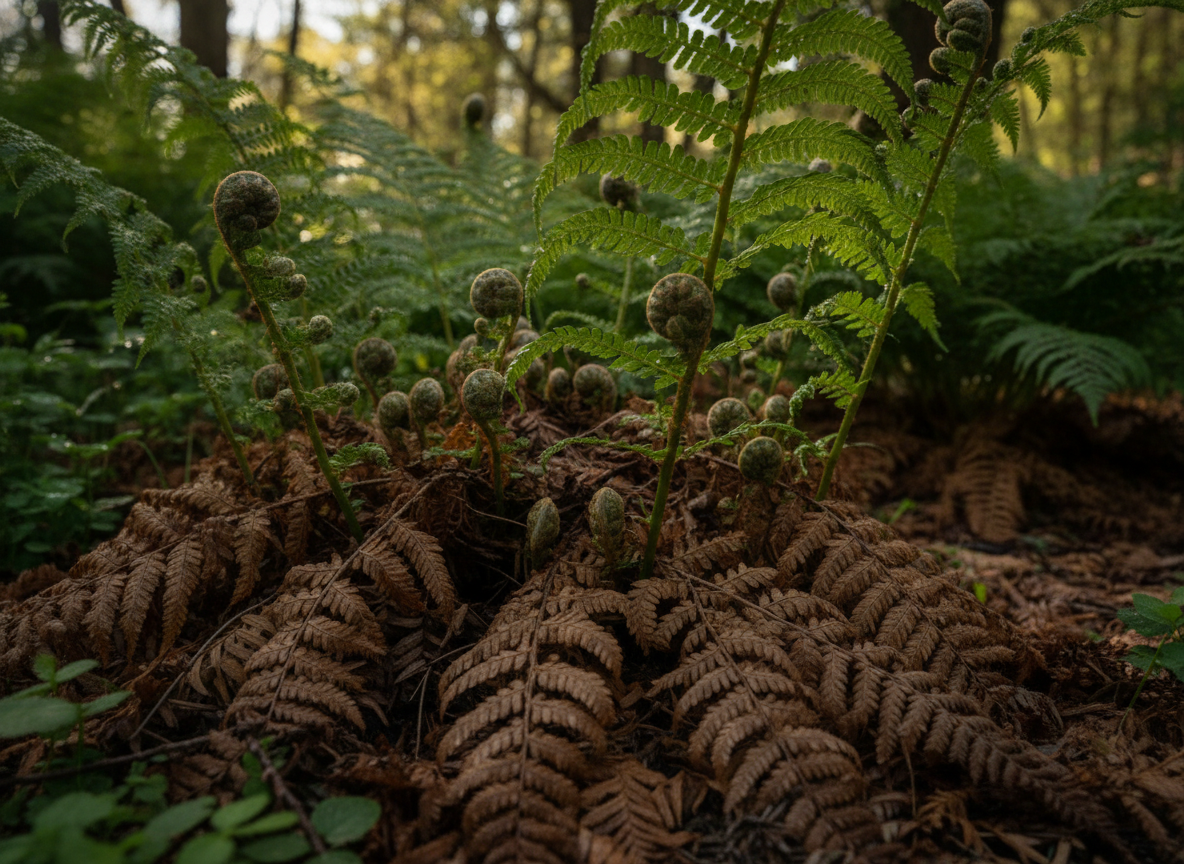 A naturalistic photo of fern fronds, old and new, in a garden — AI-generated illustration
Why the old fronds earn their keep
A fern grows from a crown — a tight, congested cluster of growing points sitting at or just above soil level. Everything next year depends on that crown coming through winter alive. Tucked down inside it, already formed, are next spring’s fronds: the coiled, knuckle-tight croziers (fiddleheads) that will unfurl in April. They spend the whole winter as tender little spirals sitting right at the surface, and they are the most frost-vulnerable part of the whole plant.
The old fronds, collapsing over the top of the crown, are exactly what shelters them. As they die back they form a loose, insulating thatch that traps a pocket of still air, sheds the worst of the rain, and keeps hard frost off the growing points below. Cut that thatch away in October and you expose the crown and its croziers to every frost, freeze-thaw cycle and cold wind of the winter — and in a hard one, that’s the difference between a fern that romps away in spring and one that comes back weak, or not at all.
It’s the same logic behind leaving ornamental grasses standing until spring and not cutting hardy fuchsias back in autumn: the tatty top growth is earning its keep as winter protection, and cutting it early throws that protection away for the sake of a tidy bed.
 Evergreen ferns growing in a natural forest setting — AI-generated illustration
Evergreen ferns: don’t cut these at all
Not every fern dies back, and it matters which sort you have, because the rule flips for the evergreens.
Ferns like the soft shield fern (Polystichum setiferum), hart’s tongue (Asplenium scolopendrium), the male fern in mild spots (Dryopteris affinis) and hard fern (Blechnum spicant) hold their fronds right through winter — glossy, green and doing real work in the low light of December. There’s no autumn tidy to do here at all. Cutting an evergreen fern down in autumn doesn’t just remove winter protection, it removes the entire plant’s working foliage for the cold months and leaves you staring at a bare crown for half the year.
Leave them completely alone until early spring. Then, just as the new croziers begin to push, you can shear off the previous year’s fronds if they’re looking battered — this gives the fresh growth room and light and tidies the plant in one cut, at the only time it costs the fern nothing. If the old fronds still look good, you can even leave them and simply pull away anything that browns off during the season.
Tree ferns need active protection, not a cut
If you grow a tree fern (Dicksonia antarctica), the stakes are higher and the rule is the same only more so: never cut the fronds off in autumn. The growing point of a tree fern is a single crown at the very top of that fibrous trunk, fully exposed to the sky, and if it freezes the whole plant dies — there’s no second crown lower down to recover from.
The old fronds are its first layer of insulation. As they arch over and die back, fold them inward over the crown rather than removing them, then pack the hollow of the crown with a generous plug of dry straw or bracken and, in colder gardens, wrap the top of the trunk with fleece or hessian. The aim is to keep frost off that central bud all winter. Come spring, once the danger of hard frost has passed, you unwrap it, clear out the packing, and only then cut away the fronds that didn’t survive.
 Garden scene with ferns, burlap bags, gardening tools, and autumnal foliage — AI-generated illustration
What you can safely do this autumn
Leaving ferns standing doesn’t mean ignoring the bed entirely. There’s a little you can do now without touching the crown:
- Remove only fully collapsed, slimy fronds. A frond that has gone soft and rotten rather than dry and papery isn’t insulating anything — it’s just sitting wet against the crown. Snip those few away and leave the rest.
- Clear fallen leaves off the crown. A thick, wet mat of tree leaves packed into the centre of a fern can hold too much moisture and rot the growing point. Lift it off; the fern’s own dry fronds are the blanket you want, not a sodden layer of oak and sycamore.
- Mulch around, not over. A ring of leaf-mould or bark around the crown helps insulate the roots. Keep it clear of the very centre so the crown can still breathe.
That’s the whole autumn job. No secateurs to the standing fronds.
Cut in spring, when the croziers appear
The cut you’re holding off comes in early to mid spring — roughly March into April, depending on your garden — and the plant tells you when. As soon as you see the new croziers pushing up through the centre of the crown, the old fronds have done their winter’s work and can come off.
Cut the whole ring of last year’s fronds back to the base in one go, working around the crown with secateurs or shears and taking care not to snap the emerging spirals, which are brittle. Done at this point the cut is pure gain: you clear the tatty old growth, flood the new croziers with light, and give yourself a clean, fresh fern for the season — with none of the frost risk that the same cut would have carried in October.
It’s the same wait-for-the-signal timing as holding off on hostas until the foliage collapses: let the plant finish with the old growth before you take it away.
So the autumn rule for ferns is the quiet one. Leave the fronds where they are, clear only what’s gone slimy or smothering, and let the old growth shelter the crown through the cold. The tidy-up is a spring job — and in spring it’s the making of the plant, not the undoing of it.