The one border plant that’s just come alive
Walk past a wall-side border in the last week of September and something has appeared that wasn’t there a fortnight ago: naked pink stems, half a metre tall, each carrying a loose head of lily-like flowers in a shade of pink so bright it looks almost artificial. No leaves, no warning — just bare stalks pushing straight up out of bare soil while everything around them is folding for winter. That’s Nerine bowdenii, the Bowden lily, and it’s one of the few genuinely showy things a Northern European garden throws up in October.
Because it flowers on bare stems, at an odd time, and mostly at the foot of a warm wall where nobody weeds too carefully, the nerine is a plant people leave well alone — which is exactly right, but usually for the wrong reasons. Nerines don’t just tolerate neglect; they reward it. The two instincts a tidy gardener brings to autumn — cut it back, and split the clump before it gets congested — are the two things most likely to cost you next year’s flowers. Here’s what the plant actually wants.
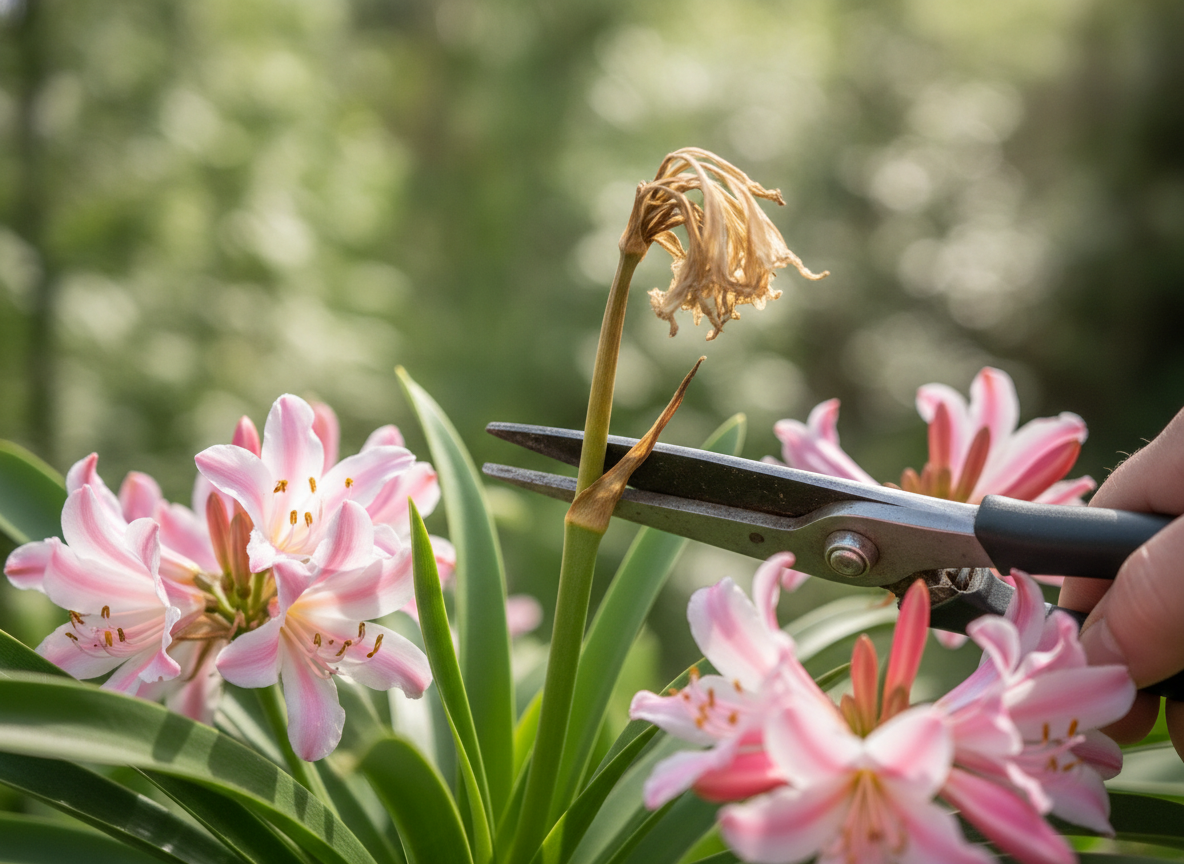 A hand prunes a dead flower stem among living nerine flowers — AI-generated illustration
Deadhead the spent stem, and stop there
When each head has gone over — the individual trumpets shrivel from the outside of the umbel inwards, so a stem can still look half-decent when the first flowers have browned — wait until the whole head is finished, then follow the stalk down and cut it off low, near the neck of the bulb. That’s the entire prune. There is nothing else on a nerine to cut in autumn.
The point of taking the stem off isn’t tidiness so much as thrift. A finished nerine head will try to set seed if you leave it, and ripening seed pulls sugar the bulb would rather bank for next autumn’s flowers. Snip the spent stalk and you close that drain. It’s the same logic behind deadheading agapanthus down to the base while leaving every leaf untouched — take the seed off, and the plant spends its energy on itself instead. Don’t expect a second flush for your trouble; nerines flower once, and once only, but a stem cut now is energy saved rather than spilt.
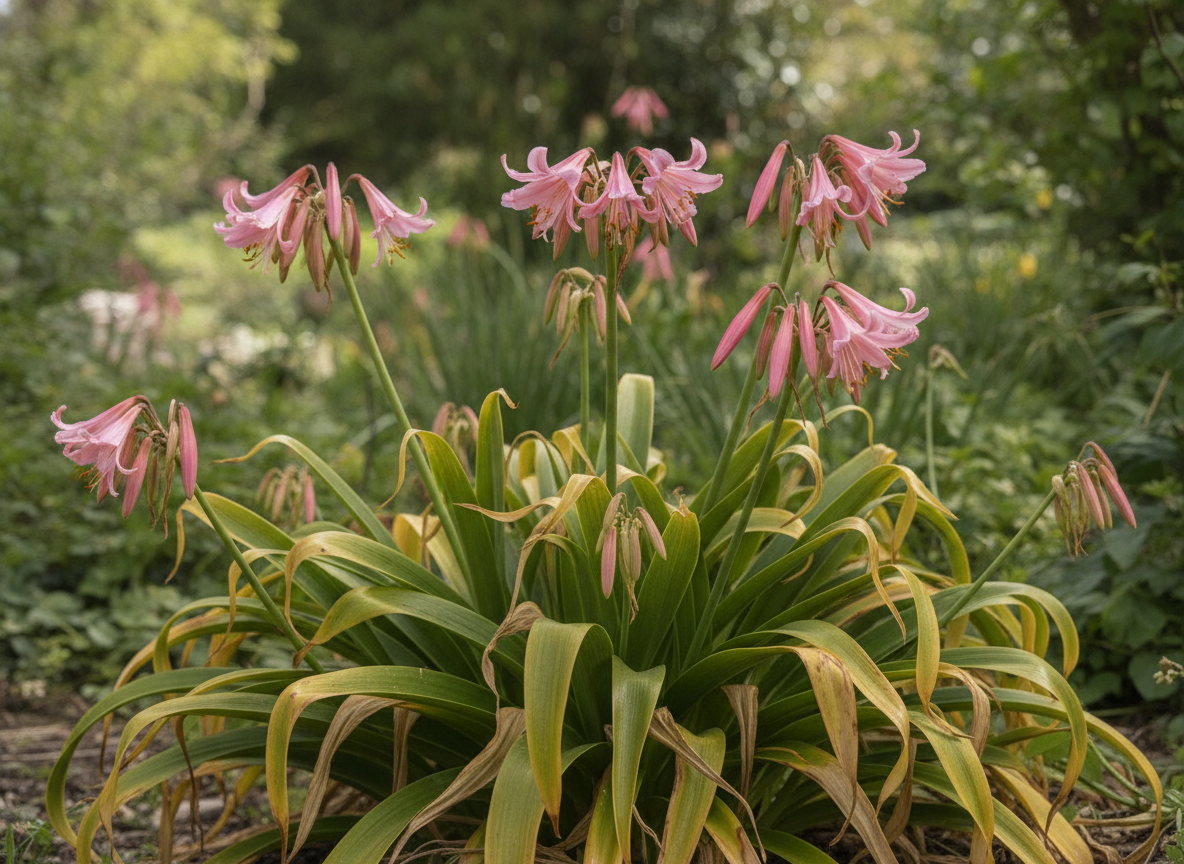 A cluster of nerine flowers with their leaves visible in a garden setting — AI-generated illustration
Never cut the leaves — they only turn up as the flowers go
Here’s the part that catches people out. On most bulbs the leaves come first, then the flower, then the leaves fade — a neat sequence. Nerines run it backwards. The flowers open on bare stems in autumn, and only as they finish, or just after, do the strap-shaped leaves emerge from the neck of the bulb. Those leaves then sit there green all winter, right through the coldest months, and don’t die back until late spring or early summer.
That upside-down timing is the whole reason not to touch them. Those winter leaves are the plant’s engine, and they’re running at exactly the season when nothing else in the border is: every mild day from November to May, they’re photosynthesising and packing the bulb with the reserves that become next October’s flowers. Shear them off in a tidy-up — or worse, mistake them in spring for something that’s “finished” and cut them green — and you’ve unplugged the bulb halfway through its working year. The clump limps back thin, or skips flowering altogether.
So the rule is the same one that governs every bulb, corm and tuber in the garden, just shifted to a strange calendar: enjoy the flower, leave the leaves, and let them die down on their own timetable. Only when a leaf has yellowed and pulls away with a gentle tug is it truly spent. It’s the identical mistake gardeners make with crocosmia, cutting the sword leaves that are still feeding the corm — the flower is the part you enjoy, the leaves are the part that pays for it.
Why crowding makes them flower more
Now the counter-intuitive bit. Almost every clump-forming perennial in your border tells you the same story as it ages: the middle goes bare, the flowering thins, and the fix is to lift it, split it, and replant the vigorous outer pieces. Congestion is the enemy, and autumn is the classic moment to divide crowded clumps for more flowers.
Nerines are the exception that proves the rule. They flower best when they’re packed shoulder to shoulder, bulbs jostling at the surface, roots undisturbed for years on end. A newly planted or freshly divided clump will often sulk and skip a season or two before it settles — the plant reads root disturbance as a reason to grow more bulb, not more flower. Leave it be, let the bulbs multiply into a tight congested mat, and that’s precisely when the flowering peaks. A nerine that’s “outgrown its space” is usually a nerine about to put on its best show.
Which means the standard advice is inverted here: don’t divide a nerine on a schedule, and never lift one just because it looks crowded. The only time to split a clump is when flowering has genuinely fallen away after many years — and even then you do it in spring or early summer, as growth is starting, not in autumn while the plant is gearing up to bloom. Dig up the mat, tease it into fist-sized clumps rather than single bulbs (single bulbs sulk longest), and replant them straight back, shallow. Then leave them alone for years again.
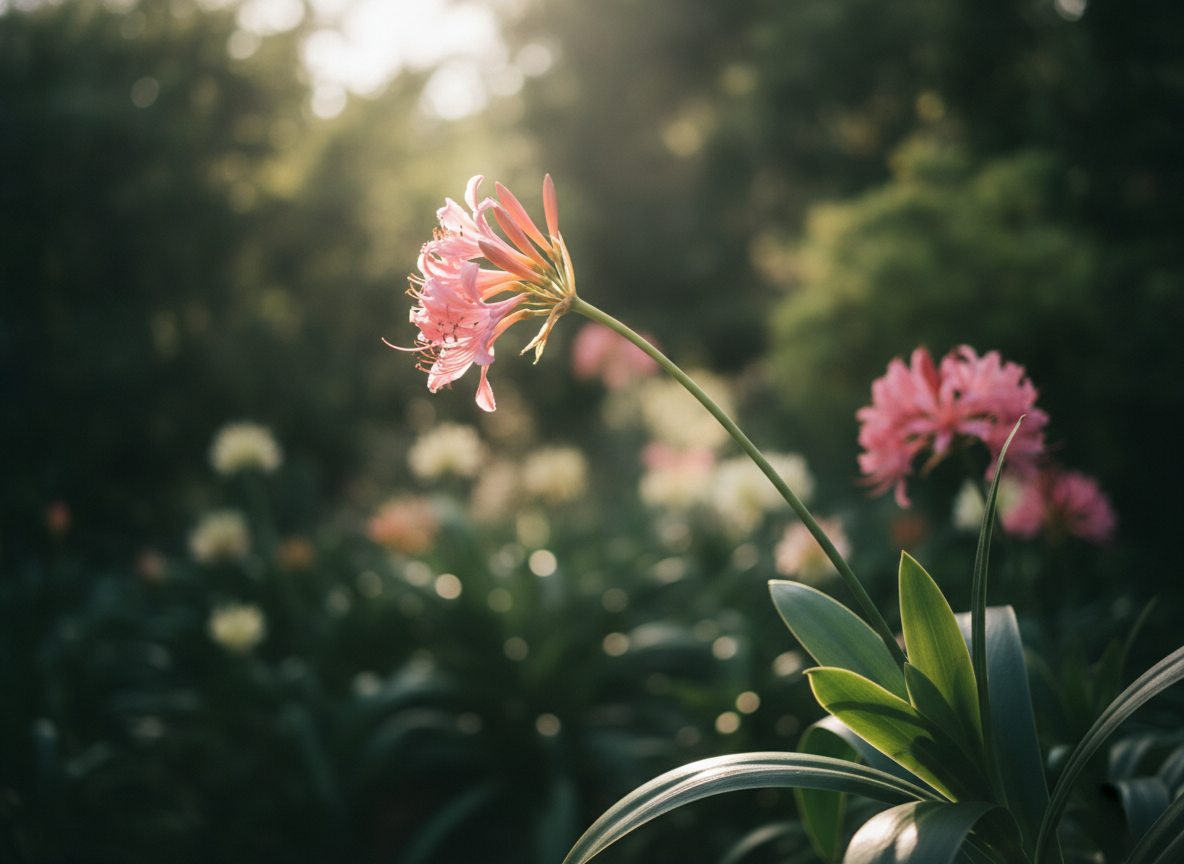 Nerine flower with stem and leaves, sunlight in the background — AI-generated illustration
Plant with the neck out and the shoulder in the sun
If you’re planting nerines, the single detail that decides whether they thrive is depth — and it’s the opposite of what feels right for a bulb. Don’t bury them. Set each bulb so its neck and shoulder sit above the soil surface, with only the base and roots covered, and space them a hand’s width apart. Planted deep in the dark, like a daffodil, a nerine grows leaves and refuses to flower.
The reason is where they come from. Nerine bowdenii is a mountain plant from the Drakensberg in South Africa, adapted to sit in thin, sharp-draining ground with its shoulders baking in the sun. That exposed neck isn’t neglect — it’s the trigger. The bulb needs a good summer roasting to ripen and set flower, and the sun on its shoulder is what delivers it. It’s the same principle behind a bearded iris rhizome, which wants to sit half out of the soil with the sun on its back, and it fails for the same reason when you mulch over it or plant it too deep. Give a nerine a sunny, sheltered spot against a south- or west-facing wall, in soil that drains fast, and it will flower for decades.
Getting them through winter
Nerine bowdenii is the hardiest of the nerines by a wide margin, and in most of Britain, the Low Countries and similar mild-temperate gardens it comes through winter outdoors without fuss — provided the two things it hates aren’t present: cold wet feet, and deep shade. Sharp drainage and that warm wall do most of the work. The one vulnerable part is the winter foliage, which can scorch in a hard frost, so a sheltered position earns its keep.
For a first winter after planting, or in a colder inland garden, spread a dry mulch — grit, gravel or bark — over the roots to take the edge off, but keep it clear of the exposed necks; a mulch heaped over the shoulders traps damp and rots the bulb, undoing the very thing the sunny neck is for. Nerines in pots are the exception to the leave-alone rule only in that they run out of food faster: give them a high-potash feed (ordinary tomato feed) while they’re in growth and flower, then stop, and move the pot somewhere it won’t sit sodden over winter. Pot-bound is fine — a congested pot flowers as freely as a congested clump.
Not sure whether the strappy leaves at the base of your wall are this year’s engine or last year’s spent growth — or whether a shy clump wants feeding, resettling, or simply leaving alone for another year? That’s the call Cresco makes for you, tracking each plant by type and by your own garden’s weather, and telling you the one thing actually worth doing this week: deadhead the stem that’s finished, and spare the leaves that aren’t.