The shoots you cut now are next spring’s flowers
By the middle of June a wisteria that flowered in May has stopped looking elegant and started looking feral. Long green whips are shooting out in every direction — over the gutter, into the neighbour’s plum tree, back on themselves in a tangle. The instinct is to leave them: they’re growing, the plant is clearly happy, why interfere?
That instinct is exactly backwards. Those whips are this year’s growth, and every centimetre of length you let them keep is energy the plant is spending on leaves and tendrils instead of flower buds. The single most reliable thing you can do for next May’s display is to cut that growth back hard, now, before midsummer is out — and then a second time in winter.
This is the famous two-cut system, and it is genuinely the difference between a wisteria that drips with racemes and one that’s all foliage. The summer cut is the one most people skip, because it feels destructive to take secateurs to a plant in full leaf. Do it anyway. The plant will thank you in ten months.
If you trained and tied the new shoots back in May rather than letting them run, you’ve already done half the work — see why May is for bending and tying, not cutting. This post is the next step: the summer shortening cut that turns those shoots into flowering spurs.
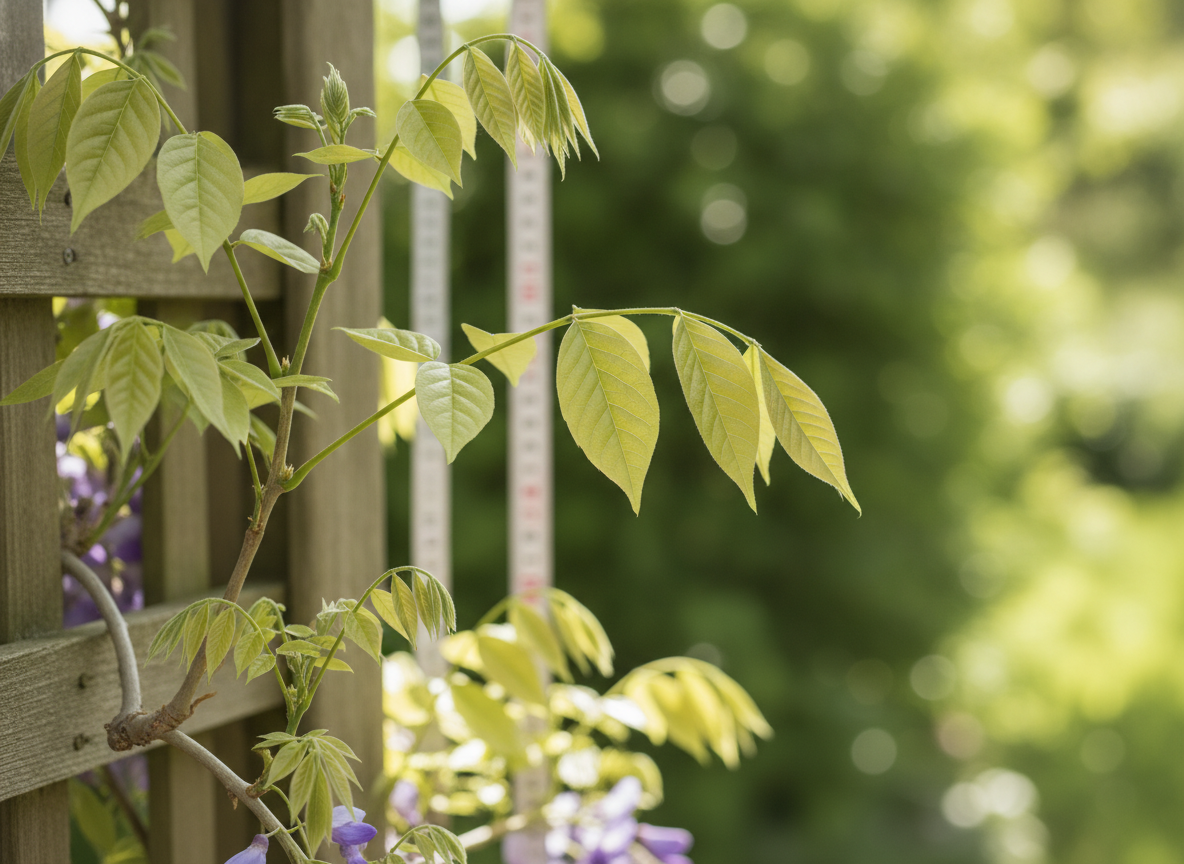 A wisteria vine with leaves and a measuring tape in the background — AI-generated illustration
Why “five or six leaves” and not a number of centimetres
The rule every guide repeats is to cut this year’s whippy growth back to five or six leaves from the main framework. It sounds arbitrary until you understand what’s happening inside the stem.
Wisteria flowers from short, stubby spurs — the gnarled knuckles of wood along an established plant’s main branches. Each spur carries the fat, rounded flower buds that open into next spring’s racemes. A long, unpruned whip puts all its energy into the growing tip; it stays vegetative, throws leaves, and sets no flower buds at all. Shorten that whip to five or six leaves, and you remove the dominant tip. The plant responds by ripening the wood that’s left and concentrating its energy into the buds at the base — the future spurs.
So the count isn’t about tidiness. Five or six leaves leaves enough leaf area to feed the developing buds, while cutting off the hungry growing point that would otherwise eat the season. Cut shorter than that in summer and you risk forcing soft regrowth; cut longer and you’ve barely slowed the plant down.
When the summer window actually opens
The classic instruction is “July or August,” but that’s a guide, not a starting gun. The real trigger is the growth, not the date: the summer cut is due about two months after flowering, once this year’s shoots have lengthened to a foot or more and are starting to firm up at the base.
In a normal Northern European year, with wisteria flowering in May, that puts the first pass at the very end of June, running through July and into August. There’s no harm in starting now if the whips are already long and leafy — you’re not waiting for a magic week, you’re waiting for the plant to give you enough growth to cut back to.
Two practical reasons not to leave it until late August:
- Wood ripens better with more summer ahead of it. A shoot cut in early July has six weeks of warm weather left to ripen the remaining wood and plump the basal buds. The same shoot cut in late August has run out of season.
- A second flush is easy to catch. Vigorous plants will push fresh whips after the first cut. If you started in late June, you’ve got time for a tidy-up pass in August. Start in late August and there’s no second chance.
If you only ever do one summer cut, do it in July. But the gardeners who get the heaviest flowering treat it as a rolling job from late June onward, walking the plant every couple of weeks and shortening whatever’s run away since last time.
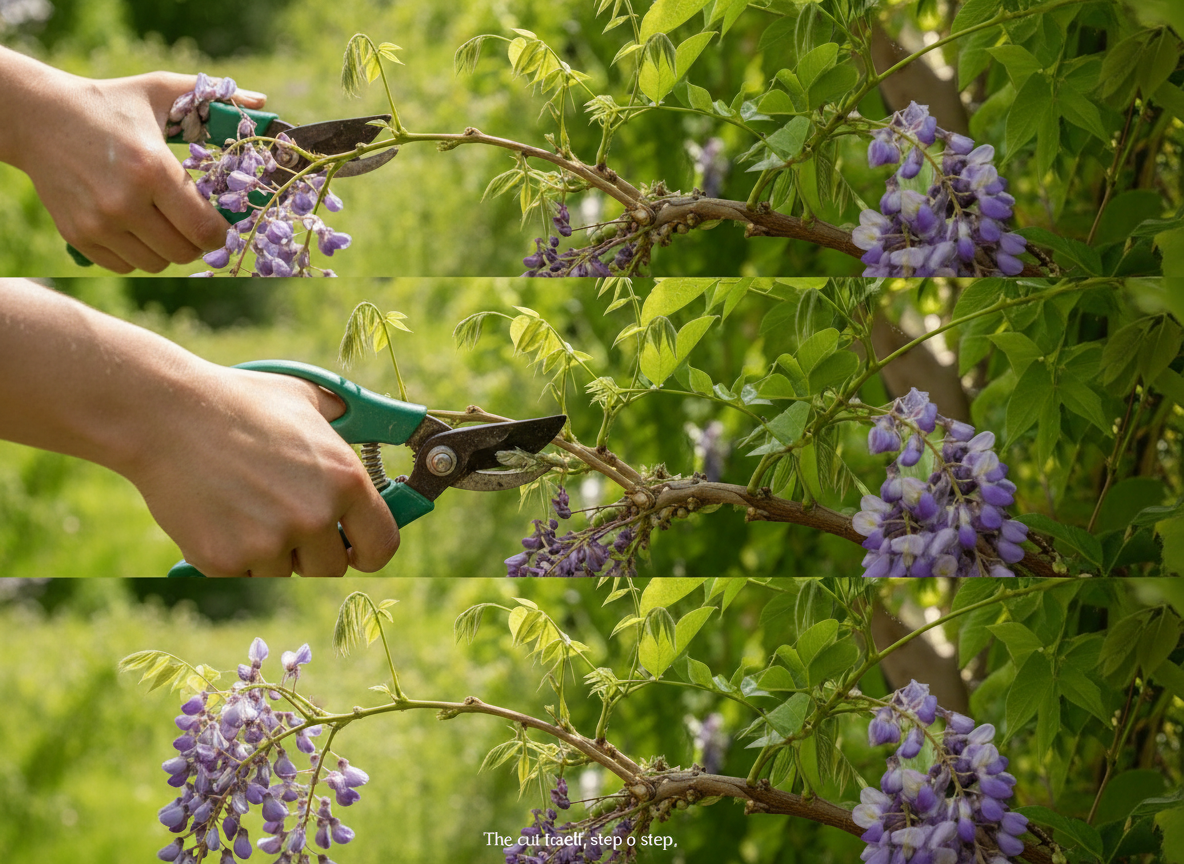 A hand uses pruning shears to cut wisteria branches — AI-generated illustration
The cut itself, step by step
You don’t need much: a sharp, clean pair of secateurs, and for anything thicker than a pencil, loppers. Wipe the blades between plants — the same blade hygiene that matters when you’re pruning plums and cherries in the silver-leaf window applies here, even if wisteria is far less fussy.
- Identify this year’s growth. It’s the soft, green, often still-flexible wood, paler than the older brown framework. That’s what you’re shortening — never the main structural branches.
- Count five or six leaves from where the shoot joins the framework. A wisteria leaf is the whole pinnate frond, with its row of leaflets — count fronds, not leaflets.
- Cut just beyond the sixth leaf, about a centimetre above a leaf joint, with a clean angled cut. You’re aiming to leave a short stub that will ripen into spur wood.
- Leave any shoot you want to extend the plant. If you’re still filling a wall or pergola, pick a strong, well-placed whip, tie it in along its support, and leave it unpruned. Everything else gets the five-or-six-leaf treatment.
- Cut out basal and rootstock suckers at source. Anything coming from below the graft union or straight out of the ground belongs to the wild rootstock — tear or cut it off flush, the same hard rule as rose suckers.
The plant will look noticeably tidier the moment you finish — the shaggy halo of whips gone, the framework and its spurs visible again. That’s the look you want going into late summer.
Don’t stop in summer — the winter cut finishes the job
The summer cut on its own gives you a much better plant. But the spurs are only fully set up if you follow it with the second, harder cut in winter.
In January or February, with the leaves off and the framework bare, go back over every shoot you shortened in summer and cut it back again — this time to two or three buds from the base, leaving a stub of roughly 8 to 10 cm. Those fat, rounded buds are the flower buds; the slim, pointed ones are leaf buds. Cutting back to two or three plump buds in winter is what concentrates the display and keeps the plant from creeping ever outward year on year.
Think of it as a two-stage funnel. Summer’s cut to five or six leaves slows the plant and starts ripening the wood. Winter’s cut to two or three buds removes the rest and points everything that’s left at flowering. Skip the winter cut and the spurs get longer and leggier each year, with flowers drifting further from the framework. Do both and you build the tight, knuckled spur system that makes an old wisteria so spectacular.
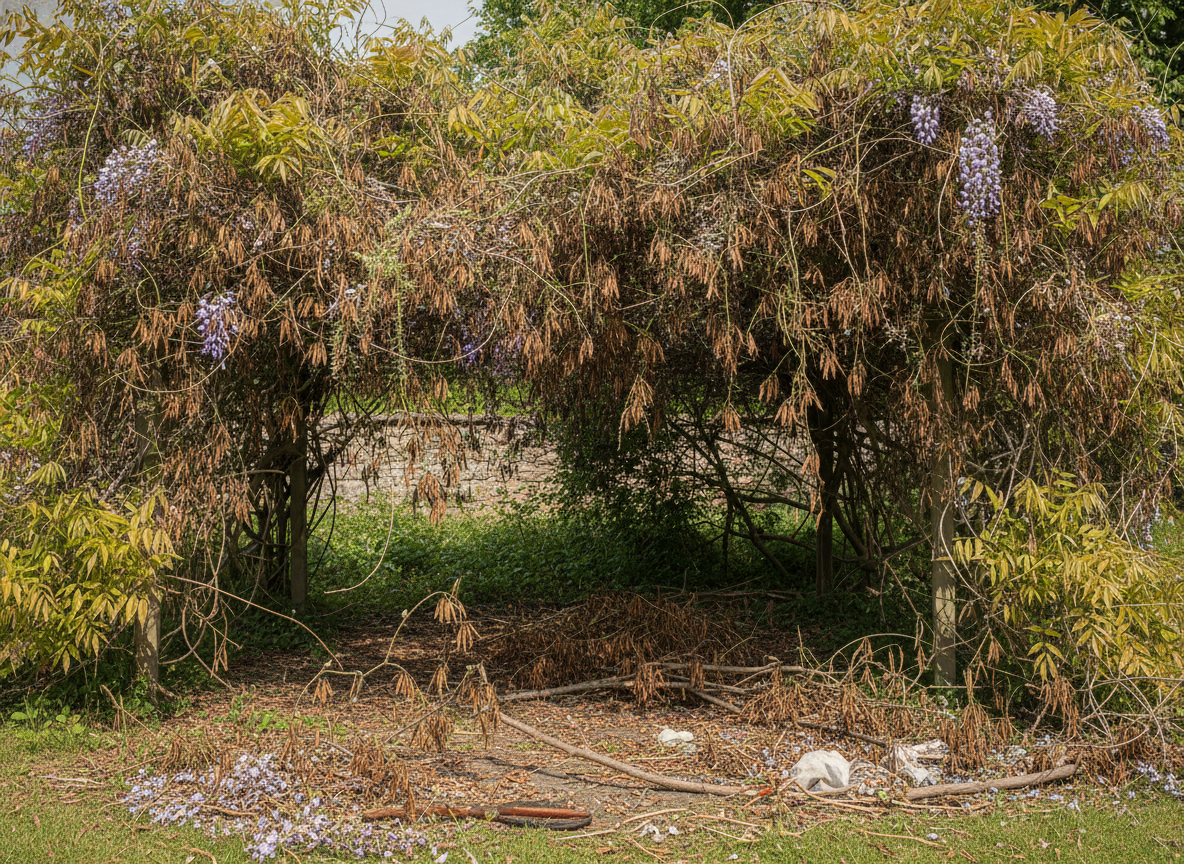 A lush wisteria arbor, overgrown and partially dried, with some purple flowers — AI-generated illustration
The mistakes that cost you next year’s flowers
A few errors come up again and again, and each one shows up as missing racemes the following May.
- Cutting the framework instead of the whips. The thick, brown structural branches carry the spurs. Shorten this year’s green growth only. Hack into the framework and you remove flowering wood wholesale.
- Leaving everything until February. A winter-only prune is better than nothing, but you’ve let the plant waste a whole summer growing wood you then cut off. The summer cut is what redirects that energy in real time.
- Feeding with a high-nitrogen fertiliser. Lawn feed or anything nitrogen-rich pushes leafy growth at the expense of flowers — exactly what you’re pruning to prevent. If you feed at all, use a high-potassium feed (sulphate of potash) in spring.
- Panicking about a non-flowering young plant. Seed-grown wisteria can take a decade or more to flower, and even grafted plants often sulk for the first few years after planting. If yours is young and you’ve pruned correctly, the answer is usually patience, not harder cuts.
A quick note on which wisteria you’ve got
The two main garden species twist in opposite directions, which is a genuinely useful field test when you’re training shoots. Chinese wisteria (Wisteria sinensis) twines anticlockwise; Japanese wisteria (Wisteria floribunda) twines clockwise. Japanese forms tend to have longer racemes and flower a little later, often with the emerging leaves; Chinese forms usually flower on bare stems just ahead of the foliage.
For summer pruning it makes no practical difference — both want the same five-or-six-leaf cut now and the two-or-three-bud cut in winter. But knowing which way your plant twists helps when you’re deciding how to wind a new leader around its support without fighting the plant’s own habit.
Let Cresco track the window for you
The hardest part of wisteria isn’t the cut — it’s remembering that there are two of them, months apart, and catching the summer one before the plant has run away. That’s exactly the kind of timing Cresco is built for: tell it you’ve got a wisteria and it will remind you when the summer shortening cut is due and again when the winter spur-pruning window opens, adjusted to your own location and season rather than a generic “July.”
If you garden by feel rather than by calendar, see how Cresco tracks every plant’s pruning window for you — and never miss the summer cut that decides next spring’s flowers again.