Why late November is tool time
The summer deadheading is long over, the autumn tidy-up is mostly done, and the big winter jobs haven’t started yet. Apples, pears, currants, grapevines and roses all wait for proper dormancy, which in most gardens means the next few weeks through to early March. That makes right now the quietest gap in the pruning year — and the best moment to look at the tool that will make almost every one of those cuts.
After a season of use, most secateurs are in worse shape than their owners think. Sap has built up on the blades, the edge has rolled over from cutting into wire or a stem that was slightly too thick, and the pivot has worked loose so the blades no longer meet cleanly. You get used to it gradually, squeezing a little harder each month, until a blunt pair feels normal.
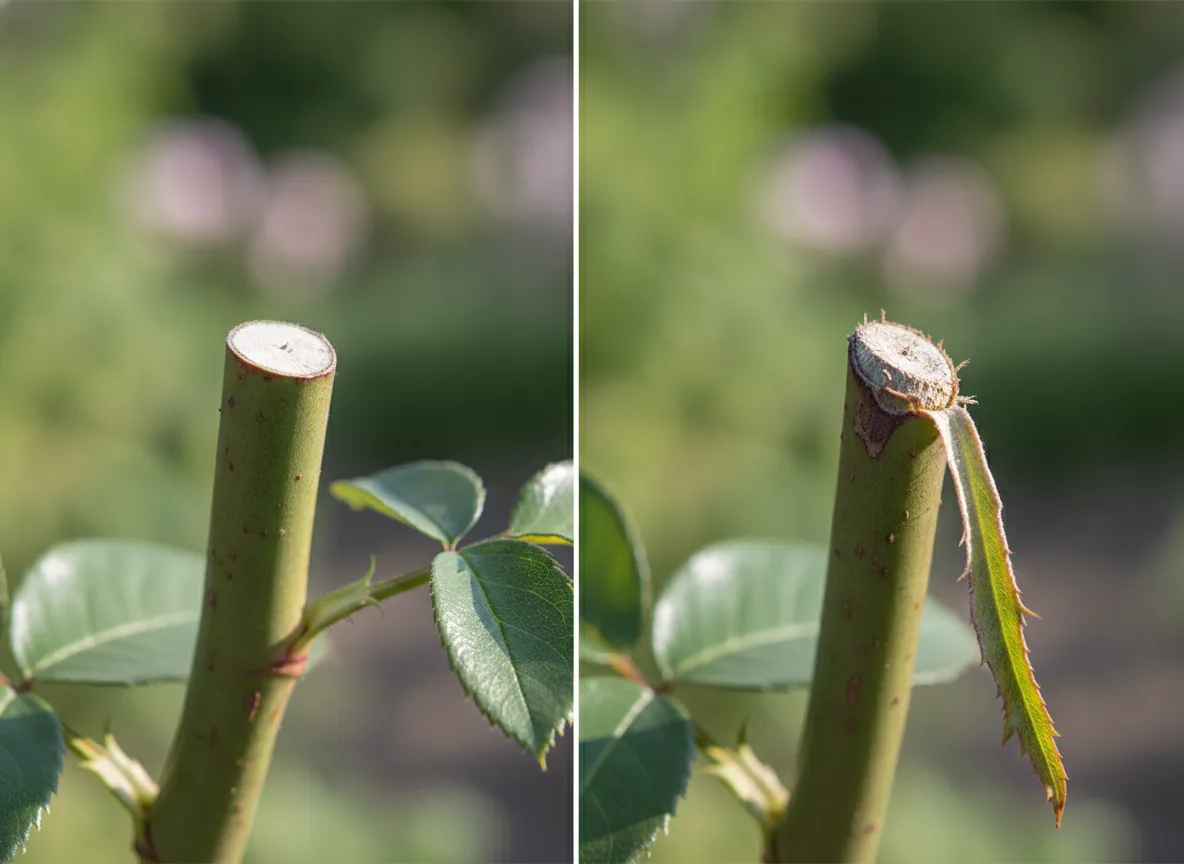 A clean cut and a crushed cut on plant stems — AI-generated illustration
What a blunt blade does to a plant
A sharp blade slices through the cells of a stem. A blunt one pushes them aside and crushes them before it finally breaks through. You can see the difference on the cut itself:
- A clean cut is smooth, flat and slightly shiny, with the bark tight to the wood all the way round.
- A crushed cut is bruised and fibrous, often with a torn strip of bark hanging off one side and a flattened, split stub where the anvil or lower blade pressed in.
That matters more than it looks. A plant seals a wound by growing a ring of callus tissue over it, and it does that fastest across a clean surface. A crushed stub dies back further, takes longer to close, and stays open to fungal spores for weeks longer. In winter, when trees heal slowly anyway, that gap is exactly what diseases such as apple and pear canker need — the reason apples and pears are pruned in deep winter, not autumn is wasted if the tool tears every wound.
There’s a cost to you too. Blunt secateurs need far more grip, and a winter session on a fruit tree can mean several hundred cuts. If your hand aches after half an hour, the blade is usually the reason, not the tree.
The paper test
Before you take anything apart, find out how bad it is. Hold a sheet of ordinary printer paper by one corner and cut into it with the tip of the blades, then with the middle.
- If the secateurs slice a clean line, they’re sharp.
- If they fold the paper and drag it into the jaws, or leave a torn, chewed edge, the blade needs sharpening — or the pivot is loose and the blades are drifting apart.
Do the same test again when you’ve finished. It’s the quickest way to tell whether your work has paid off.
Bypass or anvil? Check before you sharpen
How you sharpen depends on the type of secateurs, so look closely first.
- Bypass secateurs work like scissors: a curved cutting blade slides past a thicker, hooked lower blade. This is the type most gardeners use and the one recommended for live wood, because it cuts cleanly right up to a bud. Only the upper cutting blade is sharpened, and only on its bevelled (sloped) side. The flat back of that blade, which faces the lower blade, has to stay perfectly flat.
- Anvil secateurs have one straight blade that closes onto a flat block of metal or plastic. The blade is usually ground on both sides, so you sharpen both. The anvil itself isn’t sharpened; if it’s grooved or dented, replace it — most brands sell spares.
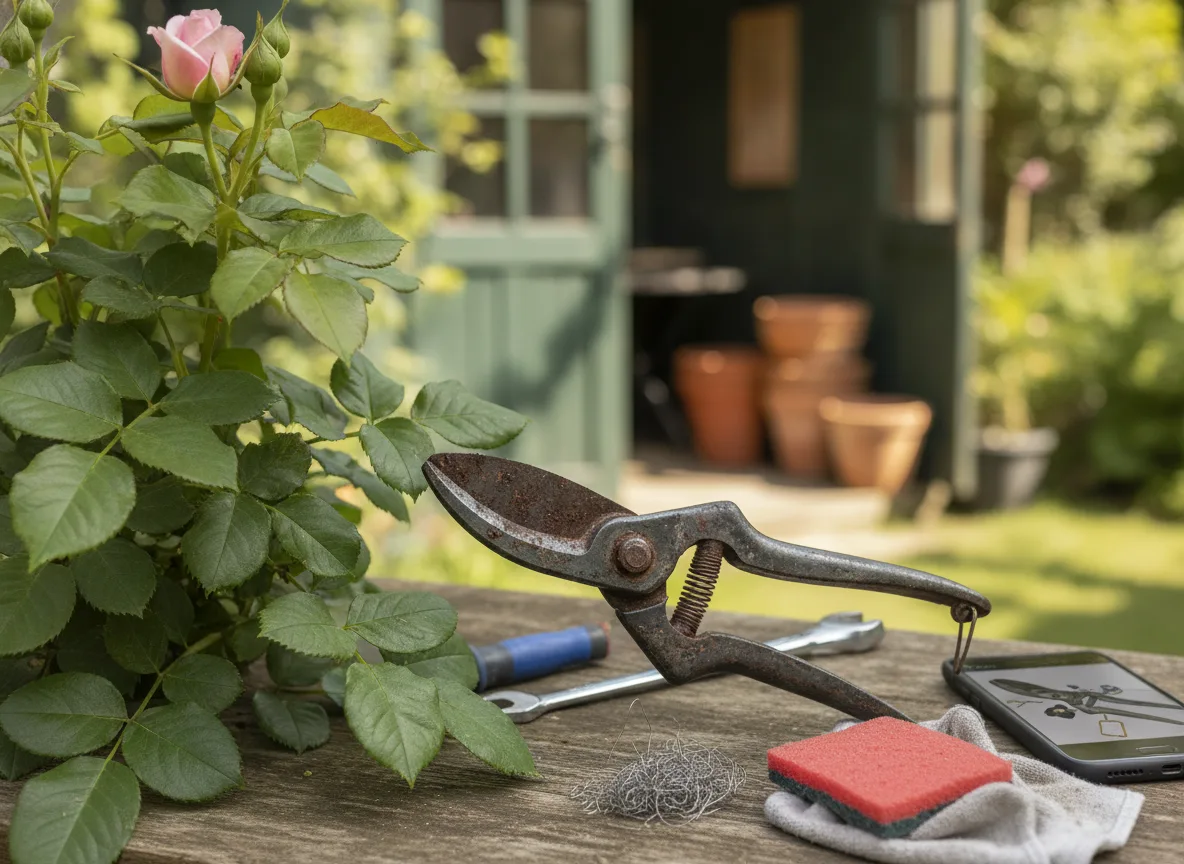 Blunt secateurs, wire wool, spanner, and phone on a garden table — AI-generated illustration
Clean first: sap, rust and grime
You can’t sharpen a blade properly while it’s coated in old sap. Clean it first.
- Open the secateurs fully and, if your model allows, take the blades apart. Many good-quality bypass secateurs come apart with a small spanner or screwdriver at the pivot; take a photo first so you know how the spring and washers go back.
- Scrub off dried sap with fine wire wool, or a nylon scouring pad, dampened with a little surgical spirit or white spirit. Sap from conifers and fruit trees sets hard and sticky; give it a minute to soften before you rub.
- Remove light rust the same way. Deep pitting near the edge can’t be fully removed, but surface rust lifts easily.
- Wash, then dry thoroughly. Any water left in the pivot will rust it over winter.
How to sharpen bypass secateurs
You need a small sharpening stone or a fine diamond file — something credit-card sized is ideal, because you bring the stone to the blade rather than the blade to the stone. A coarse file from the shed is too aggressive and will take off more metal than you need.
- Find the original bevel. Look along the cutting edge: there’s a narrow, slightly brighter strip where the factory ground the angle. That’s the angle to follow. On most secateurs it’s somewhere between 20 and 30 degrees; you don’t need to measure it, just match what’s already there.
- Wet or oil the stone, depending on the type (a diamond file can be used dry or with a drop of water).
- Stroke along the bevel, from the base of the blade towards the tip, holding the stone flat against that bright strip. Use light, even pressure and follow the curve of the blade. Ten to twenty strokes is usually enough for a blade that’s been used for a season.
- Check for a burr. Draw a fingertip gently over the flat back of the blade, moving towards the edge (never along it). When you feel a tiny rough lip along the whole length, the bevel is sharp.
- Remove the burr from the flat side with one or two passes of the stone held completely flat against the back of the blade. Don’t tilt it — putting even a slight angle on the back stops the two blades meeting cleanly.
- Leave the lower hooked blade alone, apart from cleaning it. Its job is to hold the stem, not to cut it.
For anvil secateurs, follow the same steps on both sides of the blade, matching each bevel, and finish with a couple of light passes on each side to remove the burr.
Little and often is the rule. A quick touch-up every few weeks during the winter pruning season keeps the edge far better than one heavy session a year — and takes a minute rather than an evening.
Set the pivot and oil everything
A perfectly sharp blade still crushes stems if the blades drift apart as they close. When you reassemble the secateurs:
- Tighten the pivot nut until the blades close smoothly with no visible gap between them, but without feeling stiff. Too loose and stems get dragged between the blades; too tight and the spring can’t open them. Make a few test cuts on a twig and adjust a quarter-turn at a time.
- Check the spring. A weak or broken spring makes you open the jaws by hand on every cut. Springs are cheap and easy to replace on most branded secateurs.
- Put a drop of light oil on the pivot and wipe a thin film over both blades. Camellia oil or a general-purpose light machine oil both work. It keeps rust off over winter and helps the blades glide.
Then repeat the paper test. A well-set pair slices paper cleanly from the base of the blade all the way to the tip.
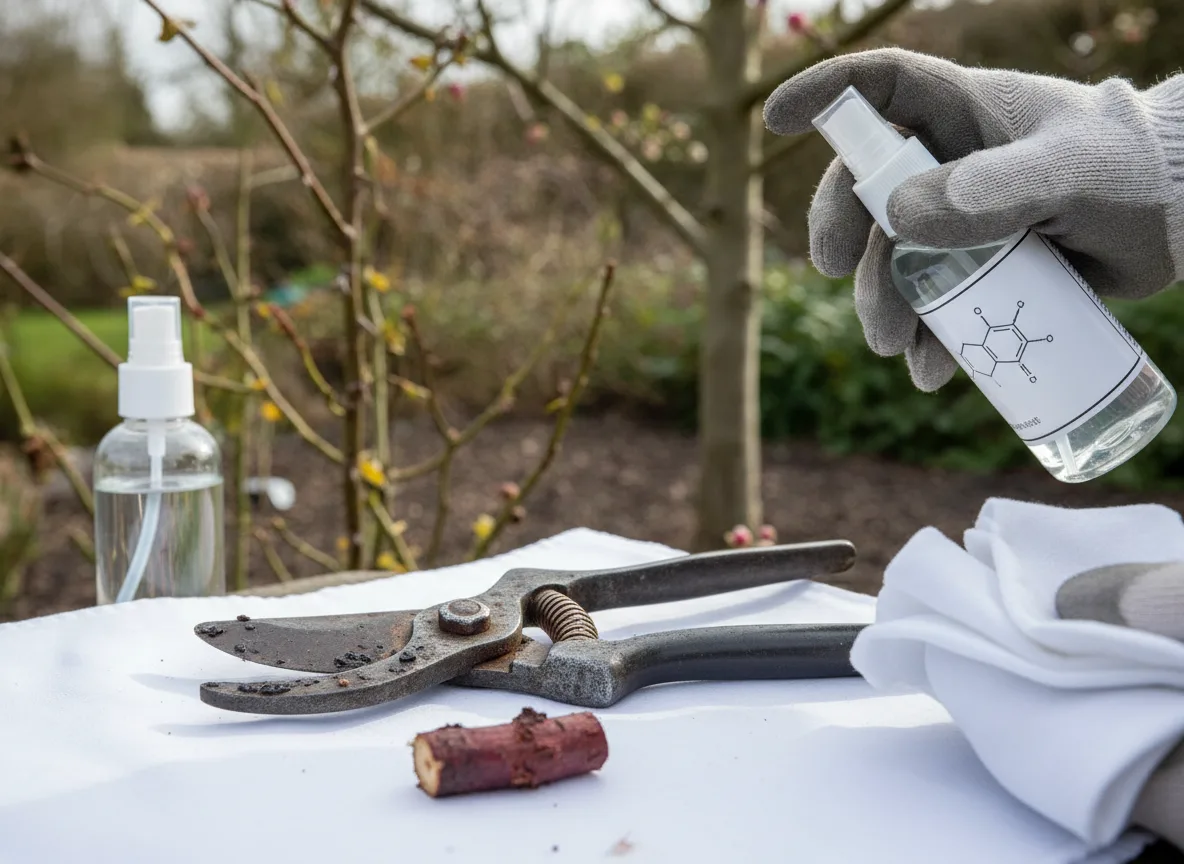 A gloved hand sprays disinfectant on garden secateurs next to a plant cutting — AI-generated illustration
Clean between plants, not just once a year
Sharpening is a once-or-twice-a-season job, but cleaning the blades is worth doing far more often, especially in winter when you’re working on fruit trees and roses.
- Wipe the blades between plants when you’re cutting out anything diseased: cankered apple or pear wood, coral spot, or roses with dieback. A cloth or wipe with a household disinfectant, or 70% alcohol (surgical spirit), is enough.
- Avoid soaking blades in bleach. It works as a disinfectant, but it corrodes steel and pits the edge you’ve just sharpened.
- Take off sticky sap at the end of each session, before it hardens. Five seconds with a cloth now saves ten minutes of scrubbing later.
Loppers, saws and shears
The same principles apply to the rest of the kit you’ll use this winter.
- Loppers are sharpened just like bypass secateurs: the bevel of the cutting blade only, with the flat back kept flat. Check the pivot bolt too; on loppers it loosens quickly.
- Pruning saws with hard-pointed (impulse-hardened) teeth — the dark-tipped teeth on most modern folding saws — can’t be sharpened with a file. When one starts to bind or drift in the cut, buy a replacement blade. Keep it clean of resin with the same spirit you used on the secateurs.
- Hand shears for hedges and lavender sharpen along their bevels with the same stone. Set the pivot so the blades meet along their whole length.
Know when to replace
Not every pair is worth saving. If the cutting blade is chipped deep into the edge, bent so the blades no longer meet, or worn so short from years of sharpening that it no longer reaches the lower blade, it’s time for a new blade or a new pair. Many better-quality brands sell replacement blades, springs and anvils, so a good pair of secateurs can last decades.
Ready for the winter prune
With a sharp, clean, well-set pair in your pocket, the winter jobs are quicker and kinder to the plants: thinning the spur clusters on a pear tree, shortening rose stems, and taking out the branches you’ve marked over summer. Pick a dry, frost-free day for the cutting itself — frozen wood tears even under a sharp blade.
If you’d like to know exactly when each plant in your garden is ready for its winter cut, Cresco tracks the pruning window for every plant, based on your local weather — so the sharpened secateurs come out at the right moment.