A pear tree covered in blossom, and still small pears
Older pear trees have a habit that catches a lot of gardeners out. Every April the tree is white with blossom, it sets fruit by the hundred — and in September you pick a crop of small, hard, gritty pears, half of which never ripen properly. Some years it crops heavily; the next year it barely bothers.
The usual reaction is to prune harder at the tips: shorten every branch, cut back all the new growth, make the tree “tidier”. That rarely helps, and often makes it worse. The problem on an established pear is almost never the tips. It’s the spurs: the short, knobbly fruiting shoots along the branches. Pears make them far more freely than apples, and after ten or fifteen years they pile up into dense, crowded clusters that carry far more flower buds than the tree can feed.
The winter fix is to thin those clusters out. Now the leaves have dropped, mid-November to early March is the time to do it.
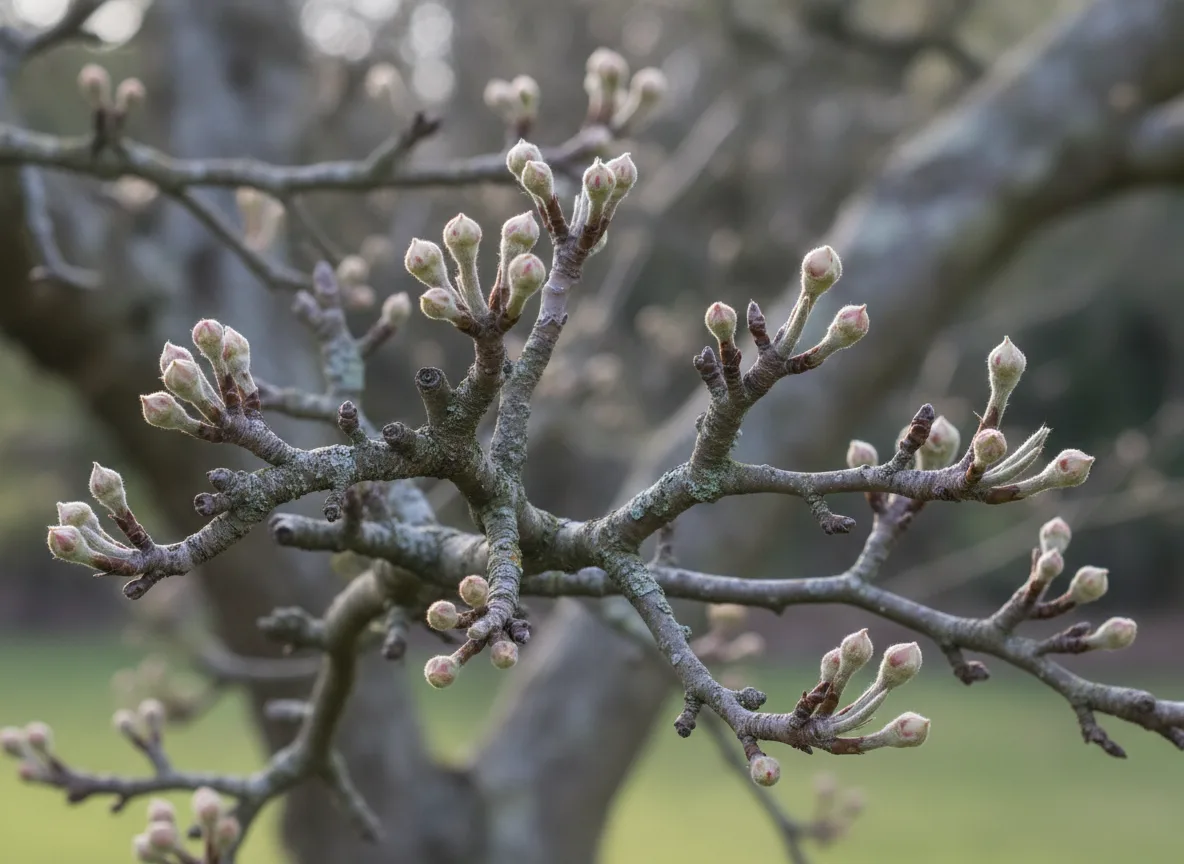 A close-up of a pear tree spur system with visible fruit buds — AI-generated illustration
What a spur system looks like
A spur starts as a short side-shoot with a fat, rounded flower bud at its tip. Each year it branches a little more, adds another bud or two, and grows outward by a few millimetres. On a pear that has been left alone for a decade, one spur can become a gnarled, many-fingered knuckle the size of a fist — growers call it a spur system.
You can tell the buds apart now, with the leaves off:
- Fruit buds are plump, rounded and slightly hairy, sitting on short stubby wood.
- Growth buds are slim and pointed, lying flat against the shoot.
A healthy branch has spurs dotted along it, each with a handful of fruit buds. A congested one is lined end to end with knotted spur systems, many of them tangled, shaded and pointing inwards.
Why too many spurs means smaller pears
Every fruit bud on a pear opens into a cluster of several flowers. Pears set fruit easily, so a crowded spur system becomes a crowded bunch of fruitlets, all competing for the same water, sugar and light. The result is many small pears, poor flavour and fruit that doesn’t fill out.
It also wears the tree out. A pear that sets far too much one year has little left to form flower buds for the next, which is how trees slip into biennial bearing — a heavy crop one year, almost nothing the year after.
Old spur systems have one more drawback: the oldest, innermost parts sit in the shade and produce weak buds that rarely set fruit at all. They take up room and give little back.
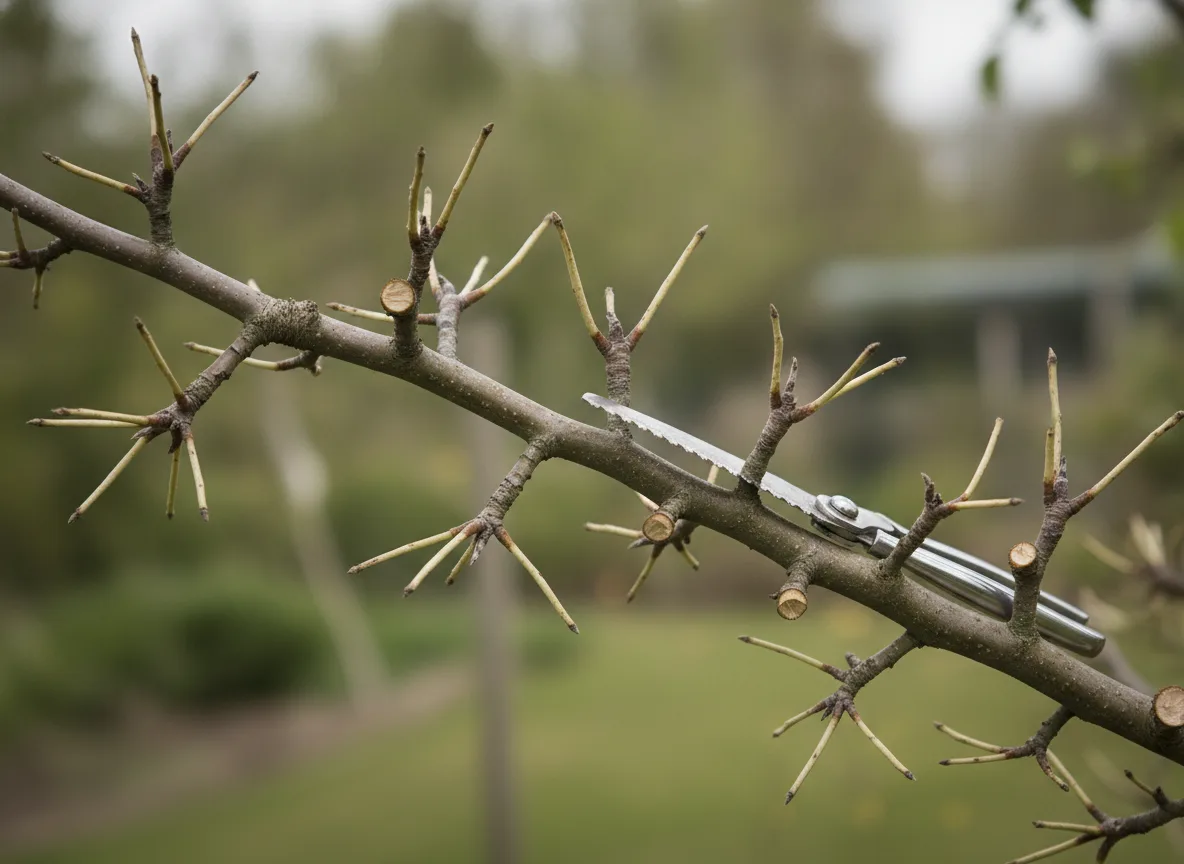 A small pruning saw rests on a pear tree branch — AI-generated illustration
How to thin the spurs, step by step
You need sharp, clean secateurs, and a small pruning saw for the oldest knuckles. Pick a dry day, not a frosty one — frozen wood tears instead of cutting cleanly (see the frost rule for winter cuts).
- Work one branch at a time. Start at the trunk and move outward, so you don’t lose track of what you’ve done.
- Space the spur systems 10–15 cm apart. That is the RHS guideline for apples and pears. Where two or three clusters sit almost touching, keep the healthiest, best-placed one and cut the others off flush with the branch.
- Take out the badly placed ones first. Remove spurs on the underside of a branch (shaded, and their fruit hangs in the leaves), and any pointing straight into the centre of the tree.
- Simplify the big knuckles. On a spur system that has become a fist of buds, cut away the oldest, weakest fingers at the base, and keep two or three younger sections with the plumpest fruit buds. As a rough rule, aim to leave a spur system with three to five fruit buds rather than ten or twenty.
- Remove the very old, worn-out spurs entirely. If a spur system is long, bare at its base and carries only thin, pointed buds, take it off. New spurs will form along the branch to replace it.
Done over a whole tree, this is slow but quiet work: lots of small cuts, very little wood on the ground. That is exactly the point.
What about the tips and the main branches?
They still get their usual winter attention, but lightly. Do the basic structural work first: take out anything dead, diseased or damaged, and any branch crossing through the middle. Then shorten the previous summer’s growth on the main branch leaders by about a quarter, cutting to an outward-facing bud.
Leave most of the other new side-shoots alone. On a pear, unpruned side-shoots tend to form fruit buds along their length over the next year or two, becoming the next generation of spurs. Cut them all back hard and you mainly get a thicket of vigorous upright shoots next summer.
Pears grow naturally upright and tall, much more so than apples. Where a vigorous branch heads skyward, cut it back to a lower side branch that points outward, rather than stubbing it off halfway. For removing larger limbs, cut just outside the branch collar, and keep the whole winter’s pruning to roughly 10–20% of the canopy.
Spurs or tips: know which kind of pear you have
Nearly all garden pears — ‘Conference’, ‘Doyenné du Comice’, ‘Concorde’, ‘Beth’, ‘Williams’ Bon Chrétien’ — are spur-bearers, and everything above applies.
A few older varieties, such as ‘Joséphine de Malines’, fruit partly at the tips of last year’s shoots. On those, leave a good share of the shoot tips uncut and thin the spurs more lightly.
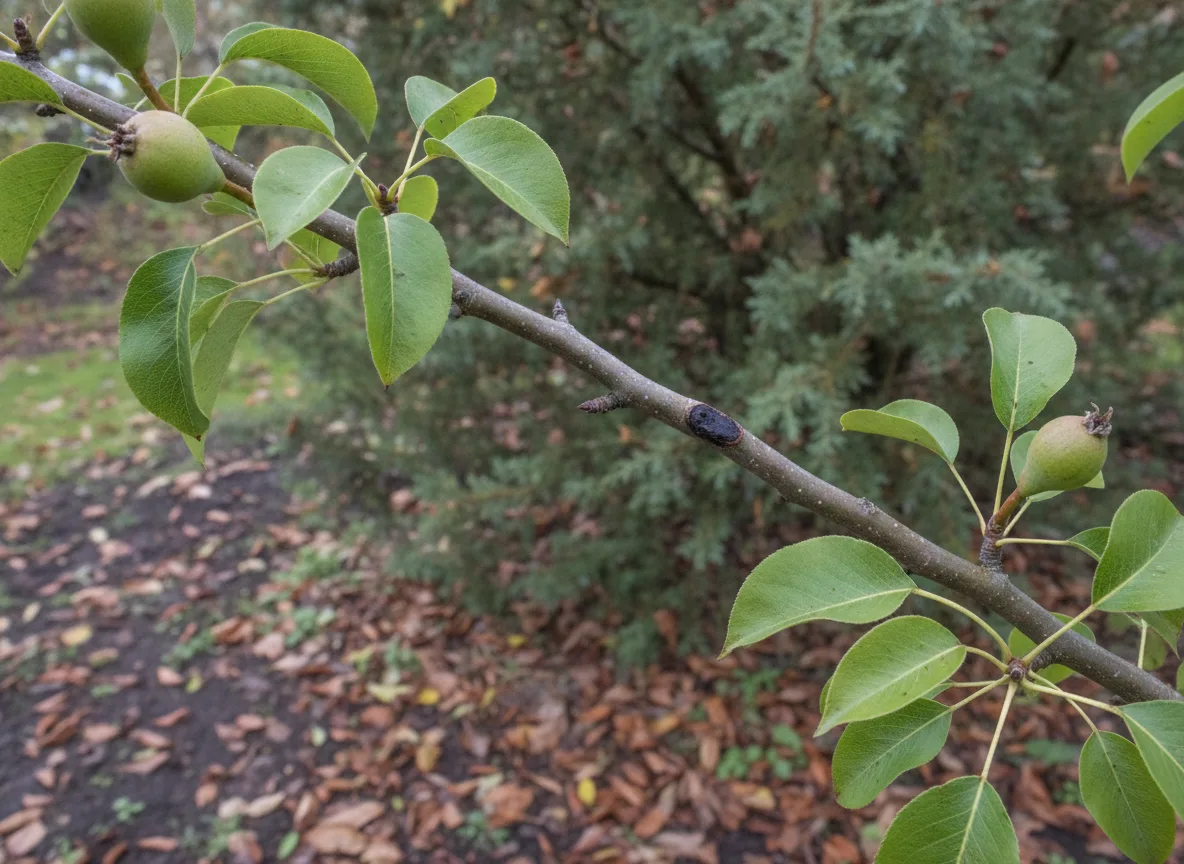 Pear tree branch with fruit and canker next to juniper — AI-generated illustration
Pear rust, canker and timing
Two diseases are worth keeping in mind while you prune.
Pear rust shows in summer as bright orange spots on the leaves. It overwinters on juniper, not on the pear, so no amount of pear pruning will clear it. Don’t cut spurs out because of rust; if it’s bad every year, look for infected junipers nearby instead.
Canker is the bigger reason the timing matters. Fresh wounds in damp, mild autumn weather are an open door for it, which is why pears are pruned in the dormant season and not straight after harvest. We covered the reasoning in why apple and pear trees are pruned in winter, not autumn. Cut out any cankered wood back to clean, healthy tissue, and clean your blades between trees.
Big, neglected tree? Spread it over several winters
If your pear hasn’t been touched for years, don’t try to thin every spur system and fix the structure in one go. Do the structural work and a share of the spur thinning this winter, and carry on next winter. Removing too much at once triggers a flush of water shoots, just as it does on apples — the same approach as rescuing an overgrown apple tree over three winters works for pears.
Next summer: thin the fruit too
Spur thinning reduces the number of fruit clusters; it doesn’t stop each cluster setting several pears. In June, after the natural fruit drop, thin each cluster to one or two fruitlets, spaced about 10–15 cm apart along the branch. Together, the winter cut and the summer thinning are what turn a tree of small, gritty pears into one of full-sized, juicy ones.
If you want a reminder when your pear tree’s pruning window opens, or when it’s time to thin the fruit, Cresco tracks it for each plant in your garden, based on your local weather.