The tree that came with the house
It’s one of the most common garden inheritances there is: an old apple tree at the bottom of the garden that nobody has pruned for ten or twenty years. It’s too tall to pick from, the middle is a tangle of crossing branches, half the fruit is small and scabby, and the top is full of thin, upright shoots pointing at the sky.
Now the leaves are down, you can finally see the whole mess — and the temptation is to fix it in one weekend. Get the saw out, take it down to a sensible height, clear out the centre, and be done with it.
That’s the one approach that reliably makes an old apple tree worse. The fix isn’t one hard prune. It’s three moderate ones, one per winter.
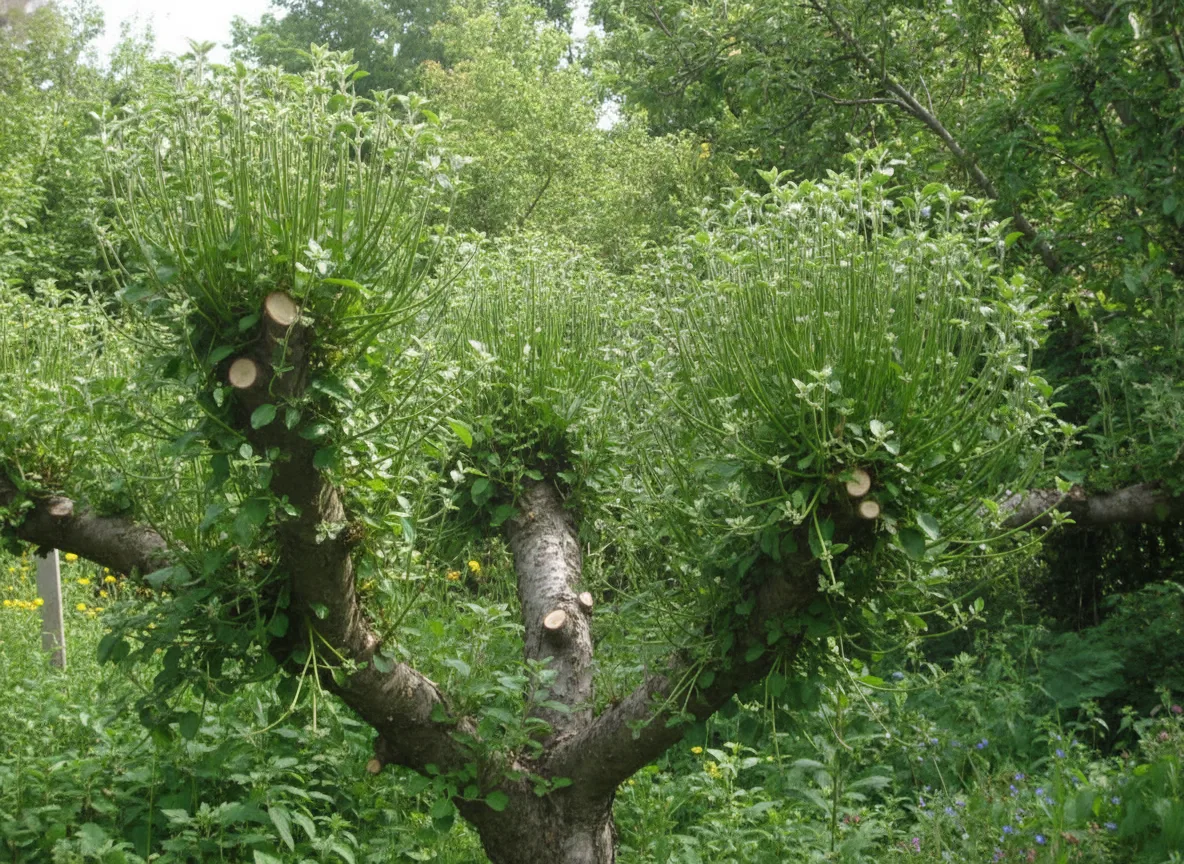 Apple tree with water shoots growing from pruned branches — AI-generated illustration
Why one big cut backfires
An established apple tree has a root system sized for its canopy. Those roots have spent decades stockpiling energy to feed all of that wood. Take half the branches off in a single winter and the roots don’t shrink to match — in spring they push the same flood of sap into a much smaller tree.
The tree answers with water shoots: dense thickets of vigorous, vertical, leafy stems sprouting from every cut and along the tops of the big branches. They don’t fruit for years, they shade the canopy, and they leave you with a bigger pruning job the next winter than the one you started with. Cut those off and the tree simply grows more. A tree pruned too hard can stay stuck in that cycle for years.
Large wounds are the second problem. Old apple wood heals slowly, and every big, fresh cut is an entry point for canker and wood-rotting fungi. Dozens of them in one season is a lot to ask of an elderly tree.
The quarter rule
The guideline renovators use, and the one the RHS gives, is simple: if more than about a quarter of the canopy needs to go, spread the work over several winters. For a properly neglected tree that usually means three.
Each winter you take out no more than roughly 20–25% of the live branch wood. The roots stay in balance with what’s left, the regrowth stays moderate, and the tree has a season to heal before the next round. It’s slower, but at the end you have a tree that crops, rather than a hedge of water shoots.
Two more limits come with it:
- Avoid removing branches thicker than about 20 cm unless they’re dead, split or dangerous. Wounds that big rarely close over on an old tree.
- Never take the tree down to a stump of main limbs in one go. Height comes down in stages, by cutting tall branches back to a lower, outward-facing side branch (more on that below).
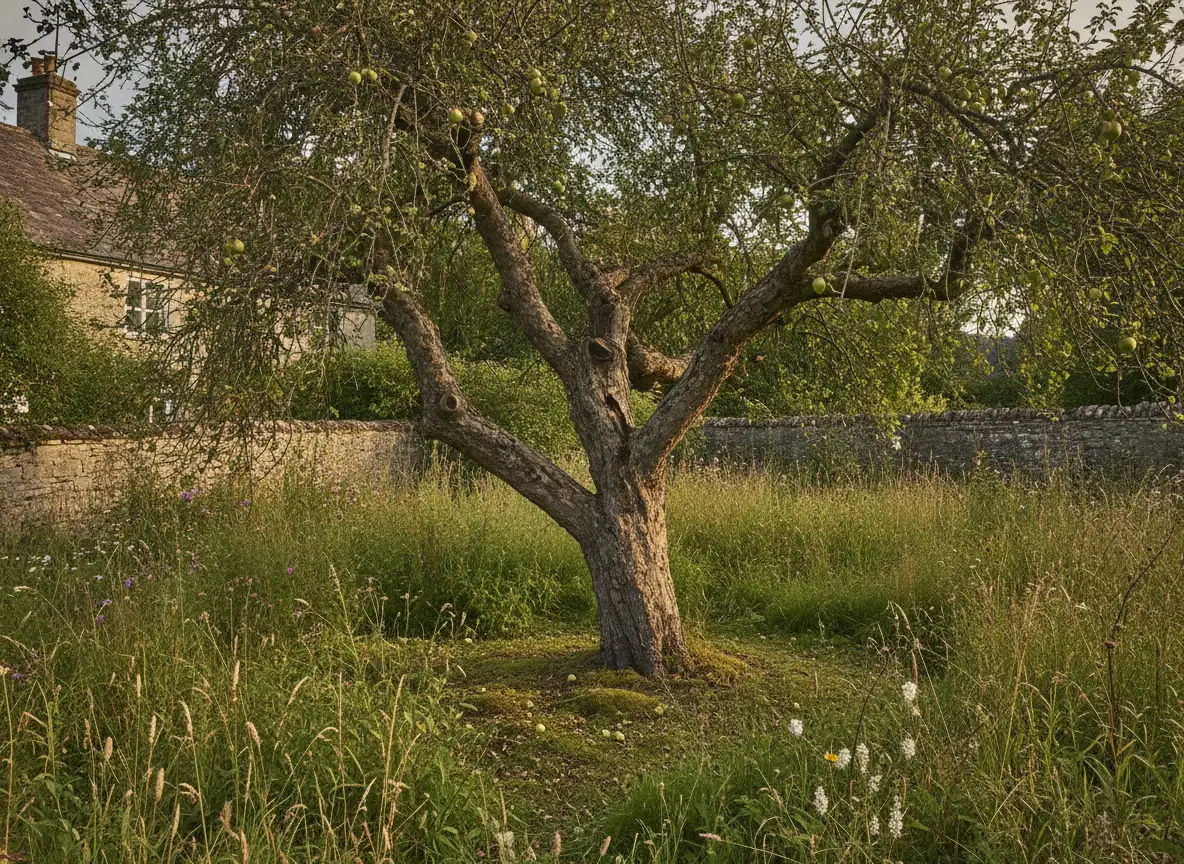 An overgrown apple tree stands in a garden with a house and wall in the background — AI-generated illustration
Before you start: is it worth saving?
Give the tree an honest look first. A renovation is worth it if the trunk is sound and the main branches are solid. Tap the trunk and look at the base: big cavities, soft crumbly wood, bracket fungi on the trunk, or honey-coloured toadstools at the base in autumn all point to rot. A tree that’s hollow and leaning may be safer removed than rescued — and for anything high or near a house, call an arborist.
If the tree is sound, it’s worth the effort. Old trees often carry heritage varieties you can’t buy any more, and a mature apple brought back into shape will crop for decades.
Winter one: dead wood, and the worst big branch
The first winter is about clearing the obvious and taking out one or two of the biggest problems.
- The three Ds. Remove everything dead, diseased or damaged. Dead wood is grey, brittle and has no buds. Cankered wood shows sunken, cracked bark, often with a ring of swollen edges; cut back well below it into clean wood. Dead wood doesn’t count towards your quarter, so this alone can make a big difference.
- One or two large limbs. Pick the worst offenders: a big branch growing straight through the centre, one rubbing hard against another, or one that’s split. Take it back to the trunk or to a strong side branch.
- Stop there. Even if the tree still looks crowded, leave the rest for next year.
Large branches need a three-cut approach so the weight doesn’t tear a strip of bark down the trunk: an undercut, a top cut further out to drop the weight, then a final clean cut. Make that final cut just outside the swollen ring at the base of the branch, never flush with the trunk. There’s a full walk-through in how to remove a tree branch outside its collar.
If the tree is also carrying clumps of mistletoe, which old neglected apples often do, winter is the time to deal with it too. See how to take mistletoe off an apple tree.
Winter two: open the centre, bring the height down
By the second winter you’ll see some water shoots from last year’s cuts. That’s normal. Leave most of them for now; you’ll sort them out in a moment.
This year’s quarter goes on shape:
- Open the centre. Thin out the congested branches in the middle so the tree moves towards an open goblet, with light reaching the inside of the canopy. Crossing and rubbing branches go first.
- Lower the height. Shorten the tallest branches by cutting them back to a lower side branch that points outwards and is at least a third of the thickness of the branch you’re removing. That side branch takes over as the new tip. Lopping a branch off at an arbitrary height, with no side branch to take over, is exactly what triggers a broom of water shoots.
- Deal with the water shoots. Thin last year’s crop hard, but keep one or two that are well placed: growing outwards into a gap, from a good angle. In a few years those become the young fruiting branches that replace the tired old ones.
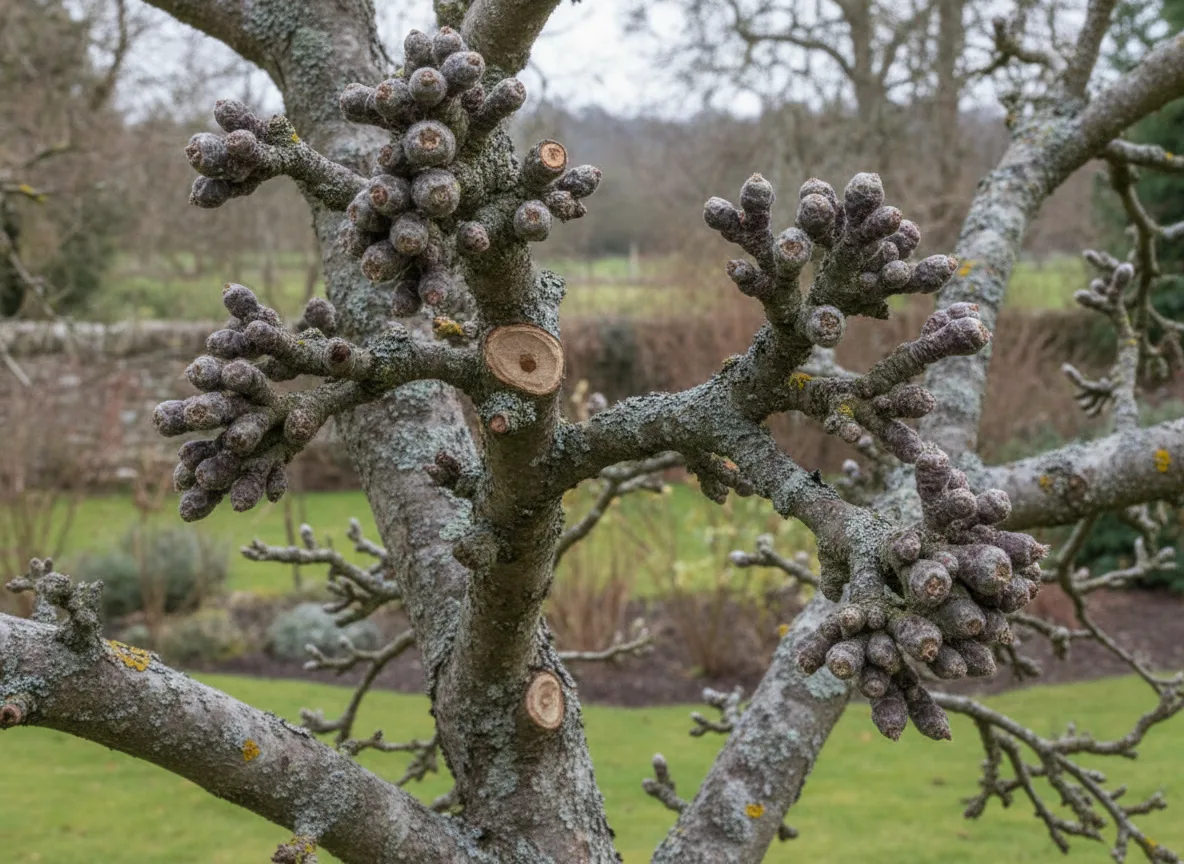 Overgrown apple tree branches with fruiting spurs, some recently thinned — AI-generated illustration
Winter three: spurs and fine-tuning
With the framework sorted, the third winter is detail work. Old apple trees often carry huge, knobbly clusters of fruiting spurs that have been building for decades. They produce lots of small fruit. Thin the biggest spur systems, removing about a third to a half of each cluster, especially the oldest parts and those on the underside of branches. The tree then puts its energy into fewer, larger apples.
Take out any remaining crossing branches, thin the water shoots again, and shorten the leaders of the main branches lightly. From here the tree goes onto ordinary annual winter pruning, which is the restrained job described in why apple trees are pruned in winter, not autumn.
Timing, and the summer helper
Renovation pruning belongs in full dormancy, from November to February, once the leaves are properly down and before the buds start to swell. Choose a dry spell so the cuts aren’t sitting wet, and avoid days of hard frost, when old wood is brittle and more likely to tear.
Water shoots that come back each year can also be pulled off in July, while they’re still soft and green at the base. Torn off by hand rather than cut, they’re far less likely to sprout again. A tree renovated in winter and tidied lightly in summer settles much faster than one pruned in winter alone.
Two things not to do: don’t paint the wounds — a clean cut in the right place heals better on its own — and don’t feed the tree heavily with nitrogen during renovation, which only fuels more water shoots. A mulch of well-rotted compost over the root area in late winter is enough.
The payoff
Three winters feels like a long time for one tree. But a renovated apple usually starts cropping better in the second year, and by the fourth it’s a tree you can reach, with fruit you’ll want to pick. Rush it and you can spend those same years fighting water shoots.