Why you notice it now
All summer, mistletoe hides in the canopy. Its leaves are the same mid-green as the apple’s, and the clumps sit high up where nobody looks. Then the leaves drop in November and suddenly there they are: round, evergreen balls hanging in the bare branches, sometimes one, sometimes a dozen.
That’s exactly why late autumn and winter is the time to deal with it. You can see every clump, the tree is dormant, and — conveniently — there’s a seasonal demand for the sprigs you cut off. Whether you hang them over the door or give them away, harvesting mistletoe in December is the easiest piece of orchard care you’ll do all year.
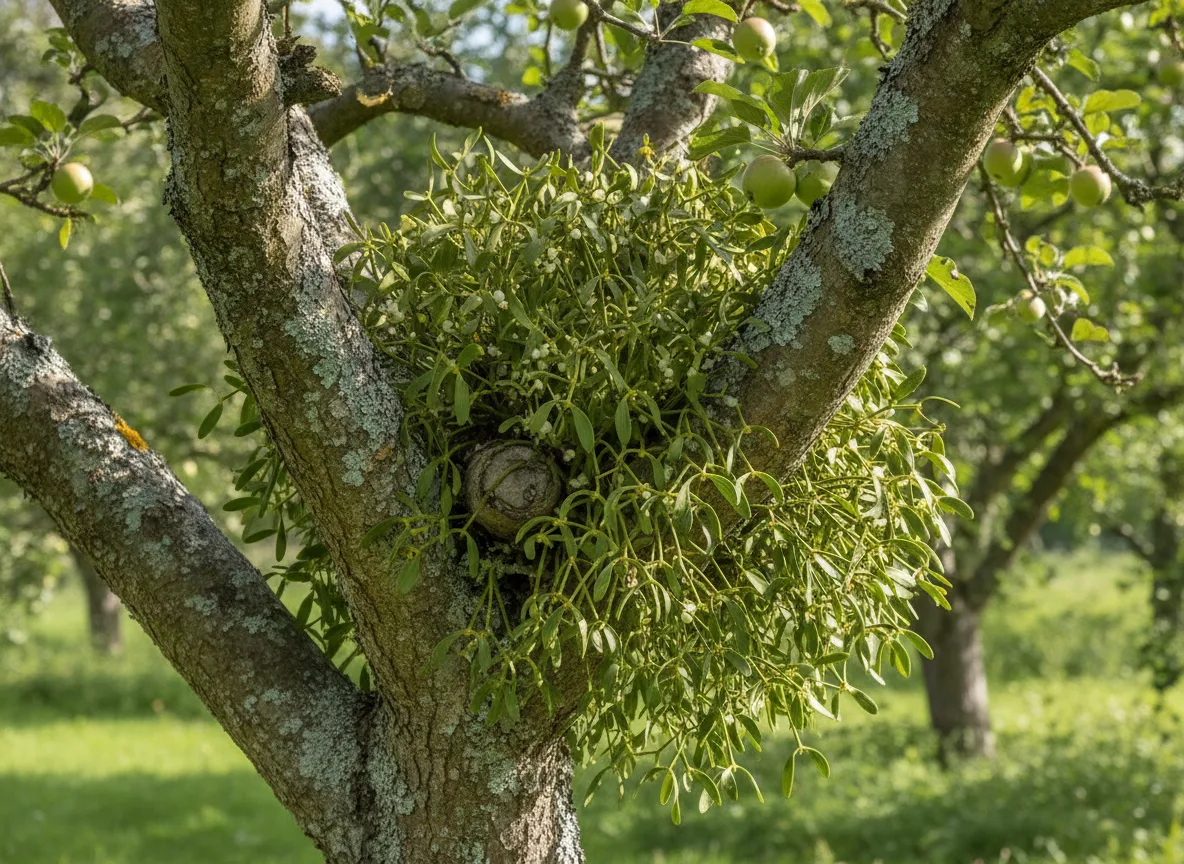 A clump of mistletoe growing on a healthy apple tree branch — AI-generated illustration
What mistletoe actually does to an apple tree
European mistletoe (Viscum album) is a hemiparasite. It has green leaves and makes some of its own sugars, but it takes all of its water and minerals straight from the tree. It does that through a root-like structure called the haustorium, which grows into the branch’s wood and taps into the sap stream.
A clump or two on a big, healthy tree does very little harm. Plenty of old orchards in the UK and the Low Countries have carried mistletoe for decades. The trouble starts when it’s left to spread:
- The branch beyond the clump starves. Mistletoe sits between the roots and everything further out, so the wood past a heavy clump gets less water. It flowers less, fruits less and often dies back.
- Branches get heavy and brittle. A large clump catches wind and snow. Infested limbs are more likely to snap in a winter gale.
- It multiplies. Birds — mistle thrushes and, in winter, blackcaps — eat the white berries and wipe the sticky seeds onto nearby twigs. One berried clump becomes five within a few years, and they’re often on the same tree.
So the goal isn’t to wipe out every sprig. It’s to keep mistletoe at a level the tree can carry, and to stop it taking over the young, productive wood.
Snipping the leaves off doesn’t work
The instinct is to grab the clump and pull, or snip it off where it meets the bark. That gives you a nice bunch for the hallway, and the tree looks clean. Next autumn, the mistletoe is back in exactly the same spot.
The reason is the haustorium. It stays alive inside the branch, often running several centimetres along the wood beyond where the clump appears to start. Cut away the leaves and the haustorium simply pushes out new shoots. You haven’t removed the mistletoe, you’ve pruned it — and like most plants, it often comes back bushier.
That’s actually useful if you want a steady supply of Christmas sprigs from a big old tree that’s coping fine. But if the aim is to get it off the branch, the cut needs to go into the apple, not the mistletoe.
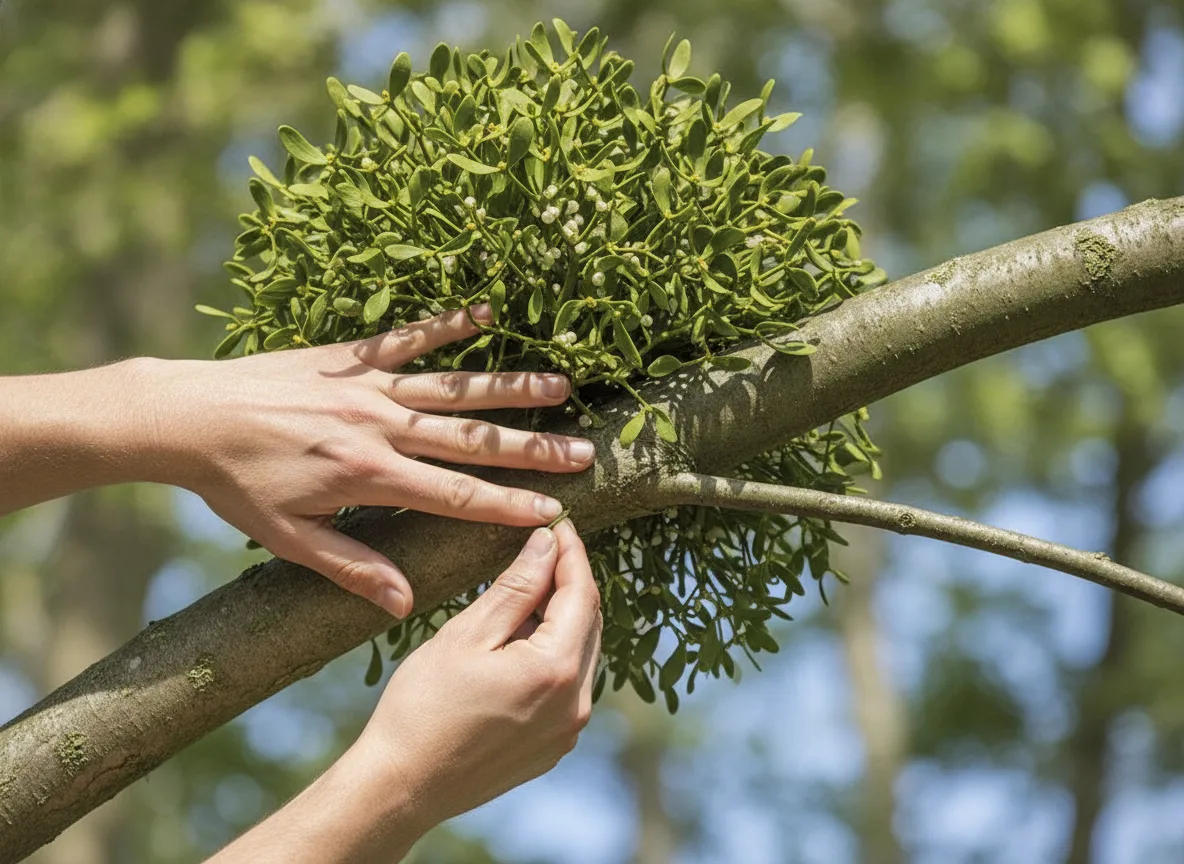 A hand measures a generous span below a mistletoe clump on a tree branch — AI-generated illustration
Where to cut: a hand-span below the clump
To remove mistletoe properly, take the section of branch it’s growing on.
- Follow the branch back from the clump towards the trunk. You’re looking for a cutting point at least 20–30 cm below where the mistletoe attaches — roughly a generous hand-span. That’s usually enough to get beyond the haustorium.
- Cut to a healthy side branch or back to the parent limb. Don’t leave a bare stub; a stub with no buds dies back and invites rot. Cut just above a side shoot pointing in a useful direction, or remove the whole branch back to where it joins a bigger limb.
- On larger limbs, cut outside the collar. Where a whole branch comes off, saw it just outside the swollen ring at its base, never flush with the limb. There’s more on this in our guide to removing a tree branch at the collar.
- Check the cut face. If you see small green or yellow-green flecks in the wood, the haustorium extends further. Take another 10 cm off.
Use clean, sharp tools: a pruning saw for anything thicker than a thumb, loppers or secateurs for thinner wood. Burn, bin or compost the cut wood — mistletoe can’t re-root from cut branches lying on the ground.
When it’s on the trunk or a main limb
Sometimes mistletoe has settled on wood you can’t remove — the trunk itself, or a main scaffold branch holding up half the tree. Cutting that out would do more damage than the mistletoe.
In that case:
- Cut the clump off flush with the bark, as close as you can get.
- Keep doing it every winter. Each time, the haustorium uses up energy to resprout, and clumps that are cut back regularly never get big enough to berry and spread.
- Some arborists wrap the spot in a few layers of black polythene after cutting, to block out light and stop regrowth. If you do, keep it loose so it doesn’t girdle the limb, and check it each year.
It’s management rather than a cure, but a tree with a small, regularly cut sprig of mistletoe on its trunk will carry on cropping happily for years.
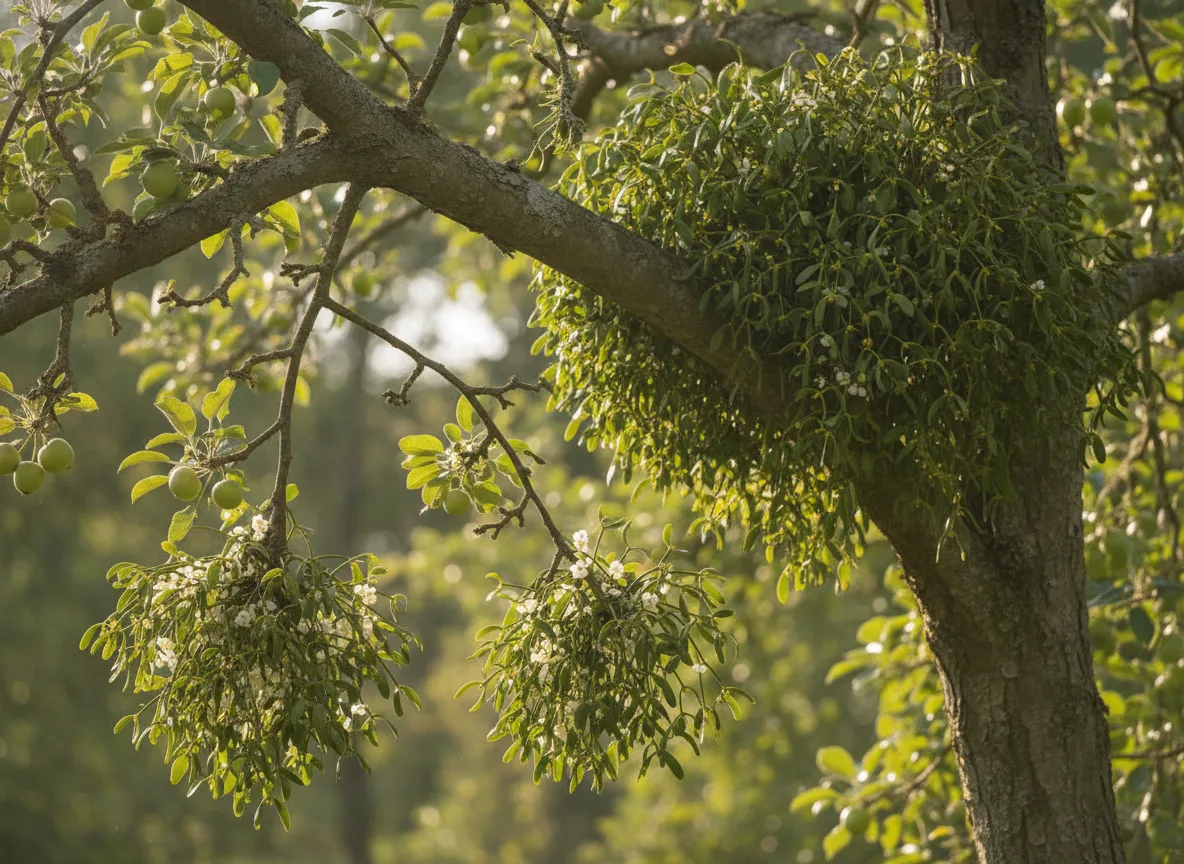 A large mistletoe clump growing on a tree branch, with smaller clumps nearby — AI-generated illustration
Which clumps to cut, and which to keep
Mistletoe plants are either male or female, and only the females carry the white berries. That gives you an easy way to prioritise:
- Cut first: berried clumps on young, fruiting wood, and anything on branches that are already thinning or dying back. These do the most damage and spread the most seed.
- Cut next: any clump on a small or young tree. A tree under ten years old, or on a dwarfing rootstock, has very little spare capacity.
- Fine to leave: one or two clumps on a large, vigorous old tree, especially if they’re on an outer branch you’d be happy to lose one day. They’re good for winter birds and for the insects that depend on mistletoe.
A rough rule: if more than about a quarter of a tree’s branches carry mistletoe, it’s time for a serious cut-back over the next two winters. Spreading the work over two seasons stops you taking out too much of the canopy at once, which would trigger a flush of water shoots.
When to do it
Any time from leaf fall to late February. Mistletoe is easiest to spot in November and December, and the berries are ripe then too, so cutting before birds strip them stops the next generation being sown.
If you’re giving your apples and pears their winter prune anyway, combine the two jobs. The mistletoe cuts count towards the total — don’t remove more than about a quarter of the canopy in one winter, including both. Our guide to why apple trees are pruned in winter, not autumn covers the rest of that prune.
Avoid cutting during a hard frost: frozen wood splinters more easily and the cut faces tear.
Quick checklist
- Look for mistletoe in the bare canopy from November.
- Remove berried clumps first, especially on young or struggling branches.
- Cut the branch 20–30 cm below the clump, back to a side shoot or the parent limb.
- On the trunk or main limbs, cut flush and repeat every winter.
- Keep total pruning under a quarter of the canopy per year.
- Enjoy the sprigs indoors — and keep the berries away from children and pets, as they’re toxic.
Cresco can remind you of each tree’s winter pruning window, so the mistletoe check happens alongside it rather than being forgotten until the next spring.