Bare-root season starts now
From early November to the end of March, hedging plants are sold bare-root: dormant whips dug straight from the nursery field, roots wrapped in a bag, no pot. They are a fraction of the price of potted plants, they establish faster, and for a native hedge of hawthorn (Crataegus monogyna), blackthorn, field maple and hazel they are the standard way to plant.
What arrives is a bundle of thin sticks, 60–100 cm tall, with a few side twigs near the top. You plant them, firm them in, step back, and they look like a row of canes. The natural instinct is to let them grow up as fast as possible, so the hedge “fills in”.
That instinct is exactly what gives you a hedge that’s bare at the bottom for the rest of its life.
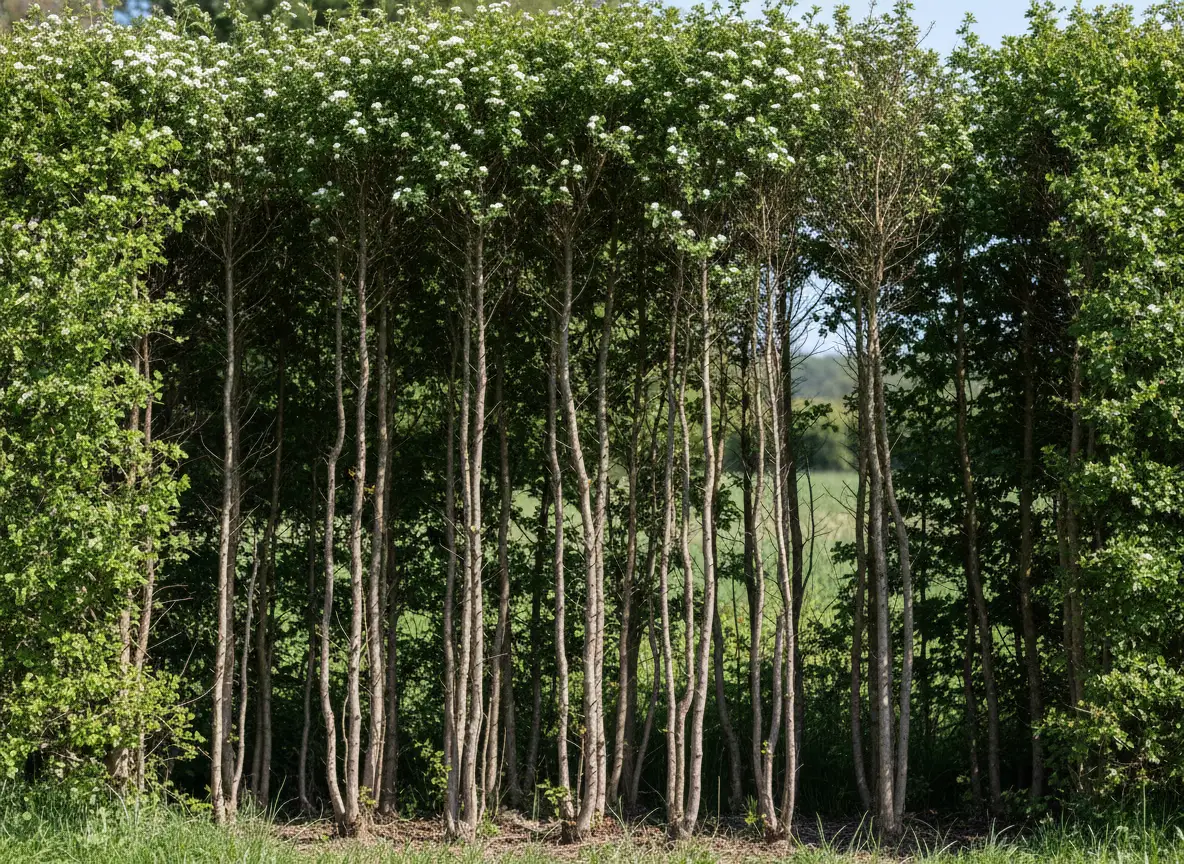 Dense hawthorn hedge with bare bases and foliage concentrated at the top — AI-generated illustration
Why a new hedge goes bare at the base
Hawthorn, like most woody plants, puts its energy into the highest bud on each stem. Botanists call it apical dominance: the tip produces hormones that keep the buds lower down asleep. Leave a whip uncut and it grows taller, with a tuft of side shoots near the top and bare stem below.
In a hedge that’s a problem you can’t fix later. By year three or four, the plants are shading their own lower stems. Light can’t reach the base, and the buds down there never wake up. You end up with a row of small trees with a gap underneath, the kind of hedge a dog, a rabbit or the wind goes straight through.
Cutting the tip off removes that hormone brake. The buds lower down the stem break instead, and each one becomes a new shoot. One stick becomes three, four, five stems, starting close to the ground. That’s the dense base you’re after, and you only get one easy chance to create it: the first winter, before the plant has any height worth keeping.
How hard to cut a new hawthorn hedge
Here the advice varies, and it’s worth knowing why.
- The gentle version. The RHS recommends cutting the leading upright shoots of a newly planted deciduous hedge back by about one third, just above a bud, straight after planting. Side shoots get the same treatment.
- The hard version. Traditional hedge-layers and farm advisers go much further with hawthorn and blackthorn. The Irish agricultural body Teagasc advises cutting new hawthorn right down to about 10 cm above the ground after planting. Many hedging nurseries say 15–30 cm.
Both work. The difference is the hedge you want. The one-third cut keeps some height and gives a reasonably bushy result. The hard cut sacrifices the first year’s height for a base that is properly dense: the classic stockproof farm hedge, thick enough to stop sheep.
For a garden boundary of hawthorn or blackthorn, I’d go in between and on the hard side: cut every whip to 15–30 cm above the soil, just above an outward-facing bud. It looks alarming. Hawthorn is extremely vigorous, and by the end of next summer most plants will have pushed several shoots 40–60 cm long, from the base.
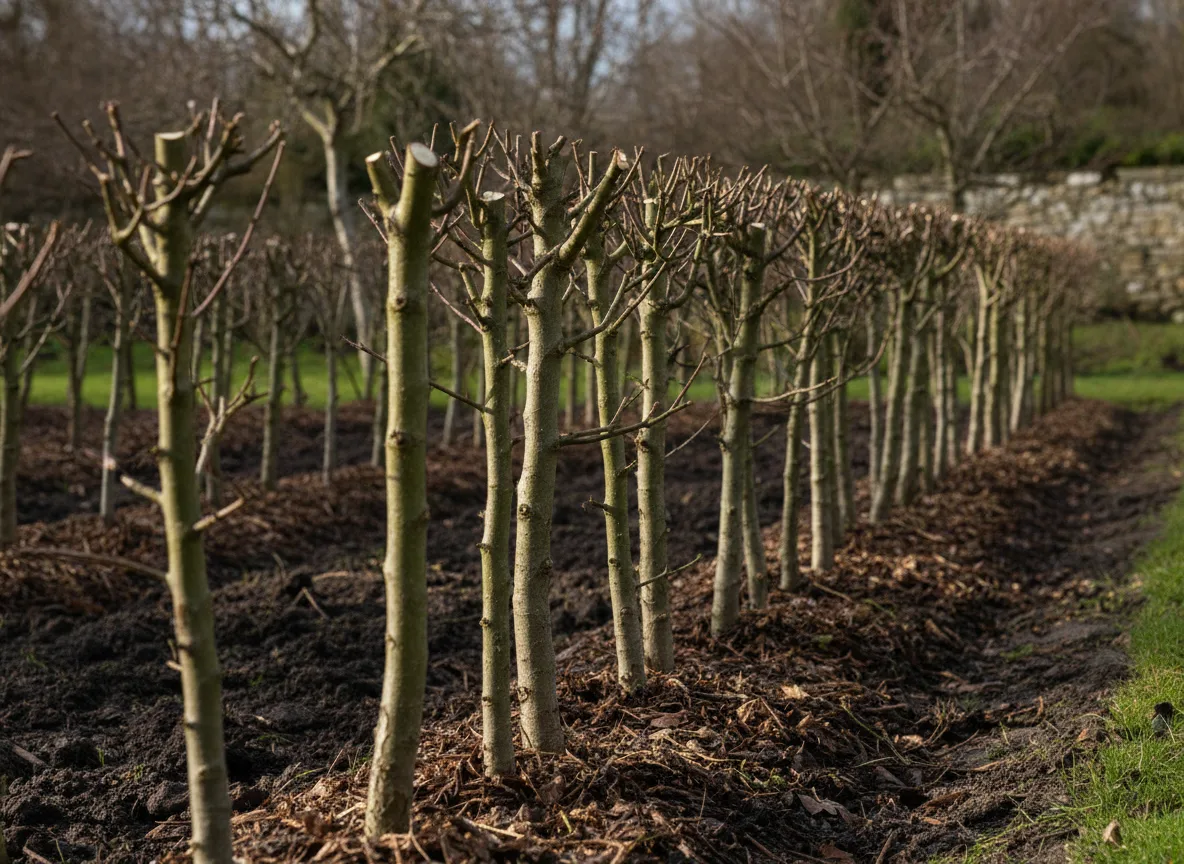 A freshly pruned, mulched hedge row in winter dormancy — AI-generated illustration
When to make the cut
Straight after planting, any time from November to March while the plants are dormant. Don’t wait for spring “to see if they take”. The cut does no harm to a bare-root whip, and the roots don’t need the top growth to settle in. If anything, a shorter top means less wind-rock and less water loss while the new roots are still finding their feet.
Avoid cutting during a hard frost, when the stems are brittle and split. Otherwise, the day you plant is the day you prune.
The second winter cut
The first cut isn’t the end. Next winter, after leaf fall, go back along the hedge and:
- Cut the new upright shoots back by about half. Yes, again. This creates a second tier of branching above the first.
- Trim the side shoots by about a third, so the young hedge stays tight and bushy from the bottom up.
- Fill any gaps. A plant that died, or a stretch that’s clearly thinner, is easy to replace now while everything is small.
From year three, you can start letting it gain height, cutting back the new growth by a third each winter until it reaches the height you want. After that it moves on to an ordinary hedge trim, once a year, in late summer, after birds have finished nesting.
Always shape the hedge so it’s wider at the base than at the top, a slight “A” shape. A hedge with straight or top-heavy sides shades its own base, and you’re back to the bare-legged problem you cut so hard to avoid.
Which new hedges need the hard cut, and which don’t
Not every hedge wants the same treatment. Getting this wrong in the other direction does real damage.
Cut hard (to 15–30 cm, or by at least half):
- Hawthorn
- Blackthorn
- Privet
- Hazel, dogwood and other vigorous native mix plants
Cut by about a third:
- Beech and hornbeam. Both are slower to break from low down, and a really hard cut on a young beech whip can set it back a year or kill it. Take the leader and long side shoots back by a third, no more. (Hornbeam’s later trims are a different story.)
- Field maple
Don’t cut the leader at all:
- Yew, leylandii, thuja and other conifers. Leave the top unpruned until the hedge reaches the height you want. Trim only straggly side shoots, in summer.
- Evergreen hedging like holly, laurel and box. Trim side shoots lightly in spring; leave the leader.
A conifer cut to 20 cm in its first winter often never recovers. Most conifers, apart from yew, don’t regrow from bare brown wood.
Planting tips that make the cut work
The hard cut only pays off if the roots can drive that regrowth. A few things make the difference:
- Never let the roots dry out. Keep bare-root plants in their bag or heeled into soil until the moment they go in. Five minutes in a cold wind kills fine roots.
- Plant in a staggered double row for a thick hedge: two rows about 40 cm apart, plants every 40–50 cm, offset like a zigzag. That’s about five plants per metre.
- Plant at the same depth as they grew in the nursery. Look for the soil mark on the stem.
- Firm in well, then water, even in winter.
- Keep a 50 cm strip free of grass and weeds for the first two or three years. Grass competition slows a young hedge more than anything you do with secateurs. A mulch of bark or leaf mould helps.
The short version
A new hawthorn hedge isn’t shaped by how it grows, but by where you cut it. Cut the whips hard after planting this winter, cut the new shoots by half next winter, and only then let it grow up. Two years of patience gives you a hedge that’s thick right down to the ground, for decades.
If you’re also trimming established hedges this year, see how a June trim makes privet twice as thick. And if your hedge is one of many plants on your list, Cresco keeps a pruning calendar for each of them and tells you when the next cut is due.