The cut is what makes it bushy
There’s a common idea that a hedge grows thick because it’s healthy, and that the trimming is just tidying. With privet (Ligustrum) it’s the other way round: the trimming is what builds the density. Leave a privet unclipped for a season and it doesn’t thicken — it bolts. You get long, bare, whippy stems with a tuft of leaves at the far end and daylight through the middle.
The reason is apical dominance. Every growing shoot tip releases hormones that suppress the buds further down the stem. Cut that tip off and the suppression lifts: two, three, sometimes four side buds wake up and break, each becoming a new shoot with its own tip. Do that across the whole face of a hedge and you’ve roughly doubled the number of growing points. That’s the “twice as thick” — it isn’t a slogan, it’s branching arithmetic. The hedge is denser because you cut it, not in spite of it.
Privet happens to be the ideal plant for this because it’s one of the fastest hedging shrubs there is — 60 to 90 cm of growth in a single season — and it breaks freely from almost any wood you cut into. Most conifers won’t forgive a cut into bare brown wood. Privet treats it as an invitation.
 A garden scene with various flowering plants, a wicker basket, and gardening tools — AI-generated illustration
Mid-June, not just late summer
A lot of advice files privet under “trim in late summer” and leaves it there. That’s the maintenance cut. It misses the more important one.
A fast grower putting on the better part of a metre a year needs cutting two to three times across the season, not once. The first of those falls now, in the back half of June, once the soft spring flush has firmed up and stopped extending. This is the cut that sets the hedge’s framework for the whole year — the one that decides whether it spends the summer getting denser or getting leggier. The mid-to-late-summer cut that everyone remembers is just keeping that framework tidy.
If you only ever trim privet once a year, it will look untidy again within about six weeks and slowly thin from the inside. Two or three lighter cuts beat one hard one every time — for the look, and for the plant.
 A garden bed with plants heavily cut back in the foreground and blooming plants in the background — AI-generated illustration
How hard to cut
For an established hedge, this is a light cut, not a reshaping. Take the soft new growth back to within a centimetre or two of last year’s clipped line — far enough to remove the loose, lighter-green extensions, not so far that you’re sawing into the old framework. Wherever you can, cut to just above an outward-facing pair of leaves or buds, so the new shoots break outward and fill the face rather than crossing into the middle.
A young hedge you’re still building is the exception, and the instinct to be gentle works against you here. To get density low down, you have to cut a young privet harder than feels right in its first two or three summers — taking off a good third of the new growth each time. Every cut multiplies the shoots, and a privet that’s allowed to race up to full height untrimmed will be bare at the knees for the rest of its life. Build the thickness first; let the height come later.
Whatever the age, keep your blades sharp and clean. Privet stems are soft and a blunt trimmer crushes and tears them, leaving a frayed brown edge along the whole top of the hedge a week later. Sharp shears or a well-set hedge trimmer cut cleanly and the regrowth hides the line within days.
Cut a batter, not a wall
The single most common privet complaint — “green on top, bare twigs at the bottom” — almost always comes down to the shape you cut, not the timing.
If you clip the sides dead vertical, or worse, slightly wider at the top, the upper growth overhangs and shades out the base. Privet won’t hold leaf in deep shade, so the bottom thins, goes bare, and stays bare. The fix is to cut a batter: a hedge that’s a touch wider at the base than at the top, with the faces sloping gently inward as they rise. It looks subtle — a few centimetres of taper over a metre of height is enough — but it lets light reach the bottom of the hedge, and a privet that gets light to its base stays clothed to the ground.
If your hedge is already bare-bottomed, cutting a batter from now on won’t refill it overnight, but it stops the rot and lets new basal shoots get the light they need to break.
The same light-and-shape logic runs through every formal hedge — it’s exactly why the late-June beech-hedge window and the cloud-cover box trim are worth getting right too.
 Newly trimmed privet with branches on a tarp and gardening shears — AI-generated illustration
Gone leggy or bare? Privet takes a hard reset
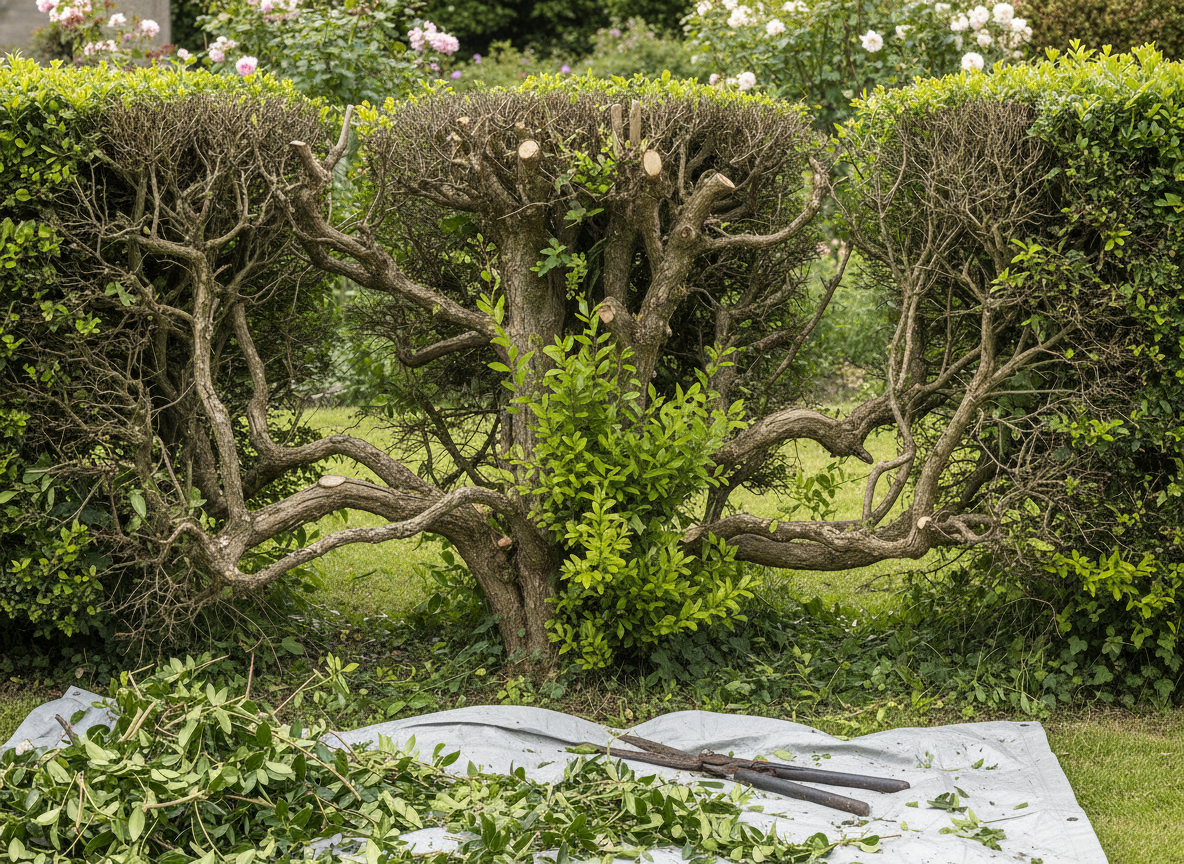
This is where privet’s tolerance for old wood becomes a genuine superpower. An overgrown, gappy, decades-old privet that you’d write off as a conifer can be cut back into thick bare wood — within a few centimetres of the ground if you’re renovating completely — and it will regenerate. Leave about 3 cm of stem so there are dormant buds to break from, feed and water it well, and a renovated privet can throw a metre or more of fresh growth in a single season.
The catch is timing. A drastic renovation is a job for the dormant season — late winter, before the end of February — not midsummer. What you can do now, in June, is a moderate reduction: bring a hedge that’s outgrown its space back by a third or so, knowing the cuts will break and re-clothe quickly while the plant is in full growth. Save the cut-to-the-stumps reset for next winter.
Check for nesting birds first
June is peak nesting season, and privet — dense, twiggy, evergreen-ish — is one of the most popular nest sites in the garden. Across the UK and the Netherlands it’s an offence to damage or destroy an active nest, and the protected window runs right through summer, roughly March to August.
So before the trimmer comes out, part the foliage and look. Listen for the giveaway: the thin, insistent cheeping of a brood being fed. If you find an active nest, stop — leave that whole section unclipped and come back to it in a few weeks once the young have fledged. The framework cut isn’t so time-critical that it’s worth a nest. A privet shrugs off being trimmed a fortnight late; a brood doesn’t get a second chance.
What to do this week
- Wait for a settled spell once the soft spring growth has firmed up — any dry day in the back half of June.
- Check the whole length for active nests first, and skip any section that has one.
- Take the new growth back to within a centimetre or two of last year’s line; cut harder on a young hedge you’re still thickening.
- Cut a batter — base wider than the top — so light reaches the bottom and it stays green to the ground.
- Use sharp, clean blades, and plan on a second (and maybe third) lighter cut later in the summer.
Privet is forgiving enough that you’ll get away with rough timing — but “forgiving” and “at its best” aren’t the same hedge. The plants that stay dense to the ground are the ones cut little and often, to the right shape, starting now. If you’d rather not keep the schedule for every hedge and shrub in your head, Cresco tracks each plant’s pruning window against your local weather and tells you the week to pick up the shears.