What pollarding actually is
Pollarding means cutting every branch of a tree back to the same point on top of a short trunk, again and again. Willows (Salix) take it better than almost anything else. After a few rounds, the cuts form a swollen, knobbly head (the knuckle, or pollard head) that bristles with dormant buds. Each spring those buds shoot straight up into a crown of long, whippy wands.
Done regularly, it keeps a fast, big tree small enough for a garden, beside a ditch, or along a drive. It also gives you a steady supply of willow rods for supports, edging and cuttings.
The catch is in the title. Once a willow has been pollarded, the new branches are only loosely anchored in the soft tissue around the old cuts. They aren’t grown into the trunk the way a natural branch is. Leave them for ten or fifteen years and they get thick and heavy, all pulling outwards from one point. Eventually one tears loose, rips open the head, and lets water into a trunk that’s often already hollow. Neglected pollards are the ones you see split in half after a storm.
So pollarding is a commitment. Start it, and the tree needs you back every few years for the rest of its life.
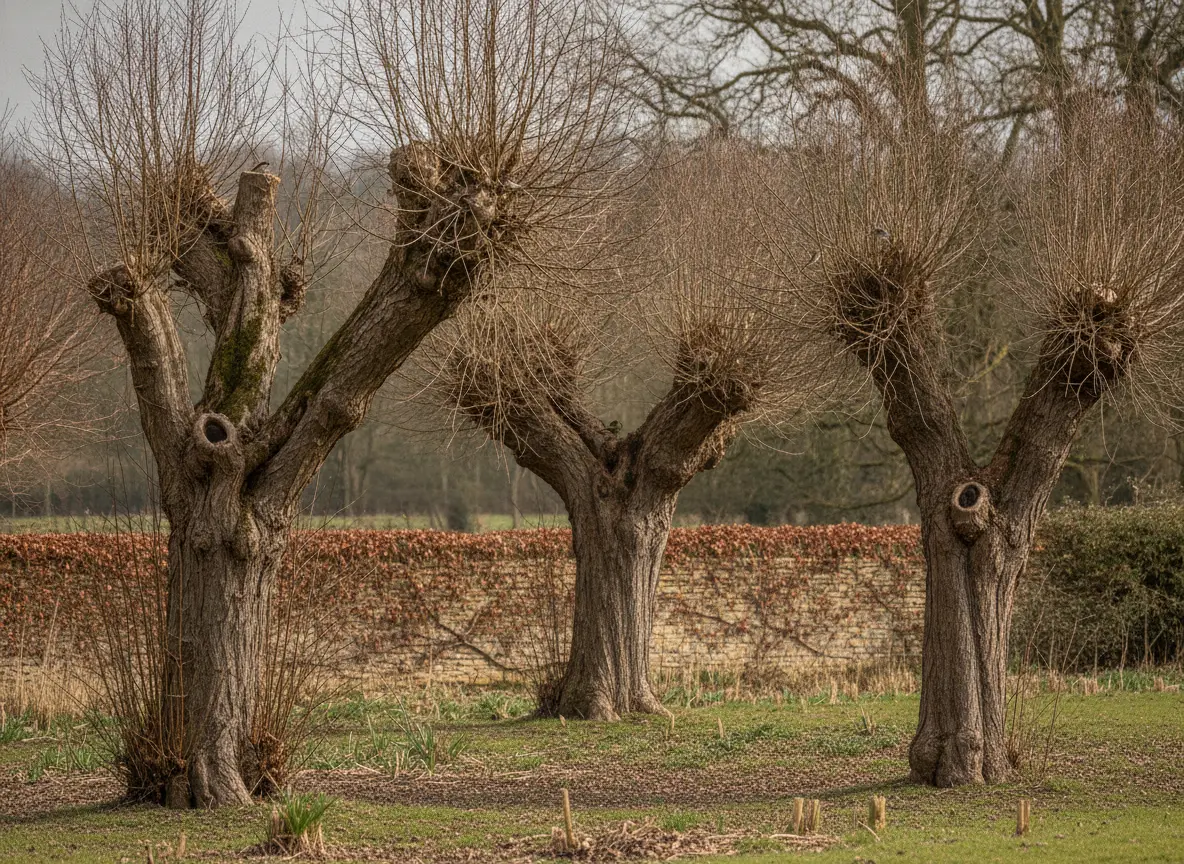 Three pollarded willows stand bare in a field with a wall behind them — AI-generated illustration
When to pollard: leaves off, before the birds
The window runs from November, once the leaves have fallen, to mid-March. That’s the dormant season. The tree has pulled its reserves back into the trunk and roots, there’s no sap rising to bleed from the cuts, and you can see the branch structure clearly.
The end of the window matters as much as the start. From mid-March, birds start nesting, and a willow crown is a favourite spot. In the UK, disturbing an active nest is an offence under the Wildlife and Countryside Act. Finish before the nesting season, and check the crown first if you’re working late in the window.
Avoid days of hard frost. Frozen wood is brittle and tears rather than cuts, and a ragged cut heals slowly.
How often: one to five years
How often you cut depends on what you want from the tree:
- Every year or two for coloured-stem willows, such as Salix alba ‘Britzensis’ with its orange-red bark, or S. alba var. vitellina in egg-yolk yellow. The youngest wood has the brightest colour, so frequent cutting gives the best winter show. It’s the same idea as cutting dogwood for winter stems, just raised up on a trunk.
- Every three to five years for a classic pollard of white willow (S. alba) or crack willow (S. fragilis). This is the traditional cycle. The branches are still thin enough to cut with a pruning saw, and not yet heavy enough to strain the head.
- Never longer than about eight years if you can help it. After that, the branches get too thick to cut cleanly and the risk of splitting rises quickly.
Write the year on your calendar, or in the Cresco app, when you finish. It’s easy to lose track of a job you only do every four winters.
 A freshly pollarded willow in winter, every branch cut just above the knuckle — AI-generated illustration
The cut: just above the knuckle
On an established pollard, the job is simple. Every branch comes off.
- Work from the outside in, taking the longest, heaviest branches first so you can see what you’re doing and nothing falls onto the head.
- Cut each branch 2–5 cm above the knuckle, not flush with it. The dormant buds that make next year’s shoots sit in that swollen tissue. Cut into it and you remove them, along with the tree’s best defence against rot.
- Angle the cut slightly so rainwater runs off rather than pooling on the stump.
- For branches thicker than your wrist, use three cuts so the bark doesn’t tear down the trunk. First an undercut about 30 cm out, then a top cut a little further out to drop the weight, then the final cut above the knuckle.
A sharp pruning saw handles most three-to-five-year growth. Don’t use a chainsaw from a ladder. If the head is above head height, or the branches are thicker than about 15 cm, it’s a job for a tree surgeon.
Don’t paint the cuts. Willow seals its own wounds, and wound paint only traps moisture against the wood.
An overdue pollard: take it in stages
If you’ve inherited a willow that hasn’t been cut for ten years or more, don’t take everything off in one winter. A tree that suddenly loses its whole crown has nothing left to feed the roots, and old pollards in particular can fail to resprout.
Spread the work over two or three winters instead. Remove roughly a third to half of the branches in the first year, choosing the heaviest and the ones leaning furthest out. Some people leave one or two thinner branches as “draw” branches to keep the sap moving. Take the rest the following winter, once the first cuts have sprouted.
Expect a few cuts not to regrow on a very old tree. That’s normal. As long as most of the head sprouts, it’ll recover.
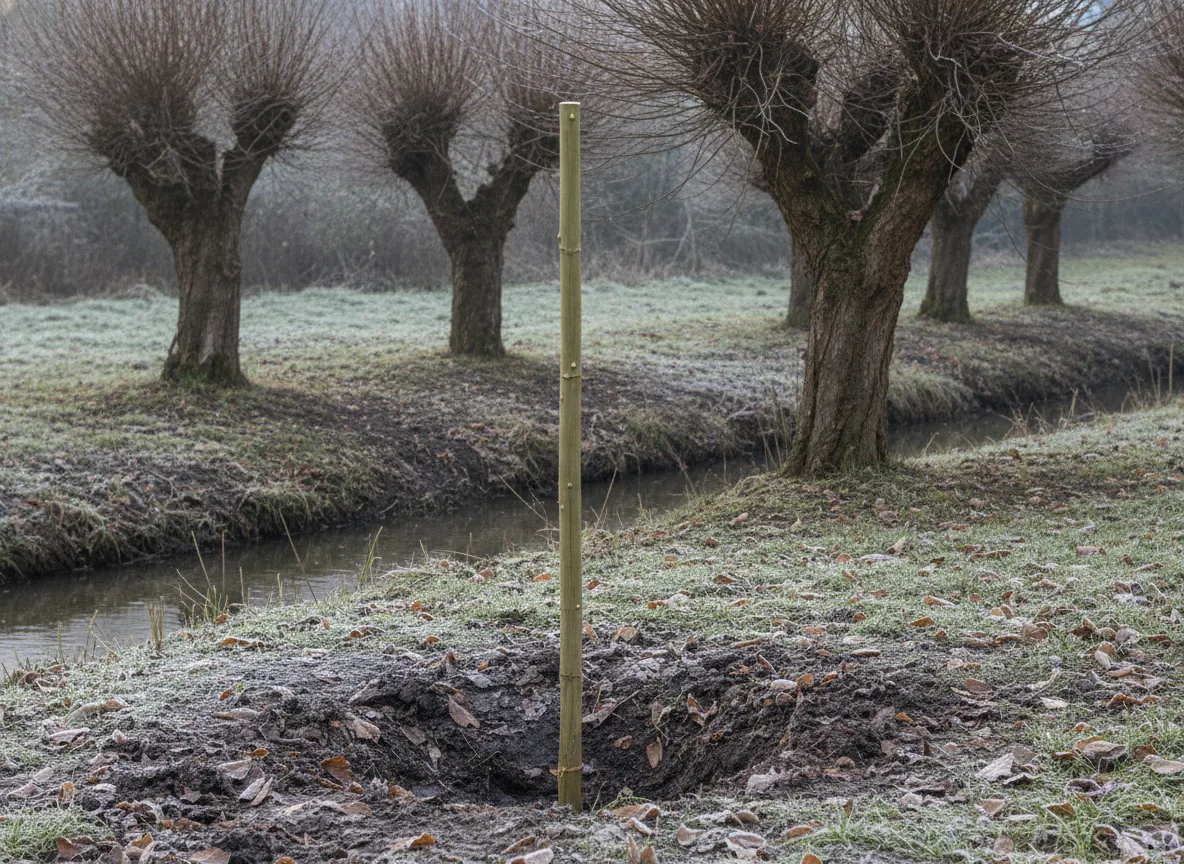 A willow pole set in moist ground, with established pollards in the background — AI-generated illustration
Starting a new pollard
The traditional way to start a willow pollard is surprisingly simple. In winter, push a straight, freshly cut willow pole about 2–2.5 m long and roughly 5–8 cm thick into moist ground, around 50 cm deep. Willow roots so readily that most of these “setts” take.
Let it grow freely for a few years until the trunk is thick enough to carry a head. Then, in winter, cut all the new shoots back to just above the top of the pole, at the height you want the head. Repeat on the cycle above, and after three or four rounds the knuckle starts to form.
You can pollard a young willow you’ve already planted the same way. Choose the height, around 1.8–2.5 m is typical, and cut all the branches back to it once the trunk is at least as thick as your arm.
Don’t waste the wands
A pollarding session leaves a pile of straight, flexible rods, and nearly all of it is useful:
- Cuttings. Willow is the easiest hardwood cutting there is. Push a pencil-thick length 20–30 cm long into the ground and it will root by spring. See the hardwood cuttings guide for the method.
- Plant supports. Thin rods make sweet pea wigwams, pea sticks and supports for floppy perennials.
- Weaving. One- and two-year rods bend easily for edging, small hurdles or a living willow fence.
Leave a couple of the thicker logs in a quiet corner, too. Old pollards are wildlife hotspots: hollow heads shelter beetles, bats and owls, and stacked deadwood does a smaller version of the same job.
Not just willow
The same technique works on other trees that resprout from old wood: limes, London plane, Catalpa, Paulownia (cut hard for huge leaves), and mulberry. The principle doesn’t change. Cut in the dormant season, keep to the knuckle, and stay on a regular cycle, because every pollard depends on you coming back.