Why November is when this cut happens
Bare-root fruit trees are lifted from the nursery fields from early November, and that’s when most young apple and pear trees are planted: between leaf fall and bud break, usually November to early March. The RHS advice is to do the first prune straight after planting, while the tree is still fully dormant.
Most of these trees arrive as a maiden: a one-year-old tree on its rootstock. It comes in two forms:
- An unfeathered maiden, or “whip”: a single straight stem with no side-shoots at all.
- A feathered maiden: the same main stem, but with a few side-shoots (the “feathers”) already growing from it.
Left alone, a whip keeps doing what it does best: growing straight up. You end up with a tall pole that branches high, out of reach for picking and pruning, with fruit held where only the birds can get to it. One cut in the first winter decides where the branches start.
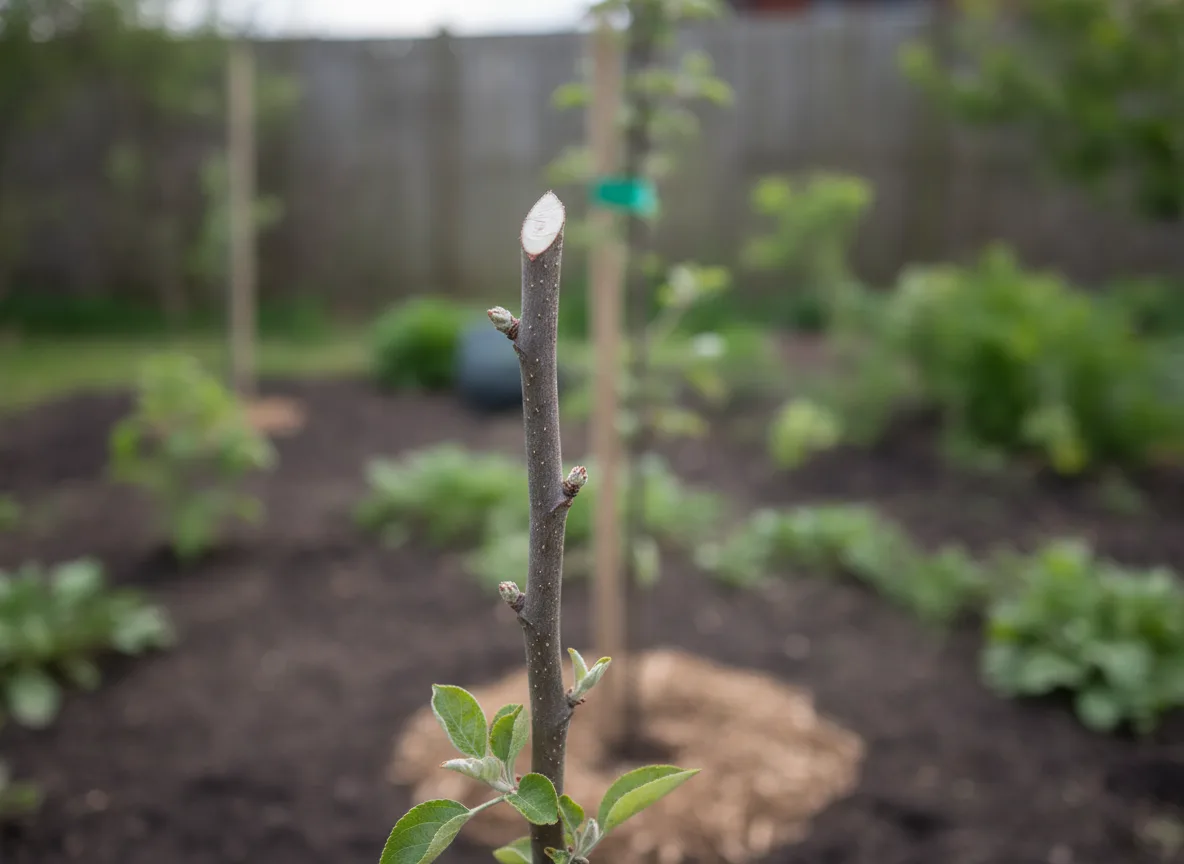 Young apple whip topped just above a bud — AI-generated illustration
The whip: one cut, just above a bud
For a free-standing bush tree, the most common shape in gardens, the first cut is simple:
- Measure about 75 cm from the ground. On a very dwarfing rootstock such as M27 or M9 you can go a little lower, to around 60 cm; for a half-standard with a longer clear trunk, cut higher, at roughly 1.2 m.
- Find a healthy bud just below that height. Ideally one with two or three more good buds beneath it.
- Cut just above that bud, with a short slope away from it, so rain runs off and the bud isn’t left under a stub.
That’s all. Taking off the top removes the hormone that keeps the buds lower down asleep. In spring, the top three or four buds below the cut break into shoots, and those shoots become the first branches of the tree.
It looks like a waste: you’ve just paid for a tree and cut half of it off. But a whip that isn’t topped rarely branches where you want it. The buds near the top take all the energy and the lower stem stays bare.
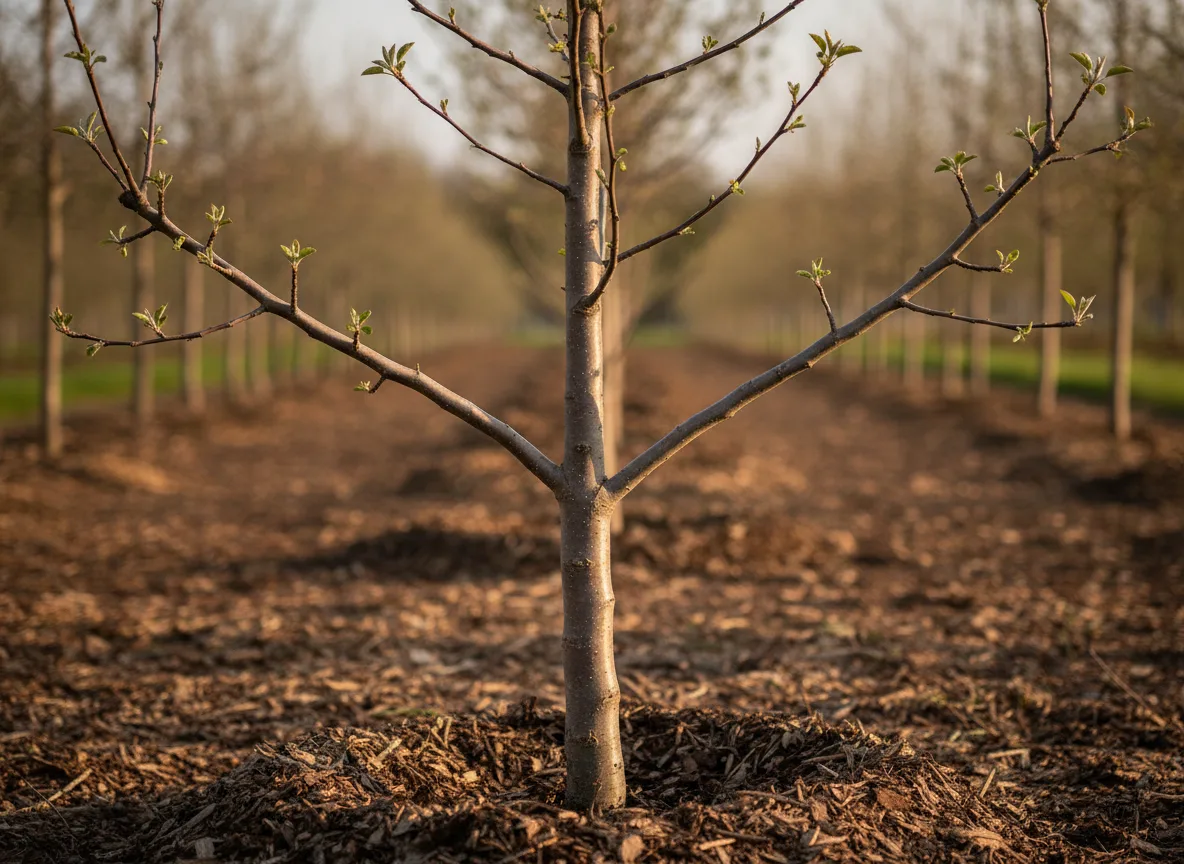 Young tree with well-spaced, wide-angled first branches — AI-generated illustration
The feathered maiden: choose your branches
A feathered maiden gives you a head start, because some branches are already there. Your job is to pick the best ones:
- Keep three or four well-placed feathers spread around the stem, ideally starting at about 60 cm from the ground and with wide angles to the trunk. Wide-angled branches are stronger and fruit earlier than narrow, upright ones.
- Remove feathers below about 60 cm flush with the trunk, outside the small collar at their base. They would only form a cluttered, low skirt of branches.
- Shorten the leader to a bud just above the highest feather you’re keeping.
- Shorten the kept feathers by about half to two thirds, each to an outward-facing bud, so they branch further and grow out rather than up.
If a feather is very weak or pointing straight across another one, take it out. Three good branches are worth more than six crowded ones.
Then leave it to grow
After that first cut, the tree needs no more pruning this winter. In spring and summer, the new shoots grow out from just below the cuts. Two things to watch in its first year:
- Remove any fruit that forms. The RHS advises letting a young tree put its energy into roots and branches in the first year, not into apples. Pinch off the tiny fruitlets after blossom.
- Water in dry spells through its first summer, and keep a circle of about a metre around the trunk free of grass and weeds.
Next winter, pick the best three or four of the new shoots as your main branches, shorten them by about half to an outward bud, and remove any that crowd the centre. From the third winter on, the tree moves on to the normal winter pruning that apple and pear trees get every year.
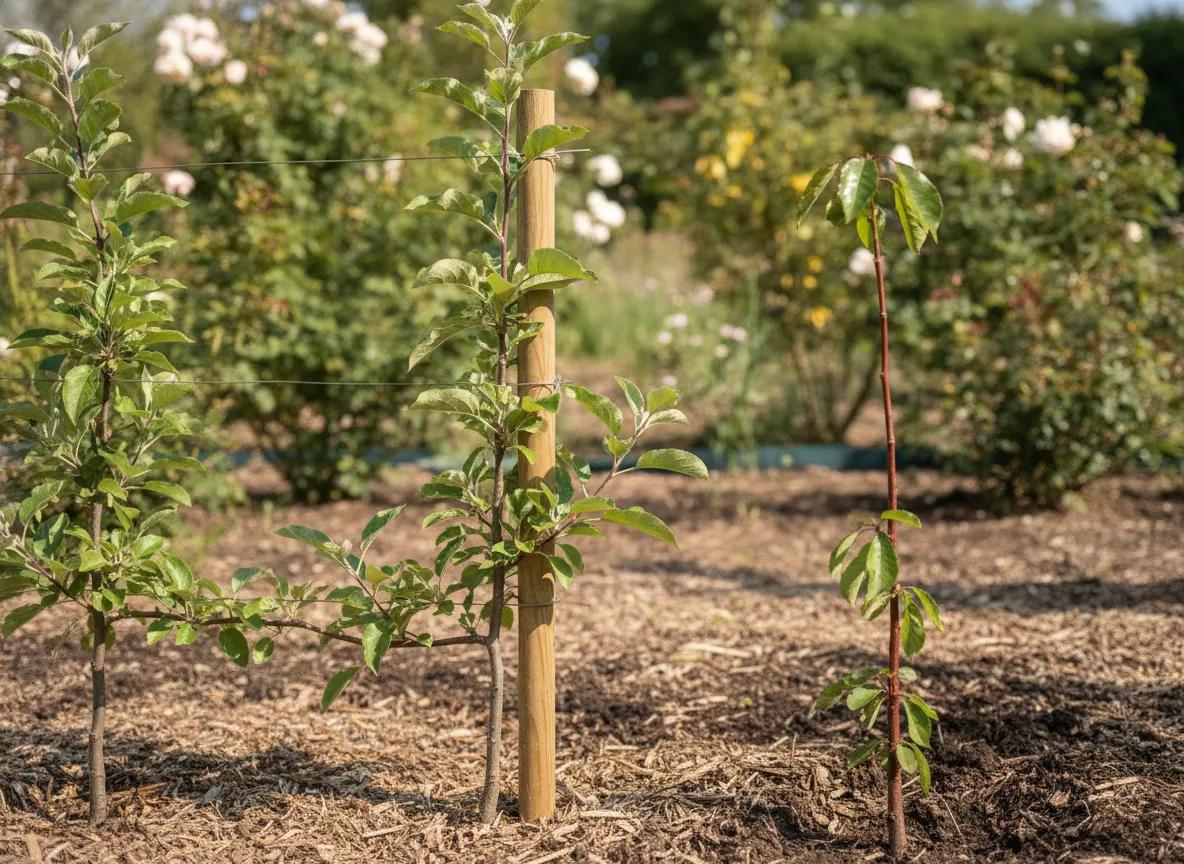 Young fruit trees in their first summer after planting — AI-generated illustration
When not to make this cut
The 75 cm cut is for a free-standing bush or half-standard apple or pear. Leave it out in these cases:
- Cordons and espaliers. Trained forms have their own planting cut and are shaped mostly with a summer prune. A cordon, for example, is not topped at all at planting.
- Plums, cherries, apricots and peaches. Stone fruit is never pruned in winter: open cuts in cold, wet weather let in silver leaf disease. Plant them now, but wait until the buds start to break in spring for the first formative cut, and do later pruning in summer (more on the stone-fruit window).
- Frozen or waterlogged ground. Don’t plant into it. Keep the tree wrapped and cool, or heel it in temporarily in a trench of loose soil, and plant (and prune) when the soil can be worked.
- A tree sold as already shaped. Two- or three-year-old trees from a nursery often have their framework of branches. Just remove damaged wood and leave the rest.
Quick checklist
- Plant bare-root apple and pear trees from November to early March.
- Whip: cut just above a bud at about 75 cm (60 cm on very dwarfing rootstocks).
- Feathered maiden: keep three or four feathers above 60 cm, shorten them by half to two thirds, and cut the leader just above the top one.
- First summer: pick off fruitlets, water in dry spells.
- No winter cuts on plums or cherries.
Planting more than one tree, or not sure what your rootstock is? Add the tree to Cresco and it reminds you when each step is due, from this first cut to its summer prune.