Why these trees break the winter rule
Almost everything you read about pruning fruit trees points at the dormant season: leaves down, sap stopped, secateurs out in January. That holds for free-standing apples and pears. But if you grow a cordon, espalier, fan, pyramid or stepover — a tree kept deliberately small and flat against a wire or wall — the most important cut of the year happens in summer, while the tree is in full leaf.
The reason is the way a tree answers a cut. Prune hard in winter and the tree wakes up in spring with stored energy and nowhere to put it, so it throws out vigorous, leafy “water shoots.” On a trained tree that’s the last thing you want — you’re trying to keep it compact, not feed its ambition. Cut in summer instead and the response is the opposite: growth has already slowed, the tree can’t fully rebuild what you removed, and the energy goes into fruit buds for next year rather than this year’s whippy growth. As a bonus, taking out the leafy summer shoots lets light onto the ripening fruit, which is what gives you bigger, sweeter, better-coloured apples and pears.
 A split image of an apple tree and a birch tree in a garden setting — AI-generated illustration
Which trees this is for — and which it isn’t
Summer pruning is for restricted, trained forms where keeping the shape is the whole point:
- Cordons — single stems on an angle
- Espaliers — horizontal tiers on wires
- Fans — ribs spread on a wall
- Pyramids and spindlebushes — compact, tiered cones
- Stepovers — knee-high single horizontal arms
If you grow an ordinary bush or standard apple in the open — a tree you can walk under — leave the secateurs in the shed until winter. Summer pruning a free-standing tree just removes leaf it needs to fatten its crop, and won’t keep it any smaller. The technique earns its keep only where you’re holding a tree to a frame.
 . A hand in a white glove holds a device near apples and pears in an orchard — AI-generated illustration
The test that beats the date
This is where the calendar lies to you. Every guide gives a month, but the right week depends on your tree, your variety and your summer — which is exactly the kind of timing Cresco is built to track. The signal to watch for is maturity in this year’s new shoots, not a date:
- The bottom third of the new shoot has gone stiff and woody, not soft and bendy.
- The leaves on it are dark green and leathery, not pale and floppy.
- The tip has set a terminal bud — growth at the end has stopped.
When those three line up, the shoot is ready. As a rough guide, pears reach that point from mid- to late July and apples from mid- to late August, with everything running about ten days later the further north you garden.
The mistake almost everyone makes is going too early. Prune a soft, still-growing shoot in late June or early July and the tree simply regrows — you’ve pruned for nothing and you’ll be doing it again in six weeks. Patience here is the whole skill: wait for the wood, not the date.
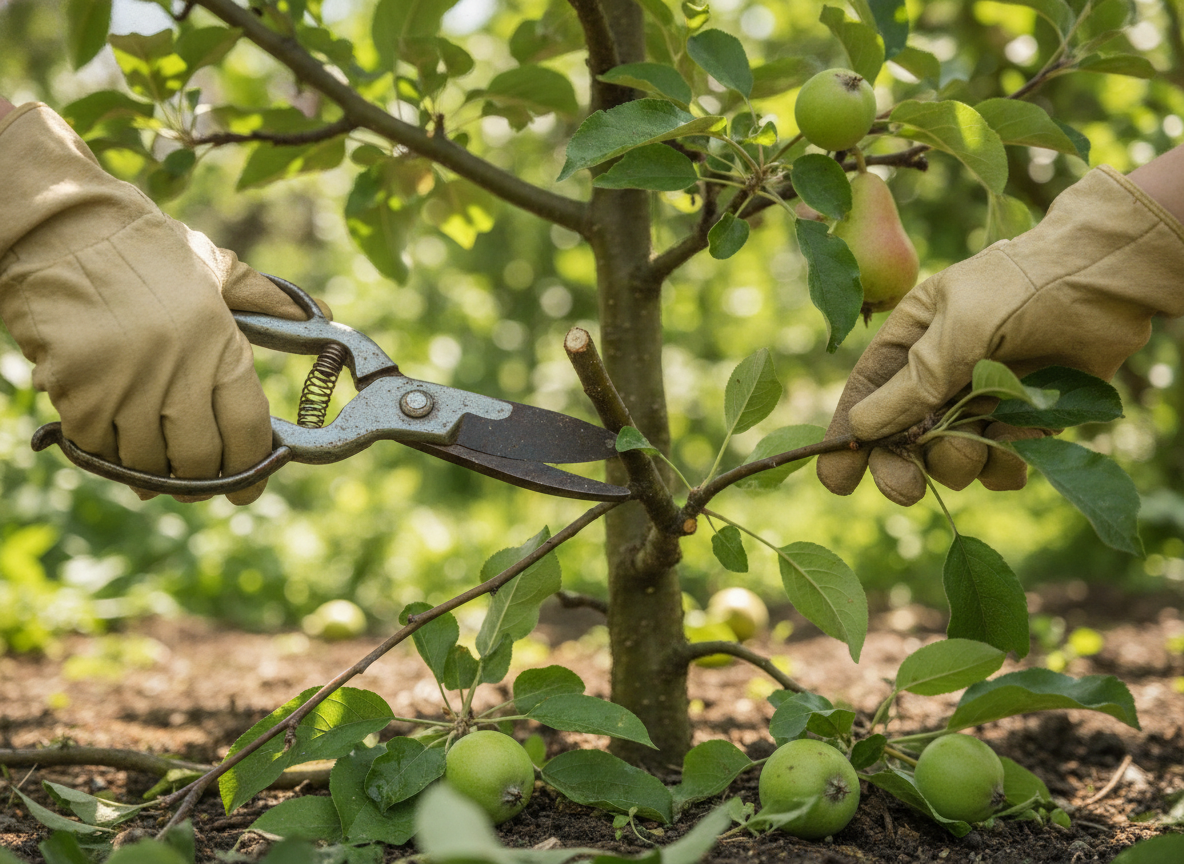 A person prunes a small fruit tree with green apples and pears — AI-generated illustration
The cut, shoot by shoot
Once the shoots are ready, the rule depends on where each shoot is growing from — and there are only two cases.
New shoots growing straight off the main stem or a main branch (longer than about 20 cm / 8 in): cut them back to three leaves above the basal cluster — that little rosette of leaves at the very base of the shoot. Don’t count the basal cluster; count three good leaves past it and cut just above the third.
New shoots growing from an existing spur or last year’s pruned side-shoot: cut these harder, back to one leaf beyond the basal cluster — a stub of roughly 2.5–5 cm (1–2 in). These short stubs are what thicken into the fruiting spurs that carry next year’s crop.
Two things to leave alone. Ignore any shoot shorter than about 20 cm — it’s not worth cutting and may already be carrying a fruit bud. And don’t touch the leader (the leading tip of a cordon or each espalier arm) until it has filled the space you want it to; that one is shortened in winter, not now.
If it grows back
Even with good timing, a vigorous tree on rich soil can push a fresh secondary shoot from a cut you made in August. Don’t panic and don’t keep chasing it through autumn. If a strong regrowth appears, snip it back to one leaf in September, once it too has firmed up. One tidy follow-up is normal; constant regrowth is the tree telling you that you pruned too early, or that it’s over-fed.
And to be clear, summer pruning doesn’t replace the winter job — it sits alongside it. You still do the usual dormant-season tidy: removing dead, diseased or crossing wood and shortening the leaders. The British “modified Lorette” approach most gardeners follow is simply winter prune as normal, plus one well-timed summer cut. The summer cut is the one that keeps a trained tree productive and in shape; the winter cut keeps its bones right.
If you grow stone fruit on a wall too, the timing logic is different again — plums and cherries are cut in summer to dodge silver leaf disease, not to form spurs. There’s a separate window for those in when to prune plums and cherries. And if you’d rather not track every tree’s window by hand, that’s exactly what Cresco’s pruning calendar does — it checks each plant against your local weather and tells you the week, not the month.