Two shrubs share the name spiraea, and only one wants the knife now
Spiraea is two completely different jobs wearing one label, and getting them mixed up is the single most common way gardeners ruin the shrub. The mistake is honest: you walk past in mid-June, the arching white shrub by the fence has gone over, and the low pink one in the border is just coming into colour. Reach for the shears with the wrong one in front of you and you either cut off a year of flowers or waste an afternoon for nothing.
The dividing line is which wood the plant flowers on.
Bridal wreath spiraea — Spiraea ‘Arguta’, S. × vanhouttei, S. nipponica ‘Snowmound’, S. prunifolia, S. thunbergii — flowers in April and May on wood that grew the previous summer. By the third week of June the long, foaming sprays of tiny white flowers have browned and dropped. This is the one that wants pruning now, the moment the flowers fade, so that every shoot it makes between now and autumn has the whole rest of the season to ripen into next spring’s flowering wood.
Summer-flowering spiraea — Spiraea japonica and its cultivars (‘Goldflame’, ‘Anthony Waterer’, ‘Magic Carpet’, ‘Little Princess’), plus S. douglasii — does the opposite. It flowers in flat pink or crimson heads on the current year’s growth, from June right through August. Prune it now and you are cutting off the flower buds it is about to open. That one gets cut hard in late winter, February or March, while it is dormant.
So before a single cut: look at the flower. White, in long arching sprays, already finished? Prune today. Pink, flat-topped, just starting? Leave it — put it on the late-winter list.
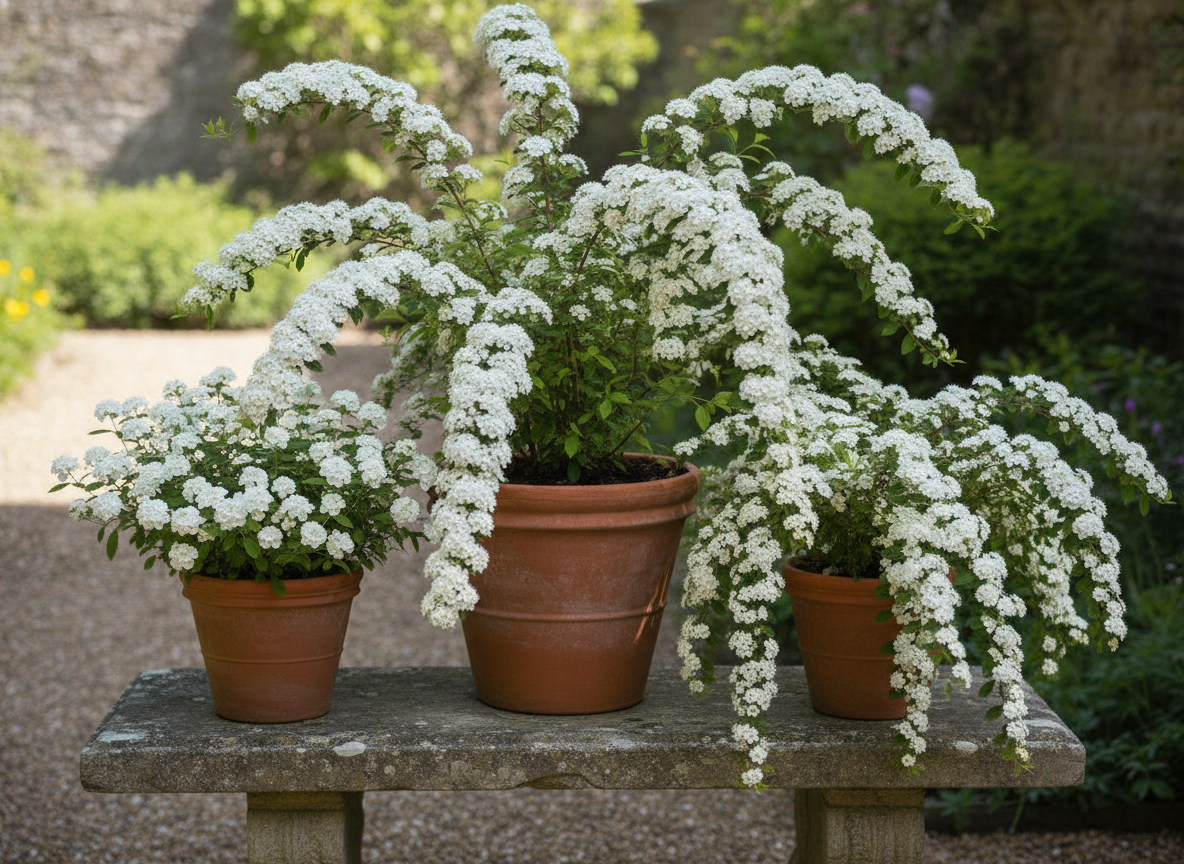 Three potted spiraea plants with white flowers sit on a stone bench — AI-generated illustration
How to tell which spiraea you’ve got
If yours isn’t flowering at all right now, the plant still tells you which camp it’s in:
- Shape and size. Bridal wreath types are big and fountain-shaped, often 1.5–2.5 m, with long stems that arch right over to the ground. Japonica types are low, dense mounds, usually knee- to thigh-high, growing stiffly upright.
- Leaf colour. Many japonica cultivars have bright foliage — gold, lime, or red-tipped new growth (‘Goldflame’ opens coppery-orange). Bridal wreath spiraeas are plain mid-green.
- When you remember it flowering. Spring, before the borders really got going, on bare-ish arching wands? Bridal wreath. High summer, alongside the lavender? Japonica.
When in doubt, the safe move is to wait and watch one full year. You never lose flowers by missing a prune; you lose them by cutting at the wrong time.
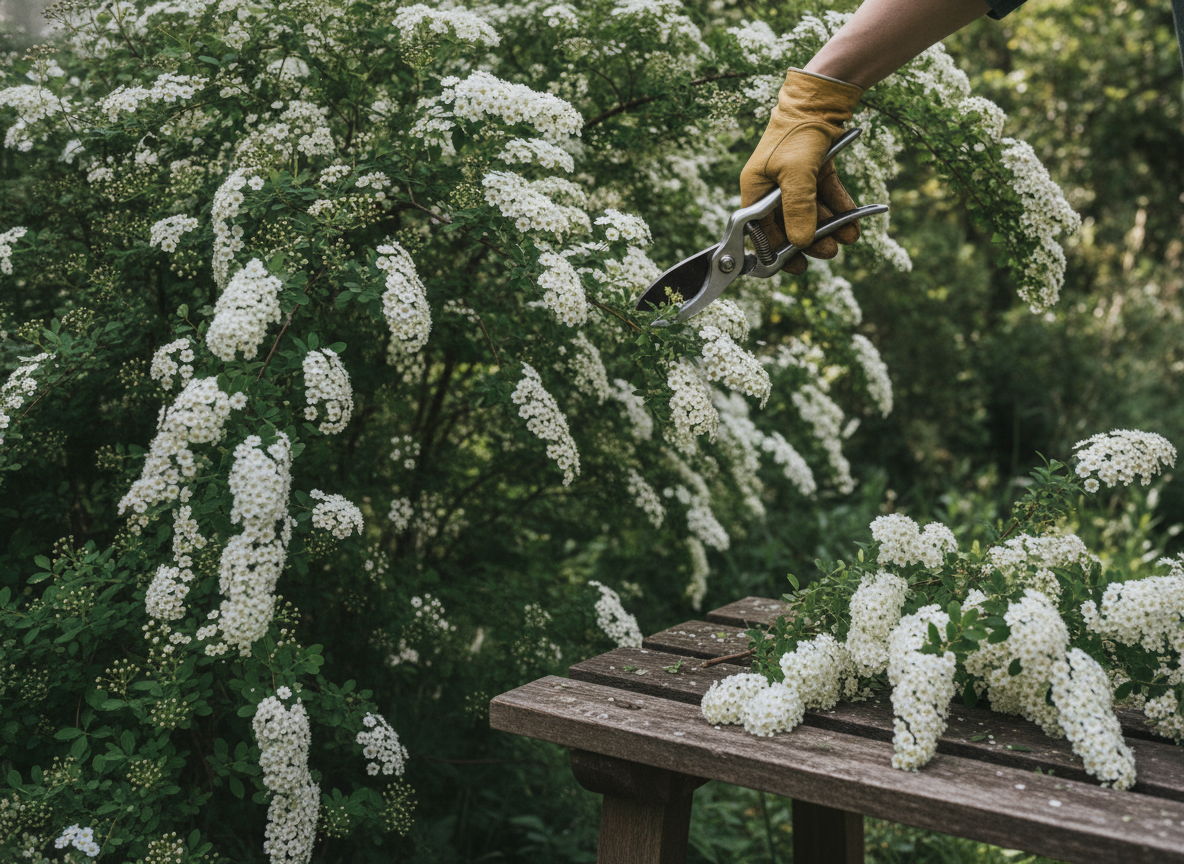 A gloved hand prunes a bridal wreath bush with shears, placing cut branches on a wooden bench — AI-generated illustration
The cut, branch by branch
Once you’ve confirmed it’s a bridal wreath type and the flowers are spent, the prune is quick and forgiving. You’re doing two things at once: shortening this year’s flowered growth, and renewing the framework underneath.
Start with the stems that just flowered. Follow each spent, arching wand back from its brown flower-trail to the first strong new shoot pointing in a direction you like — usually a vigorous green sideshoot that’s already pushing out below where the flowers were. Cut just above it. That removes the tired flowered tip and throws the plant’s energy into the young shoot, which becomes a flowering branch next April.
Work with the shrub’s natural fountain shape, not against it. The whole charm of bridal wreath spiraea is the cascade of arching stems; if you cut everything back to the same height you flatten it into a green meatball that never arches and never foams. Cut each stem to a different length, following the line it already wants to take. Step back often.
This is the same after-flowering logic that keeps deutzia and weigela flowering hard year after year: shorten the flowered wood, then renew the oldest stems from the base.
Take a fifth of the oldest wood to the ground
The second cut is what stops the shrub silting up. Every bridal wreath spiraea, left to itself, slowly fills with old grey wood that flowers less each year and shades out the young growth in the centre.
Each June, after the shortening cuts, pick out the oldest three or four stems — the thickest, greyest, most fissured ones, often arching right down to the soil and barely flowering along their length. Cut them out completely, right at the base. On an established plant that’s roughly a fifth to a quarter of the bush, and it’s the fifth that was about to retire anyway. The RHS recommends exactly this renewal cut for the spring-flowering spiraeas, and it’s the difference between a shrub that looks tired by its sixth year and one that flowers like new indefinitely.
The plant answers the base cuts by throwing strong new shoots from low down. Those are next year’s arching wands and the year after’s flowering wood. Done annually, no stem ever gets older than four or five years, and the shrub holds its size and shape without ever needing the brutal “cut the whole thing to a stump” rescue.
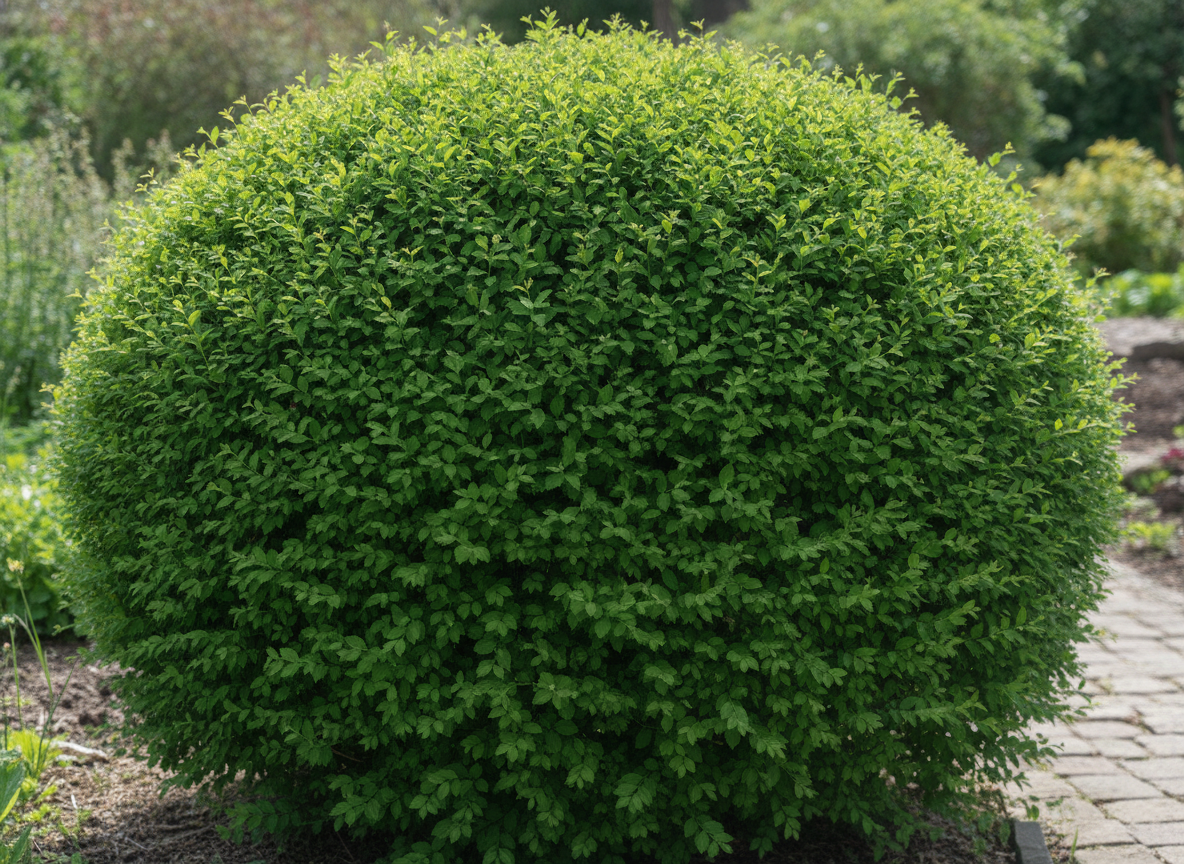 A dense, round, green shrub sits beside a path in a garden — AI-generated illustration
The mistake that turns it into a green dome
The cut that quietly kills the display isn’t a base cut — it’s the hedge-trimmer haircut. Running shears over the top of a bridal wreath spiraea to “tidy” it does three things, all bad: it leaves the old wood inside untouched, it removes the new shoots that would have carried next spring’s flowers, and it locks the plant into a dense dome that flowers only in a thin band on the outside. Each year the band gets thinner.
If yours has already been sheared into a hollow dome, you can reset it. Either work the one-in-three renewal over three seasons, taking out a third of the oldest wood each June, or — if it’s badly congested — cut the entire shrub down to about 30 cm right after flowering. You’ll lose next spring’s flowers from a hard reset, but the shrub comes back vigorous and properly arching, and you’re back on the annual after-flowering rhythm from there.
Get the timing right, every year
The whole thing turns on one fact most labels never tell you: whether your spiraea flowers on old wood or new. Get that right and the prune is five forgiving minutes; get it wrong and you lose a year of flowers either way.
That’s exactly the kind of plant-specific timing Cresco keeps straight for you. Photograph the shrub, and it identifies whether you’ve got a spring bridal wreath or a summer japonica, then puts the right job on your calendar at the right moment — prune-after-flowering in June for one, cut-back-in-late-winter for the other — adjusted to your local weather rather than a generic date. No more standing over a shrub in June wondering whether the secateurs help or hurt.