What crown lifting actually is
Crown lifting (also called crown raising) is the simplest way to fix a tree that has grown into your space. You remove the lowest branches, or shorten them back to the trunk, so the bottom of the canopy sits higher off the ground. The tree keeps its height and spread; you just get the space underneath back.
Gardeners usually do it for one of three reasons:
- Headroom. A branch you duck under on the way to the shed, or one that scrapes the car roof. The usual target is about 2.5 m of clearance over a path or lawn and closer to 5 m over a drive used by vans.
- Light. Lifting the canopy lets low winter and spring sun reach the lawn, a border or a window behind the tree. Under a lifted tree you can grow spring bulbs, ferns and woodland plants where before there was only bare soil.
- Views and air. A tree with branches down to the ground blocks everything behind it and keeps the area under it damp and still. Lifted, it frames the view instead.
It’s a different job from crown thinning (removing branches throughout the canopy) or crown reduction (making the whole tree smaller). Lifting only touches the bottom of the tree, which is why it’s the one most gardeners can do themselves.
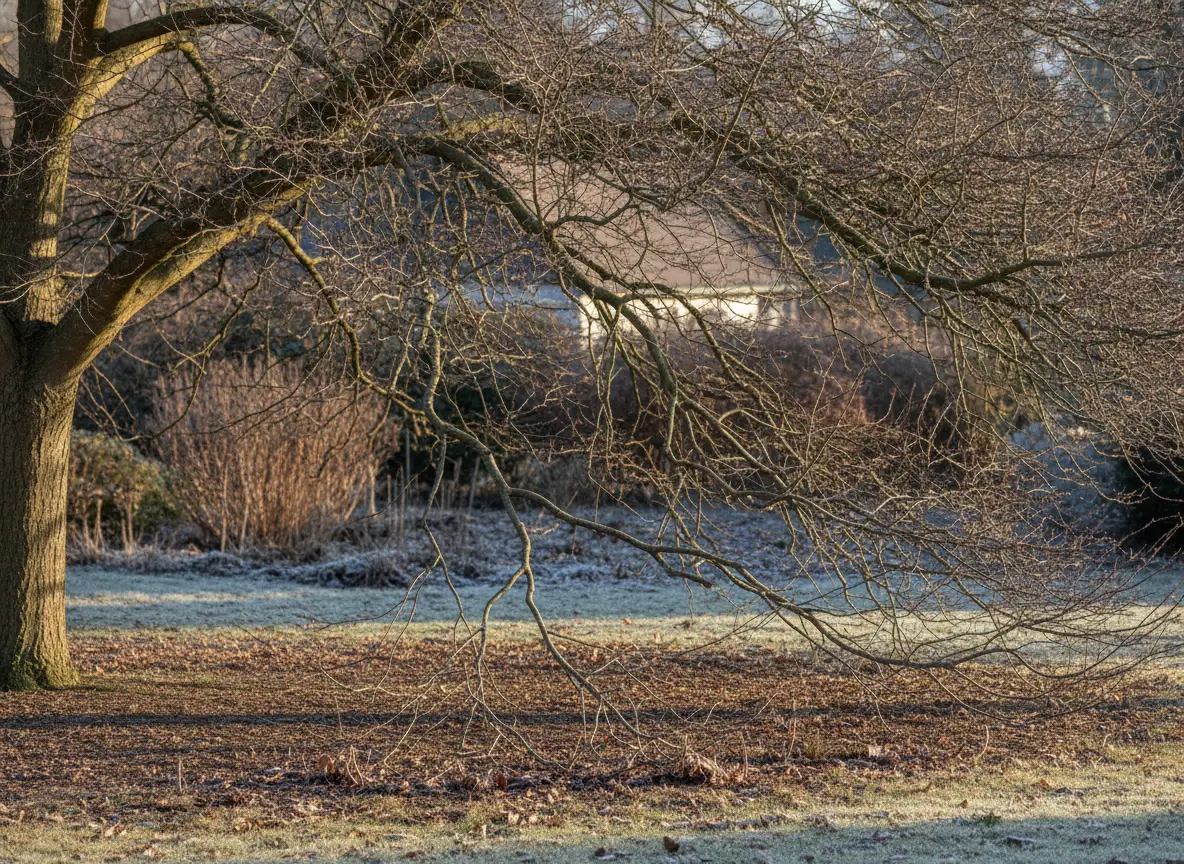 Deciduous tree branches in winter light — AI-generated illustration
Why November to February is the time
For most deciduous garden trees, the dormant season is the best time to crown-lift. There are two reasons.
You can see what you’re cutting. With the leaves off, the structure of the tree is obvious: which branches start low on the trunk, which ones arch down, and which side branches hold them up. In summer, a branch that looks like it’s hanging low may just be weighed down by leaves and fruit. In winter you see the branch as it really is.
The tree loses less. A dormant tree has pulled its reserves back into the trunk and roots. Removing a branch now takes away wood, not a season’s worth of leaves that are busy making food. Spring growth then starts from a tree that hasn’t been set back.
Pick a mild, dry day. Frozen wood tears and splits under a saw, so follow the frost rule for winter cuts and leave it for another day if the branches are stiff with frost or it’s colder than about -5 °C.
The trees to leave until late summer
A few common garden trees should not be lifted in winter:
- Birch, maples (including Japanese maples) and walnut bleed heavily if cut from midwinter into spring, when the sap starts rising. Lift them in late summer or early autumn while they’re in full leaf. See why birch is pruned in autumn, not spring.
- Cherries, plums and other Prunus are open to silver leaf disease when cut in the dormant season. Lift them in summer, in dry weather.
- Evergreen broadleaves such as holm oak, holly and evergreen magnolia are better lifted in late spring, once the worst frosts are over.
Everything else that drops its leaves (oak, lime, beech, hornbeam, rowan, crab apple, hawthorn, ornamental pear, sweet gum, apple) can be done now.
How high can you go? The two-thirds rule
The one number to remember: keep at least two-thirds of the tree’s height as living crown. On a 9 m tree, that means a clear trunk of no more than 3 m. Lift higher than that and the tree becomes top-heavy, catches more wind at the top and has too few leaves left to feed itself well.
Two more limits keep the job safe:
- Take no more than about a fifth of the canopy in one year. If getting the clearance you want means removing more, do it over two or three winters.
- Be careful with branches thicker than a third of the trunk’s diameter. A cut that size leaves a wound the tree struggles to seal, and rot often follows. On mature trees, anything over about 10 cm across is usually a job for an arborist.
Young trees: lift a little at a time
On a young tree, the low branches are doing useful work. Their leaves feed the trunk and make it thicken and taper, which is what keeps it upright in a gale. Strip a young tree to a bare pole in one go and you get a thin, whippy trunk with a tuft on top.
Nurseries handle this with “feathers”: the side shoots on the lower trunk are shortened rather than removed, and the lowest ones are taken off the trunk a few at a time each winter. Raise the crown gradually over several years, removing only the lowest tier or two each time, until you reach the clear trunk you want.
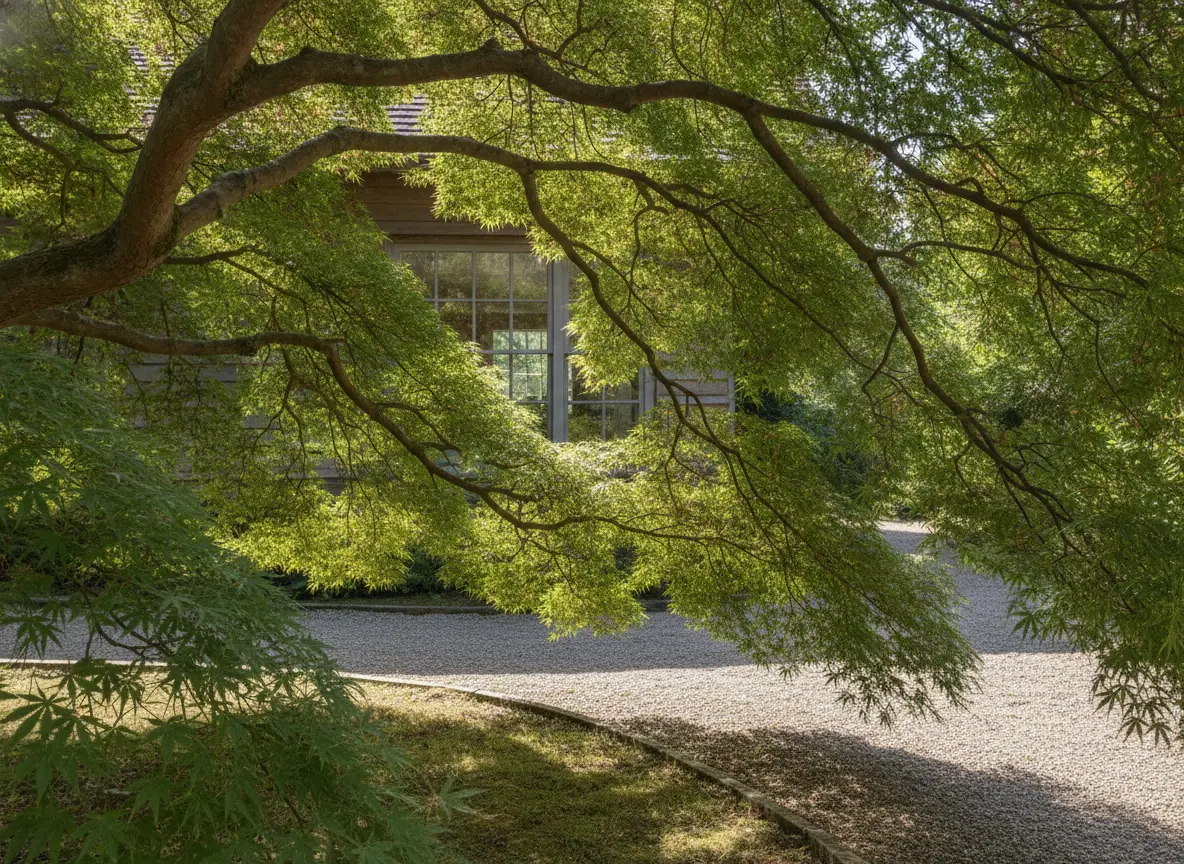 A maple tree frames a building and a gravel path — AI-generated illustration
Which branches to take
Start at the bottom and work up, one branch at a time. Step back after every cut and look at the tree from a few paces away. A branch you can’t put back is a good reason to go slowly.
- First, the lowest branch on the trunk, and any that sweep down towards the ground.
- Then the branches that cross the space you need, such as the path, the drive or the window.
- Leave the scaffold branches that form the main shape of the crown, even if one of them is a little low. Sometimes shortening a low branch back to an upward-growing side branch gives you enough headroom without removing the whole limb.
- Keep it balanced. If you take a big branch off one side, look for one to take off the other side too, so the crown doesn’t end up lopsided.
Branches that come back to the trunk are removed completely, at the collar, with no stub left behind.
The cut: three steps for anything heavy
Small branches, up to about 3 cm thick, come off with loppers or a pruning saw in one clean cut just outside the collar, the slightly swollen ring where the branch joins the trunk. Find it first: the cut just outside the branch collar is what lets the tree seal the wound.
For anything heavier, a single cut will tear. As the saw goes through, the weight of the branch rips a strip of bark down the trunk. Use three cuts instead:
- Undercut. About 30 cm out from the trunk, saw upwards from the underside, a quarter to a third of the way through.
- Top cut. A few centimetres further out, saw down from the top until the branch breaks off. The undercut stops the tear running back towards the trunk.
- Final cut. Remove the short stub that’s left, cutting just outside the collar.
Don’t paint the wound. Wound sealants trap moisture and slow down the tree’s own defences. A clean cut in the right place is all it needs.
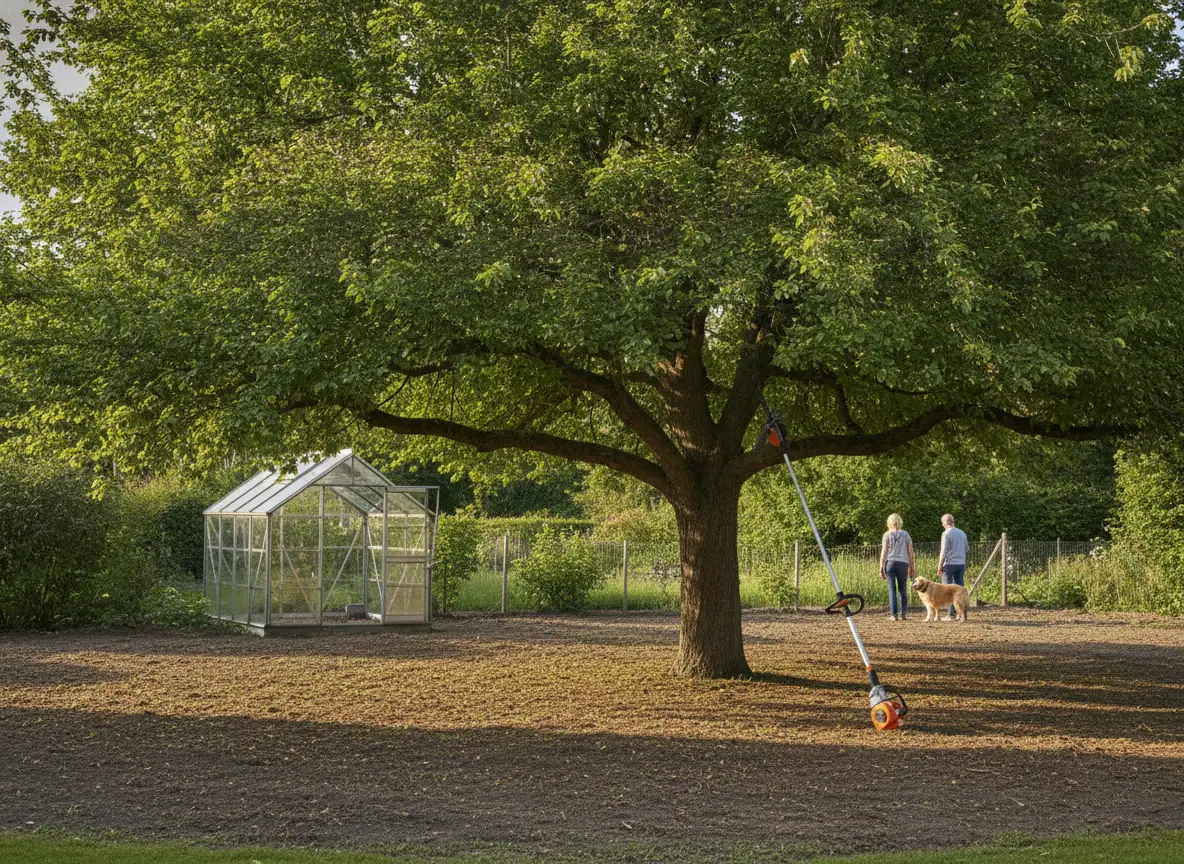 A wide shot of a garden with a large tree and a greenhouse — AI-generated illustration
Before you start: safety and permission
- Stay on the ground where you can. A pole saw reaches most branches up to about 4 m. Cutting from a ladder with a saw in one hand is how most garden tree accidents happen; if a branch needs a ladder and two hands, or a chainsaw, call an arborist.
- Look at what’s under the branch. A falling limb swings as it drops. Clear the area and keep people, pets and greenhouses out of the way.
- Check whether the tree is protected. In the UK, trees under a Tree Preservation Order or in a conservation area need consent from the council before you prune them, and that includes crown lifting. Other countries and municipalities have similar rules, so check before you cut a large tree.
- Winter is the right season for wildlife too. Most birds nest from March to August, and cutting into an active nest is illegal in many countries. Doing the job now avoids that problem.
After the cut: the shoots that come back
Some trees, especially lime, oak and some poplars, react to crown lifting by sending up a mass of thin shoots from the trunk around the old wounds and from the base. They’re called epicormic shoots, and if you leave them they’ll turn into a new set of low branches within a few years.
Rub them off with your thumb while they’re still soft in early summer, or cut them flush with secateurs. Do it every year for the first few years and they’ll slow down.
Keep track of the second and third winter
A good crown lift is rarely a one-off. Young trees are lifted a tier at a time; big jobs are spread over two or three winters to stay inside the one-fifth limit; and birch, maples and cherries need their turn in a different season. That’s easy to forget by next November.
Cresco keeps that schedule for you. Add the tree, and it tells you which season to cut, how much is safe this year, and when to come back for the next tier.