Two plants sold under one name
Walk into a garden centre and ask for “a salvia” and you can go home with either of two very different plants. One is a hardy herbaceous perennial — Salvia nemorosa and its hybrids, the dense violet and navy spikes like ‘Caradonna’ that die right back to the ground each winter and come again from the crown. The other is a shrubby, woody-based plant — Salvia microphylla and greggii, the ones with small aromatic leaves and loose sprays of red, pink or purple flowers all summer: ‘Hot Lips’, ‘Amistad’, ‘Cerro Potosí’, ‘Nachtvlinder’.
They share a name and almost nothing else about how they get through winter. The border perennials are fully hardy and cut back hard without a second thought. The shrubby ones are only borderline hardy, keep their structure above ground, and are far more likely to be killed by what you do to them in autumn than by the cold itself. Treat the second like the first — reach for the shears now, “to tidy it up before winter” — and you set up the most common way these plants die.
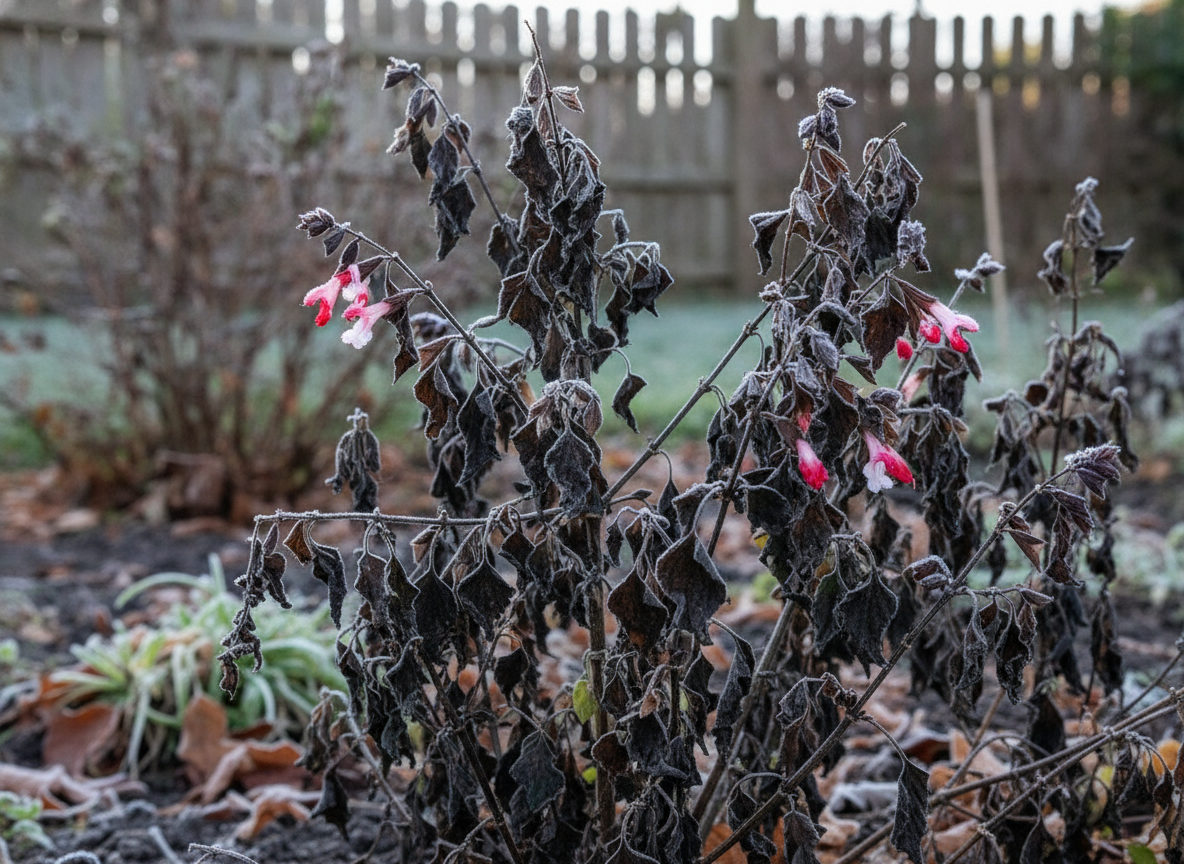 A frosted “Hot Lips” Salvia plant with red and white flowers — AI-generated illustration
Why the autumn cut is what kills it
A shrubby salvia goes into winter carrying real risk already: ‘Hot Lips’ is rated hardy to about −10°C, and the tender ones like ‘Amistad’ considerably less. What tips a plant that would have survived into one that doesn’t is almost always the autumn cut, and it does its damage two ways.
The first is regrowth. Cut a shrubby salvia back hard in September or October and, while the soil is still warm, it answers the wound by pushing soft new shoots. That growth has no time to firm up before the frosts, so the first hard night blackens it — and the dieback doesn’t stop at the new growth. It runs back down into the older wood you meant to keep, and by spring you’re cutting into dead stems well below where you started.
The second is water and cold at the base. The top growth of a shrubby salvia is doing a job all winter: it shelters the crown and the woody base from the worst of the wet and cold, and it keeps the plant’s centre of gravity where the roots can hold it. Cut that away and you leave open, pithy stem ends that soak up rain, freeze, and split — a direct route for rot into the crown at the exact moment the plant can least repair it. On heavy, wet soil, that combination of a bare crown and a wet winter kills more shrubby salvias than temperature ever does.
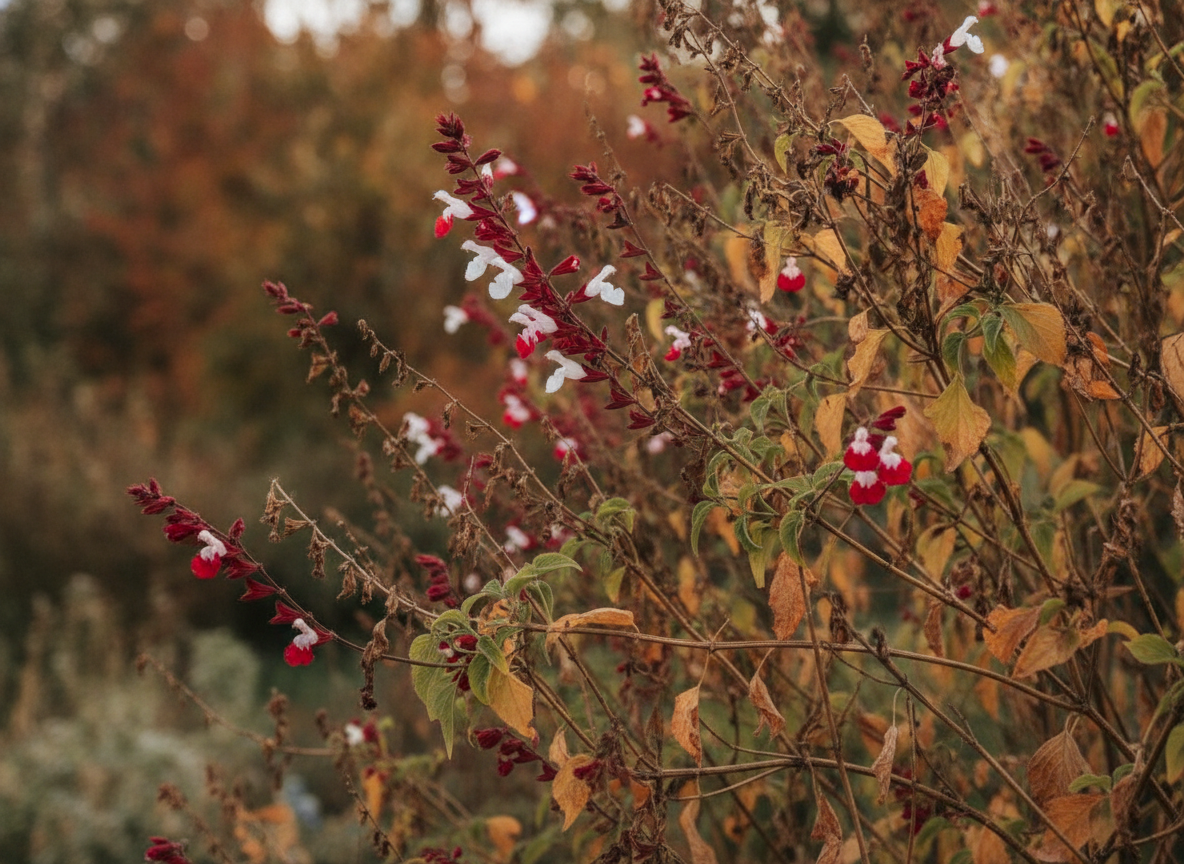 A garden plant with red and white flowers and autumn leaves — AI-generated illustration
The autumn job: leave it, mostly
So the September and October task is close to nothing, and that’s the point.
- Leave the top growth standing. Don’t shear it, don’t shape it, don’t “neaten” it. Every stem you keep is insulation for the crown and a bit of ripe wood you’ll be glad of in spring.
- Deadhead lightly, if you like. You can still snip off the last spent flower sprays back to a leaf to keep it looking presentable, as long as you’re taking flowers and not cutting into the woody framework. That’s tidying, not pruning.
- Take the sail down only where you must. On an exposed, windy site a tall, top-heavy plant rocks in gales and works a gap open at its base where water collects and freezes. There, shortening the very longest stems by a third steadies it. In a sheltered spot, leave it completely alone.
- Give a young or tender one a mulch. A first-winter plant, or a less-hardy variety like ‘Amistad’, appreciates a dry mulch — bark, gravel, or leaf mould — heaped over the crown once the ground turns cold. Keep it loose so the base can still breathe.
If your salvia is in a pot, move it to the driest, most sheltered spot you have — against a house wall, under an eave — and get it up off cold, wet paving on feet. Wet, not cold, is what rots a potted shrubby salvia over winter.
The real prune is in mid-spring
Wait until the plant is visibly breaking into new growth — usually April, once you can see fresh green buds low down on the woody stems — and then prune properly. Cut each stem back to just above the lowest pair of healthy new shoots, taking the plant down to a low, open framework roughly 10–15 cm tall. Cutting to living buds like this is what keeps a shrubby salvia compact and stops it turning into a bare, leggy tangle with all its flowers up at the top.
The one rule that never changes: prune to growth you can see, not to bare wood in hope. Unlike the border perennials, a shrubby salvia is slow and reluctant to break from old, hard wood with no buds on it, so cutting into a dormant stem in autumn — when nothing is growing to guide the cut — is a gamble you don’t need to take. In spring the plant tells you exactly where it’s alive.
If flowering slows in the middle of summer, a light all-over trim in July gives you a fresh flush into autumn — but that’s a summer job on a plant in full growth, not the same as this hard framework cut.
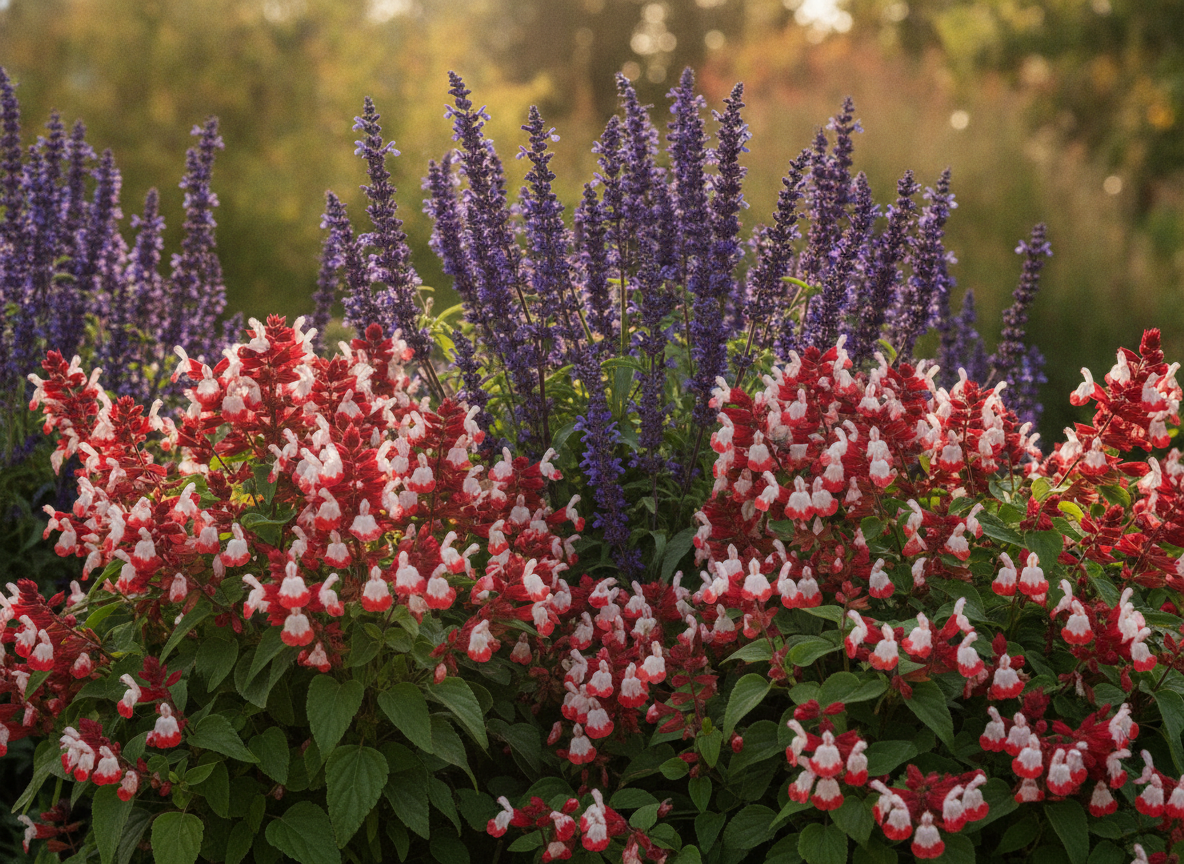 Red and white hot lips salvia blooming in the foreground with purple salvias in the background — AI-generated illustration
Don’t confuse it with your border salvias
This is worth being clear about, because the advice for the two salvias is nearly opposite. If your plant is a hardy herbaceous type — dense upright spikes that vanish to nothing each winter — the job is completely different: you cut those back to fresh side shoots to keep them flowering, and they take an autumn or spring cut in their stride. That’s covered in how to cut border salvias back for a second flush.
The shrubby ones belong with the other borderline-hardy plants that hate an autumn haircut — the same logic that keeps you off Russian sage until spring. When in doubt about which salvia you’ve got, look at the base in winter: if there’s woody stem still standing, it’s the kind to leave alone.
The short version
- Shrubby salvias (microphylla, greggii — ‘Hot Lips’, ‘Amistad’) are only borderline hardy and keep their structure above ground over winter.
- An autumn hard-prune provokes soft regrowth that frost kills, and opens the crown to wet and rot — that’s what kills the plant, more than the cold.
- Leave the top growth standing through autumn and winter; deadhead lightly at most, and mulch young or tender ones.
- Prune hard in mid-spring, cutting each stem to the lowest new shoots you can see — never into bare, budless wood.
- Border (herbaceous) salvias are a different plant with the opposite rule: cut those back freely.
Not sure which salvia is in your border, or when your particular one wants cutting? Cresco identifies the plant from a photo and gives you its pruning window for your own garden and local weather — so you leave the shrubby ones standing and cut the hardy ones at the right time.