Right now, ivy is the last filling station open
Walk past a mature patch of ivy (Hedera helix) on a warm September afternoon and you’ll hear it before you see it: the whole wall humming. Ivy is one of the very last plants to flower — those dome-shaped clusters of tiny yellow-green flowers open from September into November, weeks after almost everything else has shut up shop for the year.
That timing is the whole point. When the borders are winding down, ivy is pouring out nectar and pollen for honeybees stocking the hive for winter, for wasps, hoverflies, red admirals — and for the ivy bee (Colletes hederae), a solitary bee that emerges in autumn and forages on almost nothing else. Then the flowers turn to black berries that ripen over winter and feed blackbirds, thrushes and woodpigeons in the hungry gap of February and March.
So the urge that hits every autumn — “the ivy’s got out of hand, I’ll cut it back now” — is the one to resist. Trim ivy in September or October and you shear off the flowering growth exactly when it’s doing its most valuable work of the year. The tidy-up isn’t wrong; the timing is.
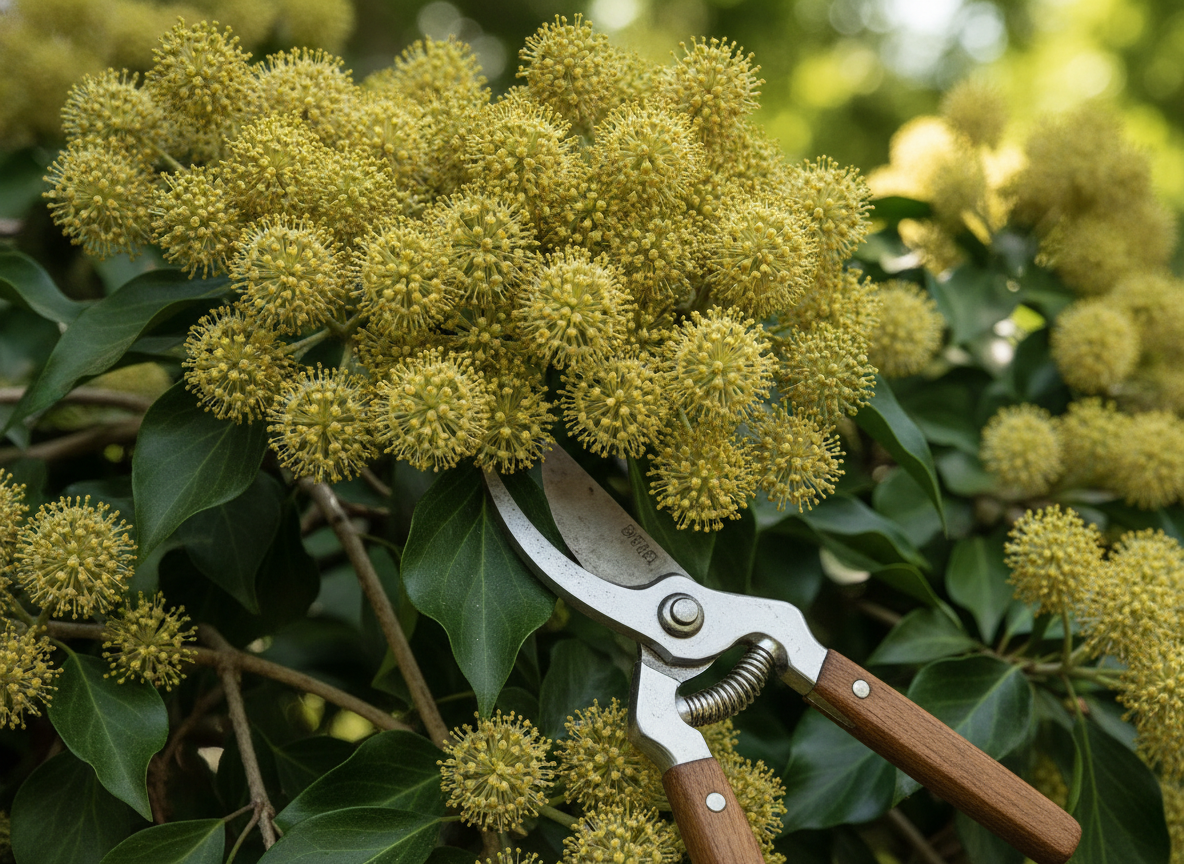 A pair of pruning shears cut into flowering ivy — AI-generated illustration
The flowering growth is the bit you’d cut
Here’s the catch that makes autumn trimming so costly: the growth you’d naturally reach for is the growth that flowers.
Ivy has two lives. As it climbs, it produces the familiar juvenile growth — lobed, arrow-shaped leaves on clinging stems that race up a wall or fence. But once it reaches the top, gets good light and has some age on it, it switches to its adult, “arborescent” form: bushy, shrubby growth with rounded, un-lobed leaves that stands proud of the wall. Only the adult growth flowers and fruits.
That bushy top is exactly the part that looks untidy, sticks out past the gutter, and makes you fetch the shears. Cut it off in autumn and you haven’t just tidied the edge — you’ve removed this year’s entire nectar bar and the berry crop that follows it. Give it a year to build adult growth again and you’re back to square one.
 Ivy flowers cling to a window in late winter — AI-generated illustration
The right window: late winter, before the birds nest
If ivy genuinely needs cutting back — off a window, out of a gutter, away from the roofline, or simply reduced in bulk — the window to aim for is late winter to very early spring, roughly February into early March.
That date isn’t arbitrary. By late winter the flowers are long over and the berries have mostly been eaten, so you’re no longer taking food out of the system. And you’re cutting before the nesting season really begins: ivy is dense, evergreen and one of the first places small birds like wrens, robins and dunnocks build in, so from March onwards you risk destroying an active nest — which is not just a shame but illegal to disturb in most of Europe. Cutting in that late-winter slot threads the needle: after the wildlife has taken what it needs, before the next lot moves in.
It’s the same logic that runs through the autumn border. We leave the last coneflower heads standing for the birds rather than deadheading them off, and we time the holly-hedge trim so it keeps its berries into winter. Ivy is the same call, just later: the “mess” is the wildlife value.
When it can’t wait — and when it truly can’t
There are a couple of honest exceptions. If ivy is lifting roof tiles, blocking a gutter, growing into a window frame or working under render, deal with the offending stems now — a plant doing structural damage doesn’t get to wait until February. But that’s spot surgery: cut back the specific stems causing the problem, not the whole flowering canopy.
And there’s one hard stop the other way. Never do a big ivy cut-back between March and August without checking first, and assume any dense ivy is a potential nest. If you find one, stop and come back in autumn or the following late winter. A tidy wall is not worth a destroyed brood.
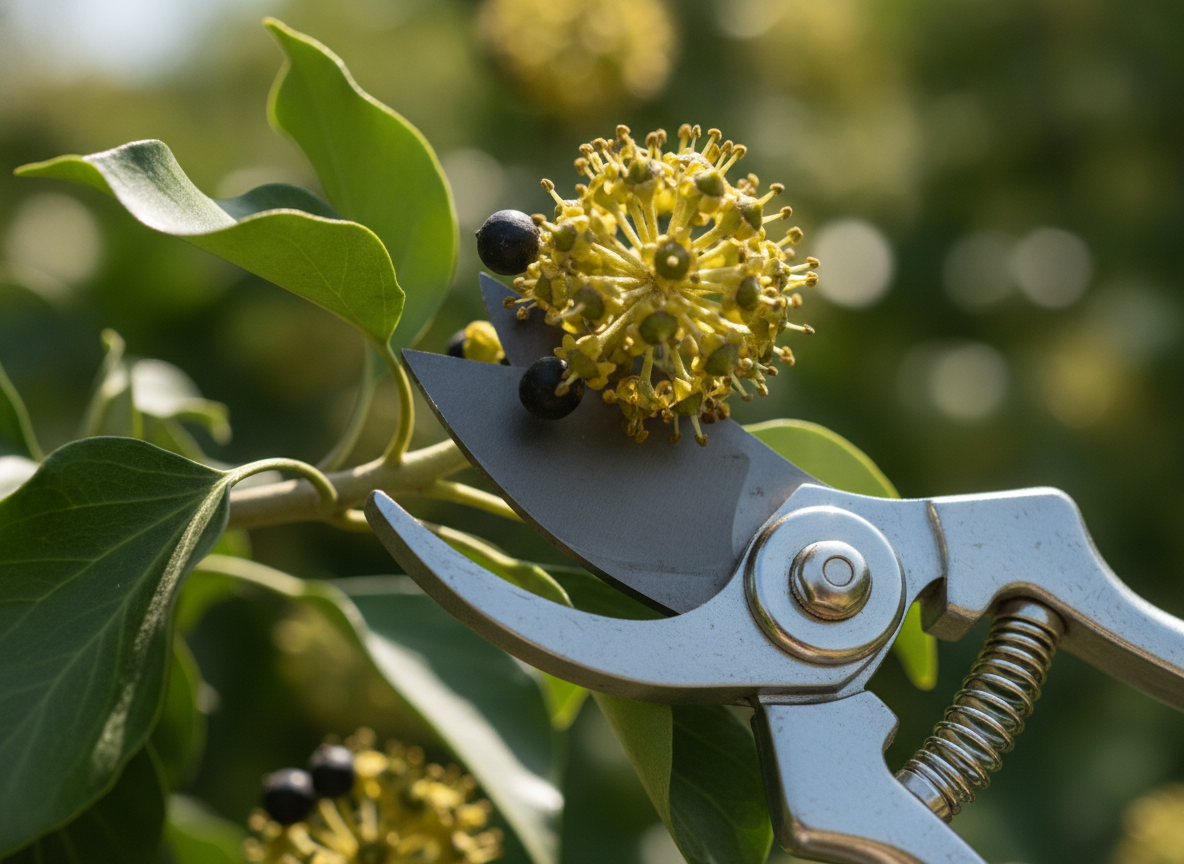 Ivy flower with berries being pruned by shears — AI-generated illustration
How to cut it, when the time comes
When February comes and you’re clearing or reducing ivy properly:
- Reducing a wall or fence covering: shear the face over hard — you can take it back to a flat green sheet, or right back to the main stems if you want to renovate it. Ivy is astonishingly tough and regrows from old wood, so you can’t really cut it too hard in late winter.
- Getting it off the wall: cut the stems through at the base and, crucially, leave the clinging pads to dry and drop over the following weeks. Ripping living ivy straight off pulls at the surface; letting the severed stems die first means the pads release far more cleanly.
- Ivy in a tree or hedge: you don’t need to strip it out for the tree’s sake (see below). If you want to reduce it, sever the main stems near the ground and let the top die back in place.
- Ground-cover ivy: run the shears or a strimmer over it in late winter to freshen it; it’ll be away again by late spring.
Wear gloves and long sleeves — ivy sap irritates a lot of people’s skin — and go steadily near masonry so you’re cutting stems, not gouging mortar.
Does ivy really wreck walls and strangle trees?
Mostly, no — and the fear drives a lot of badly-timed cutting.
On walls, ivy’s aerial roots cling to the surface; they don’t bore into sound brick or good mortar. Studies (including work by English Heritage) found ivy can even buffer a wall against temperature swings and driving rain. The real risk is on surfaces that are already failing — crumbling mortar, cracked render, flaking paint, or where stems reach under tiles and into gaps. So keep ivy off anything in poor repair and off the roofline, but a sound wall can carry it happily.
On trees, ivy is not a parasite. It roots in the ground and takes nothing from the tree — it just uses the trunk for support. On a healthy, established tree it’s harmless and adds huge wildlife value. The only real cautions are a struggling or top-heavy tree, where the extra weight and “sail” in winter gales matters, or where ivy in the canopy hides problems from view. In those cases, sever the stems at the base in late winter and let the top wither.
It’s the same “is it actually a problem?” question worth asking before you pull Virginia creeper off the gutters: deal with what’s genuinely doing damage, and leave the rest to earn its keep.
Let Cresco track the timing for you
Ivy is a perfect example of a plant where the when matters far more than the how: cut it in September and you rob the bees; cut it in April and you risk a nest; cut it in February and you get a tidy wall with a clear conscience. The hard part is remembering that this one wants leaving now while the plant beside it wants cutting.
That’s what Cresco’s pruning planner is for: tell it what’s growing on your walls and in your borders and it builds the schedule around each plant and your local weather, so the “leave it now, cut it in late winter” jobs land in your list at exactly the right moment. Browse more seasonal pruning guides to get the rest of the garden’s timing right.