Why late summer is when it gets into the gutters
Virginia creeper spends the whole growing season doing one thing: reaching. An established plant can put on three to six metres in a single summer, and by the end of August those long, whippy new shoots have found the top of the wall. That’s where the trouble starts. Left alone, the growing tips slip in behind the gutter, feel their way under the lowest course of roof tiles, and wrap themselves around window frames and downpipes — and once they’re in, they hold.
Late summer is the moment to stop them, for two reasons. First, the growth is still soft and green, so it cuts and pulls away easily; leave it until the wood hardens over winter and it’s a far bigger, more brittle job. Second — and this is the one people miss — right now you can still see what you’re doing. In a few weeks the whole wall turns to that famous sheet of scarlet, and a blaze of autumn colour hides exactly the shoots you most need to find: the ones creeping under the eaves and packing the gutter with growth that will hold wet leaves all winter. Cut now, while the framework is still readable.
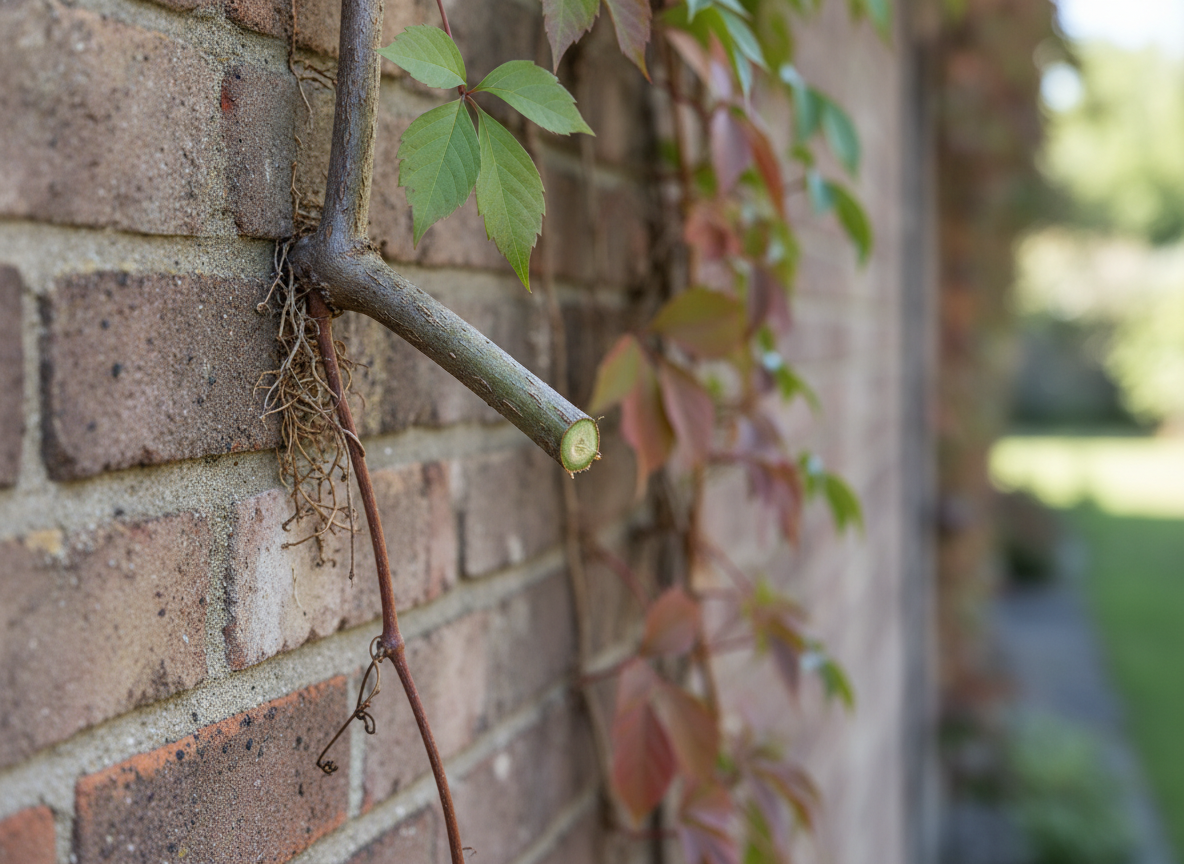 Virginia creeper stem cut from the main vine, still attached to a brick wall — AI-generated illustration
Cut the stem, then wait — don’t rip it off the wall
Here’s the mistake that pulls paint off render and leaves a rash of little grey footprints across the brick: grabbing a fistful of creeper and yanking it off the wall.
Virginia creeper doesn’t twine the way a honeysuckle does, and it doesn’t drive rootlets into the wall like true ivy. It climbs on adhesive pads — tiny sticky discs at the tips of its tendrils that glue themselves flat to the surface. While the shoot is alive, those pads grip hard. Tear a living stem away and the pads come off with a layer of whatever they were stuck to — paint, limewash, soft render — and the ones that stay behind sit there as dark dots for months.
So don’t pull live growth. Cut it first. Sever each unwanted shoot at the point you want the plant to stop — back below the gutter, clear of the window — and then leave the severed length exactly where it is for a week or two. Once it’s dead and dry, the pads lose their grip and the whole thing peels away cleanly in your hand, or simply drops. On sound brick or stone the little footprints left behind are only cosmetic; on a painted or rendered wall, cutting-then-waiting is the difference between a clean edge and a patch you’ll be repainting next spring.
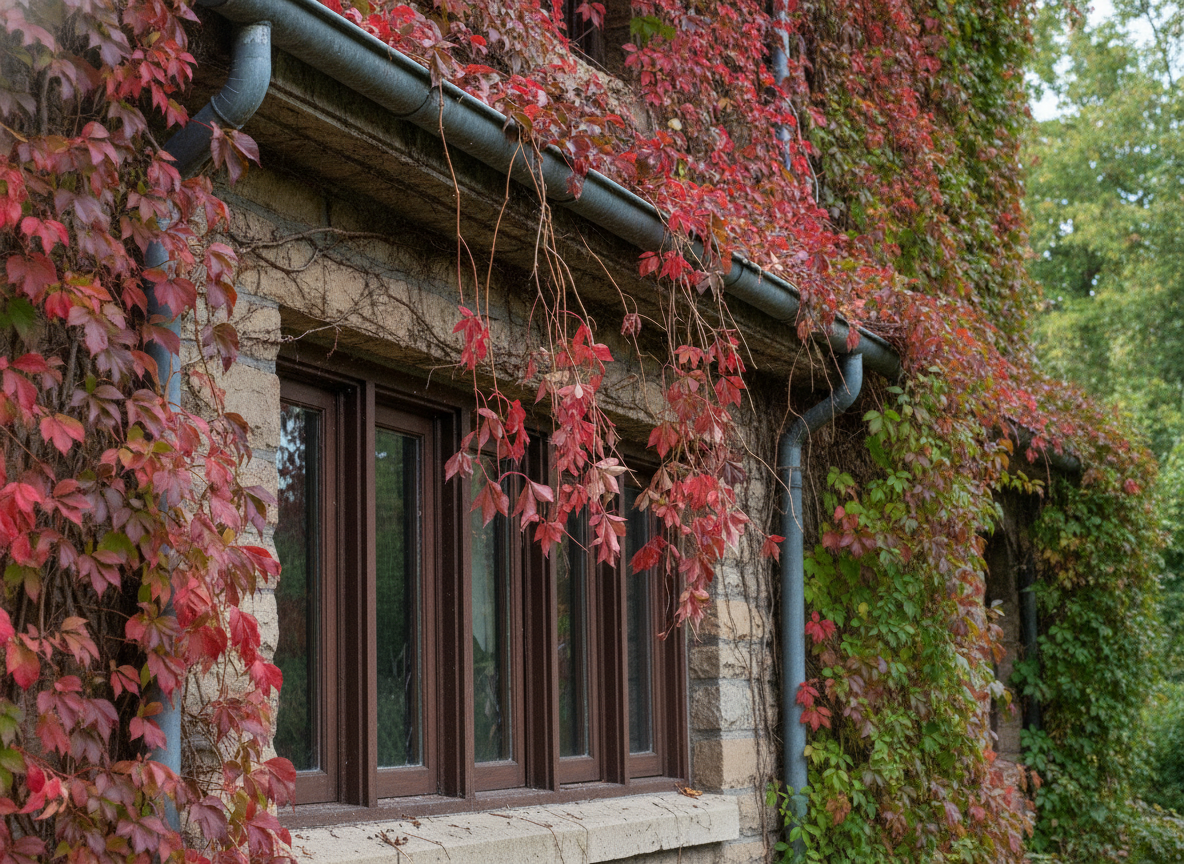 Virginia creeper grows over a stone building, near windows and a gutter — AI-generated illustration
Where to cut: below the gutter, clear of the frames
Work along the top and edges of the plant with three hard lines in mind — lines the creeper isn’t allowed to cross.
The gutter is the first. Keep the plant a good hand’s width — 20 to 30 cm — below the gutter line, and pull out anything already growing up into it. A shoot in the gutter isn’t just untidy: it dams up wet leaves, holds water against the fascia board, and works its way under the tiles from above.
Windows and doors are the second. Cut the creeper back clear of every frame, so it can’t lever into the joints or foul an opening — and so you’re not fighting a curtain of it every time you clean the glass.
Roof tiles and eaves are the third, and the most important. Nothing should be growing up under the lowest row of tiles or in behind the bargeboards and soffits. That is where the real damage happens — lifted tiles, blocked airflow, damp finding its way in. Follow any shoot heading roofwards back to well below the eaves and cut it right out. Below those three lines, the creeper can clothe as much wall as you like; that scarlet autumn sheet is the whole reason to grow it.
The hard prune waits for leaf-fall
The cut you’re making now is a maintenance cut — dragging the plant back off the house and out of trouble before winter. The bigger, structural prune is a separate job, and it waits.
Virginia creeper is deciduous, so once the leaves drop — from late autumn through winter, while the plant is fully dormant — the entire woody framework is laid bare against the wall. That’s the moment for any heavy reduction: cutting back to a permanent skeleton of main stems, taking out the crossing and congested growth, and deciding how much wall you actually want covered. It regrows readily from old wood, so you can afford to be bold; a plant cut hard in winter comes back dense and well-furnished in spring.
Doing the heavy work then, rather than now, means you cut with the structure in plain view — and you’re not forcing out a flush of tender new growth just as the first frosts arrive. Think of it as two cuts a year: get it off the house in late summer, shape the framework in winter. It’s much the same rhythm a wisteria wants, for much the same reason.
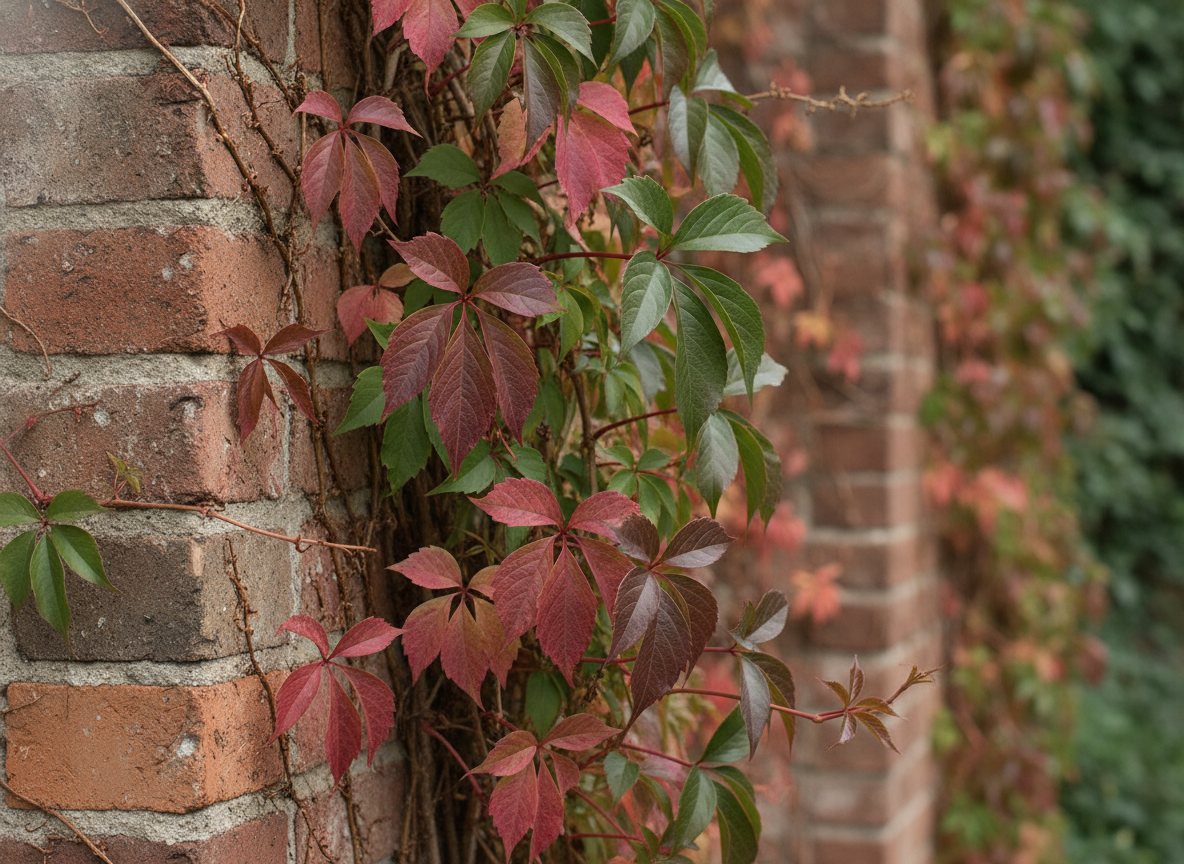 Virginia creeper vines with red and green leaves growing on a brick wall — AI-generated illustration
Virginia creeper, Boston ivy or true ivy?
It’s worth knowing which plant you’ve actually got, because three very different climbers get lumped together as “the creeper on the wall.”
Virginia creeper (Parthenocissus quinquefolia) has leaves split into five separate leaflets, like a splayed hand, turning brilliant scarlet in autumn. Boston ivy (Parthenocissus tricuspidata) has broad, three-lobed leaves closer to a maple’s, and colours just as fiercely. Both are deciduous, both climb on adhesive pads, and everything above applies to them equally.
True ivy (Hedera) is the odd one out: it’s evergreen, it climbs by clinging aerial roots rather than pads, and it can genuinely work those rootlets into failing mortar. If that’s what’s on your wall, the same late-summer principle still holds — keep it out of the gutters and off the roof — but check the pointing while you’re up there. One habit worth keeping whichever you grow: wear gloves. The sap can irritate skin, and the berries that follow are mildly toxic, so they’re not for picking at.
The short version
Give Virginia creeper — or Boston ivy — a cut back off the house in late summer, before the leaves colour and hide the framework. Cut each wayward shoot rather than pulling it, keep the plant a hand’s width below the gutter and clear of windows and tiles, then leave the severed growth to dry and peel away on its own. Save the hard, structural prune for winter, when the bare stems show you exactly what you’re doing.
For the wider calendar of which climbers and shrubs to cut when, our month-by-month pruning guide lays out the whole year. And if you’d rather simply be told when each plant on your walls needs cutting — based on your own garden and local frost dates — that’s the job Cresco was built for.