The one cut a holly hedge asks for
Holly (Ilex aquifolium) is one of the slowest, densest evergreens you can grow as a hedge, and that slowness is a gift: you don’t chase it round the garden the way you chase a privet. An established holly hedge needs one shaping trim a year, and the window is late summer — roughly August into early September across the Netherlands, Belgium and the southern UK. By then the season’s soft growth has firmed up, so a cut taken now holds its line cleanly through autumn and into winter instead of blurring under a fresh burst of shoots.
Tight formal work — clipped holly topiary, crisp architectural hedges — is the one case for a second cut: a light tidy in late spring to hold the edge, then the main trim in late summer. But for a plain screening hedge, once a year in the late-summer window is all it takes. The catch is that this single cut sits right on top of the plant’s berries, and how you make it decides whether you get a berried hedge in December or a bare green wall.
 Late summer plants with fading blooms and tall grasses in natural light — AI-generated illustration
Why late summer, and not a hard cut
The late-summer date is a shaping trim — a tidy of the year’s growth, not a reduction. If your holly has genuinely outgrown its space and needs cutting back into the thick old wood, that is a different job at a different time. Save anything drastic for late winter into early spring (roughly February to April), before the new growth stirs. Cut a holly hard in September and you force it to push soft, pale shoots with no time to harden before the first frosts — exactly the growth the cold scorches. Shape now; renovate in spring.
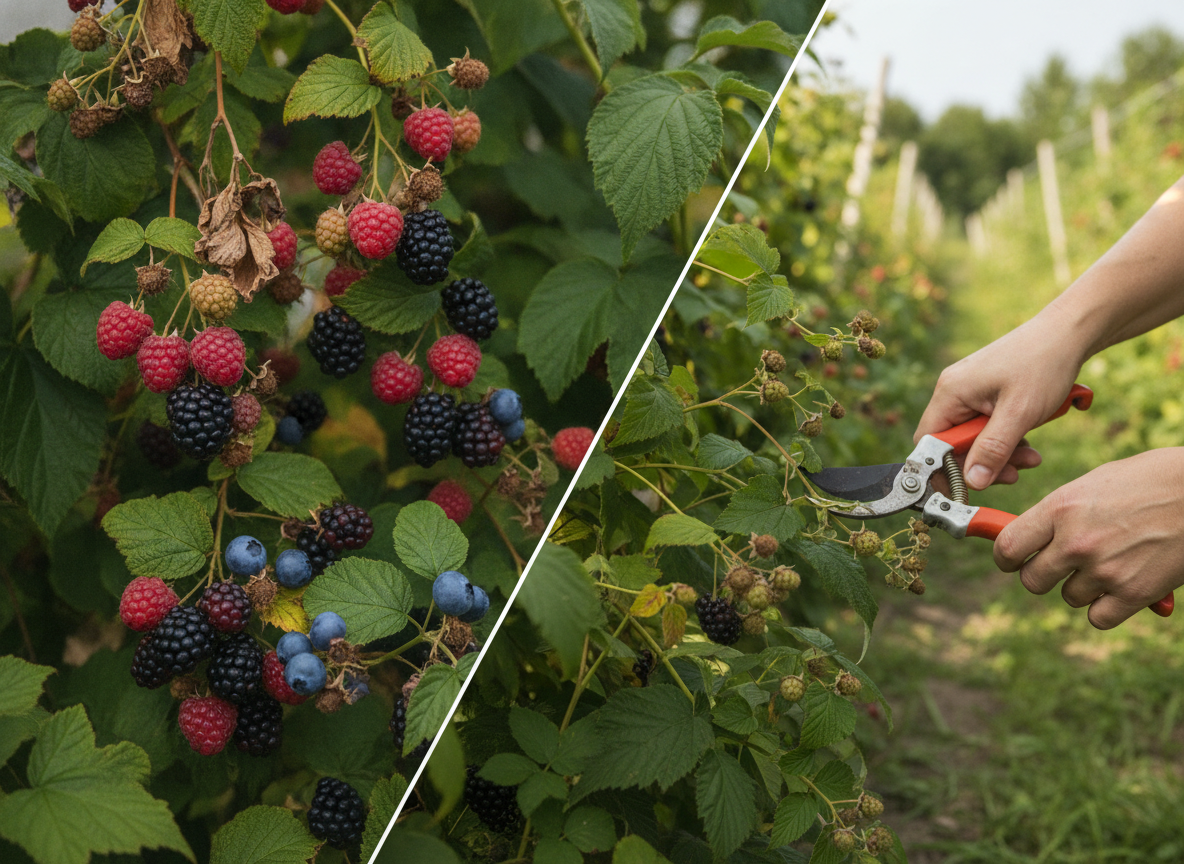 A close-up of berry bushes and a person pruning them — AI-generated illustration
The berry tradeoff, and how to cut around it
Here is the part gardeners miss. Holly is dioecious — plants are either male or female, and only the females carry berries, and only then if a male holly grows somewhere nearby to pollinate them. If your hedge berries at all, it holds female plants. And the berries you’re hoping for at Christmas form on last season’s wood — the growth the plant made a year ago. Shear a female holly hard in late summer and you cut away exactly the wood that was about to fruit. You get a beautifully sharp edge and almost no berries.
So the trim is a balancing act, and you get to choose. If berries matter more than a razor edge, keep the late-summer cut light: shorten this year’s new shoots back to just above a bud, tidy the outline, and leave the older, berry-bearing wood alone. If you’d rather have the crisp shape and don’t mind a lean berry year, cut harder — just know that’s the trade you’re making. There’s no setting that gives you both a hard shear and a full berry display; the wood can’t be in two places at once.
This is the same tug-of-war you get on pyracantha, where a tidy after flowering quietly steals the autumn berries — evergreens grown for their fruit all punish the over-keen shearer. With holly you at least get to pick your side each year.
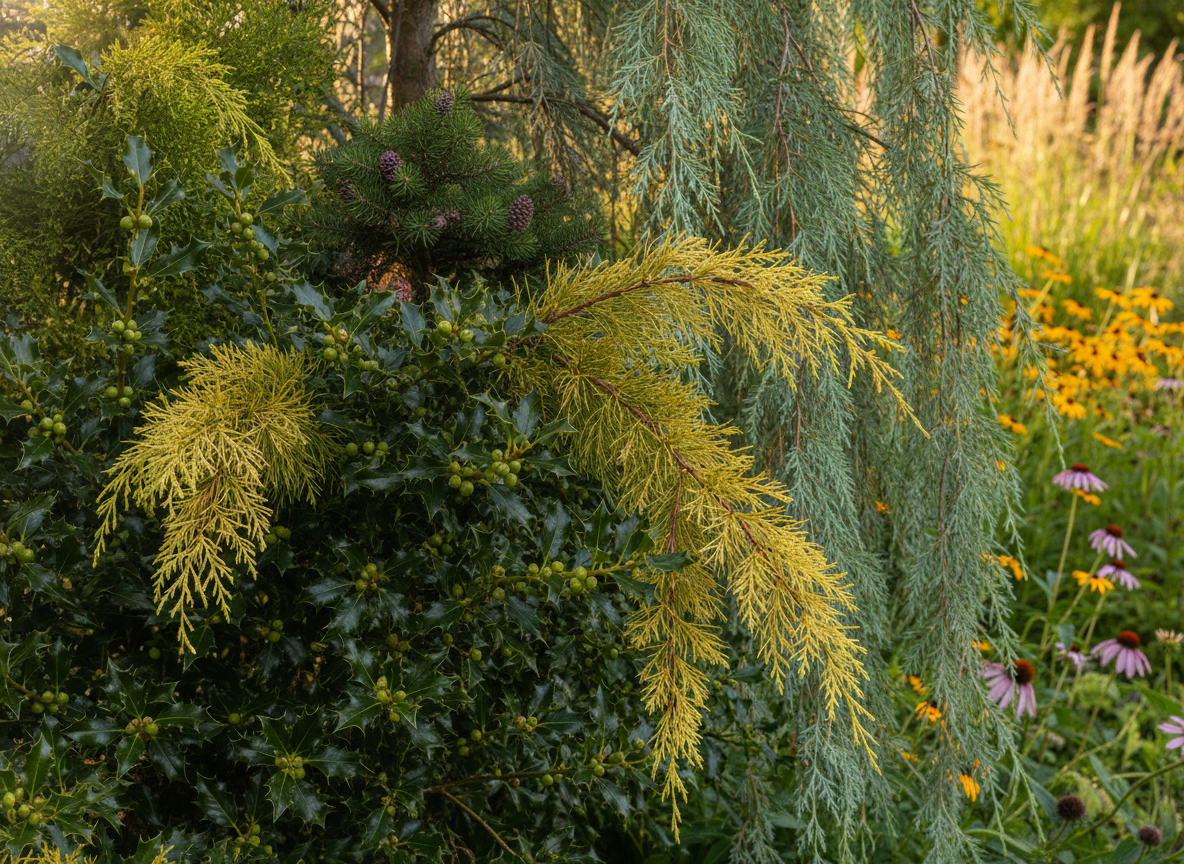 A close-up of holly, golden cypress, and other conifers in a garden — AI-generated illustration
Holly breaks the conifer rule too
There’s a reason a hard renovation cut is safe on holly when it’s fatal on a hedging conifer. Cut a leylandii, Thuja or Lawson’s cypress back into the bare brown wood behind the green and that patch stays brown for good — there are no dormant buds left in the old wood to break, so the scar never re-greens. Holly is built the other way. Like yew, the one hedging conifer that regrows from bare wood, holly holds dormant buds under the bark of its old stems and even the main trunk. Cut it hard and, given a season or two, fresh green breaks straight out of wood that looked dead.
That’s why an overgrown holly is worth renovating rather than digging out — but it’s also why the renovation cut belongs in spring, not now. The buds need the whole growing season ahead of them to answer a hard cut and firm up before winter. In late summer they don’t have it.
Making the cut cleanly
A few things save you grief on the day:
- Secateurs on large-leaved holly, not shears. A hedge trimmer or shears slices straight through holly’s big glossy leaves, and every cut leaf browns at the edge and looks tatty for months. On a formal hedge with small foliage, shears are fine; on anything with big leaves, take the extra time and cut shoot by shoot just above a leaf or bud.
- Gloves, and a tarp underneath. Holly’s spines don’t soften once they’re off the plant — bare clippings stay vicious underfoot for a year or more because the leaves are slow to rot. Lay a sheet, gather everything, and bag or shred it rather than leaving it in the border.
- Check for late nests first. Dense holly is prime nesting cover, and it’s an offence across most of Northern Europe to cut a hedge while birds are actively nesting. By the late-summer window most broods have fledged, but part the foliage and look along the length before the blades come out.
Get the timing and the touch right and a holly hedge rewards you twice over: a clean evergreen screen that holds its shape all winter, and — if you kept the cut light — a scatter of red berries just when the rest of the garden has given up. For the exact fortnight to trim yours in your own postcode and weather, Cresco builds the window into your plant’s care plan.