The one rule that separates conifers from every other hedge
A beech hedge that you cut too hard grows back. A privet hedge you butcher to the stumps grows back. Most conifers do not. Leyland cypress (×Cuprocyparis leylandii), Lawson’s cypress (Chamaecyparis lawsoniana), Thuja, Cupressus — the whole family of fast green screening hedges shares one unforgiving trait: they regrow readily from green, leafy growth, and almost never from the bare brown wood underneath it.
This is the single fact that decides whether your trim improves the hedge or ruins it for good. Every conifer hedge carries a thin shell of green needle-growth on the outside and a dead, twiggy brown interior where light no longer reaches. As long as your shears stay in the green, the hedge thickens and heals. The moment you cut back into the brown — even by a few centimetres on one panel — you expose a patch that stays brown forever. There is no second flush coming to cover it. That bare scar is permanent, and on a Leylandii it can be a metre wide.
So the summer trim is not about taking off as much as you can. It’s about taking off exactly the right amount, often, and never crossing the green-to-brown line. Get that right and a conifer hedge is the densest, fastest, most private screen you can grow. Get it wrong once and you may be looking at a brown gap for the rest of the hedge’s life.
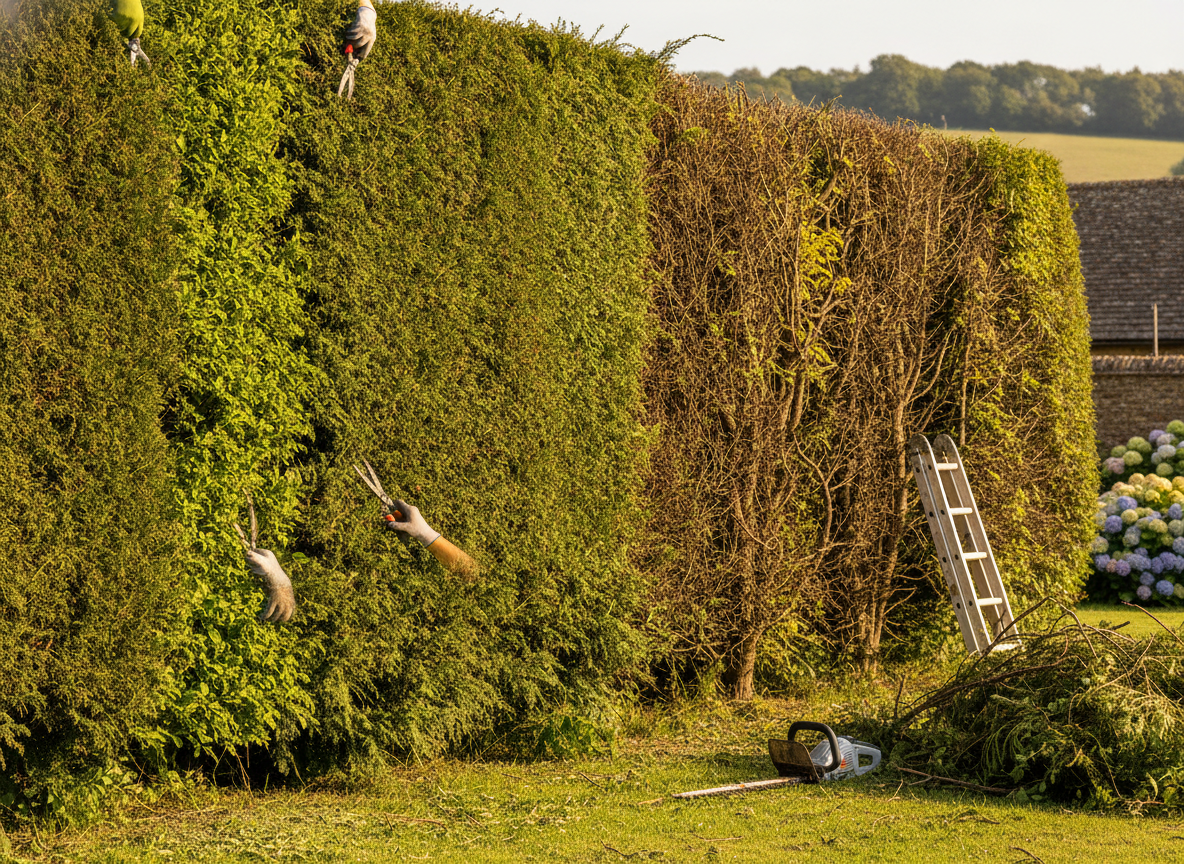 Gardener pruning a leylandii hedge with shears and a chainsaw — AI-generated illustration
Why summer is the window — and why little-and-often beats one big cut
Leylandii is the fastest-growing hedging conifer in common use — up to 75–90 cm of new growth in a single season in good soil. That speed is exactly why it needs cutting during the growing season rather than in winter. A conifer trimmed while it’s actively growing seals and re-clothes its cut surface quickly; a hard cut taken in the dormant cold sits raw and ragged for months.
The reliable window across the Netherlands, Belgium and the southern UK runs from roughly late June through to the end of August, with a lighter top-up possible into early September. Late June — right now — is the ideal moment for the main shaping cut: the spring surge has put on most of its length, the new growth has firmed up enough to cut cleanly, and there’s still plenty of warm growing weather left for the hedge to green over the cut face before autumn.
A second reason for summer over spring or autumn is the calendar of nesting birds. Dense conifer hedges are prime nesting habitat, and across most of Northern Europe it’s an offence to cut a hedge while birds are actively nesting in it — the main season runs from early March to the end of July. By late June many broods have fledged, but not all: before the trimmer comes out, part the foliage and check along the length of the hedge for active nests. If you find one, work around it and come back to that section once the chicks have left.
And the rhythm matters as much as the timing. A vigorous Leylandii is far better cut two or three times lightly through the season — once now in late June, again in August, perhaps a tidy in early autumn — than hacked once a year. Frequent light trims keep the green shell thin and dense and stop the hedge ever outrunning you into that brown territory you can’t recover. The gardener who trims twice a year keeps the hedge for decades; the one who lets it bolt and then panics with a big annual cut is the one who ends up with bare patches.
The dead zone: why brown wood never reshoots
It’s worth understanding why the brown wood stays brown, because it changes how you cut. Conifers like Leylandii, cypress and Thuja carry their growth buds almost entirely within the current green, photosynthesising foliage. Unlike beech, hornbeam or privet — which keep dormant buds hidden in old wood, ready to break when light returns — most conifers shed that ability as the wood ages. Once an inner stem has been shaded out and gone brown and twiggy, it holds no living buds. Cut to it and there is simply nothing left to grow.
You can prove it to yourself with one branch. Part the outer foliage and look inside any established conifer hedge: a dark, dry, leafless thicket of brown twigs, with the living green confined to a shell maybe 10–20 cm thick on the outside. That shell is the entire hedge’s capacity to regrow. Your job every summer is to keep that shell thin, even and dense — and to never, ever shave through it to the dead core.
This is also why a Leylandii that has been left to balloon for years becomes a trap. The green shell sits far out from the centre, and to bring the hedge back to a sensible width you’d have to cut deep into the brown — which kills the face. There’s no gentle way back. We’ll come to what you can do with an overgrown hedge below, but prevention is the whole game: a hedge kept narrow from the start never reaches that dead end.
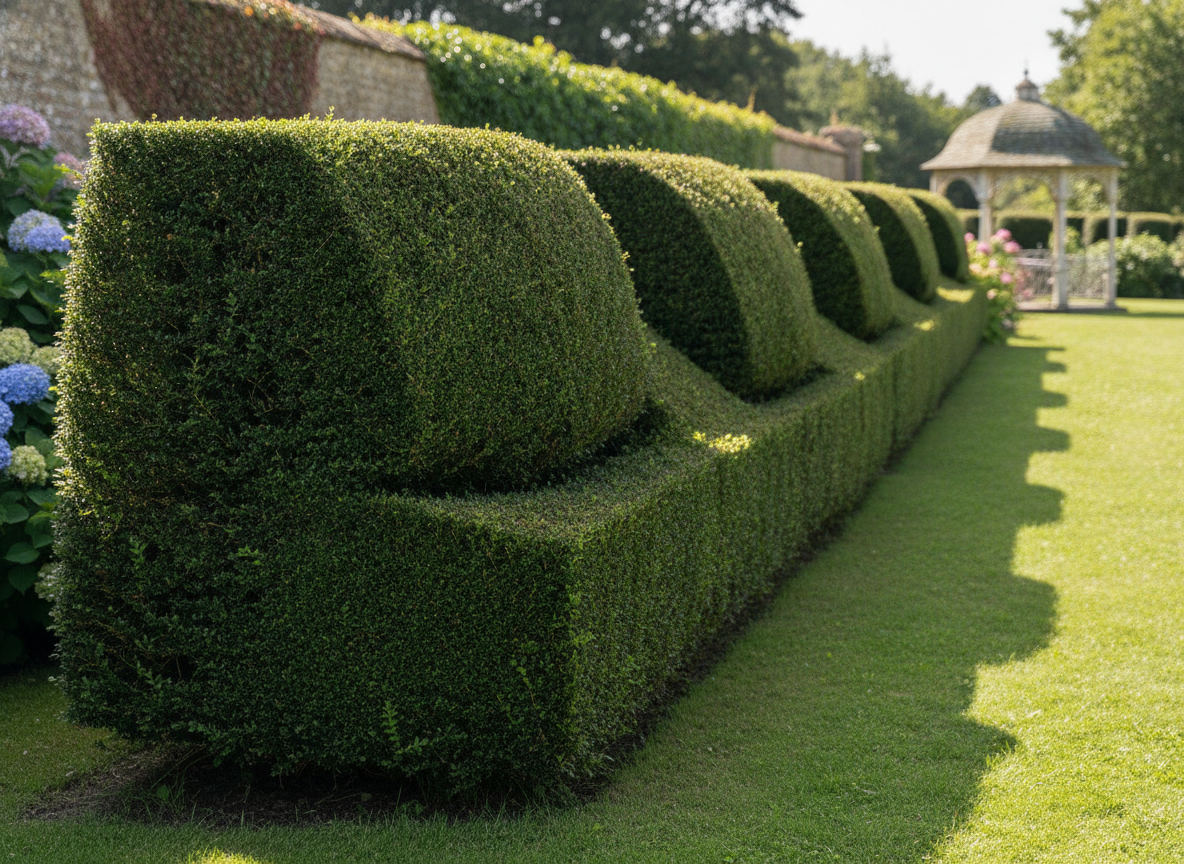 A row of trimmed leylandii hedges in a garden — AI-generated illustration
The cut: keep the batter, take the top, stay shallow on the sides
Three things make a conifer trim succeed.
The batter. Like any tall hedge, a conifer wants to be cut as an A-frame — distinctly narrower at the top than at the base, with the two faces sloping gently inward as they rise. This isn’t just aesthetics. A vertical or, worse, top-heavy conifer hedge shades its own lower flanks, and shaded conifer foliage thins, browns and dies back — the classic bare-bottomed Leylandii. A batter of even 10–15 cm of inward lean over a 2 m hedge keeps light on the lower foliage and keeps the hedge clothed to the ground. It also sheds snow, which otherwise splays the top open and tears it apart.
The sides — shallow only. On the faces, you are shaving the soft green tips back to just short of where you cut last time, staying firmly within the green. Think of it as trimming a few centimetres off the new growth, not reshaping the hedge. If your blade is meeting resistance and you see brown twiggy material coming off, stop — you’ve hit the dead zone and you’re now creating a permanent scar. Reset and cut shallower.
The top — this is the exception. The one place you can be ruthless is the top of the hedge. Once a Leylandii has reached the height you want, you cut the leading growth out hard and keep it there. Unlike the sides, taking the top down — even cutting out the central leaders to cap the height permanently — won’t leave an ugly dead face you have to look at, because you view the hedge from the side, not from above. Most conifer-hedge regret is about height: people let Leylandii run to 6 or 8 metres and then can’t bring it back down without exposing brown. Decide your final height early and hold the top there with every summer cut.
Leylandii, Thuja, Lawson — and the one conifer that breaks the rule
Not every conifer is equally unforgiving, and the differences are worth knowing before you cut.
- Leyland cypress (×Cuprocyparis leylandii) — the fastest and the least forgiving. No regrowth from brown wood at all. Keep it shallow, keep it frequent.
- Lawson’s cypress (Chamaecyparis lawsoniana) and Cupressus — the same rule. Green only.
- Thuja / western red cedar (Thuja plicata) — slightly more forgiving than Leylandii and will tolerate a marginally harder trim, but still won’t reliably break from genuinely old, leafless brown wood. Treat it like Leylandii to be safe.
- Yew (Taxus baccata) — the great exception. Yew is the one common hedging conifer that will reshoot from old brown wood, even from a bare trunk. It’s the reason yew can be renovated and Leylandii can’t. If you have a yew hedge, you have far more room to cut hard and even renovate over a couple of seasons — a completely different proposition, and the reason yew, not Leylandii, is the conifer for a hedge you’ll keep for a lifetime.
The practical takeaway: unless you’re cutting yew, assume green-only and you’ll never go wrong.
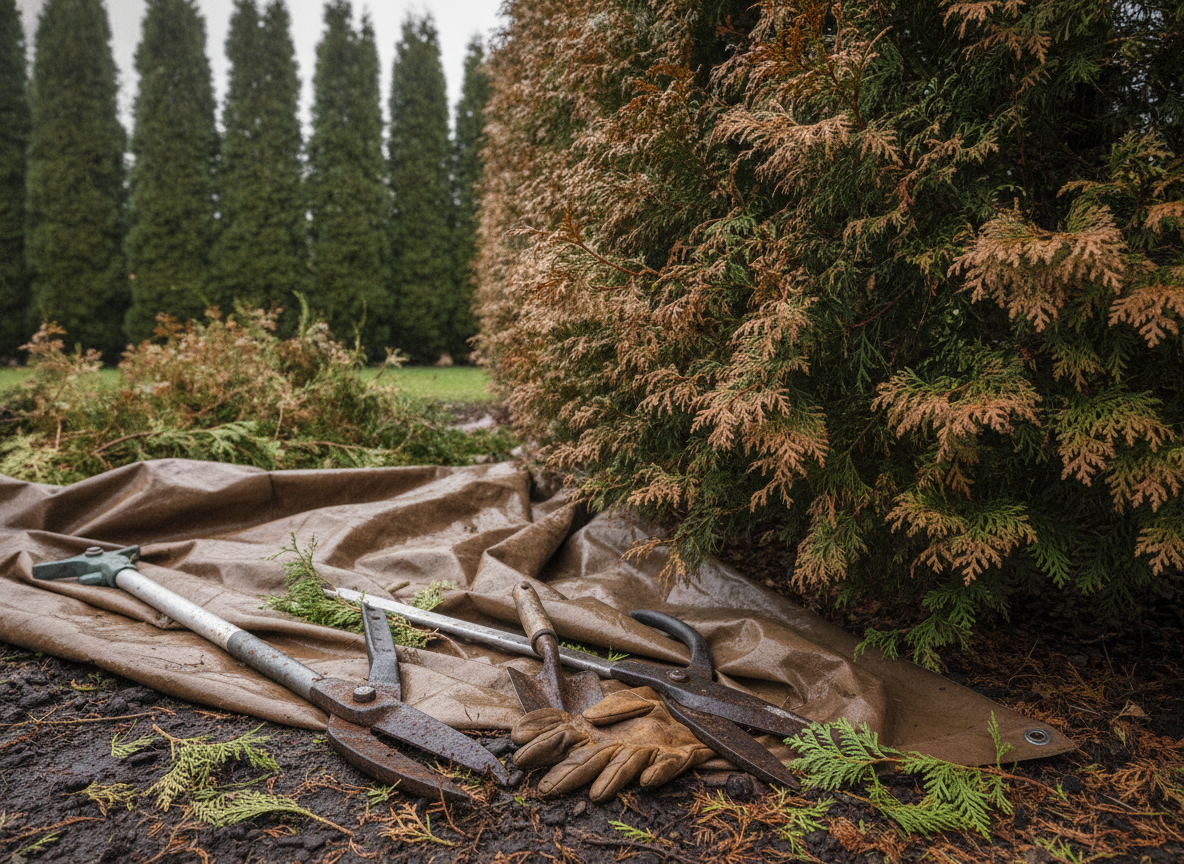 The image shows gardening tools and gloves on a tarp next to leylandii plants — AI-generated illustration
Tools, weather and the brown-edge trap
Conifer foliage browns easily at a bruised cut, so the same care that earns a clean finish on other hedges matters here too.
Sharp blades. A blunt powered trimmer crushes and tears the soft tips rather than slicing them, and crushed conifer foliage browns at the edge within days, giving the whole hedge a scorched, rusty cast. Sharpen or replace your blades before the season’s first cut.
Cloud, not blazing sun. Trim on a dry, overcast day if you can. Cutting in full midday sun, especially in a hot dry spell, exposes tender inner foliage to scorch before it has acclimatised — the same overcast logic behind the Derby Day box trim. Avoid trimming during drought or when the hedge is heat-stressed; water a dry hedge well a day or two before a big cut.
Work top-down and stand back often. Cut the top to a taut string line first, then the faces, sloping the batter inwards. Step back every few metres — conifer hedges read as one solid mass, and a dip or a bulge that you can’t see at arm’s length is obvious from across the garden.
What if your hedge is already bare or too wide?
This is where the green-only rule turns painful, because there’s no clean fix for an overgrown conifer hedge.
If a Leylandii has grown too wide, you cannot cut the sides back hard to slim it — cutting into the brown leaves a permanent dead face. The only honest options are to reduce the height (which you can do, because the top doesn’t show its cut face), to live with the width, or to remove and replace the hedge. Many gardeners eventually replace a runaway Leylandii with yew or beech precisely because those can be renovated.
If the hedge is already bare at the base from years of being cut without a batter, the green won’t come back on the dead lower wood. You can sometimes disguise it by underplanting with a lower evergreen, but the lesson is for the next hedge: build the batter in from year one.
And if you’re tempted to take a single conifer down by half to “start again” — don’t, unless it’s yew. A Leylandii cut hard into brown doesn’t recover; it just dies back where you cut and looks worse than before.
The 2026 summer window
The cool, slow spring across the Netherlands, Belgium and the southern UK has run roughly ten days behind average, but conifers have caught up fast in the recent warmth, and most Leylandii hedges have now put on the bulk of their spring extension. As of late June 2026, the new growth has firmed enough to cut cleanly — this is the moment for the main shaping trim.
Watch for a run of dry, overcast days, check the hedge for late nests first, sharpen your blades, and take a shallow, frequent cut that stays in the green. Then put a reminder in for August to do it again. Two light trims now beat one desperate cut next year.
For how conifers fit alongside everything else that wants — or doesn’t want — a cut this month, see our pruning calendar by month. For the deciduous formal hedges that play by completely different rules, compare the late-June beech hedge window.