The same shoot never fruits twice
A peach or nectarine works nothing like an apple. There are no long-lived fruiting spurs to build up over the years. Every fruit you picked this summer grew on a shoot that was put out last summer — one-year-old wood — and once it has carried a crop, it is finished. It will never fruit again. Leave it on the tree and all it does is extend, shade the wall, and push next year’s fruit further and further from the framework.
So the after-harvest job isn’t tidying. It’s a swap: out with the wood that just cropped, in with the wood that will crop next year. Summer raspberries run on exactly the same one-and-done principle — cut the fruited canes to the ground and keep the green ones — and a peach fan is the wall-trained version of the same idea.
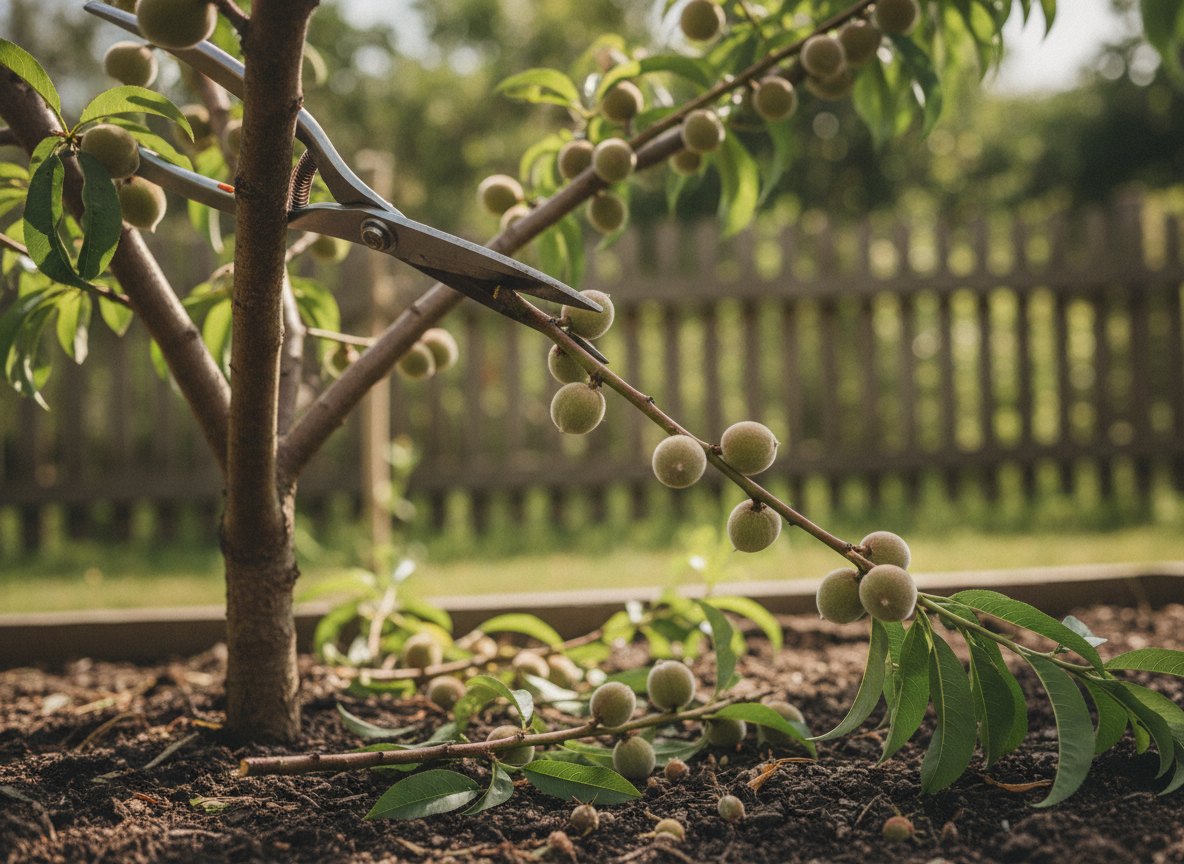 Peach tree with young peaches being pruned by hand shears — AI-generated illustration
Cut the fruited shoots out now
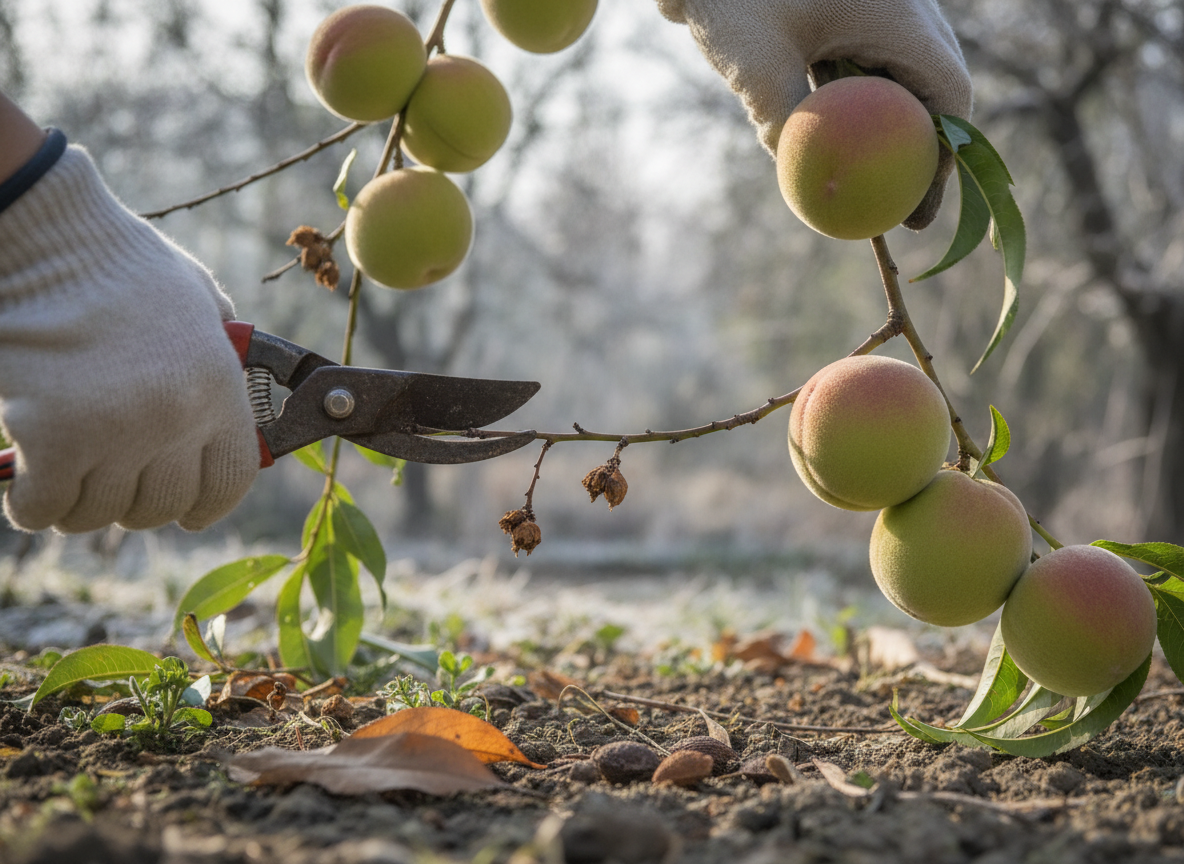
Once you’ve picked the last fruit — usually late August into September in a Northern European garden — work along each main arm of the fan and find the shoots that carried this year’s peaches. You can still see where the fruit hung; the wood is a little older and greyer than the rest. Cut each spent shoot right back to its replacement (more on finding that below), using clean, sharp secateurs and a slanted cut just above the new shoot.
Take out the obvious wrong-doers while you’re there: anything growing straight out from the wall towards you, anything pointing back into it, and any shoot that has died back at the tip. What you should be left with is a flat, open fan of young wood, evenly spaced, with light and air reaching every part.
 A young peach tree grows from the ground in front of a fallen log — AI-generated illustration
Where the replacement comes from
The trick that makes this painless is done months earlier. Back in spring and early summer, each fruiting shoot pushes out several new shoots of its own. The RHS system is to pick, from near the base of each fruiting shoot, one strong new shoot to keep as its replacement — and to pinch out the surplus while they’re still soft, leaving roughly one every 8–10 cm along the arm. That reserved shoot has spent the summer growing and ripening alongside the fruit. It’s the wood you tie in now, and it’s what fruits next year.
If those replacements are already there, the after-harvest cut is genuinely quick: fruited shoot off, replacement tied in, move on to the next.
Tie in while the wood still bends
Spread the retained shoots across the wires or trellis and tie them in with soft string, keeping them flat against the wall and evenly spaced — about 8 cm apart. Do it now, while the young wood is still supple. Left loose into autumn it stiffens, and a peach shoot you try to bend down to the horizontal in November snaps at the base instead of bending. Flat, well-spaced wood also dries faster after rain, which is your best defence against the fungal problems that thrive on a congested, damp fan.
 AI-generated illustration
Do the cutting now — never in winter
There’s a second, quieter reason the after-harvest window matters. Peaches, nectarines, plums and cherries are all Prunus, and Prunus should never be pruned in the dormant season. Winter cuts are the open door for silver leaf and bacterial canker, which move in through wounds while the tree is cold and inactive. Pruning while the tree is in full growth lets it seal the cuts quickly. It’s the same rule that governs when you can safely prune a plum or cherry — the knife comes out in the growing season, and goes away well before the leaves fall.
Missed the summer thinning?
If you never selected replacements earlier and the fan is now a thicket, don’t try to fix it all in one go. Cut out the most obviously spent and the most badly placed wood to open things up, tie in whatever strong young shoots you can find near the framework, and resolve to catch the replacements next June while they’re soft and easy to choose. A peach fan is forgiving over two seasons — it’s the one brutal winter renovation it doesn’t forgive.
Fan fruit lives or dies by timing: the June thinning, the after-harvest swap, and the hard no on winter cuts all fall on different dates for different trees, different walls and different regions — the same way the figs on that warm wall have their own late-summer job right now. Cresco keeps that calendar for every plant in your garden and checks it against your local weather, so the right week to pick up the secateurs finds you — not the other way round.