You picked the last blackcurrants in July, and the bush has spent August turning into a thicket. Now you’re standing over it with the secateurs, and the instinct — if you’ve summer-pruned gooseberries or red currants — is to shorten every side-shoot back to five leaves and tidy the outline.
Don’t. That’s exactly the wrong cut for a blackcurrant. Gooseberries and red currants fruit on a permanent framework of spurs, so you build and maintain the branches. A blackcurrant does the opposite: it fruits best on young wood straight from the base and slowly abandons its old stems. Prune it like a gooseberry and you keep the dead weight while trimming off next year’s crop.
Blackcurrants fruit from the base, not a framework
A blackcurrant (Ribes nigrum) is what growers call a stooled bush — it has no trunk and no permanent branches. Every good crop comes off wood that grew the previous summer. A one-year-old shoot fruits heavily, a two-year-old stem cropped once already and does less, and by year three or four the wood is nearly spent, throwing a few small strings near the tips and shading out everything below.
So the whole job is renewal: keep a steady supply of young shoots coming up from the base, and take out the tired old wood before it clutters the middle. Do that every year and a bush stays productive for fifteen years or more. Skip it, and within four or five seasons you have a dense dome of black, unproductive wood with the fruit stranded at the top where the birds get it first.
This is the opposite mindset to the July five-leaf prune you give gooseberries and red currants — same fruit cage, completely different rule. It’s the same “cut out what already fruited” logic behind taking out summer raspberry canes after picking.
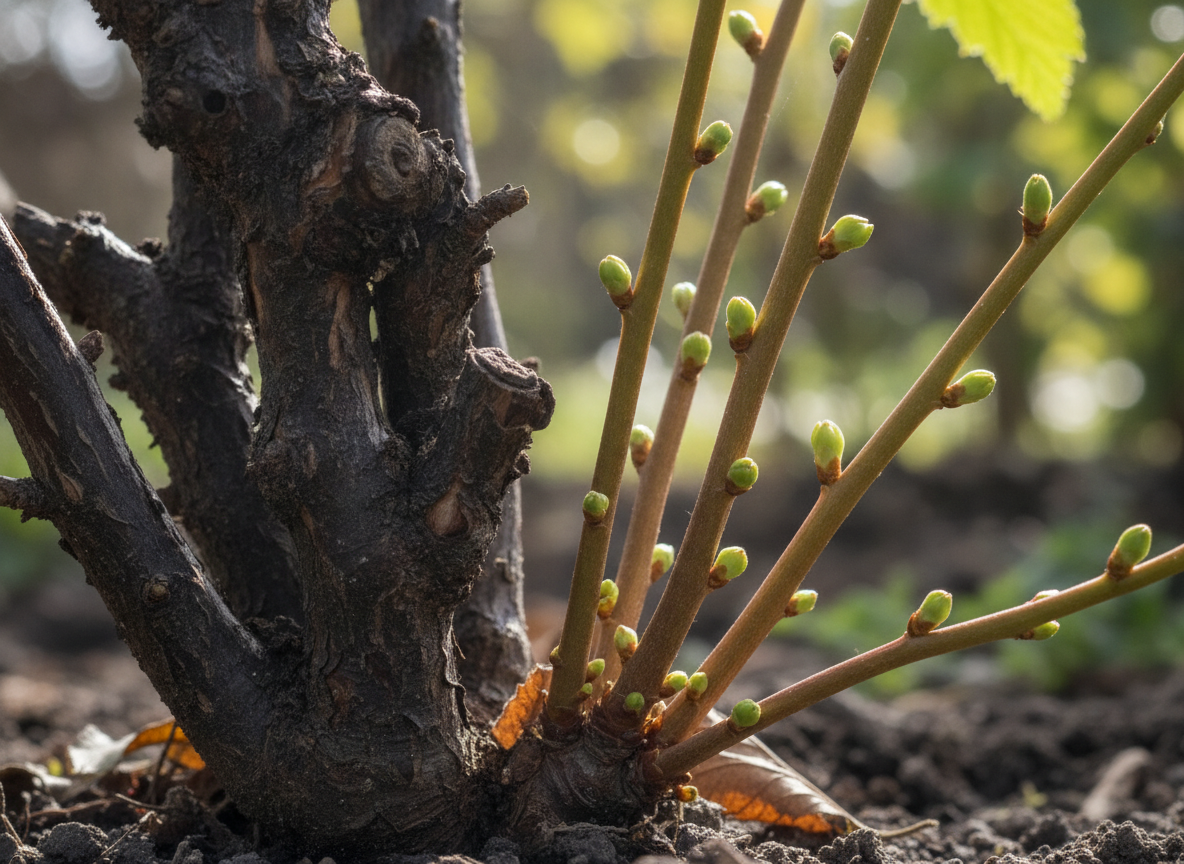 Blackcurrant stems with new green shoots — AI-generated illustration
How to tell old wood from new
You don’t need to remember which stem is which — the bush colour-codes it for you. Hold a low branch and follow it to the ground:
- This year’s new shoots are pale — tan, buff, sometimes almost olive — smooth, and often still a little soft at the tip. These carry next summer’s fruit. Leave every one you can.
- Old wood is dark, dull, and close to black, with rougher, flaking bark. It’s thicker at the base and frequently needs loppers or a small saw rather than secateurs. This is what comes out.
If you’re unsure on a middling stem, look at where the fruit hung this year and how much: the heavily cropped, darker branches are on their way out; the pale whippy growth that made nothing is your future crop. Cutting now, while the bush is still in leaf and you can still read the season’s growth, is easier than staring at a bare tangle in January.
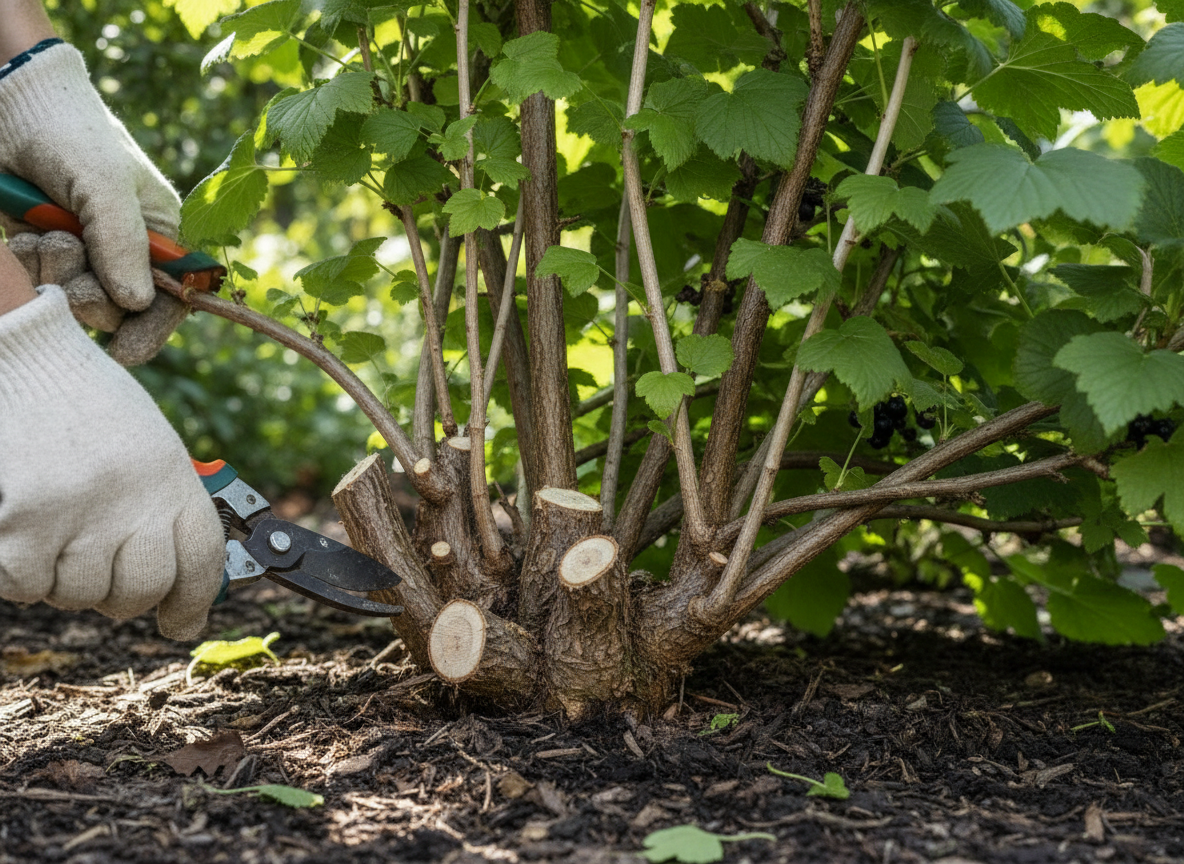 Hands pruning the oldest stems of a blackcurrant bush — AI-generated illustration
The cut: a third of the oldest stems, to the ground
Work in this order and it takes ten minutes a bush:
- Clear the obvious first. Cut out anything dead, broken, or diseased, plus low stems trailing on the soil where fruit would splash with mud and mildew.
- Take out the oldest third. Choose the darkest, thickest, most congested stems and cut them right down to the base — no stub. Aim to remove about a quarter to a third of the bush by count each year. On an old neglected bush that’s never been done, don’t take it all at once; spread the renewal over two winters so you keep some crop.
- Open the middle. The goal is a goblet shape with an open centre so light and air reach the low buds — that’s where next year’s strongest shoots break from. Remove any young stem that crosses into the middle or crowds a better one.
- Leave the young wood alone. Don’t tip or shorten the pale one-year-old shoots. Every bud on them is a potential string of fruit. Shortening them is the single most common way people quietly halve their own crop.
By spring you’ll see the answer: a forest of vigorous new shoots pushing from the base, because the bush is no longer feeding a mass of exhausted old wood.
Now or winter? Both work — pick your reason
The textbook time is winter, when the bush is fully dormant and bare, roughly November to February. Nothing is wrong with waiting.
But there are two good reasons to do the main renewal now, straight after fruiting in late summer:
- You can still read the bush. In leaf, with this year’s crop just gone, it’s obvious which stems worked and which are dead weight. In January every stem is a bare brown stick and the calls are harder.
- Light gets to the new wood while it still matters. Opening the bush now lets late-summer sun ripen and firm this year’s shoots before autumn, so they come through winter as strong fruiting wood rather than soft, shaded growth.
The one caveat: don’t prune in a warm, wet spell that’s forcing soft regrowth you can’t harden off, and take out anything showing big bud (the swollen, rounded buds that harbour blackcurrant gall mite) whenever you spot it, season regardless. Otherwise, late August into September is a fine window — and if you miss it, winter is your backstop.
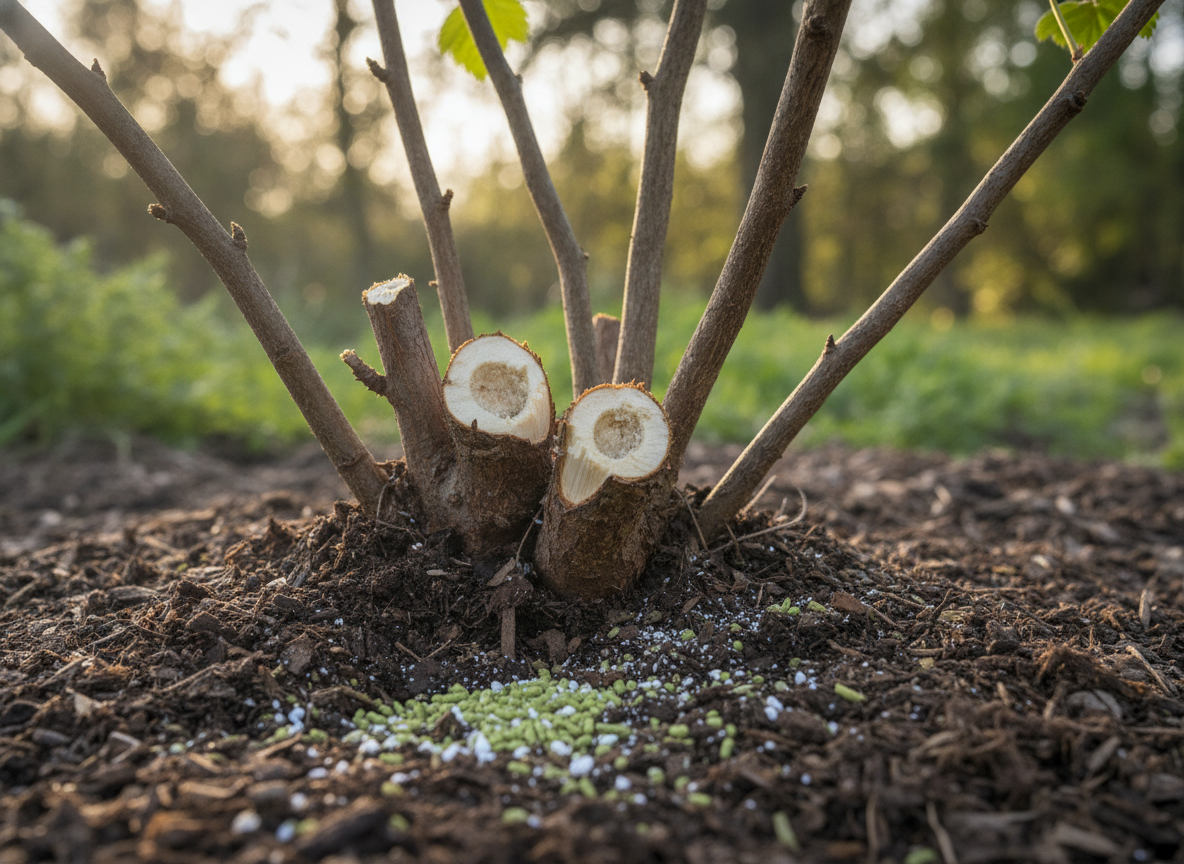 Cut blackcurrant stems with granular fertilizer at the base — AI-generated illustration
Feed the bush you just opened up
Renewal pruning asks the plant for a flush of new shoots, so give it the means. In late winter or early spring, mulch generously around the base with well-rotted manure or compost, keeping it clear of the stems, and blackcurrants — hungrier for nitrogen than most soft fruit — respond well to a spring feed. That combination is what turns “I cut a third out” into “the base threw up a dozen strong new canes.”
Brand-new bushes play by a different rule
If you planted a blackcurrant this year, don’t renewal-prune it — there’s nothing old to remove yet. The move on a newly planted bush is the opposite and feels brutal: cut every shoot down to two buds above the soil in its first winter. You lose next year’s fruit, but you force a thicket of strong shoots from below ground and build a proper stooled bush from the start, instead of a leggy one on a single leg. From then on, it’s the once-a-year renewal above.
Let Cresco call the week for your bushes
The hard part isn’t the cut — it’s remembering that the blackcurrant, the gooseberry and the raspberry in the same fruit cage each want a different prune at a different time. Cresco keeps a pruning calendar for every plant you own and checks it against your local weather, so you get told the right week to renew the blackcurrants — not a generic “prune in summer.” Add your bushes once, and the reminders sort themselves out.