The autumn tidy-up is exactly the wrong instinct
By late August, Russian sage (Perovskia atriplicifolia, now reclassified as Salvia yangii) is doing the one thing it’s grown for: a haze of tiny violet-blue flowers on branching silver stems, still standing when half the border has gone over. And that’s precisely when the temptation starts. The rest of the bed is collapsing, you’re out there with the secateurs cutting everything down, and the Russian sage — tall, a bit lax, browning at the flower tips — looks like the obvious next job.
Leave it. Cutting Russian sage back in autumn is one of the most reliable ways to lose the plant over winter, and almost nobody connects the dead stump in April to the tidy-up they did in September.
 AI-generated illustration
Why the stems have to stay on all winter
Two things are going on here, and both point the same way.
First, Russian sage is a woody-based sub-shrub, not a soft perennial that dies neatly to the ground. It flowers only on new wood — the growth it makes fresh each spring — which is exactly why it wants a hard cut at the start of the season. But cut it now and you send the right signal at the wrong time: a late-summer chop tells the plant to push soft new shoots just as it should be shutting down, and that unhardened growth has no chance against the first frost.
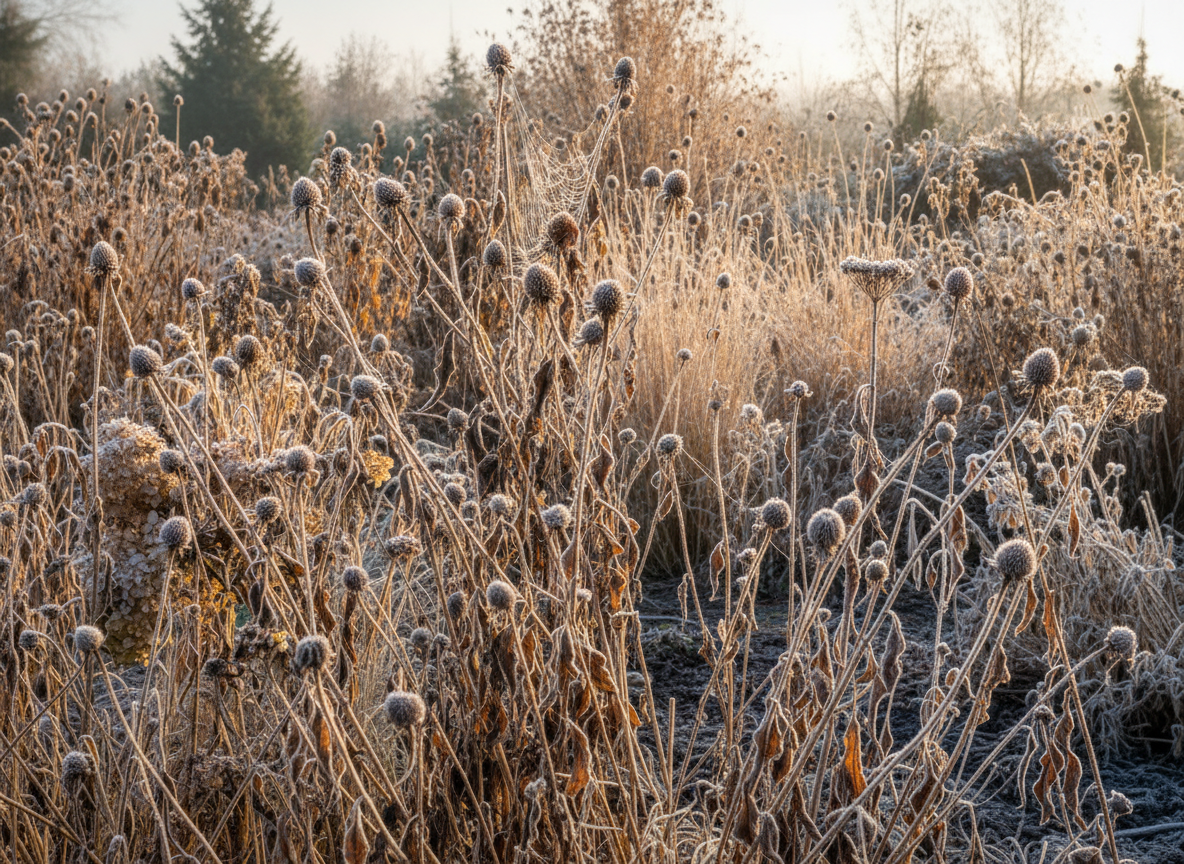
Second, and more important, the standing stems are the plant’s own winter coat. That open lattice of silvery stems traps air and sheds rain away from the base, keeping the crown drier and a few degrees warmer through the cold. Strip it off in autumn and you leave the crown bare to the one thing that actually kills Russian sage in northern Europe: not cold on its own, but cold plus wet sitting around the roots all winter. A rotted crown doesn’t come back.
There’s a third reason that costs you nothing to honour: the winter picture. Frosted and low-lit, those pale stems and seedheads are among the best things in the January garden — the same argument for leaving ornamental grasses standing until spring.
 The image shows low-cut brown stalks with green shoots emerging — AI-generated illustration
The only cut that matters: spring, to the lowest buds
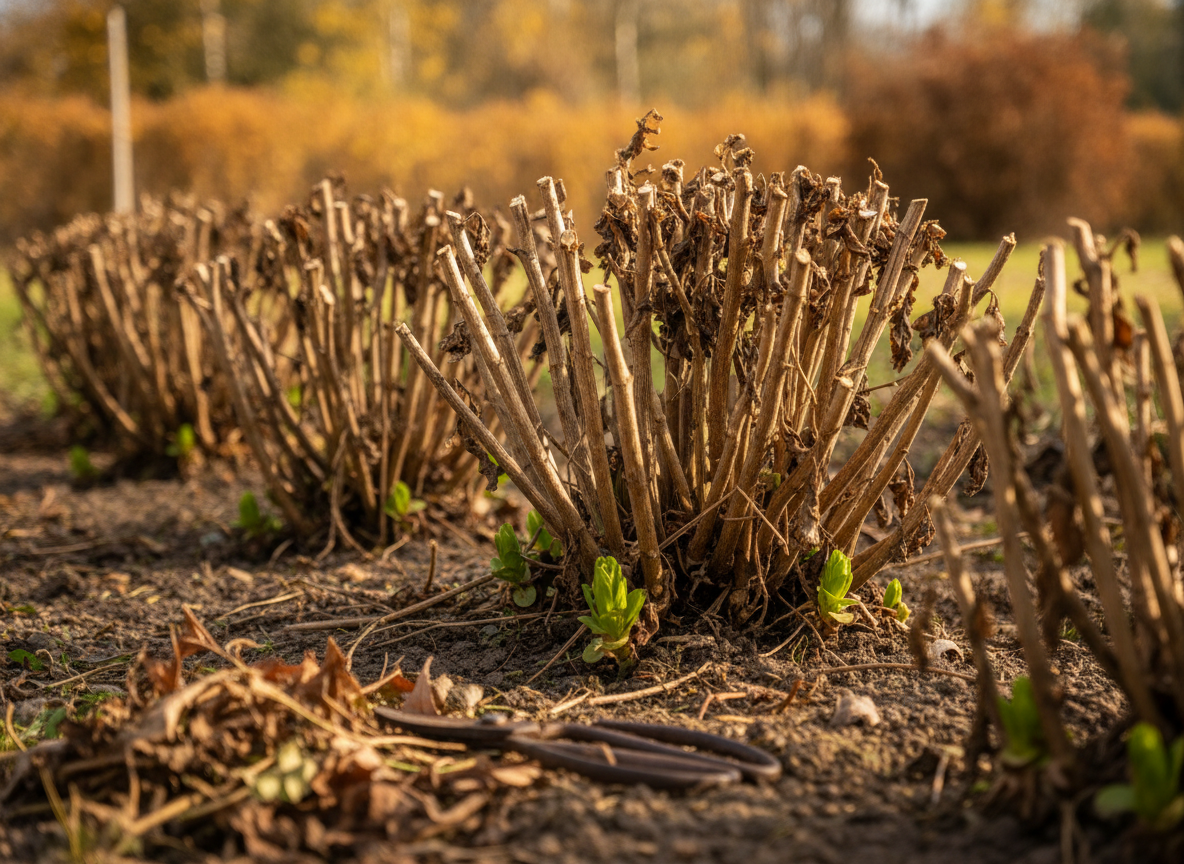
The prune Russian sage genuinely wants is a single hard one, and it comes in spring — not autumn, and not the depths of winter either. Wait until you can see new growth stirring: tiny grey-green buds breaking low down on the old stems, usually somewhere between late February and early April depending on how far north and how sheltered you are.
Then cut hard. Take every stem down to a low framework — roughly 15–45 cm from the ground — cutting each one back to just above the lowest pair of healthy buds you can find on the old wood. Don’t be timid: this is the cut that forces the vigorous new shoots the flowers ride on. A plant left unpruned grows tall, bare-legged and floppy; a hard-pruned one comes back dense, upright and flowers harder. The RHS and Gardeners’ World both put the annual prune squarely in mid-spring for exactly this reason.
One line not to cross, though — the same as with lavender — is cutting down into old, budless wood. Russian sage is more forgiving than lavender and will often break from low on the stump, but the reliable regrowth comes from live buds, so keep your cut just above them, never below into bare grey wood.
Bare and woody at the base already?
If your plant is a leggy sprawl — all bare stems at the bottom and flowers only up top — the fix is still a spring job, not an autumn one. Give it that hard cut to the lowest buds next March and it’ll usually thicken from the base again over a season or two.
Where it won’t recover is if the base is genuinely dead wood with no live buds left, which happens on old plants that have never been cut, and on ones caught by a hard, wet winter. There the honest move is to replace it — Russian sage is cheap, fast and quick to establish — or to take softwood cuttings in early summer and grow on a fresh young plant to swap in.
 Autumn garden with tall grasses, coneflowers, hydrangeas, and rose hips — AI-generated illustration
What to do now, instead of cutting
Enjoy it — this is the plant’s month. If a stem is flopping across a path, tie it loosely back rather than shortening it. When the flowers finally fade, leave the seedheads standing: they carry both the winter display and the crown protection. Hold off on feeding now, too — a late nitrogen hit does the same damage as a late cut, pushing soft growth into the frost. The moment for a light feed and a mulch is spring, right after you make the cut.
The short version
Russian sage flowers on new spring wood and shelters its own crown with last year’s stems, so the autumn tidy-up is the one prune it can’t survive. Leave the silver stems standing all winter, then make your single hard cut in spring — down to a low framework, always just above the lowest live buds. Cut now and you gamble the plant on a mild, dry winter; leave it and you get the frosted winter picture for free, and a stronger plant besides.
Knowing which plants take an autumn cut and which resent it is half the battle — our month-by-month pruning guide maps the whole year. And if you’d rather just be told when your Russian sage — and everything else — needs cutting, timed to your own local frost dates, that’s exactly the job Cresco was built for.