A blackberry cane lives two years and fruits in only one
Everything about pruning a blackberry (Rubus fruticosus) makes sense the moment you accept one fact about how the plant is built: each cane lives for two years, and it only ever carries fruit in the second. A cane pushes up out of the ground one summer, grows long and green and does nothing but grow. It overwinters. The following summer that same cane flowers, sets the berries you’ve just been picking, and then — its whole job done — it starts to die back. It will never fruit again.
So a blackberry plant in late August is really two plants tangled into one. There are the canes that grew last year and have just finished cropping, now darkening, drying and heading for the compost. And there are this year’s new canes, still green and whippy, that have spent the summer growing and will carry all of next year’s fruit. The entire late-summer job is to tell those two apart and remove one of them.
Get it right and the plant renews itself cleanly every year, cropping heavily and staying inside its space. Get it wrong — leave everything on, or cut the wrong canes off — and you either lose next year’s crop in an afternoon or end up with an impenetrable, half-dead thicket that fruits worse every season. It’s the same biennial-cane logic that governs summer raspberries; blackberries just do it on a bigger, thornier, more sprawling scale.
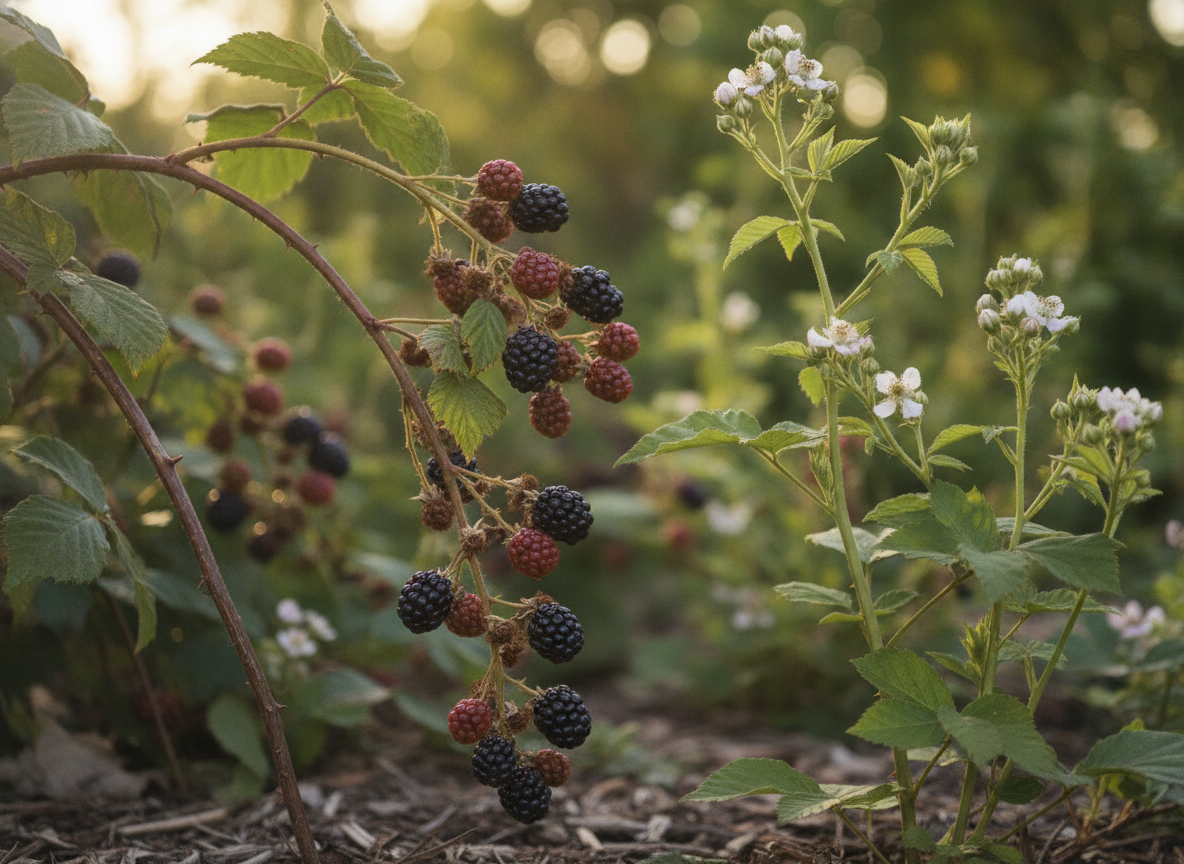 Blackberry canes with ripe and unripe berries are shown alongside new flowering canes — AI-generated illustration
Telling the fruited cane from the new one
Stand in front of the plant with your secateurs and don’t cut anything yet. First, read the canes. The difference is usually obvious once you know what you’re looking at.
The canes that have just fruited are the older ones. They carry the remains of the fruiting trusses — the little dried stalks where the berries hung — and their bark is duller, browner, sometimes greying or peeling near the base. They feel harder and less flexible, and as autumn comes on their leaves fade first. Trace one back and you’ll find it emerging from the crown alongside younger growth. These are finished.
The new canes are this year’s growth: greener or reddish, longer, more flexible, with no sign of old fruit stalks anywhere along them. On a vigorous plant they can be head-height or more, arching over and sometimes tipping down to touch the soil (where, left alone, the tip will root and start a new plant — worth knowing if you don’t want blackberries marching across the garden). These are the ones that carry next year’s crop, and they are the ones you protect.
If you train your blackberry along wires — and you should, because it makes this job trivial — you can make the distinction impossible to muddle. Tie the new canes to one side as they grow through summer and let the fruiting canes crop on the other. Come pruning time, one whole side is spent and one whole side is the future, and you barely have to think.
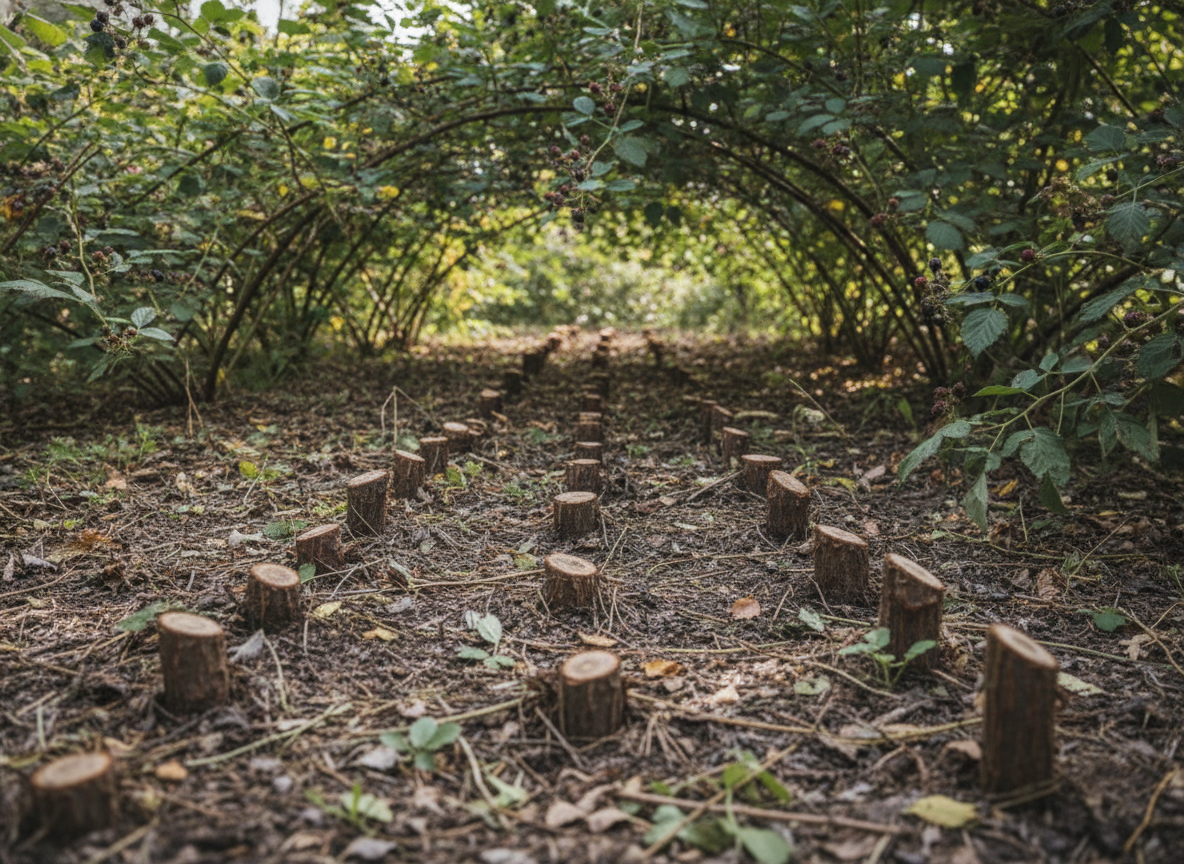 Blackberry canes cut close to the ground — AI-generated illustration
The cut: right down to the ground, no stub
Once you’re sure which is which, the cut itself is simple and unsparing. Cut every cane that fruited this year right down to the base, as close to the ground as your secateurs or loppers will reach. Don’t leave a hopeful stub — those old canes are not going to do anything except die back, harbour disease over winter and take up light and air the new canes need.
Work them out of the tangle carefully. Blackberry canes are barbed and the old ones snag on everything, including the new canes you’re trying to keep, so cut a long cane into two or three shorter lengths rather than trying to drag six feet of thorny wood out in one piece. Thick gauntlet gloves and long sleeves are not optional here.
As you clear the old wood, you also want to thin the new. A blackberry throws up far more new canes than it can fruit well — leave them all and next year’s plant is a congested thicket where light and air can’t reach the middle, which is exactly how you invite mildew and grey mould onto the fruit. Keep the strongest four to eight new canes (the exact number depends on the vigour of the variety and the space you’re training into) and cut the weakest, thinnest and most awkwardly placed ones out at the base too. Fewer, well-spaced canes crop better than a crowd.
Tie in the new canes before winter gets them
Cutting out the old wood is only half the job. The new canes you’ve kept are next year’s entire crop, and right now they’re long, whippy and vulnerable — a winter gale will whip an untied blackberry cane against a wall until it snaps, or lash it to the ground where it roots and turns your row into a bramble patch.
So once the old canes are gone, spread the new ones out along your supports and tie them in. On a wire framework, fan them evenly across the wires so no two canes cross and each one gets its own share of light and air next summer — an open, well-spaced arrangement is what keeps the fruit dry and mildew-free. If you’re growing a really vigorous variety, some gardeners weave the long canes along the lower wires or in a gentle arch to fit the length in without a jungle; the principle is the same either way, keep them separated and secured.
Use soft twine or proper tree ties, not wire tight against the cane, and don’t strangle them — a cane still needs to thicken over winter. If a cane is far too long for its space, you can tip it back by a few inches once it’s tied in, but resist cutting the new canes back hard now: unlike the fruited wood, these are the ones you want, and every foot of healthy cane is fruiting length for next year.
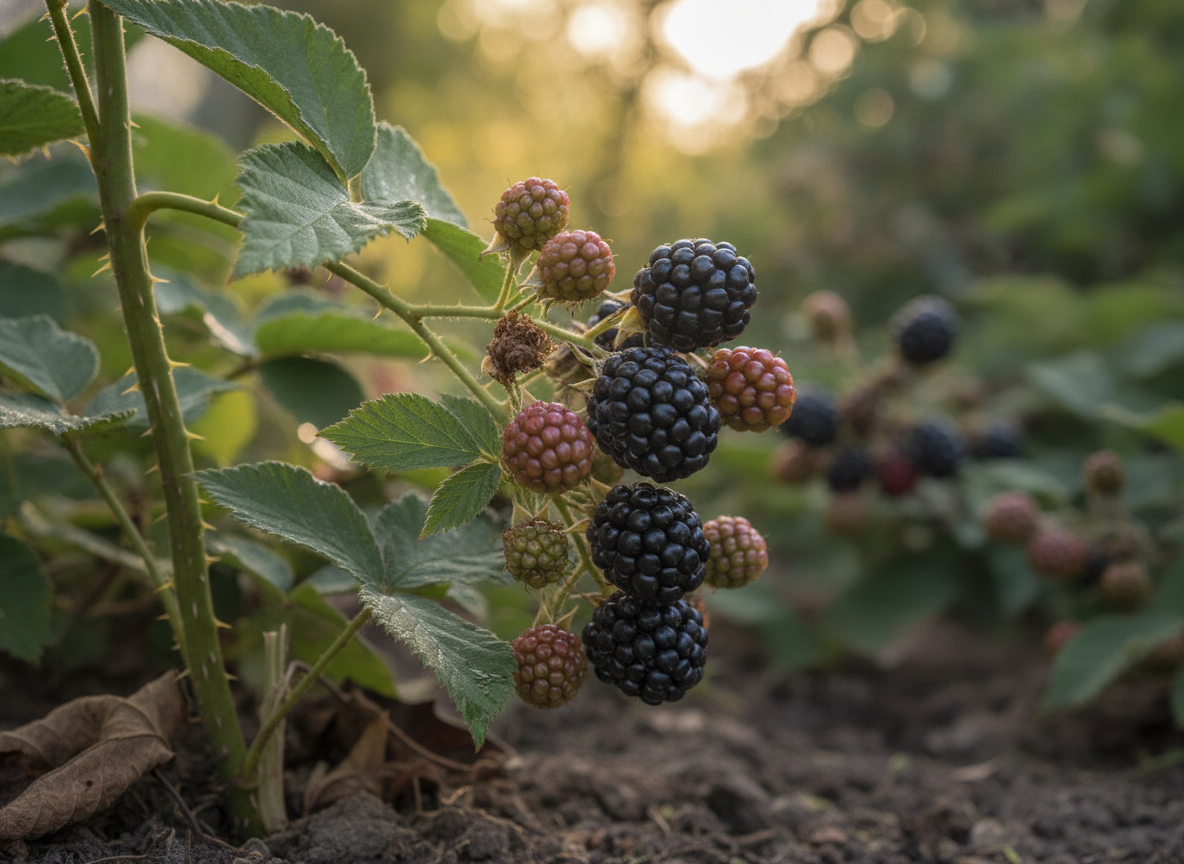 Blackberry plant with ripening berries on a primocane — AI-generated illustration
The one exception: primocane (autumn) blackberries
Almost everything above is for the standard summer- and early-autumn-fruiting blackberries, which is the vast majority of what’s grown. There’s one modern exception worth knowing so you don’t prune it wrong.
A handful of newer varieties — thornless, primocane-fruiting types such as ‘Reuben’ — fruit on the current year’s canes, the way autumn raspberries do. With those, you don’t have to separate old wood from new at all: you can simply cut the entire plant to the ground in late winter, and it will throw up fresh canes that flower and fruit the same year. If you know you’re growing a primocane blackberry, ignore the two-year logic and treat it as a cut-it-all-down plant. If you don’t know which you have — and most people growing a traditional or wild-type blackberry have the two-year kind — follow the main method above: cut out only the canes that fruited, keep the new.
The short version
After the last blackberries are picked, cut every cane that fruited this year right down to the ground — bark duller, old fruit stalks still attached — and take out the weakest new canes too. Keep the strongest four to eight green canes, fan them across your supports and tie them in firmly before the autumn gales arrive. That’s the whole job: remove the past, secure the future.
The timing shifts with the season and the variety — some blackberries finish in August, some crop into October — so the cue is the plant, not the calendar: prune once the canes have genuinely stopped fruiting. If you’d rather have the exact window for your own blackberries flagged alongside every other job in the garden, the Cresco pruning calendar tracks it against your local season. And if soft fruit is your thing, the same summer discipline applies to your bushes — see the July five-leaf prune for gooseberries and currants.