The one climber you can almost leave alone
Most of the wall shrubs and climbers I write about here are hungry for the secateurs — honeysuckle goes bare at the base, wisteria bolts, a rambling rose swallows a shed in a season. Star jasmine (Trachelospermum jasminoides, sometimes sold as Confederate jasmine or trachelospermum) is the quiet exception. It’s evergreen, it’s slow, and left to its own devices it forms a neat, glossy, self-supporting curtain of dark leaves that carries those little white pinwheel flowers through June and July, often into the first weeks of August.
That slowness is the whole point of this post. Because the plant asks for so little, the temptation each August is either to ignore it completely until it has vaulted over the top of the fence, or — worse — to wait until spring and cut it back hard “to tidy it up.” Both cost you. The first leaves you with a bare-legged tangle that only flowers at the top; the second cuts off the very wood that was about to scent your patio next summer.
The job right now, the week the last flowers brown, is small and specific: shorten the few stems that have shot past their support, tie in the growth you want to keep, and then put the shears away. That’s it.
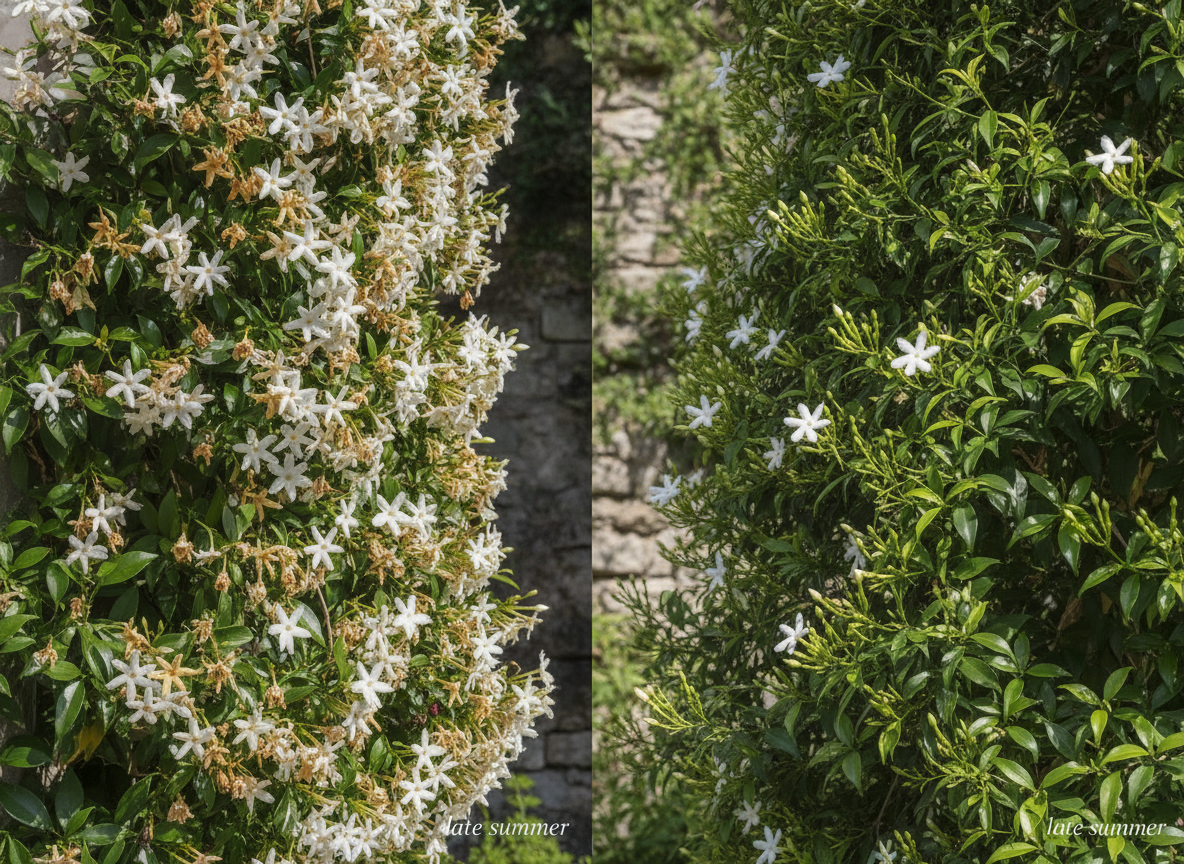 A diptych showing star jasmine in two different stages of bloom — AI-generated illustration
Why late summer, and why not spring
Here’s the part that catches people out. Star jasmine flowers on wood that is a year or more old — the growth it made last season, not the whippy new shoots racing out of the top right now. Those new shoots are next year’s flowering wood. If you leave the plant alone until late winter or spring and then cut it back, you are removing exactly the stems that were loaded with buds for the coming summer. The plant survives fine; it just spends the whole of next June looking green and giving you nothing to smell.
Pruning straight after flowering sidesteps that. You take out length and mess now, the plant has the rest of the warm season to ripen and set buds on the wood you left, and next summer’s flush is safe. It’s the same logic behind pruning true summer jasmine after it flowers rather than in spring — two different plants (star jasmine is evergreen and twining; true jasmine is deciduous), same timing rule for the same reason.
There’s one more reason the timing matters, and it’s about cold rather than flowers. Star jasmine is only borderline hardy in most of the UK and the Low Countries — it wants a warm, sheltered, sunny wall, and even then a hard winter can scorch the leaves. Any cut you make pushes a flush of soft new growth. Do that in late summer and the growth has time to firm up before the frosts; do it in autumn and you send tender shoots straight into the cold. So the window is now — late August, right after flowering — and not later. It’s the same last-safe-trim principle behind giving bay a final clip before autumn: trim an evergreen too late and the fresh growth never hardens.
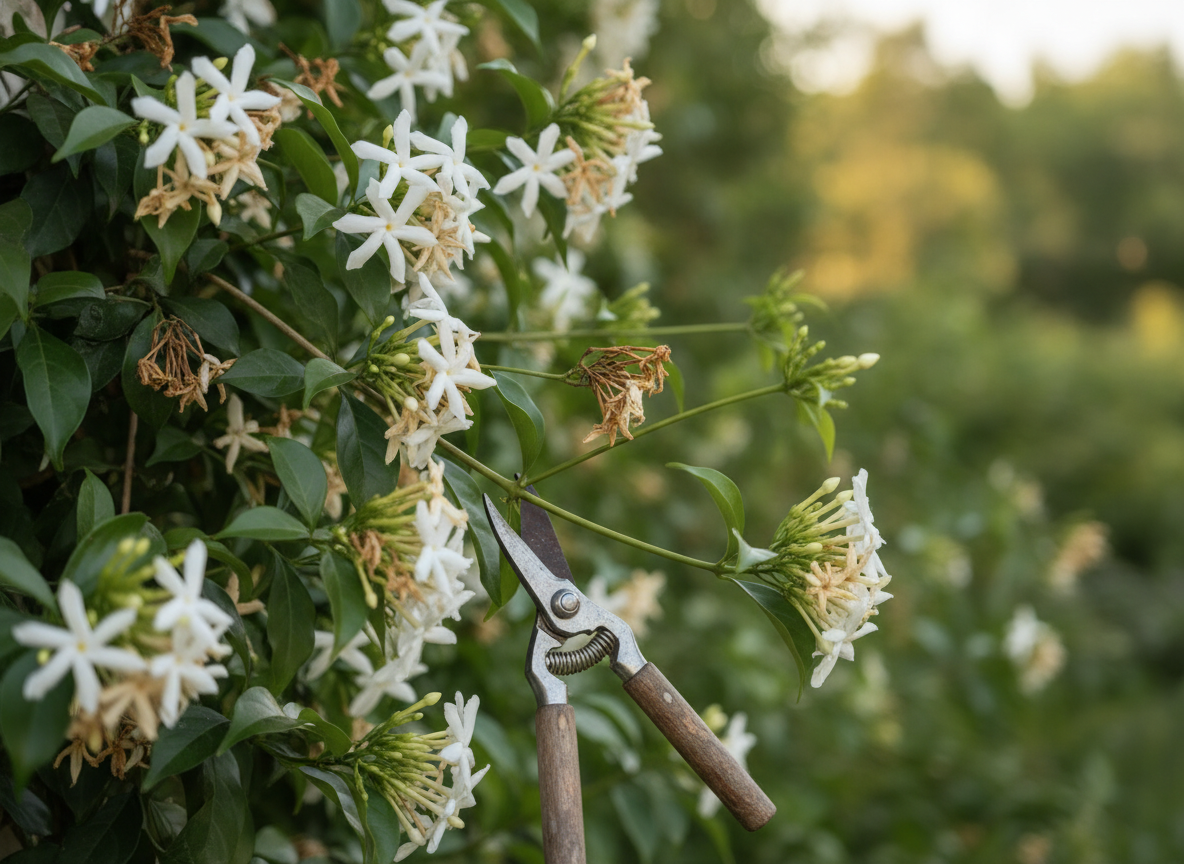 A pair of pruning shears rests on star jasmine plants in bloom — AI-generated illustration
The three-minute August job
For an established plant that’s flowering well and just looking a bit shaggy, this is genuinely quick:
- Shorten the escapees. Find the long, whippy stems that have shot up over the top of the fence or trellis and are waving around in the air. Cut each one back to a healthy leaf joint or a side shoot that’s still within the space you want the plant to fill. Don’t shear across the top like a hedge — go stem by stem so the plant keeps its natural, layered look and the cuts disappear from view.
- Tie in what you’re keeping. Star jasmine twines, but it can’t read your mind about where the gaps are. Spread the flexible new growth sideways and downwards and tie it in loosely with soft twine to fill bare patches — especially low down. Training stems horizontally makes them break into more side shoots, which is how you keep the base clothed instead of ending up with bare legs and a flowery hat. It’s the same fix I use for a honeysuckle that’s gone bald at the bottom.
- Thin, don’t hack. If the plant is congested and airless in the middle, take out one or two of the oldest stems entirely, right back to a junction. That opens it up without leaving a hole in the face of the plant.
Wear gloves. When you cut the stems they weep a milky white sap that’s a mild skin irritant and stains — a minor thing, but worth knowing before you get it on your hands and your patio.
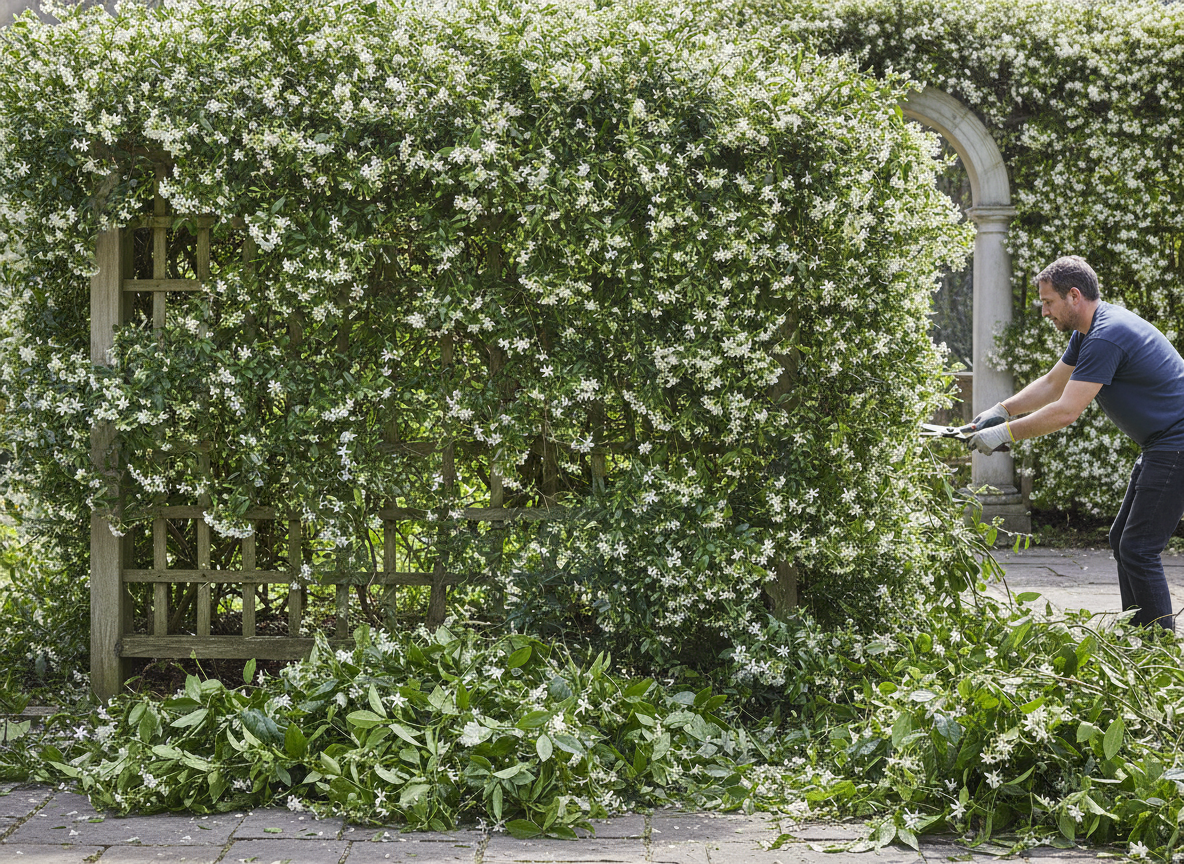 A man prunes a star jasmine vine in a garden — AI-generated illustration
What to do with a monster
Sometimes “a light trim” isn’t the honest answer. If your star jasmine has been left for years and is now a solid, bird’s-nest slab standing proud of the wall, bare and woody at the base, a tidy-up won’t fix it. The good news is that trachelospermum tolerates hard pruning — cut back into old, leafless wood and it will, slowly, break from the base.
The catch is timing, and it’s the opposite of everything above. Do a hard renovation cut in early to mid spring, not now. Two reasons: you’ll be sacrificing that year’s flowers whatever you do, so there’s no point wasting a light-prune summer on it; and cutting hard now, going into winter, on a borderline-hardy plant is asking for cold damage on all that soft regrowth. Cut it hard in spring, feed it, water it through its first summer, and let it rebuild. Accept one flowerless year and you get a full plant back.
For everything short of that — the plant that flowered well and just needs containing — resist the urge to renovate. A light trim now beats a hard cut later, every time.
The quick version
- Star jasmine barely needs pruning — it’s slow and evergreen. Most years, a light tidy is all it wants.
- Prune right after flowering, late summer, while there’s still time for new growth to harden before frost. Not autumn, not spring.
- It flowers on year-old wood, so a spring cut removes next summer’s buds and scent.
- Shorten only the wayward whips, back to a leaf or side shoot; tie in the rest, especially low down, to keep the base clothed.
- Wear gloves — the cut stems bleed a sticky, mildly irritant white sap.
- Save any hard renovation for spring, and accept you’ll lose a year of flowers for it.
Not sure whether your climber flowers on old or new wood — or when its own last-safe-trim window closes? That’s exactly what Cresco is built to answer: tell it what you’re growing and where, and it gives you the cut, and the week to make it, for your plants and your local weather.