A climber that builds from the top down
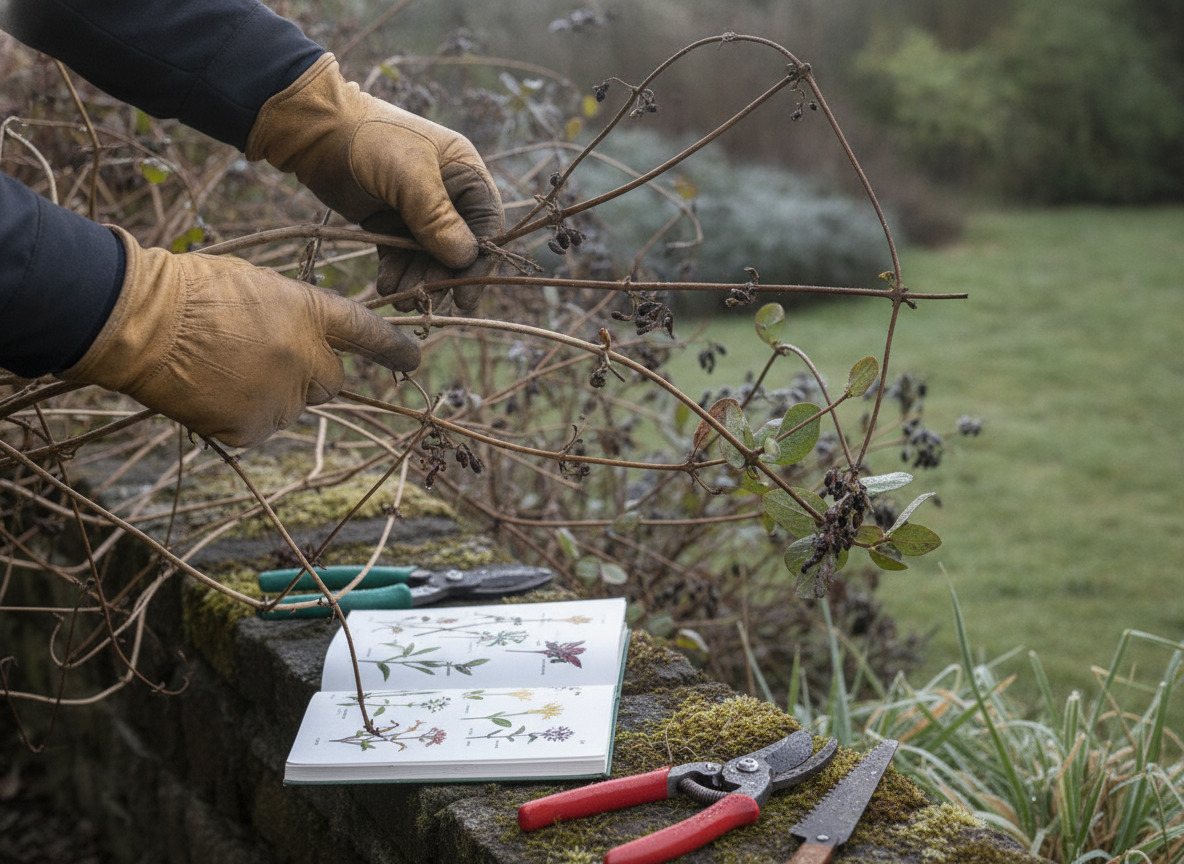
Stand under an established honeysuckle in mid-June and you’ll usually see the same thing: a fat collar of flower and scent up at head height or above, and underneath it a thicket of bare, woody stems with hardly a leaf. People assume they’ve got a shy variety, or that the plant is dying back at the base. Neither is true. This is simply how a honeysuckle grows if you leave it alone.
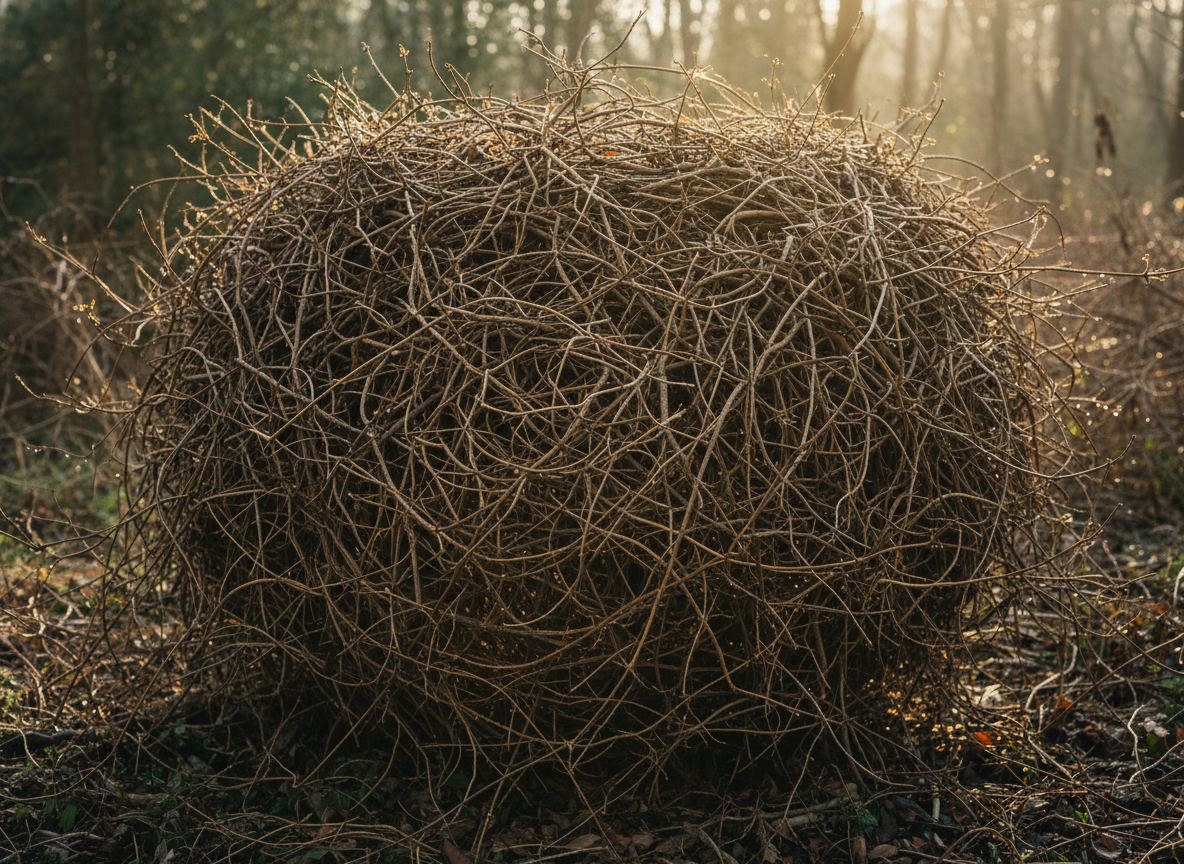
A climbing honeysuckle (Lonicera) makes its new growth from the tips of last year’s shoots. Each season the living, flowering layer climbs a little higher, and the older wood it left behind goes hard, leafless and congested — gardeners call the result a “bird’s nest”. All the work happens up top, all the flower ends up out of reach, and the scent you planted it for drifts over the fence instead of past the back door.
The fix is a cut, and for most of the honeysuckles flowering right now, June and early July is exactly the window for it.
 AI-generated illustration
First, work out which honeysuckle you have
This matters more than any other decision, because the two main groups are pruned at opposite ends of the year.
Early-flowering climbers — the common woodbine (Lonicera periclymenum), early Dutch honeysuckle (‘Belgica’), L. × tellmanniana, L. × americana — flower in May to July on short side shoots off last year’s wood. These are the ones in bloom as you read this, and these are the ones you prune straight after flowering, while they still have the whole summer to build next year’s flowering wood.
Late-flowering climbers — late Dutch honeysuckle (‘Serotina’) and Japanese honeysuckle (L. japonica) — flower on the current season’s growth, often right through to October. If you cut these now you’re removing the shoots that are about to bloom. They get a light tidy in early spring instead, never a hard prune.
A quick test if you’re not sure: a honeysuckle that’s at full throttle in June and tailing off by August is almost certainly an early type — prune it. One that’s only just getting going now and carries on into autumn is a late type — leave the secateurs in the shed until next March.
(And if your “honeysuckle” is a dense little evergreen hedge, that’s shrubby honeysuckle, Lonicera nitida — a different plant grown for foliage, trimmed two or three times a season like box. None of what follows applies to it.)
 A rusted pruning shear cuts a honeysuckle branch with spent flowers — AI-generated illustration
The after-flowering cut, in two moves
For an early-flowering climber that’s just finished, the prune is two jobs done at the same visit.
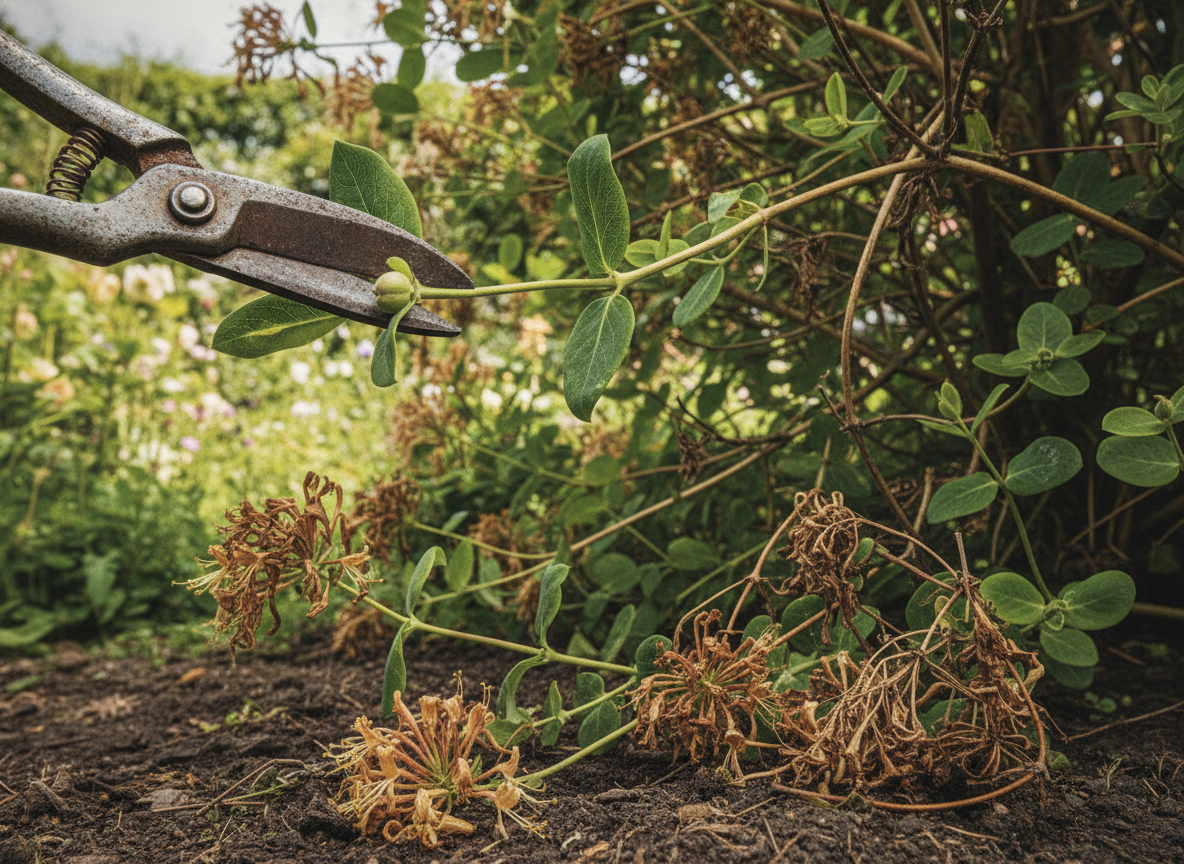
1. Shorten the flowered shoots by about a third. Run over the growth that just carried flowers and cut it back by roughly a third, always to a point just above a healthy pair of leaves or a side shoot pointing where you want growth. This keeps the plant in bounds and pushes it to make short flowering spurs rather than long bare whips. Don’t shear it like a hedge — going over the whole thing with trimmers removes the very wood that flowers and turns the plant into a leafy green ball with no scent.
2. Take out one or two of the oldest stems at the base. This is the move that actually cures the bare bottom. Each year, choose the one or two thickest, woodiest, most flowerless stems and follow them right down to near ground level, then cut them out completely. It looks brutal, but it forces the plant to throw fresh shoots from low down — and those low shoots are next year’s flowers, at a height you can actually smell. Over three years you replace the whole tired framework one stem at a time. It’s the same one-in-three logic that renews a weigela after flowering, applied to a climber.
As you go, tie any strong new growth in across its support rather than letting it bolt straight up. Honeysuckle flowers more freely when its stems are spread and trained sideways, for the same reason a climbing rose flowers along a horizontal cane instead of just at the top.
Don’t deadhead it to death
There’s a temptation to keep snipping every faded flower through summer. Resist it. The spent blooms on a honeysuckle ripen into clusters of red or orange berries that birds strip in autumn — one of the best things the plant does. Do your one proper prune after the main flush, then leave the rest alone to set fruit.
 A tightly woven ball of bare honeysuckle branches rests on the ground — AI-generated illustration
If it’s already a solid bird’s nest
Some honeysuckles are too far gone for a tidy — a metre-deep tangle of dead and live wood with a green wig on top. Don’t try to renovate that in summer. Wait until late winter (February is ideal), and cut the whole plant down hard, to about 60 cm from the ground. You’ll lose this year’s flowers, but the honeysuckle responds with a mass of vigorous new shoots from the base, and you start the framework again from scratch. Give it a mulch and a feed afterwards to fuel the regrowth.
While you’re in there, thinning a congested plant does one more quiet favour: better airflow. Honeysuckle is prone to powdery mildew and aphids when it’s crowded and dry at the roots, so an open framework plus a cool, mulched root run keeps it cleaner all summer.
The 30-second version
- Flowering now and fading by August? Early type — prune straight after flowering.
- Just starting and blooming into autumn? Late type — leave it till spring.
- Shorten flowered shoots by a third, to a leaf or side shoot.
- Cut one or two of the oldest bare stems right to the base — repeat yearly.
- Tie new growth sideways; don’t shear the whole plant.
- Leave most spent flowers to berry for the birds.
- Total tangle? Hard-renovate to 60 cm in February instead.
Not sure whether the honeysuckle on your fence is an early or a late type — and therefore whether to cut it today or wait nine months? Snap a photo with Cresco and it’ll identify the plant and tell you the exact pruning window for your variety and your local season, so you cut on the right week instead of guessing.