The June flop isn’t a watering problem — it’s the first flush finishing
By the second week of June your catmint has done the thing it always does: the neat blue-grey haze of late May has flopped open in the middle, the stems have peeled outwards from the centre, and there’s a bare, brown doughnut where the plant used to be full. Most people read that collapse as thirst and reach for the watering can. It isn’t thirst.
What you’re looking at is a Nepeta that has finished its first flush. The flower spikes are soft and top-heavy, the square stems that carry them are thin, and once the first wave of bloom is over those stems can no longer hold themselves up. They lean out, the centre opens, and the plant starts directing its energy into setting seed on the spent spikes. Watering a flopped catmint just gives you a wetter flopped catmint.
The fix is the same one that works on most early-summer perennials, and catmint responds to it faster and more reliably than almost anything else in the border: cut it back hard, now, and it rewards you with a clean second flush. The difference with catmint is how you cut it.
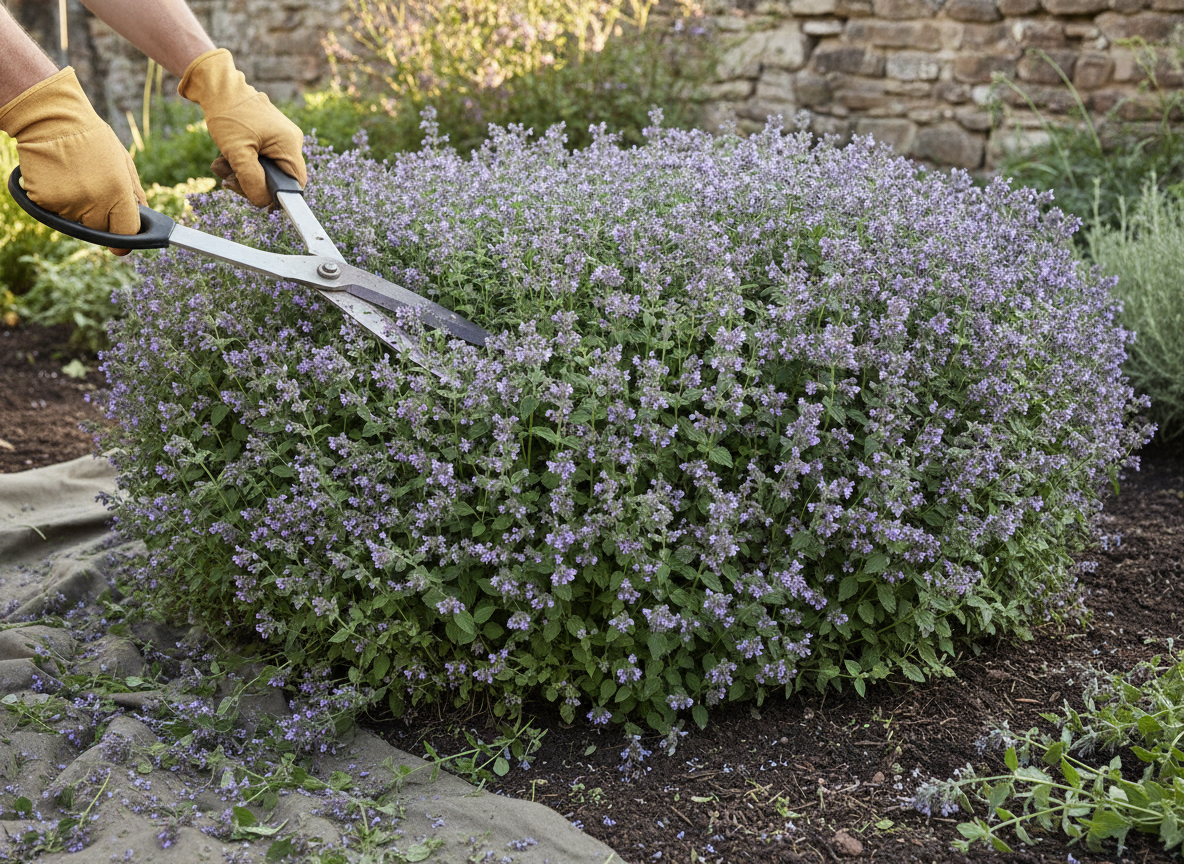 A person in gardening gloves uses shears to cut back a catmint plant — AI-generated illustration
Shear the whole plant — catmint is the rare perennial that wants a hedge cut
On most flowering shrubs, running the shears over the whole plant like a box hedge is exactly the wrong move — it’s why a sheared weigela flowers less every year instead of more. Catmint is the exception. You don’t pick out individual stems or hunt for buds. You take the shears (or a pair of one-handed grass shears, which is faster) and cut the entire mound back in one go.
Go hard. Cut the whole plant down to about 8–10 cm — a low green stubble of basal foliage. It feels brutal, especially while there’s still some blue left on the outer stems, but the new flush comes from the base, not from the old growth you’re removing. A timid trim that only takes the flower spikes off the top leaves a full-height, leggy plant with no reason to start again, and you’ll be looking at the same flopped doughnut in a fortnight.
If a clump is large and you want to keep colour in the border a little longer, you can do it in two halves a fortnight apart — shear the front half now and the back half once the front is regrowing — so you’re never staring at a bare patch. But the single hard cut over the whole plant is the standard, and it’s the one that gives the tidiest result.
Time it as the flowers go grey, not when they go crisp
The window is wide and forgiving, but the best moment is when the flush is going over, not gone. Watch the colour: catmint fades from blue to a dull grey-mauve as the florets drop, and when most of the spike has turned and the plant has started to flop, that’s your signal. In a normal Northern European year that’s the second or third week of June, earlier after a warm spring.
Cutting at the grey stage rather than waiting for fully brown, crisp seedheads matters for the same reason it does on delphiniums and lupins: the moment the plant finishes ripening seed, it reads its job as done for the year and the second flush gets weaker or doesn’t come at all. Cut while it’s going over and you interrupt the seed-set, redirect that energy into fresh basal growth, and get a second wave of flowers in roughly four to six weeks — so a mid-June cut flowers again from late July into August, just as the rest of the border goes quiet.
This is the same logic behind the Chelsea chop — only here you’re not chopping to delay the first flush, you’re chopping after it to buy a whole second one.
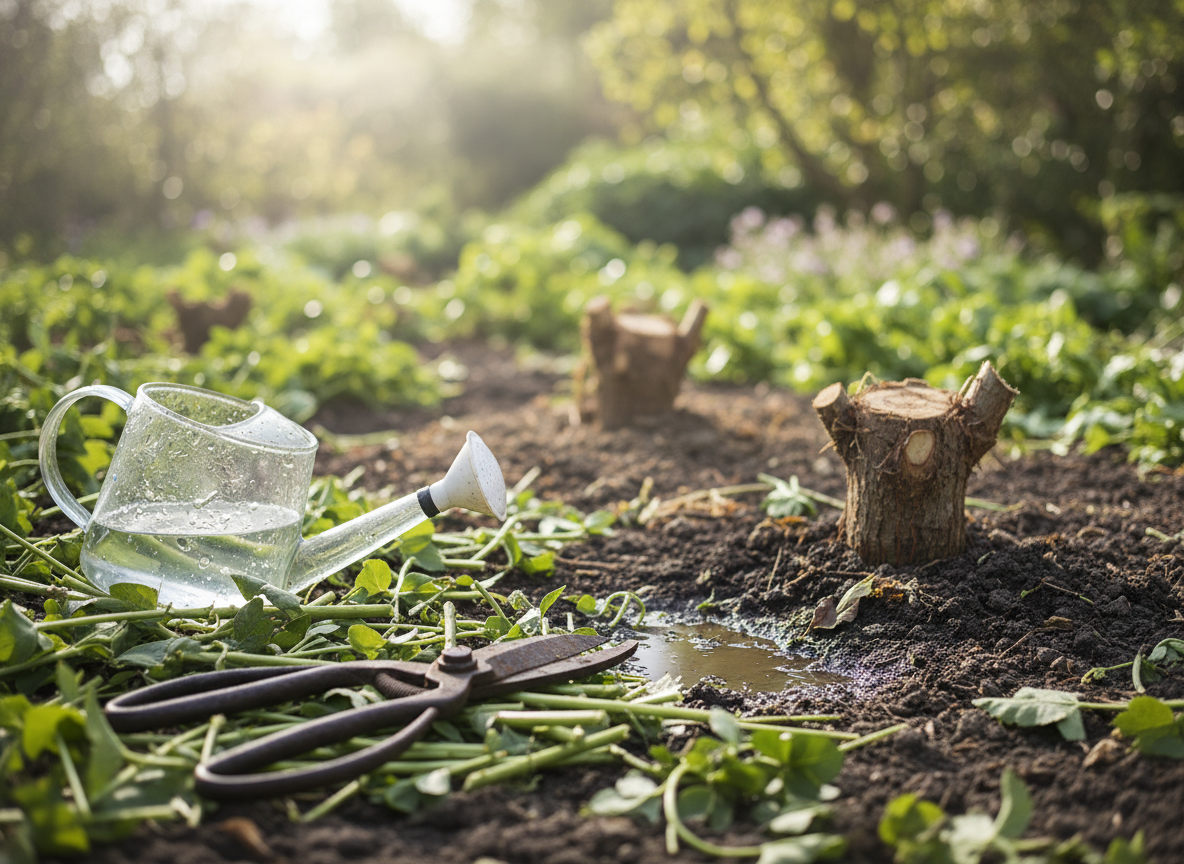 Garden scene with watering can, pruning shears, and cut plant stumps — AI-generated illustration
Feed and water the day you cut, then leave it alone
A plant you’ve just sheared to stubble needs two things to push a strong second flush: water and a light feed. If June is running dry — and it often does once the cut is done — give the clump a good soak, and scatter a handful of a balanced or potassium-leaning feed around the crown. Potassium drives flowering; a high-nitrogen feed just gives you soft floppy leaf, which is the problem you were trying to fix.
Don’t overdo the richness, though. Catmint flops worse on fat, overfed, overwatered soil than it does on a lean, sunny, free-draining spot — the soft growth is exactly what can’t hold itself up. So feed once after the cut to fuel the regrowth, then back off. Within a week or two you’ll see fresh grey-green shoots breaking from the base, and the plant rebuilds itself into a tighter, lower mound than the leggy thing you cut down.
The bees will forgive you — and so will the cats
Cutting catmint back hard in full flower feels antisocial when it’s covered in bees, and it’s worth knowing you’re not robbing them for long. The whole point of the cut is more flowering, not less: across a season, a sheared-and-reflushed catmint gives you something like sixteen to twenty weeks of bloom instead of the natural four to six, so the pollinators get a second helping in late summer when forage is getting scarcer.
If your patch is a magnet for next-door’s cats, the same cut helps there too — the bruised foliage releases the scent that draws them, so do the shearing on a day you’re happy to let them have their moment, and the regrowth settles down within a few days.
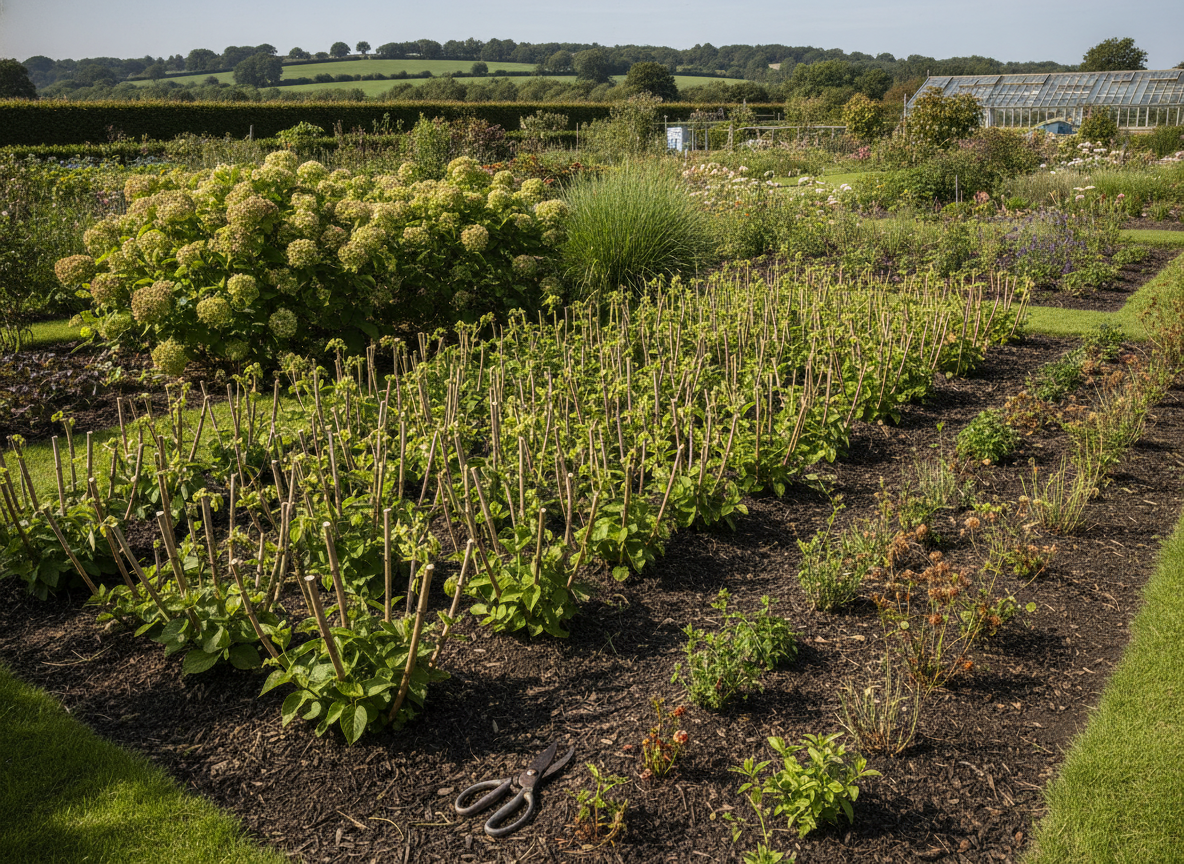 A formal garden with various plants, some recently cut back, under natural daylight — AI-generated illustration
Variety matters: the sterile ones reflush best
How well your catmint comes back depends partly on which one you have. The popular sterile hybrids — Nepeta ‘Walker’s Low’, ‘Six Hills Giant’, the faassenii types — put almost no energy into seed and rebloom hard and reliably after a cut. The older Nepeta racemosa / mussinii sorts self-seed more freely; cutting them back before the seed ripens does double duty, giving you the second flush and stopping a scatter of seedlings.
A genuinely floppy clump — usually ‘Six Hills Giant’, which is the biggest of the lot — can take an even harder cut, right down to a few centimetres, to force sturdier regrowth. And if you’ve planted catmint this spring, go gentler in its first year: deadhead the spent spikes to keep it tidy, but let a young plant build its roots rather than forcing it through a full chop-and-reflush cycle. From its second summer on, it’ll take the hard cut and pay you back twice a year.
What you actually get back
Done at the right moment, the mid-June shear buys you three things at once: it ends the flop and resets the plant into a neat low mound, it triggers a real second flush of blue just as high summer arrives, and it keeps a short-lived, self-seeding perennial vigorous for more years. It’s the easiest hard cut in the early-summer garden — one pass with the shears, a feed, a soak, and you’re done.
Not sure whether your Nepeta is one of the sterile rebloomers or a self-seeder, or whether a clump is established enough to take the hard cut? Snap a photo in the Cresco app and it’ll tell you what you’re looking at and exactly when its window opens.