Right now, in the second week of June, lady’s mantle (Alchemilla mollis) is doing the one thing it does better than almost any other plant in the garden: throwing up a haze of tiny chartreuse flowers above those pleated, water-catching leaves. After rain it holds beads of mercury along every leaf edge. It softens path edges, fills the awkward gap at the front of a border, and asks nothing of you. And that is exactly why it catches people out — because the froth that looks so good in the second week of June is also a countdown timer, and the day it browns over is the day it starts seeding itself into every crack in your paving.
The froth is a seed bomb on a timer
There is a reason you see lady’s mantle growing out of the mortar in old garden walls, out of gravel drives, out of the gap between a paving slab and a step. It is one of the most generous self-seeders in the temperate garden. A single established clump can ripen and scatter thousands of seeds, and those seeds germinate readily — in gravel, in lawn edges, in the crowns of other perennials, anywhere a seed lands and sits. One plant you bought in 2023 becomes a colony by 2027.
The froth is the warning. While the flower heads are that fresh, electric lime-green, no seed has ripened yet — the plant is still flowering. But Alchemilla moves fast. Within a couple of weeks of peak the heads dull to a muddy khaki, then to brown, and at that point the seed is viable and starting to drop. The cut you make is a race against that colour change. Make it while the heads are fading but before they brown, and you remove the entire seed crop in one pass. Leave it two weeks “to see how it goes” and you have signed up for a decade of weeding seedlings out of the gravel.
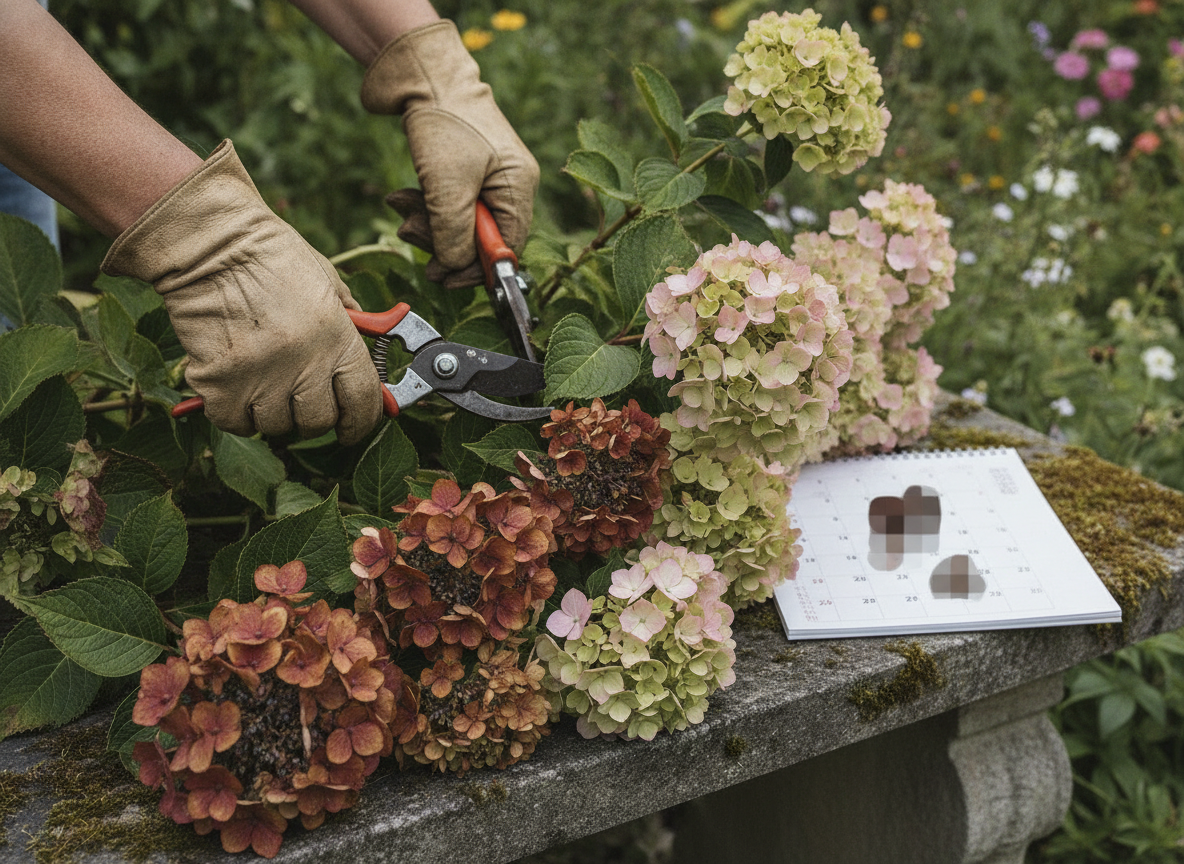 A gardener prunes hydrangeas next to a calendar — AI-generated illustration
When to cut: read the colour, not the calendar
Every guide gives you a month, and the month is wrong as often as it’s right, because lady’s mantle flowers on its own schedule depending on how warm your spring was and how much sun the clump gets. A clump in full sun on a south wall may be browning by the second week of June; the same cultivar in light shade may still be pristine in early July. So ignore the calendar and read the plant.
The trigger is colour. Walk up to the clump and look hard at the flower heads:
- Bright, uniform lime-green — peak flower. Leave it. This is the clump at its best and there is no seed to worry about yet.
- The first heads dulling to a tired yellow-green or khaki, the froth losing its sparkle — this is the window. Cut now.
- Brown, dry, papery heads that shed a fine dust when you brush them — you’ve left it too late for clean prevention. Cut anyway, but do it carefully and bag the heads rather than letting them fall (more on that below), because every one of those heads is already shedding seed.
In a normal Northern European year that window lands somewhere between mid-June and the first week of July for most clumps. The point is that you let the plant tell you, not the calendar. It’s the same principle behind cutting oriental poppies the moment they collapse rather than on a date — the plant’s colour is a more honest signal than the month.
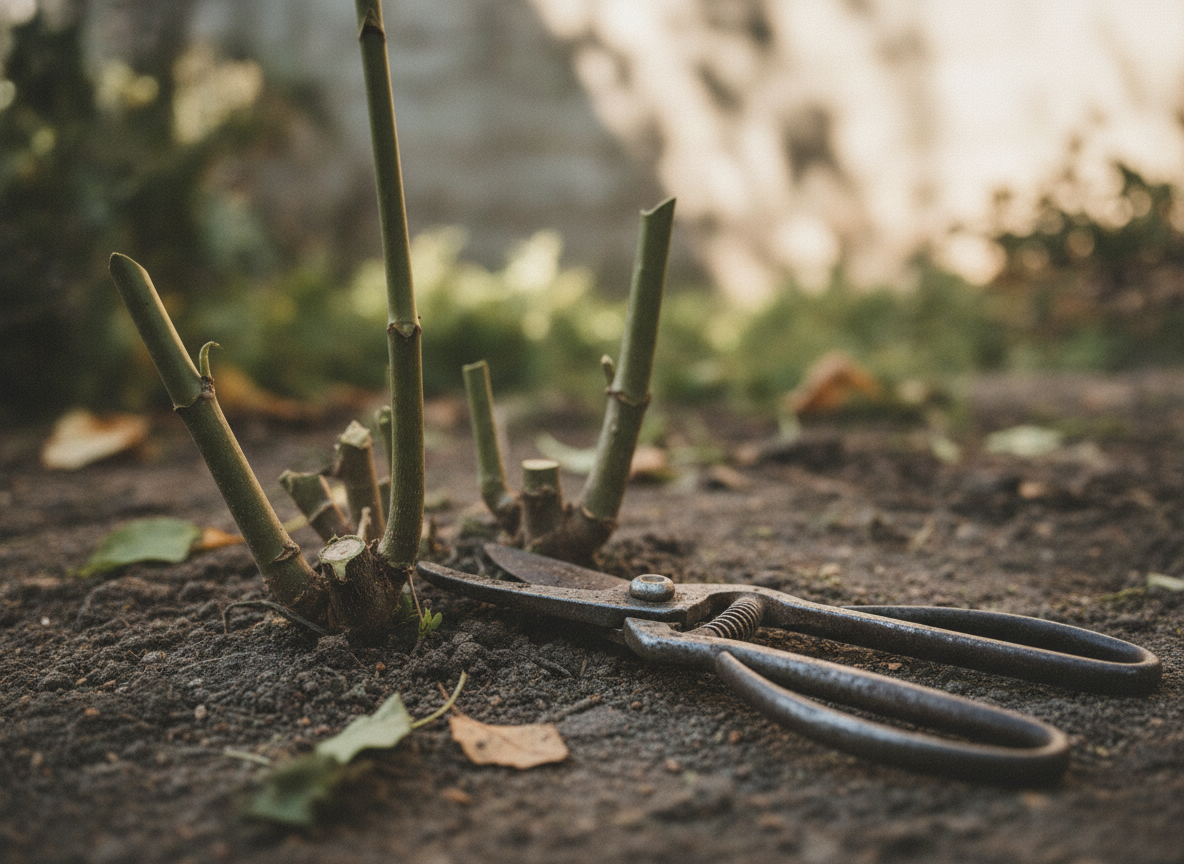 Garden shears rest on the ground next to a cut plant — AI-generated illustration
The cut: shears to the ground
This is one of the most satisfying ten minutes in the June garden, because the right cut is brutal and the plant loves it.
Take a pair of garden shears — not secateurs, which will have you picking at it stem by stem for half an hour. Gather the whole clump in one hand like a ponytail if it helps, and shear the lot off: every flower stem and every leaf, down to about five centimetres above the crown. Don’t pick and choose. Don’t try to save the leaves that still look fresh. The whole point is a clean reset, and the new foliage that comes up will be better than anything you’d be saving.
You have two levels of cut, and which you choose depends on what the clump is doing:
- The full chop (most clumps). Everything to five centimetres. Use this when the foliage has gone tired and floppy as well as the flowers — which by late June, after a dry spell, it usually has. Within two to three weeks the crown pushes a completely fresh mound of those pleated leaves, half the size of the old clump and twice as crisp, and it stays neat right through to autumn.
- The deadhead-only cut (pristine foliage). If the leaves are still genuinely good and only the flowers are fading, you can take just the flower stems back into the foliage and leave the leaf mound. This still removes the seed crop. But be honest about the leaves — nine times out of ten the full chop gives you a better-looking plant by July.
Either way, the non-negotiable part is removing the flower heads before the seed ripens. That’s the job. The fresh foliage is the bonus.
What you get back
The full chop isn’t just damage control on the seedlings — it’s the same renewal trick that works on so many early-summer perennials. Cut the clump hard now and three things follow over the next month.
First, a fresh mound of foliage. The crown pushes new pleated leaves within two weeks, and because they come up after the longest days, they stay compact and well-coloured rather than the loose, yellowing sprawl an uncut clump turns into by August. That fresh mound is what carries the plant looking good all the way to the first frosts.
Second, in a kind year, a second flush of flowers. It won’t match the June display — expect a lighter scattering of lime-green sprays in late summer rather than a full haze — but it arrives when much of the border is tired, and it costs you nothing. This is the same principle as the late-May chop that buys hardy geraniums a second show: cut a clump-forming perennial hard just after its first flush and you trade a tired mid-summer plant for a fresh, reblooming one. Lady’s mantle responds to it as reliably as any cranesbill.
Third, a tidier garden with less work. An uncut clump browns, flops over its neighbours, sets seed, and gives you a season of weeding. A cut clump sits as a neat green cushion. The ten minutes with the shears in June is the cheapest weeding you’ll ever do.
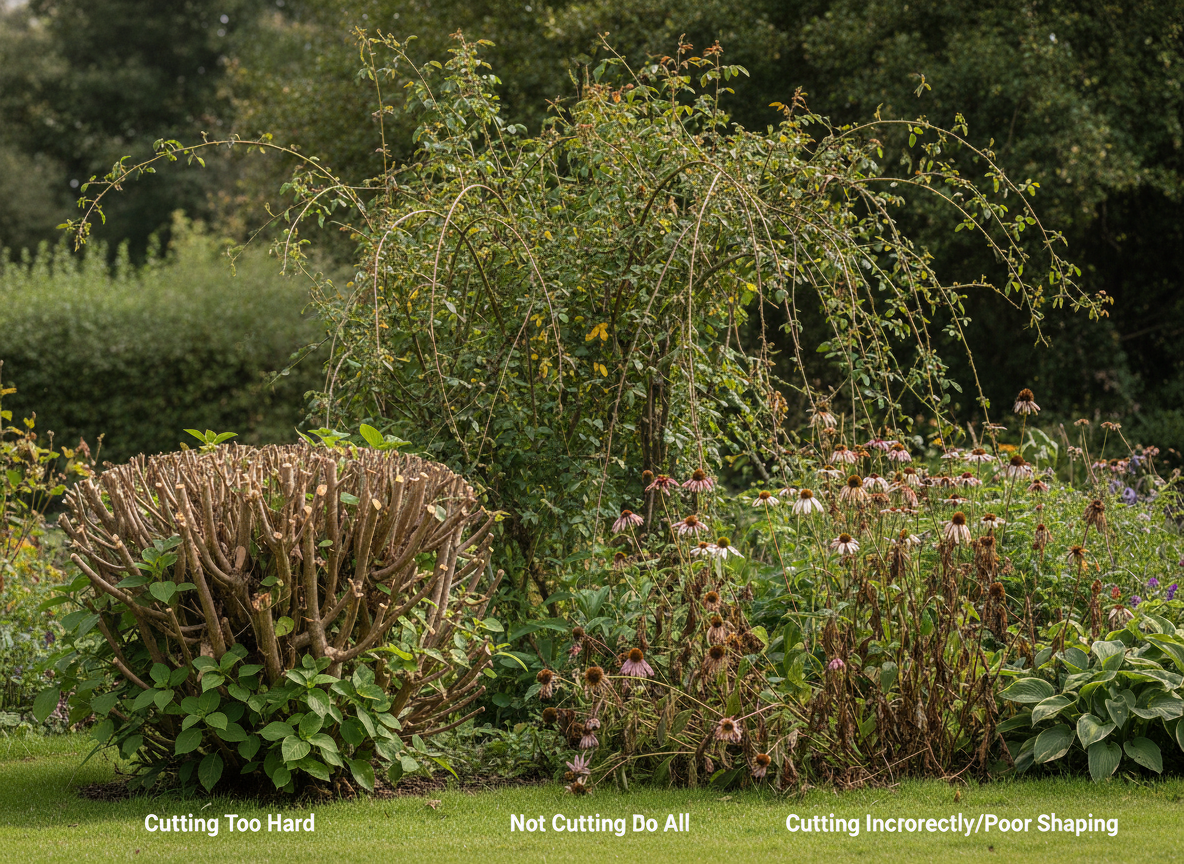 A garden scene illustrating three plant cutting mistakes — AI-generated illustration
The three mistakes
Leaving it “just a bit longer.” This is the one that costs you. The froth is so pretty that the temptation is always to enjoy it for one more week — and one more week is often the week the seed ripens. If you’re going to err, err early. A clump cut at peak flower will simply reflower; a clump cut too late has already sown next year’s problem.
Composting the seed-laden heads on a cold heap. If you’ve caught the clump while still green, the trimmings are fine on any compost heap. But if you’ve left it late and the heads are browning, those heads are full of viable seed, and a cool domestic compost heap won’t kill it — you’ll spread lady’s mantle wherever you barrow the compost. Bag late, browning heads for the council green waste, or hot-compost them. Don’t mulch your borders with your own seed bank.
Picking at it with secateurs. Lady’s mantle has dozens of fine stems, and going at it flower by flower turns a ten-minute job into a tedious hour, which is exactly why so many gardeners put it off until it’s too late. Shears, one handful at a time, done. Speed is what gets the job done inside the window.
Plan the cut so you don’t miss the window
The whole game with lady’s mantle is timing, and timing is precisely the thing that’s easy to lose track of when every plant in the garden is doing something different in June. The same week the Alchemilla needs cutting, the aquilegia is asking for its hard cut to the ground and half the border is in flux.
That’s the gap Cresco is built to close. Tell it what’s in your garden and it builds a personalised pruning schedule around your plants and your local weather — so instead of remembering that lady’s mantle needs cutting “before the seed browns,” you get a reminder in the right week, every year. Snap a photo, get the plant identified, and let the schedule keep the colour-change window from slipping past you.
Cut it while it’s fading, before it browns, and lady’s mantle goes from a self-seeding nuisance to one of the most generous, least demanding plants you own.