Bowles’s Mauve and the other perennial wallflowers (Erysimum) are the plants that never seem to stop — mauve spires from early spring to the first frosts, and a scattering of flowers in between. That non-stop flowering is exactly why they burn out. Push a plant to bloom for ten months of the year and it has nothing spare to build a solid frame, so within two or three seasons the base goes bare and woody, and the whole plant splays open from the middle like a dropped bunch of flowers.
You can’t stop that clock, but you can slow it. The trick is a light trim now, in late summer, and a completely different mindset from the hard prune you’d give a shrub.
Why they go woody so fast
A perennial wallflower isn’t really a perennial in the tough, comes-back-forever sense. It’s a short-lived sub-shrub — closer to lavender than to a hardy geranium — and it quite literally flowers itself to death. All that energy goes up into bloom spikes instead of down into strong basal growth, so the lower stems lignify (turn to bare wood) and stop producing leaves.
Left alone, a plant like Bowles’s Mauve looks superb in year one, good in year two, and by year three it’s a leggy, gappy mess with a fistful of flowers waving on top of naked stems. That’s normal. It isn’t a disease and it isn’t your fault — it’s the plant’s short lifespan showing through.
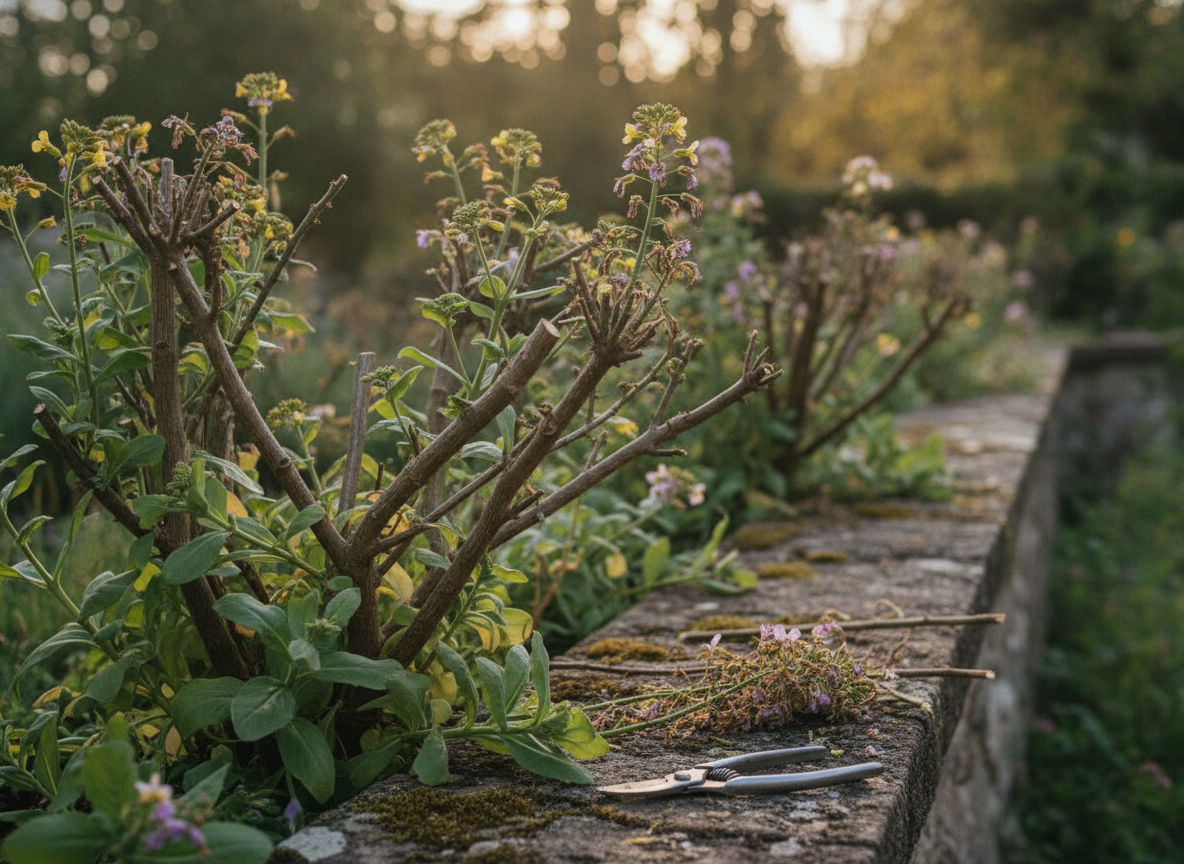 Wallflower plants with woody stems and pruning shears on a stone wall — AI-generated illustration
The late-summer trim: little and often
The single best thing you can do is shear the plant lightly after its main summer flush and keep doing it. Not a hard chop — a haircut.
- Go over the whole plant with clean secateurs or shears.
- Take off just 2–3 cm, and never more than 5 cm of top growth in one go.
- Snip out any fully spent flower spires as you find them.
That light, regular trimming forces short new side-shoots low down and keeps the plant bushy instead of bolting straight up. It’s the same “little and often, stay in the green” approach that keeps lavender and cistus compact. Late summer is a good moment because the biggest flush is over, but there’s still enough warmth for the plant to firm up its new growth before autumn.
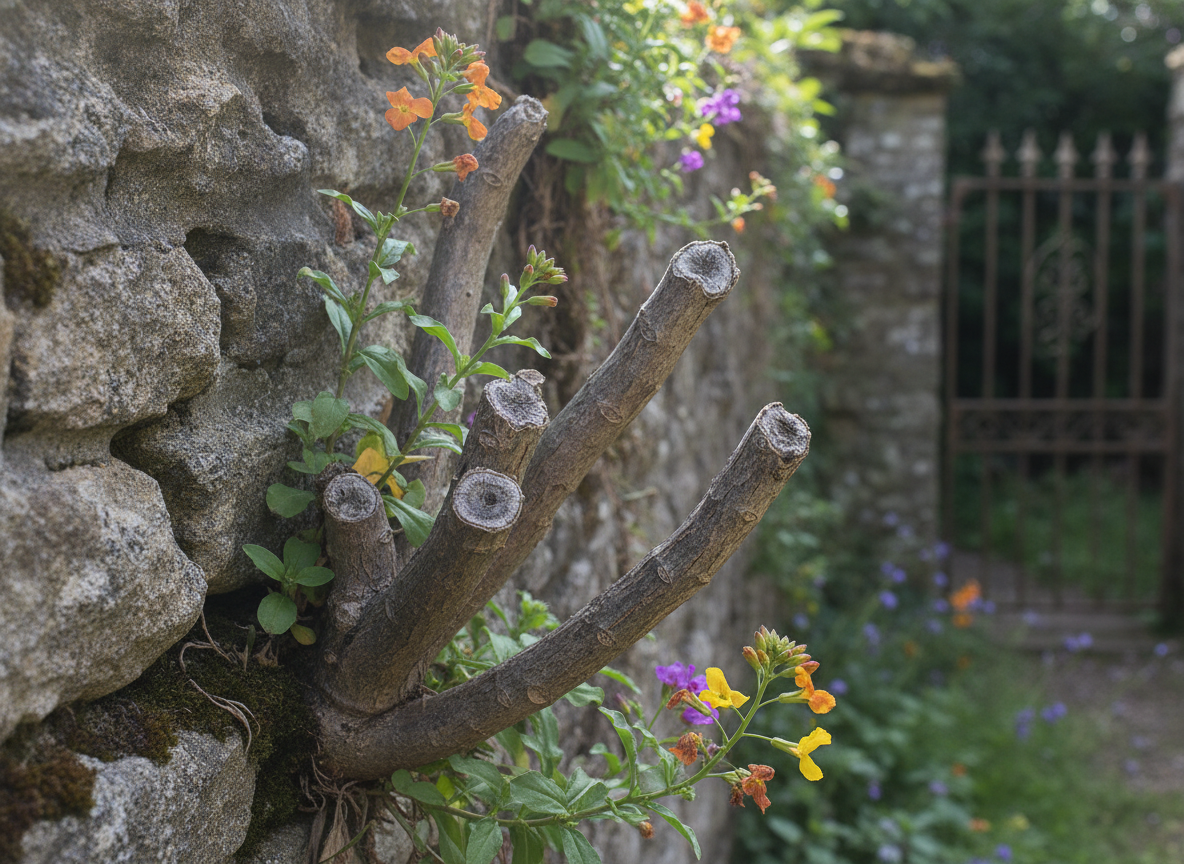 Cut woody stems of wallflowers against a stone wall and garden gate — AI-generated illustration
The cut that never grows back
Here’s the mistake that finishes off more wallflowers than any pest: trying to rejuvenate a leggy plant by cutting it hard, down into the bare woody stems.
Don’t. Like hebe, lavender and cistus, perennial wallflowers will not reshoot from bare old wood. There are no dormant buds waiting in those leafless brown stems. Cut into them and you either kill the plant outright or leave a permanent bald patch that never fills back in.
So the rule is simple: only ever cut into growth that still carries leaves. Keep your blades in the soft green part of the plant. If the base is already bare and woody, no amount of pruning brings it back — which is exactly why the next step matters so much.
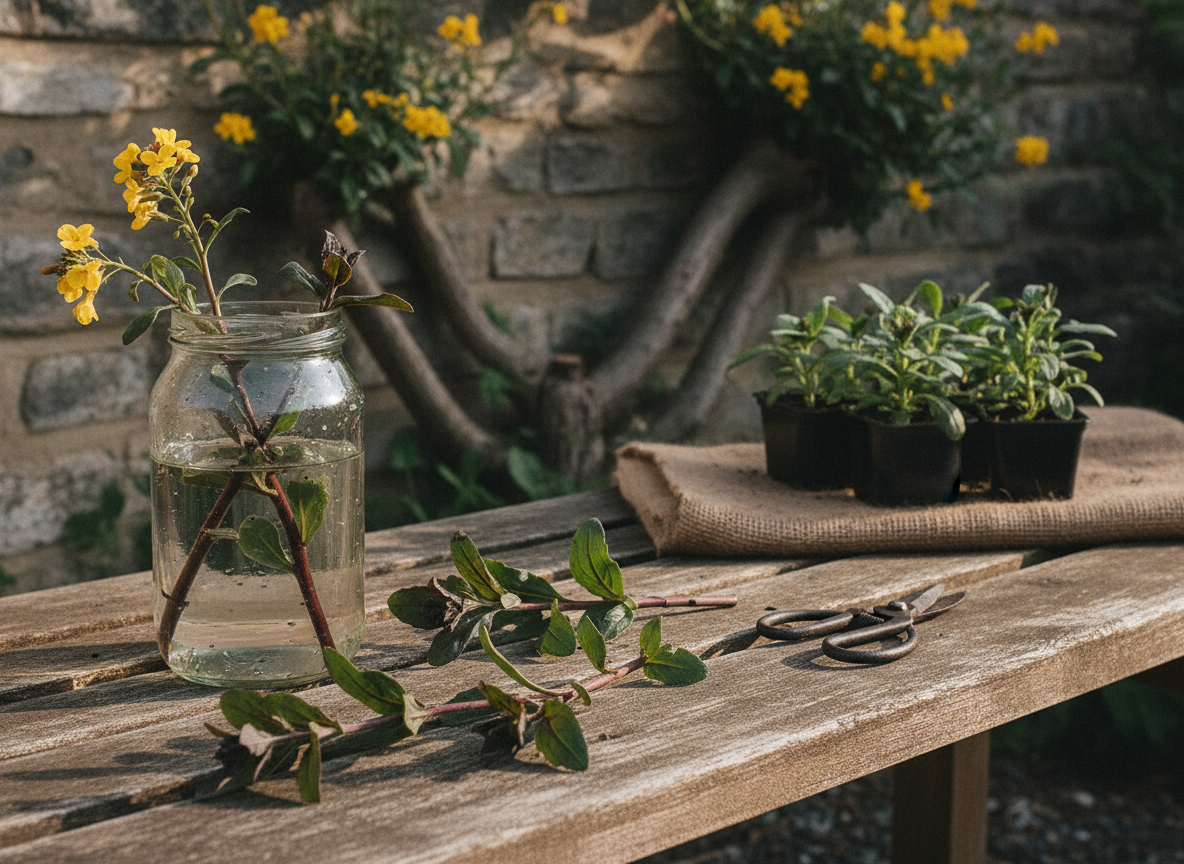 Wallflower cuttings in a jar, with rooted seedlings and pruning shears on a wooden bench — AI-generated illustration
Take cuttings now — your real insurance
Because a wallflower is short-lived by nature, the smart gardener doesn’t try to keep one plant alive forever. You keep a production line going instead. And these root almost embarrassingly easily.
Late summer is a fine time to take semi-ripe cuttings:
- Pick a healthy, non-flowering shoot about 8–10 cm long.
- Trim just below a leaf joint and strip the lower leaves.
- Push several around the edge of a pot of gritty, free-draining compost.
- Keep them somewhere bright, sheltered and out of harsh sun.
Most will root within a few weeks, and you’ll have young, vigorous plants to drop in next spring — right about when the parent starts looking tired. Do this every year and you’ll never be without a wallflower in its floriferous prime. It’s the same principle behind the whole Cresco pruning calendar: small, well-timed jobs beat one dramatic rescue.
What to do this week
- Give the whole plant a light shear — 2–3 cm off, no more than 5 cm.
- Snip out fully spent flower spires.
- Never cut down into bare, leafless wood.
- Take three or four semi-ripe cuttings as insurance.
- Leave the feeding — soft, forced growth going into autumn is the last thing a wallflower needs.
Get into this rhythm and Bowles’s Mauve keeps its shape, keeps flowering, and quietly replaces itself before you ever notice it fading.