The bed has given you its last bowlful. The leaves are going leathery, blotched with rust and grey-brown spots, and the whole patch has that tired, spent look that says the season’s over. Most gardeners leave it exactly like that until spring — and quietly wonder why next June’s crop is smaller and mouldier than the last. The plants aren’t asking to be left alone. They’re asking to be cut back hard, right now, while there’s still warmth in the soil to grow a fresh set of leaves before winter.
It feels wrong. You take shears to a plant that looks perfectly alive and reduce it to a row of stubby crowns and bare stalks. But this one late-summer job — gardeners call it renovation — is the difference between a patch that slides into decline over three years and one that fruits heavily for four or five. Here’s how to read your bed, where to make the cut, and the single mistake that turns renovation into an execution.
First, check which strawberries you have
This job is for summer-fruiting (June-bearing) strawberries — the ones that gave you a big, concentrated flush of fruit in early summer and are now done. Those are the plants to shear.
It is not for perpetual or everbearing types (sold as “everbearer” or by names like Albion, Mara des Bois, Malling Opal). Those crop in waves right through into autumn, and there may still be flowers and green fruit on them now. Shear those and you throw away the second half of their season. If your plants are still setting fruit in late August, leave them be — just pick, tidy stray leaves, and feed.
Not sure which you’ve got? Look at the plant. Nothing but old leaves and finished stalks means summer-fruiting and ready. Fresh flowers or ripening berries means everbearing and off-limits.
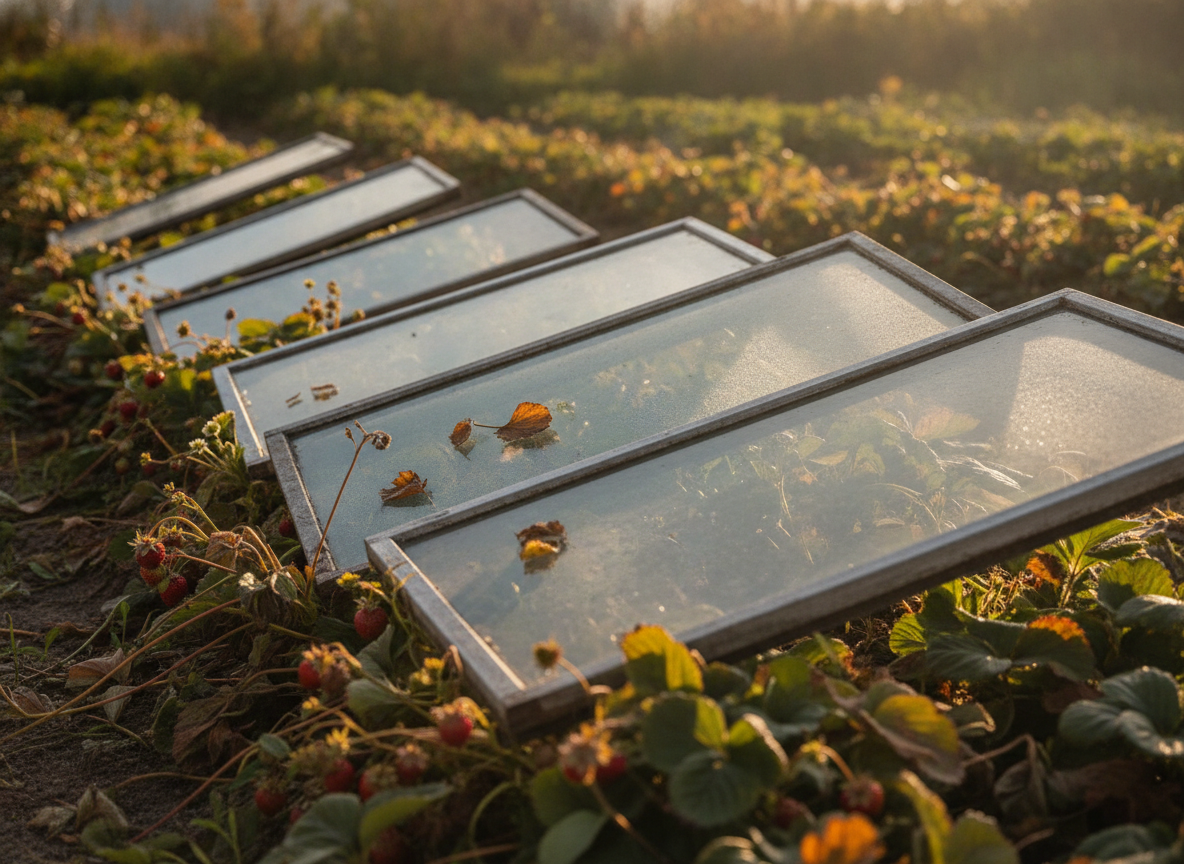 Glass frames covering strawberry plants in a field — AI-generated illustration
The window: as soon as they’ve finished, and no later than early September
The clock that matters isn’t the calendar — it’s the soil. Renovation works because the plant, stripped of its old leaves, throws up a flush of clean new foliage and quietly stocks the crown with the reserves that become next year’s flower buds. That regrowth needs warm soil and a good stretch of daylight to happen.
So the rule is simple: shear as soon as the last berries are picked, and get it done while there’s still real warmth in the ground — in most Northern European gardens that means through August and into the first week or two of September at the very latest. Leave it until October and the plant sits there shorn and sulking, with no time to rebuild before the cold shuts growth down. Done in good time, you’ll see fresh leaves within two to three weeks.
If your patch was disease-free and you’re right at the edge of the window, you can skip the leaf-shearing and just do the tidy-up below. The shearing is most worth it where mildew, leaf spot or red-brown blotches took hold this summer — cutting the foliage away removes the spores wholesale.
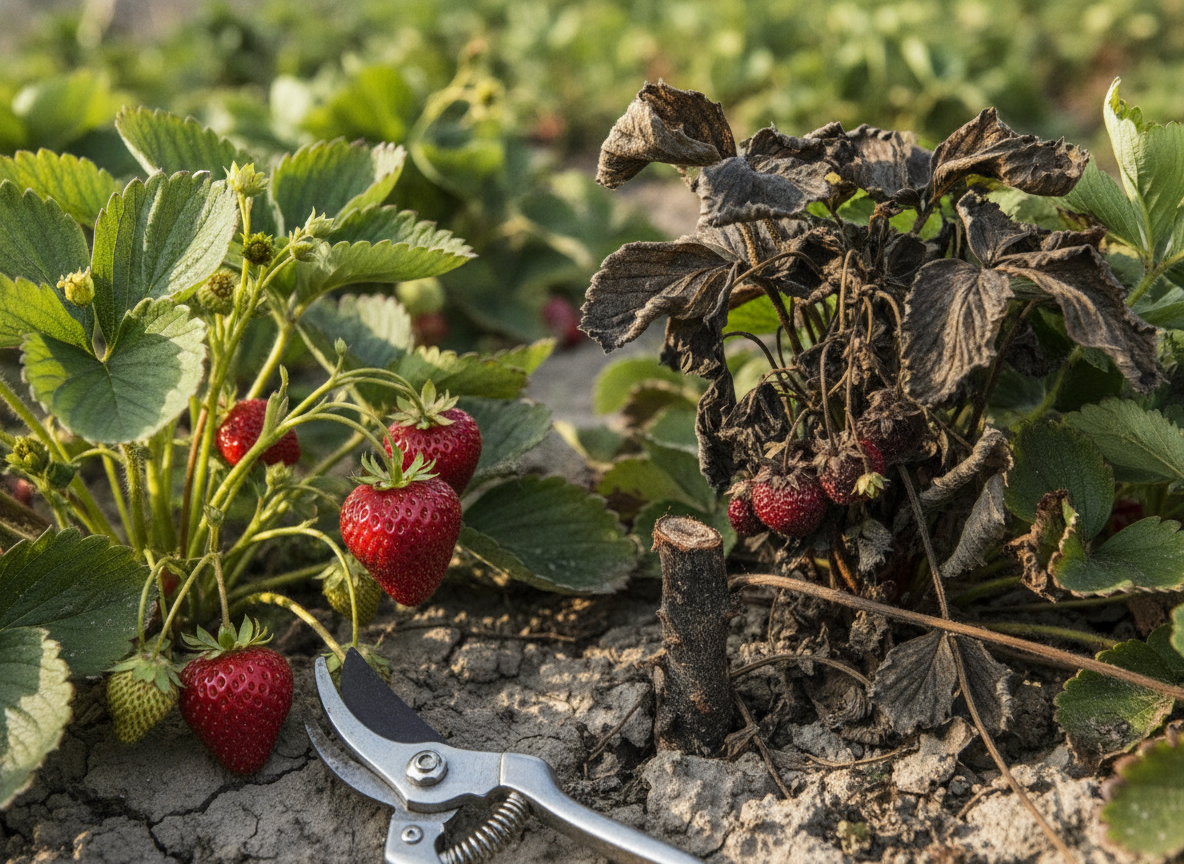 A strawberry plant with ripe fruit, a dead strawberry plant, and pruning shears — AI-generated illustration
Where to cut — and the one that kills them
Here is the whole technique, and the warning that matters most:
- Grab a handful of leaves and shear the foliage off about 8–10 cm (a hand’s width) above the crown. Old shears or secateurs are fine; for a big bed, a strimmer or the mower on its highest setting does it in minutes.
- Never cut into the crown itself. The crown is the fat, congested nub where leaves and roots meet — the plant’s entire growing point lives inside it. Nick it, mow it flat, or shear too low and you don’t renovate the plant, you decapitate it. When in doubt, cut higher. A little old leaf left behind is harmless; a scalped crown is dead.
- Rake up every scrap of the cut leaves and bin them (don’t compost diseased foliage). You’re removing this year’s fungal spores along with the leaves, so leaving them lying in the bed defeats the point.
That crown line is the difference between the two outcomes in this whole post. Everything above it is disposable and grows back. Everything at or below it is the plant.
Deal with the runners while you’re in there
By now each plant has probably thrown out a tangle of runners — long red stems with baby plantlets at the tip. They’re a decision, not a nuisance.
- Want new plants for free? Peg down three or four of the strongest plantlets into the soil (or into small pots of compost sunk beside the parent) with a bent wire or a stone. Leave them attached until they’ve rooted, usually a few weeks, then snip the umbilical stem and you’ve got young plants to widen the bed or start a fresh one next year. Strawberries lose vigour after three or four years, so having replacements coming is how you keep a patch productive indefinitely.
- Bed already full? Cut every runner off at its base. Each one you leave is energy the plant spends on offspring instead of on next year’s crown and fruit.
Either way, don’t just let them ramble. An unmanaged strawberry bed turns into a matted thicket in two seasons, and a crowded, airless patch is exactly where the mildew you just sheared away comes straight back.
 AI-generated illustration
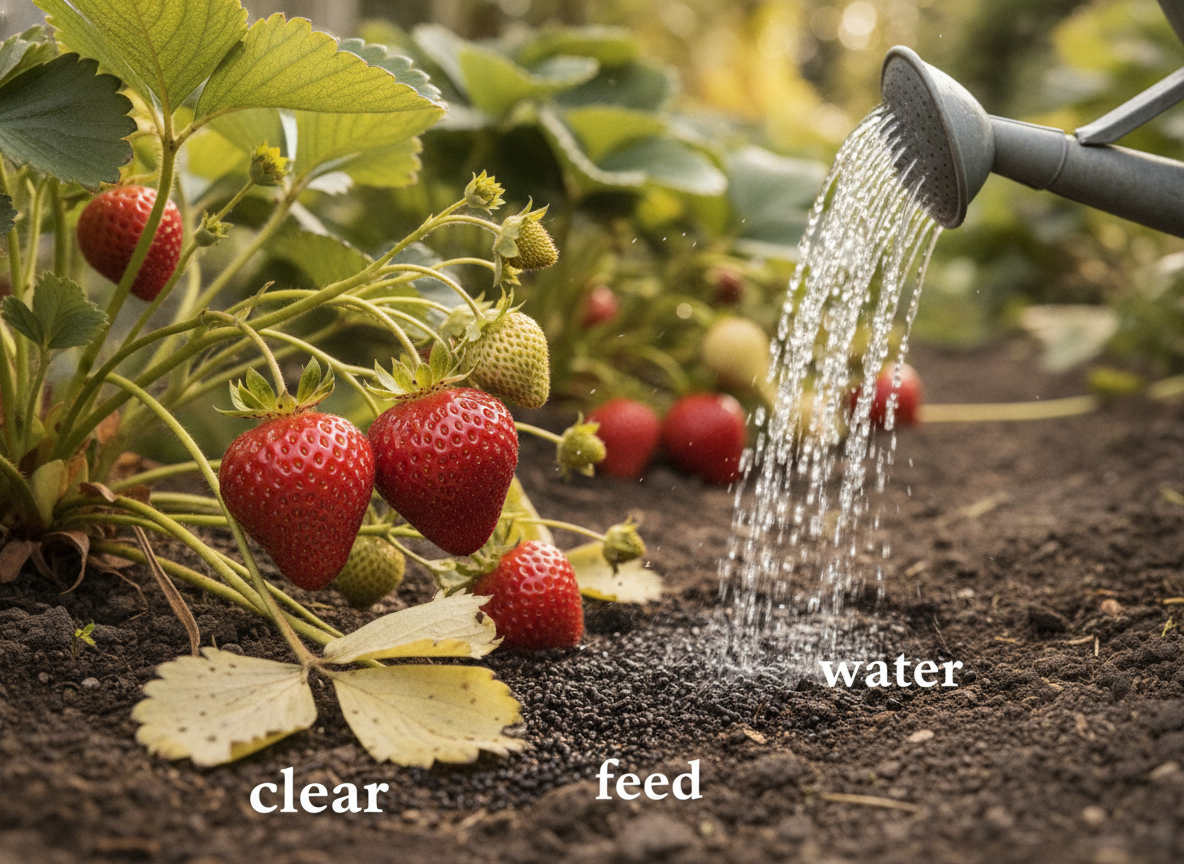
Finish the job: clear, feed, water
Shearing is half of renovation. The other half is the reset around the plants:
- Clear the bed. Pull out weeds and rake away the old straw or mulch you tucked under the fruit in early summer — it’s harbouring slugs and spores now.
- Feed lightly. A scattering of a balanced general fertiliser (or a potassium-rich one) fuels the new leaves and the flower buds forming inside the crown. Skip high-nitrogen feeds, which push soft growth that won’t harden before frost.
- Water it in. Dry soil after shearing stalls the regrowth you’re trying to trigger. A good soak gets the new leaves moving.
- Re-mulch once growth restarts, not before, so you’re not sealing weed seeds and damp against freshly cut crowns.
Do all that and by mid-autumn the bed looks green and furnished again — low, tidy, and stacked with the reserves that become next June’s fruit.
The pattern behind the cut
Renovating strawberries is the same logic that runs through most of high-summer fruit pruning: once a plant has finished cropping on old growth, you clear that spent growth away to force clean, healthy new growth for next year — while the season still has the warmth to make it. It’s the same read behind cutting the fruited canes out of summer raspberries and taking out the blackberry canes that just fruited: old wood off, new growth on. And if you’re starting a fresh patch from those pegged-down runners, the first-year flower-pinching rule is what turns them into heavy croppers.
The hard part is never the cut — it’s knowing which plant wants it, where the crown starts, and how many weeks of warmth you’ve got left to pull it off. Cresco reads your exact strawberry type, your bed’s history and your local forecast, and tells you whether to shear this week or leave the everbearers cropping — plant by plant, garden by garden. Get your pruning calendar at cresco-pruning.com.