The one conifer that grows back from brown
Every fast green hedging conifer plays by the same unforgiving rule. Leyland cypress, Lawson’s cypress, Thuja, Cupressus — cut any of them back into the bare brown wood behind the green shell and that patch stays brown forever. There are no dormant buds left in the old wood to break, so the scar never re-greens. It’s the single fact that makes a runaway leylandii almost impossible to rescue.
Yew (Taxus baccata) is the great exception, and it’s not a small one. Cut a yew hedge right back to bare, leafless brown stems — even, in a full renovation, back to the naked trunks — and within a season or two it pushes fresh green growth straight out of wood that on any other conifer would simply die. Yew keeps living, dormant buds hidden under the bark of its old stems, and when light reaches them again they break. That one difference is why yew is the hedging conifer you can keep for a lifetime and reshape when it outgrows its spot, while a leylandii that’s grown too wide can only be reduced in height or torn out.
So if you own a yew hedge, you’re holding the one evergreen screen that forgives you. You can cut it harder, correct old mistakes, and bring a neglected hedge back from bare wood — the exact move that’s fatal on the leylandii and cypress hedges that can’t take it. The trick is doing the right kind of cut at the right time of year, because a yew hedge actually has two very different cuts.
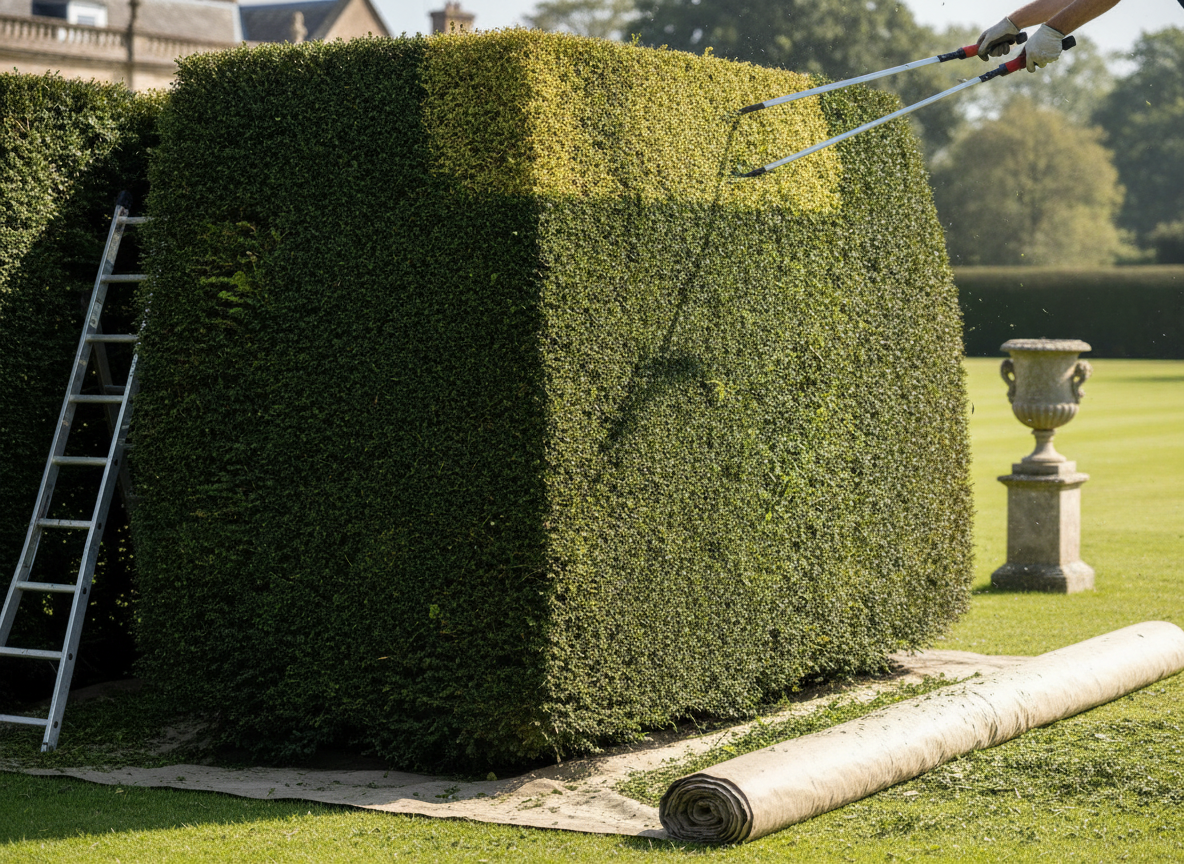 A gardener trims a large yew hedge with long shears — AI-generated illustration
When a yew hedge gets its once-a-year cut
For an established yew hedge, the shaping trim is a once-a-year job, and the window is late summer — roughly August into September across the Netherlands, Belgium and the southern UK. That timing is deliberate. Yew makes most of its new growth in a single flush in late spring and early summer; by August that growth has firmed and slowed, so a cut taken then holds its crisp line right through autumn and winter without triggering a soft second flush that the first frosts would scorch.
That’s why a yew hedge is one you don’t rush to cut in early July. The soft new growth is still extending, and trim it now and the hedge answers with another burst of pale, tender shoots that blur the clean edge by autumn and go into winter frost-tender. On an established hedge, hold off a few weeks and let late summer do the work — the cut will last twice as long and look far sharper.
The one exception is tight formal shapes — clipped topiary, crisp geometric hedges and cones. Those are often trimmed twice: a light tidy in early summer to hold the edge, and the main cut in late summer. If you’re keeping a sharp architectural line, a gentle going-over now is fair; if it’s a screening hedge, wait for August.
And before the shears come out at all, check for nesting birds. Dense yew is prime nesting cover, and across most of Northern Europe it’s an offence to cut a hedge while birds are actively nesting — the main season runs to the end of July. By the late-summer window most broods have fledged, but part the foliage and look along the length first anyway.
Why yew breaks the conifer rule
It’s worth understanding why yew can do what no leylandii can, because it’s the whole reason the hard cut is safe. Most conifers carry their growth buds almost entirely within the current green, photosynthesising foliage. Once an inner stem is shaded out and goes brown and twiggy, it holds no living buds — cut back to it and there’s nothing left to grow. That’s the dead zone inside every cypress hedge.
Yew is built differently. It retains dormant epicormic buds beneath the bark of its old stems and even its main trunk — buds that sit there for years, doing nothing, until something removes the growth above them and lets in light. Cut a yew hard and you trigger exactly that: within weeks, a fuzz of fresh green shoots breaks straight out of what looked like dead brown wood. It’s slow — yew is not a fast plant — but it is reliable. You genuinely do not have to worry that a hard-cut yew won’t turn green again. It will.
This single trait is why yew, alone among the common hedging evergreens, can be renovated rather than replaced. It’s the reason old English gardens still carry yew hedges and topiary a century or more old: they’ve been cut back to the frame and rebuilt more than once over their lives.
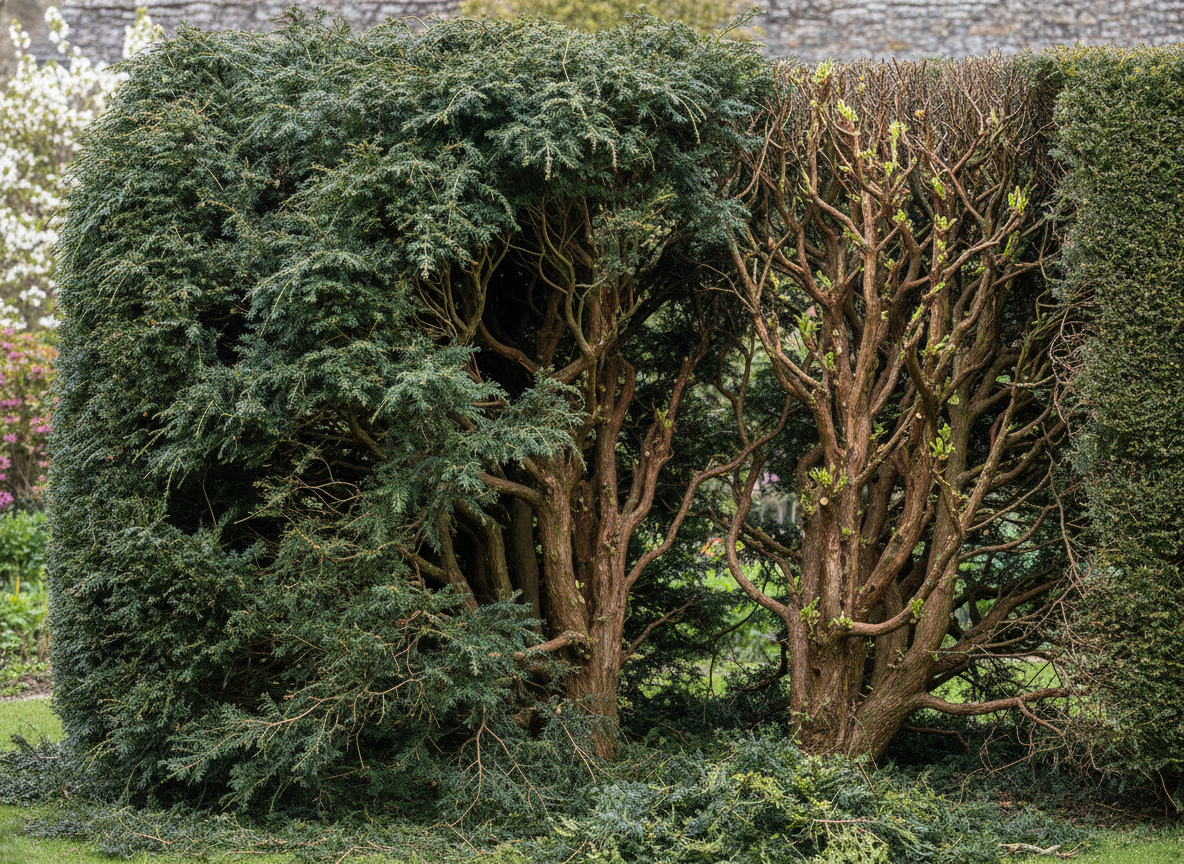 Overgrown yew hedge before and after renovation cut — AI-generated illustration
The renovation cut: bringing an overgrown yew back
Here’s the payoff for owning the forgiving conifer. If your yew has grown too wide, too tall, or bare and gappy at the base, you can cut it hard back into the old wood — the one move you must never make on leylandii — and it will re-clothe itself.
But the renovation cut is not the late-summer job, and it is emphatically not a midsummer one. Take a yew hard back in the July heat or in late summer and the tender new shoots it pushes won’t have time to harden before the frosts, and they’ll burn. Do the hard cut in spring, as the plant comes into growth — around April (late winter, February–March, also works). A spring cut gives the hedge the entire growing season ahead of it to push new shoots and green over the bare wood.
How much you can take depends on the plant and your nerve:
- Up to about half in one go. A healthy, established yew will take a reduction of up to roughly half its size in a single spring cut and bounce back.
- More than half — stage it. To bring a big, broad old hedge right back to its framework, don’t do it all at once. Cut one face the first spring, the other face the next, and the top last, so the hedge always keeps enough living green on some side to power its recovery.
- Feed and water afterwards. Renovation is a big ask of the plant. Mulch, water through dry spells, and a spring feed all help it re-clothe faster.
Then be patient. Yew grows only 10–15 cm a year, so a renovated hedge takes two or three seasons to look solid and dense again. But it will — from bare brown wood — and that’s a promise no other hedging conifer can make.
Making the shaping cut clean
For the ordinary late-summer trim on an established hedge, the same craft that earns a good finish on any hedge applies:
Cut a batter. Like any tall hedge, a yew wants an A-frame — slightly narrower at the top than the base, faces leaning gently inward. This keeps light on the lower foliage so the hedge stays clothed to the ground, and it sheds snow that would otherwise splay the top open. A lean of 10–15 cm over a 2 m hedge is plenty.
String line the top, work top-down, step back often. Cut the top to a taut line first, then the faces, and step back every few metres — a dense hedge reads as one mass, and a bulge you can’t see at arm’s length shows from across the garden.
Sharp blades, cloudy day. Bruised yew foliage browns at the cut, so sharpen the trimmer or use hand shears on the fine outer growth, and trim on a dry, overcast day rather than in blazing sun. Water a dry hedge a day or two beforehand.
And here’s the quiet luxury of yew: unlike a leylandii, an accidental nick a little too deep into older wood isn’t fatal. It will green over. That margin for error — the freedom to cut without fear of a permanent brown scar — is yew’s real gift to the gardener.
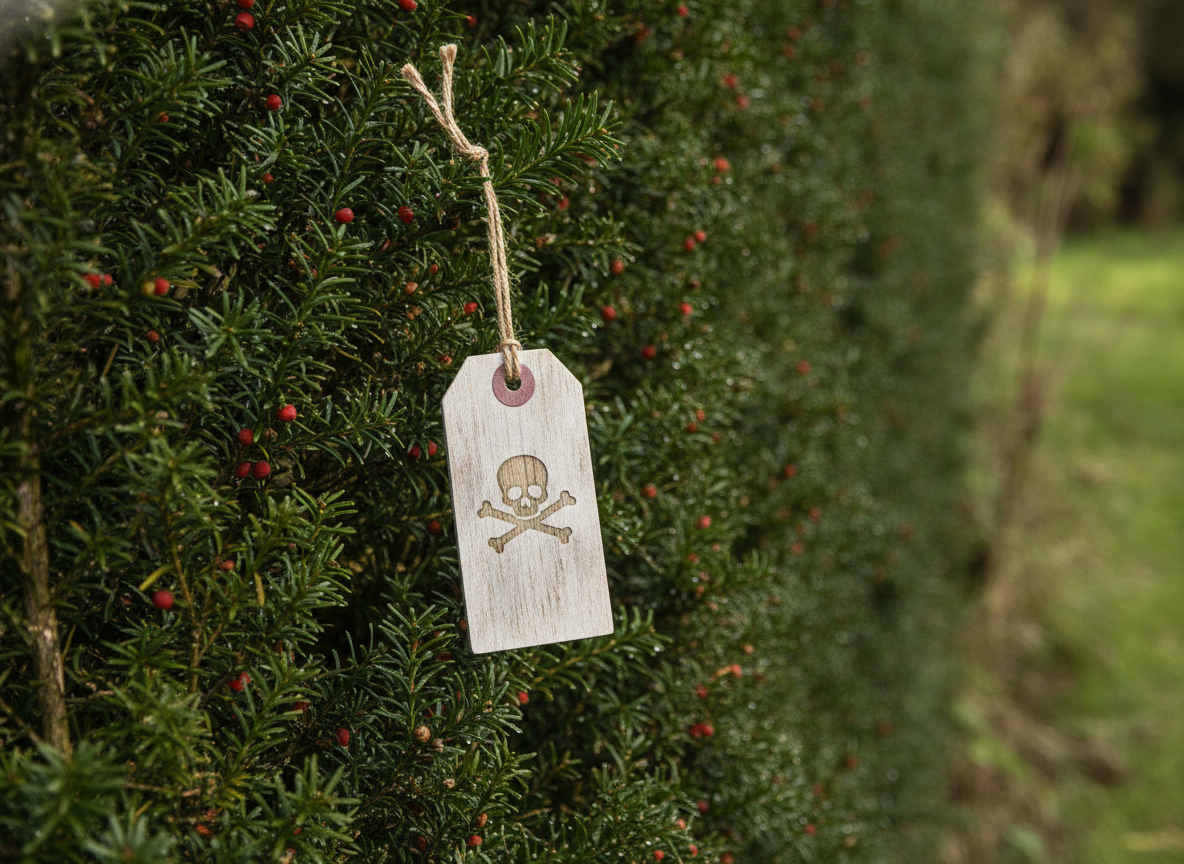 A wooden tag with a skull and crossbones hangs on a yew hedge — AI-generated illustration
One warning: every part of a yew is poisonous
Yew earns its respect one more way. Every part of the plant except the red flesh of the berry — the foliage, the bark, the seeds — contains taxine alkaloids and is highly toxic to humans and lethal to horses, cattle and sheep. Worse, the clippings don’t lose their poison as they dry; wilted yew is actually more palatable to animals and just as deadly, and a surprising number of livestock deaths trace back to hedge trimmings thrown over a fence.
So: wear gloves, keep children and pets away from the trimmings, and never dump yew clippings where grazing animals can reach them or compost them into pasture. Bag them for green-waste collection or compost them well away from any animals. It’s a safe and beautiful hedge to live with — you just don’t feed it to the horses.
The 2026 season, and what to do now
The cool, slow spring across the Netherlands, Belgium and the southern UK ran about ten days behind average, but the recent warmth has pushed yew through its main flush on schedule. As of early July 2026, that new growth is still firming up — which means the late-summer shaping window is a few weeks off, not open yet.
So the job for right now is to read your hedge, not cut it. If it just needs tidying, put a reminder in for August and give it one clean trim then. If it’s overgrown, too wide, or bare at the base, don’t reach for the saw in the heat — plan the hard renovation cut for next spring instead, and you’ll get the whole season’s recovery. Either way, you own the one conifer that lets you fix your mistakes.
For the conifers that give you no such second chance, see why you must never cut leylandii into the brown. For the deciduous formal hedges that play by their own timing, compare the late-June beech hedge window and why a June trim makes privet twice as thick. And for everything else that wants — or doesn’t want — a cut this month, there’s the month-by-month pruning calendar.