The first flush is finishing — and it’s a fork in the road
By the first week of July an astrantia (masterwort, Astrantia major) that opened its first pincushion flowers back in early June has done the bulk of its work. The best of the colour has gone. The papery little collars around each flowerhead — the part everyone loves — are starting to bleach and dry, and down at the base a low mound of hand-shaped leaves still looks healthy.
This is the moment gardeners get stuck, because astrantia gives you a genuine choice and there’s no single right answer. Leave the plant alone and those drying flowerheads hold their shape for weeks — they’re one of the few perennials whose spent blooms look deliberate rather than dead. Cut it back and you trade that late-summer structure for a flush of fresh leaves and a real second wave of flowers in autumn. Both are legitimate. What you don’t want is to drift into the third option by accident: leaving it, letting it set seed, and waking up next spring to a drift of muddy-pink seedlings that have swamped your named variety.
So the honest answer to “should you cut astrantia back?” is: usually yes — and early July, as the first flush fades but before the seed ripens, is the window that gives you the most for the least effort.
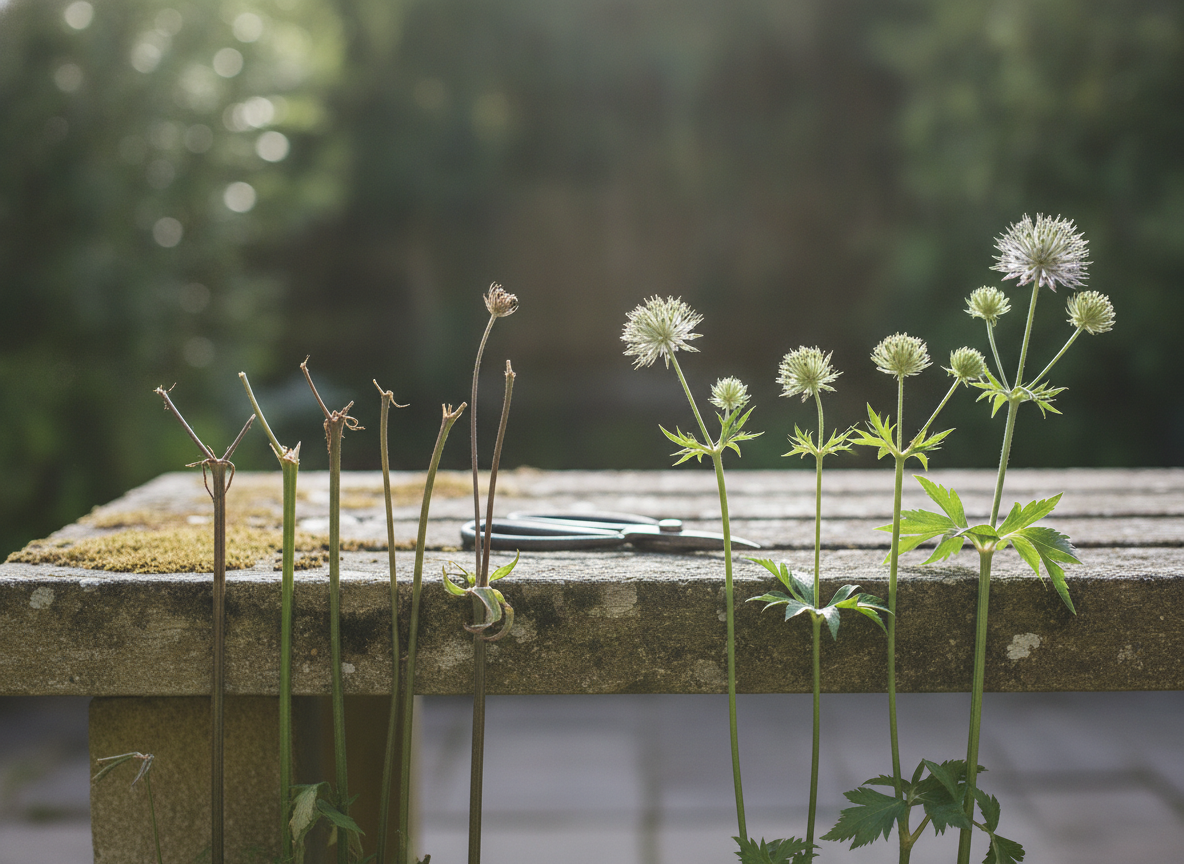 Astrantia stems, some cut back and some with blossoms, on a stone table — AI-generated illustration
Why “just deadhead it” is the weaker move here
The tidy instinct is to snip off each spent flower individually and leave the rest of the plant standing. On many perennials that’s exactly right. On astrantia it’s the least rewarding option, for two reasons.
First, picking flowers off one at a time barely changes what the plant is doing. The stems stay up, the foliage keeps ageing, and the plant reads the season as winding down. You get a slow trickle of leftover blooms rather than a proper reset. Second, deadheading is fiddly — astrantia carries dozens of small heads on wiry, branching stems, and following each one down to snip it takes far longer than the alternative.
That alternative is to stop being delicate and cut the whole plant back in one go. Once the first flush has clearly gone over — not the odd faded head, but most of the colour spent — you shear every flowering stem down to the fresh basal leaves, leaving roughly 3 cm of stubble. It’s the same logic behind cutting geums or catmint hard rather than snipping stem by stem: one clean reset triggers a stronger response than a hundred small cuts. If you’ve done the early-July Hampton Hack on your other perennials, astrantia belongs on the same afternoon’s to-do list.
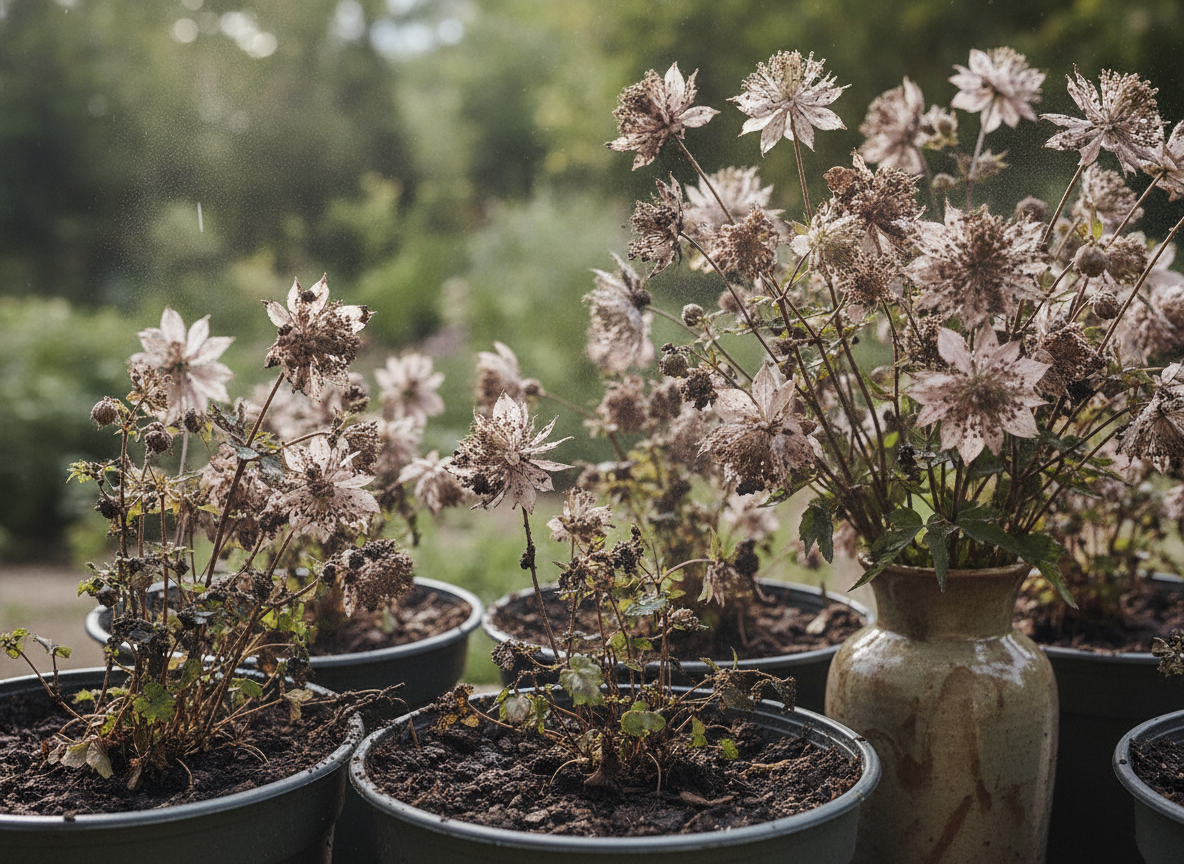 Potted astrantia seedlings and cut astrantia in a vase — AI-generated illustration
The named-variety trap: muddy pink seedlings
Here’s the reason cutting back matters more for astrantia than for most perennials. Named varieties — the deep wine-red ‘Hadspen Blood’, the near-crimson ‘Ruby Wedding’, the clean white ‘Alba’, the bright ‘Roma’ — do not come true from seed. Let a dark-red astrantia drop its seed and the seedlings that appear next spring are almost always a washed-out, muddy pink. They germinate freely, they’re vigorous, and within a couple of seasons they can crowd out and visually swamp the very plant you paid for.
So if you grow astrantia for a specific colour, the July cut isn’t just about a second flush — it’s how you protect the variety. Cutting the flowers off before the seed ripens stops the drift before it starts. The one time you might want seedlings is with a plain species astrantia grown for a loose, self-sowing cottage look — but even then, cut back the named plants nearby first, or the muddy pinks will take over that too.
 AI-generated illustration
How to cut astrantia back in early July
The job takes minutes and needs nothing more than clean shears or secateurs.
- Wait for the first flush to genuinely fade. Not the first spent head — the point where most of the colour has gone and the collars are drying. In a normal Northern European year that lands in the first half of July.
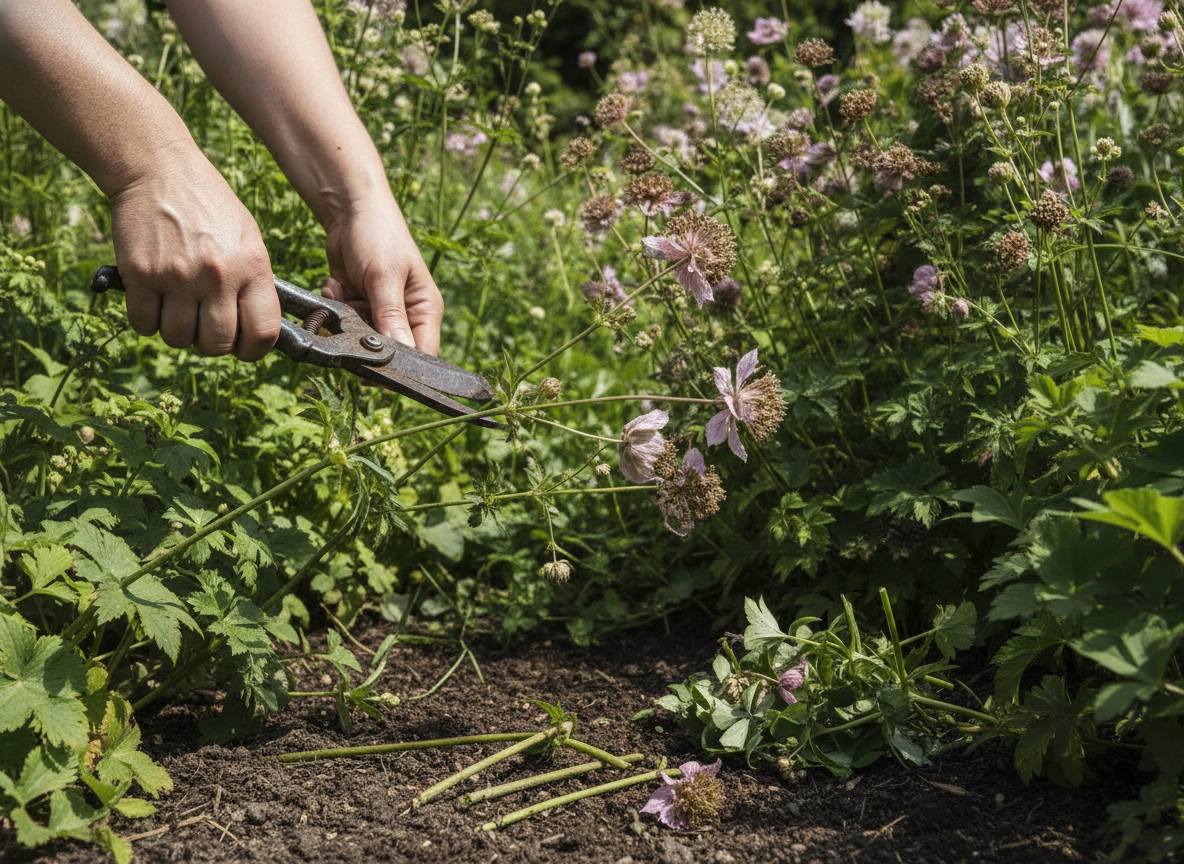
- Cut every flowering stem to the base. Take them down to the low mound of fresh leaves, leaving about 3 cm. Don’t be shy: the crown of new foliage sitting at ground level is what regrows, and it’s untouched by your cut.
- You can shear it. On a big clump there’s no need to chase individual stems — gather a handful and cut straight across just above the basal leaves.
- Water and feed afterwards. Astrantia hates drying out, and you’ve just asked it to regrow. A can of water and a light general feed after cutting makes the difference between a token response and a full second flush — especially in a dry July.
- Clear the trimmings. Getting the spent heads off the plant and out of the border is the whole point if you’re trying to stop seedlings.
One caveat worth keeping: if you deliberately grow a white astrantia like ‘Alba’ or ‘Shaggy’ for cutting and drying, its bleached seedheads are lovely left standing, and ‘Alba’ seedlings come reasonably pale rather than muddy. There, leaving a few stems is a fair trade. For the coloured varieties, cut.
What happens next
Watered and fed, a cut-back astrantia pushes a clean flush of new leaves within a couple of weeks and, in most seasons, a second wave of flowers through late August and September. It’s rarely as heavy as the June show, but it arrives when a lot of the border is tiring, and the foliage alone — fresh, veined, weed-suppressing — earns its place until the frosts.
Contrast that with a plant left uncut: it holds its dried heads handsomely for a while, then the seed ripens, scatters, and next year’s muddy-pink problem is already sown. It’s the mirror image of alliums, where the right move is to leave the seedheads standing precisely because they don’t cause you trouble. Astrantia’s do — so this is the one to cut.
Let Cresco time it for your border
The tricky part isn’t the cut, it’s the timing — “as the first flush fades, before the seed ripens” shifts by a week or two every year and every garden. That’s exactly what Cresco’s pruning planner is built for: add your astrantia, and it flags the cut-back window against your own local weather, alongside the second-flush chop for geums, catmint and the rest of the July border. One reminder, at the right moment, and you keep the variety you actually planted.