The Chelsea chop cuts before the flowers; the Hampton hack cuts after
By the first week of July a lot of the border has already peaked and burnt out. The hardy geraniums that were a haze of blue in June are now a flat, tired mat of pale seedheads. The catmint has flopped open in the middle. The delphinium spikes are two-thirds brown. Everything looks like it’s shutting up shop for the summer — and most gardeners let it, then spend August wondering why the garden looks flat.
There’s a five-minute fix, and it has a name. The Hampton hack is the early-July partner to the Chelsea chop, and the two are constantly confused, so let’s separate them cleanly:
- The Chelsea chop (late May) cuts a plant before it flowers. You shorten a late-summer perennial that hasn’t budded yet, so it branches, stays shorter, and blooms later. It’s about delaying and staggering.
- The Hampton hack (early July) cuts a plant after it flowers. You shear a June-flowering perennial that’s already done its show back to a low mound, so it throws fresh foliage and, on many plants, a whole second flush of flower.
Same shears, opposite ends of the plant’s cycle. The Chelsea chop is prevention; the Hampton hack is rescue. And July is exactly when the rescue works, because there’s still enough warmth and growing season left for the plant to rebuild before autumn.
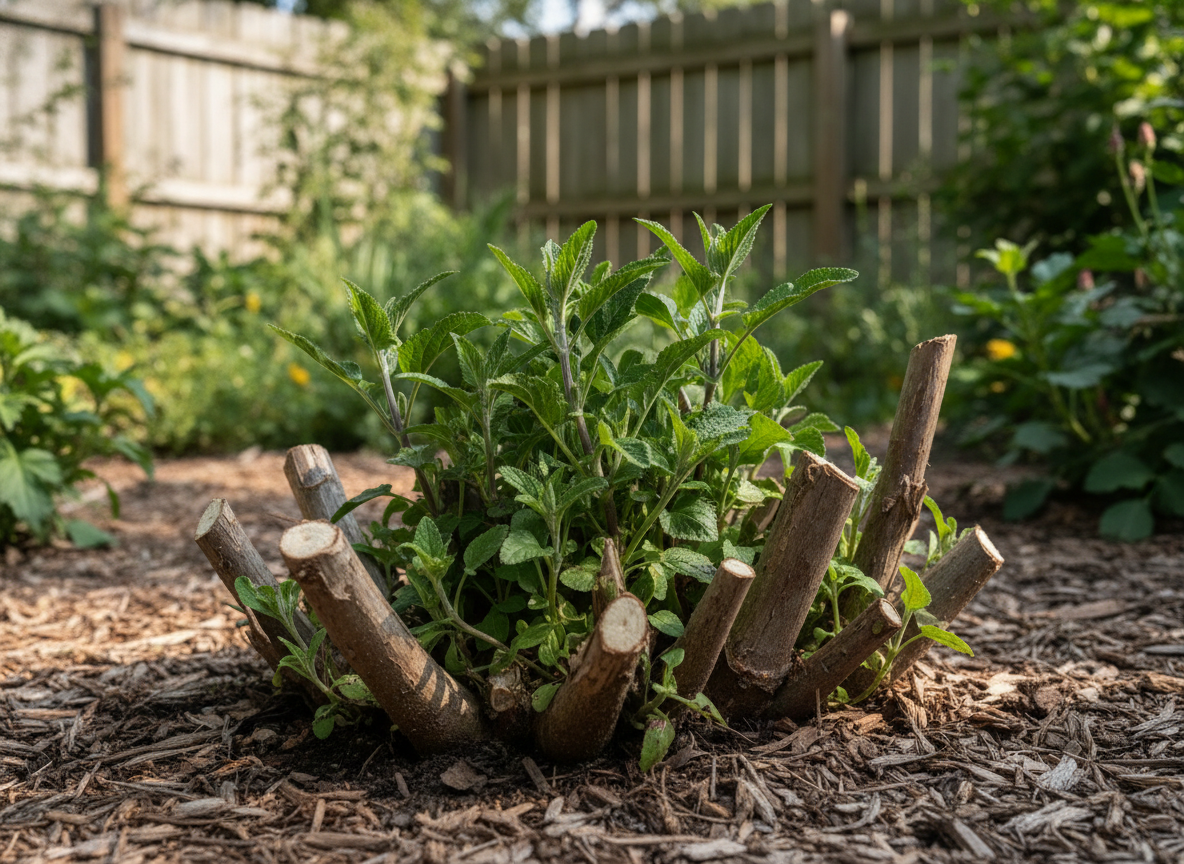 A perennial with cut stems and new growth emerging from the base — AI-generated illustration
What actually happens when you cut a spent perennial to the ground
It feels brutal the first time. You take a plant that’s still green at the base, if tatty on top, and cut the whole thing down to a few centimetres — sometimes almost to the crown. It looks like an act of vandalism for about a fortnight.
Then it does exactly what you hoped. A herbaceous perennial that has flowered and set seed is, as far as it’s concerned, finished for the year — it’s pouring energy into ripening seed rather than making new leaf. Cut off that spent top growth and you interrupt the seed-making signal. The plant still has a full root system and a warm July ahead of it, so it does the only thing it can: it pushes a fresh rosette of leaves from the base, clean and mildew-free, and on the repeat-flowering species it follows that with a second, lower flush of blooms in three to five weeks.
You get two things at once, then: an instant cosmetic fix — the tired, browning clump becomes a tidy green cushion within a fortnight — and, for many plants, a genuine second season of flower running into September.
The plants that reward it
Not everything responds, but a surprising amount of the June border does. The rule of thumb: soft-stemmed perennials that flowered in early summer and still have living green at the base. The classic candidates, most of which I’ve written up individually:
- Hardy geraniums (cranesbill) — the star of the technique. The scrambling border types (Geranium × oxonianum, G. endressii, ‘Johnson’s Blue’) can be sheared to the ground and will be a fresh dome of leaf in two weeks, often reflowering by August. Full method in chopping hardy geraniums for a second flush.
- Catmint (Nepeta) — cut it back by two-thirds once the first haze of flower greys over and it reblooms reliably. See shearing catmint after flowering.
- Lady’s mantle (Alchemilla mollis) — shear off the whole tired, seeding mass; it comes back as clean chartreuse foliage. How to cut back alchemilla.
- Delphiniums and lupins — cut the finished spike down to the base of the flowered stem and you often coax a smaller second spike later in summer.
- Oriental poppies — these positively demand it; the whole plant collapses into a brown heap after flowering and cutting it to the ground brings a fresh mound of leaf.
- Geums, red valerian (Centranthus), aquilegia, hardy salvias, brunnera, pulmonaria, knautia, meadow rue — all take the same treatment.
If a plant flowered in May or June, has soft (not woody) stems, and is still alive at the base, it’s almost certainly a Hampton-hack candidate. When in doubt, do one plant and watch it.
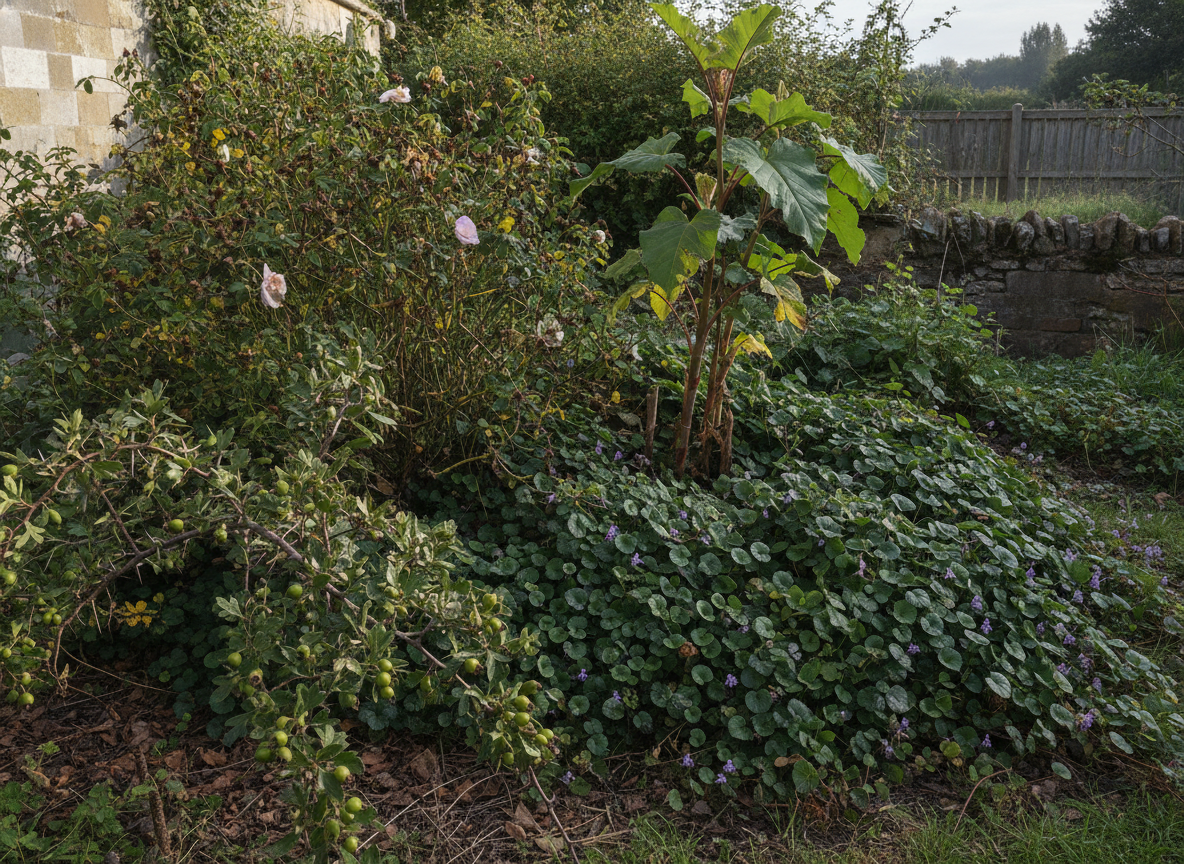 A garden scene with various plants, some with small flowers — AI-generated illustration
The plants to leave well alone
The technique is not universal, and this is where people get burnt.
- Anything woody. Lavender, cistus, rosemary, sage — Mediterranean sub-shrubs do not regrow from cut-into old wood, and a hard July chop can kill them. They have their own separate, gentler rules — see why lavender must never be cut into old wood.
- Late-summer and autumn perennials that haven’t flowered yet. Cutting an echinacea, aster, sedum, rudbeckia or Japanese anemone now removes the buds forming for their whole season. Those are Chelsea-chop plants, not Hampton-hack plants — and only in May.
- Once-flowering plants you’re growing for seedheads. If you want the architectural winter skeletons of alliums or the self-sown seedlings of foxgloves, don’t cut.
- Anything visibly stressed. A plant limping through drought or fresh from division won’t have the reserves to rebuild. Water it and wait.
How to do it — three steps, five minutes
- Cut low and cut everything. Take shears (secateurs for a small clump, one-handed grass shears for a big cranesbill) and cut the whole plant back to 5–10 cm — right through the spent flowers, stems and tired leaves together. Don’t pick daintily at individual dead heads; the point is a clean reset of the entire clump.
- Clear the debris off the crown so light and air reach the base where the new shoots will come from, then bin or compost it.
- Water deeply, once, straight after. This is the step that decides whether it works. The plant is being asked to regrow in high summer, and it can only do that if the roots are moist. If no rain is forecast, a can or two per clump, plus a scatter of general fertiliser to fuel the new leaf, makes the difference between a fast rebound and a sulking stump.
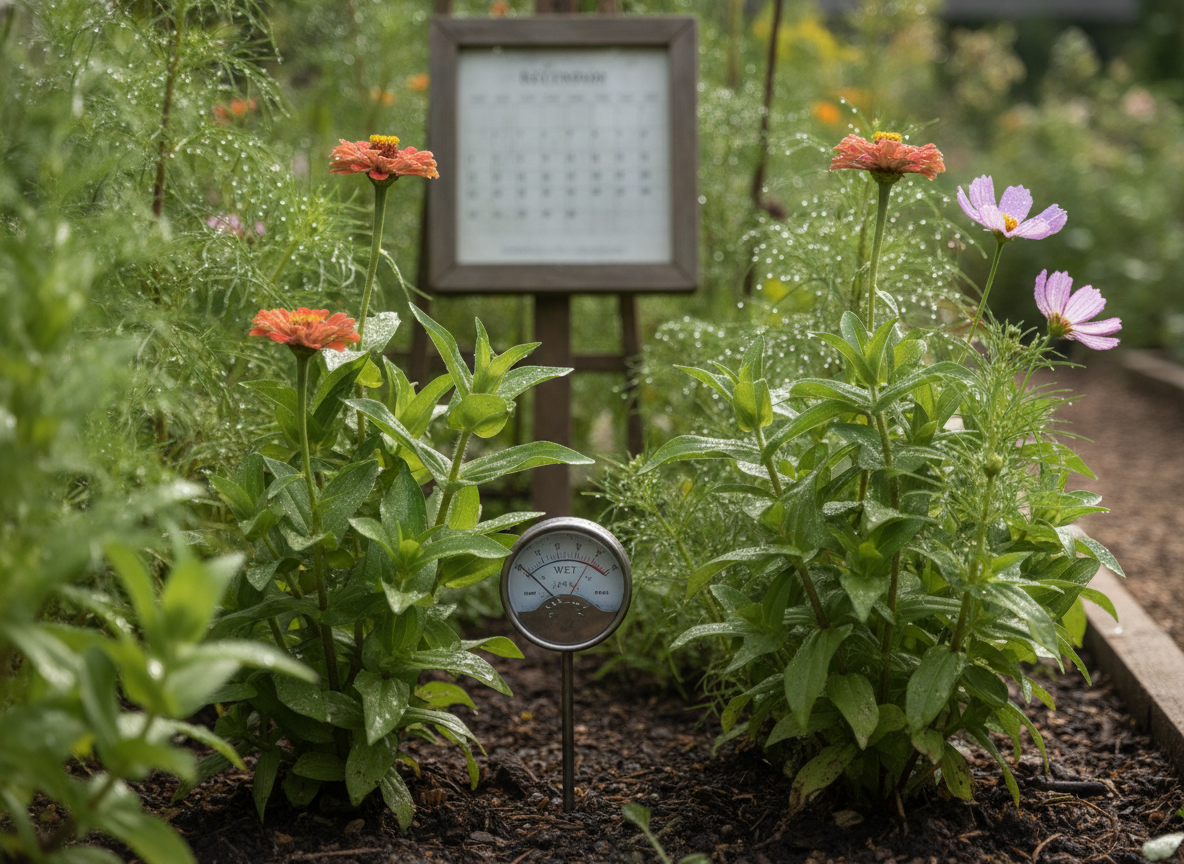 A moisture meter stands in a garden bed with blooming flowers and a blurred calendar in the background — AI-generated illustration
Moisture, not the calendar, is the real timing signal
The name says early July, and for most of northern Europe that’s about right — it’s the point where the June flush is spent but there’s still a long, warm run of growing season ahead. But the date is a proxy for two conditions that matter more than the number on the calendar:
- The first flush is genuinely over. Wait until the flowers have greyed and the plant is clearly past its show. Cut while it’s still flowering and you throw away colour you already have.
- The plant can get water afterwards. A Hampton hack going into a hot, dry fortnight with no watering is a gamble — the cut clump can bake and sulk instead of regrowing. If a heatwave is forecast, either wait for it to break or commit to watering the cut plants for two weeks.
That second point is why “early July” is guidance, not gospel. In a cool, wet summer you can hack with abandon well into the month. In a drought year, hold off, or only hack the clumps you can reach with a hose. The plant’s stage and the ten-day forecast beat the date every time.
The name outlived the show
One curiosity for 2026: the technique is named for the RHS Hampton Court Palace Garden Festival, the early-July show whose timing gave the hack its slot in the calendar. This year that show isn’t running — the RHS has moved its early-July flower show to a brand-new venue, RHS Badminton in Gloucestershire, from 8–12 July 2026, with Hampton Court returning in 2027.
The name has stuck regardless, the way “Chelsea chop” has, because it marks a time of year rather than a place. Nobody’s going to start calling it the Badminton bash. What matters is the window it points to: that first week or two of July when the early-summer border is spent and there’s still a whole second act to coax out of it.
Put it on a schedule and you’ll never miss it
The hardest part of the Hampton hack isn’t the cutting — it’s remembering to do it on the right plant at the right moment, while it’s still warm enough to matter. Miss the window by three weeks and the second flush doesn’t have time to open before the light fails.
That’s the job Cresco was built for: it knows your specific geraniums want the hack in early July but your lavender never does, and it prompts you when your local weather actually supports the regrowth rather than on a generic UK date. If you’d rather have every plant’s window tracked for you — pruning, chopping, hacking and all — that’s exactly what the Cresco pruning calendar does.
The short version
- Walk the border and find the June perennials that are spent but still green at the base
- Skip anything woody, anything not yet flowered, and anything you want seedheads from
- Shear the whole clump to 5–10 cm — flowers, stems, leaves and all
- Clear the debris and water deeply once, then feed
- Hold your nerve for a fortnight; enjoy fresh leaf, and often fresh flower, into September
Want a pruning plan that knows which plants to hack in July and which to leave? Try Cresco at cresco-pruning.com.