Those brown edges aren’t a disease — they’re saw marks
You run the hedge trimmer along your cherry laurel (Prunus laurocerasus), stand back pleased, and a week later the whole face has gone spotty with brown. The first instinct is panic: a fungus, a blight, something to spray. It’s none of those. Look closely and you’ll see the brown always sits on a cut edge — a leaf sliced clean through the middle, its severed half now dying back from the wound.
That’s the entire problem with laurel, and it has nothing to do with the plant’s health. A laurel leaf is huge — 10 to 15 cm long, glossy and thick. When a hedge trimmer or a pair of shears whips across the hedge, it doesn’t remove leaves neatly; it chops straight through dozens of them. Each half-leaf left behind can’t heal a cut that runs across its middle, so the tissue browns, curls and hangs there for weeks. Multiply that by a whole hedge face and you get the tatty, scorched look that sends people reaching for fungicide they don’t need.
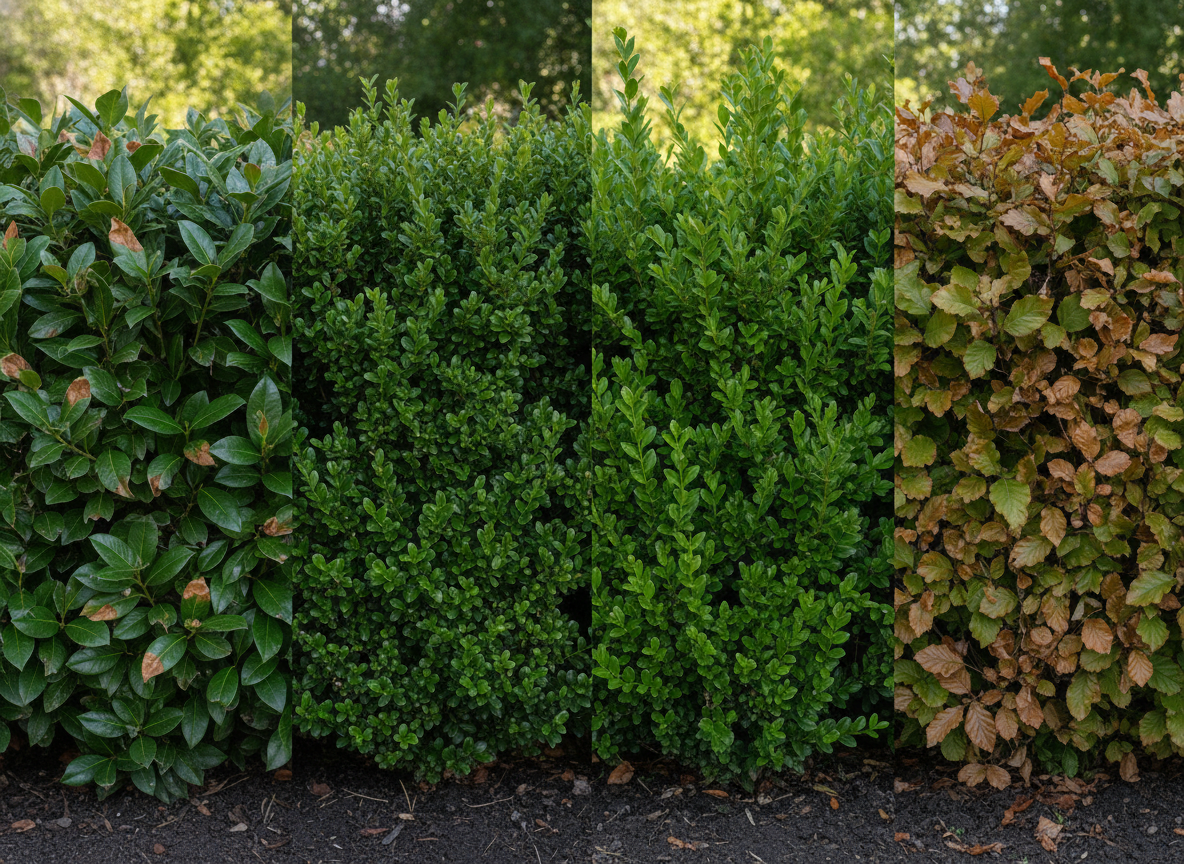 Four distinct hedges, one with browning leaves, are shown in natural daylight — AI-generated illustration
Why laurel behaves differently from box, privet or beech
The hedges you can shear happily all share one thing: small leaves. Run trimmers over box, privet or beech and the blades pass between most of the little leaves. The few that do get clipped are so small the cut edge is invisible from a metre away. That’s why a box hedge takes a mechanical trim without complaint and a laurel doesn’t.
Laurel’s leaf is the size of your thumb and then some. There is no clipping “between” them — the blade goes through leaf after leaf. So the tool that works beautifully on a fine-leaved hedge is exactly the wrong tool here.
The fix: secateurs, not shears
The RHS recommendation for large-leaved evergreens is unambiguous — prune cherry laurel with secateurs (or loppers), one stem at a time, not with shears or a trimmer. Instead of chopping across the leaves, you reach in and cut the stem just above a leaf or a pair of leaves, taking out the whole shoot and leaving only intact, undamaged leaves showing on the face of the hedge. Nothing gets sliced in half, so nothing browns.
The honest downside is time. Hand-pruning a laurel hedge stem by stem is slower than running a trimmer down it, and on a long boundary hedge that’s a real afternoon’s work. Two practical ways to live with it:
- On a hedge you care about the look of (a front garden, a feature by the door), bite the bullet and use secateurs. The clean finish lasts all season and is worth it.
- On a big, workaday screening hedge, some gardeners do trim with a machine and accept a fortnight of brown while fresh growth hides it — or trim mechanically, then go back over just the front face with secateurs to snip out the worst sliced leaves by hand. A compromise, but a visible improvement for ten minutes’ extra work.
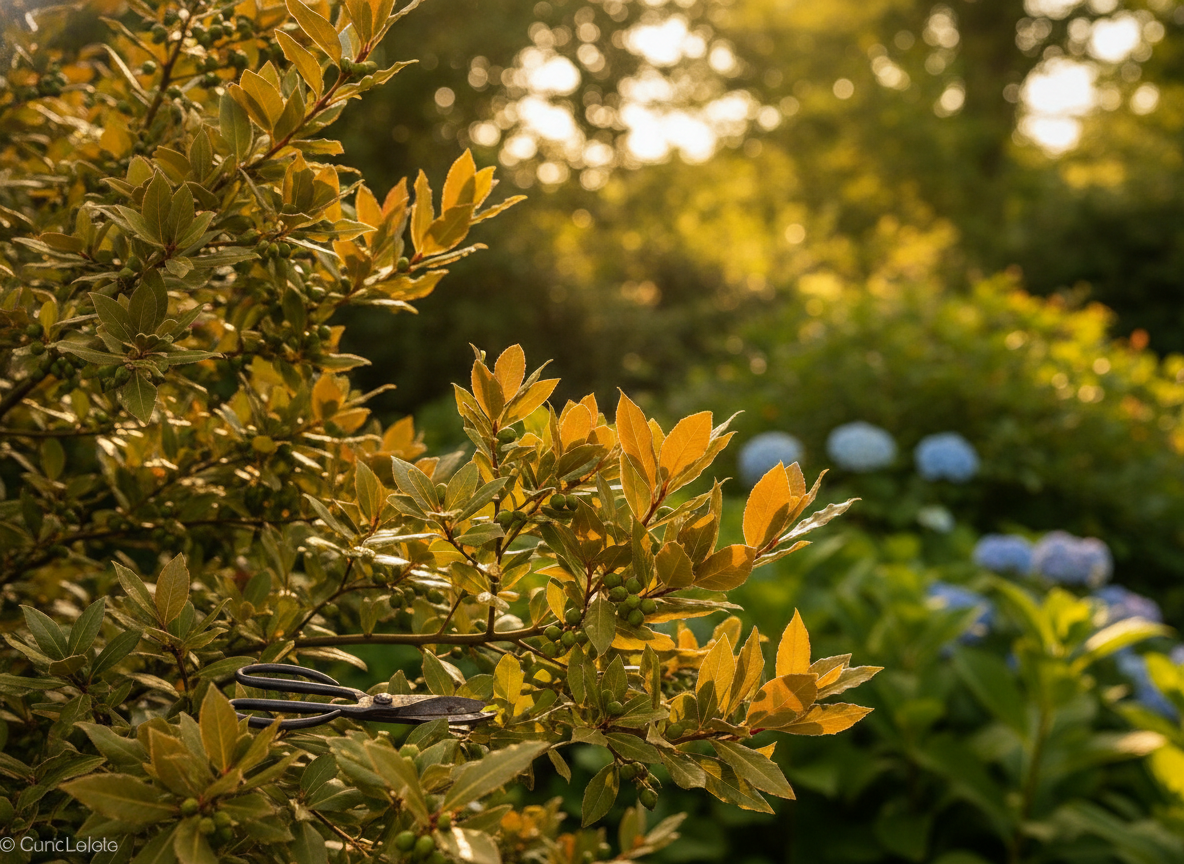 Laurel plants with pruning shears in a sunlit garden — AI-generated illustration
When to cut: summer is the window
Cherry laurel flowers on candles of white in spring, and the right time to prune is after flowering, from late spring through summer — which puts early-to-mid July squarely in the window. A cut now still leaves the plant months of warm, growing weather to push fresh shoots and cover the gaps before autumn.
Avoid the temptation to “tidy it up” late in the season. A hedge cut in October or November goes into winter with soft new growth and open wounds that don’t heal before the first frosts, and cold damage on the cut tips just gives you more brown, not less. If you only prune once a year, summer is the cut to make. Vigorous hedges can take a second light going-over in late summer, but leave the blades in the shed once the nights start drawing in.
The good news: laurel forgives a hard cut
Here’s where laurel is far more generous than a conifer. If your hedge has grown too wide, too tall, or gone bare and leggy at the base, you can cut it hard back into bare old wood and it will break new shoots from the stumps — right down to a knee-high framework if you need to renovate it. Do that kind of drastic renovation in spring (March–April) rather than mid-summer, so the plant has the whole season to rebuild, and feed and water it afterwards.
That single trait is the opposite of what a leylandii or conifer hedge will tolerate: cut those into brown, leafless wood and the gap never fills. Laurel has dormant buds hidden in the old wood; conifers largely don’t. So while you must be gentle with the tool on a laurel, you can be bold with the amount — a reassuring combination once you know it.
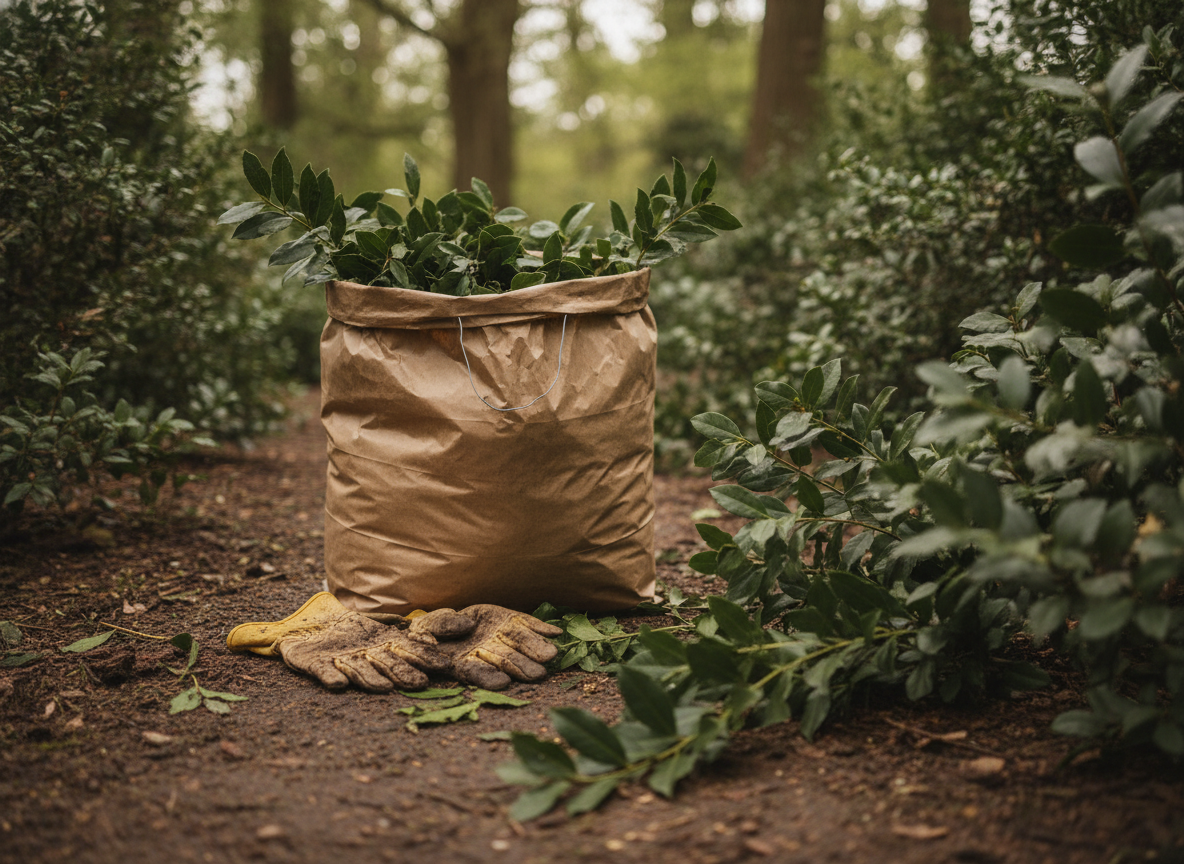 A paper bag full of plant clippings sits on the ground next to a pair of gloves — AI-generated illustration
One warning: wear gloves, bag the clippings
Every part of cherry laurel is toxic. The leaves and stems contain cyanide compounds, which is why crushed laurel foliage smells faintly of marzipan or almonds. In practice this means two things. Wear gloves and long sleeves while you prune — the sap can irritate skin. And don’t leave a big heap of cut laurel wilting in a closed shed, a car boot or a sealed bag near people or pets: as the leaves break down they release small amounts of hydrogen cyanide gas. Let clippings wilt in the open air, and compost them spread out or take them to green-waste recycling rather than piling them up in a confined space. Never burn laurel prunings in an enclosed area.
The habit that keeps a laurel looking sharp
The whole thing comes down to one swap: put the hedge trimmer down and pick up the secateurs, once a year, in summer. It’s slower, but it’s the difference between a glossy green wall and a hedge freckled with brown for a month every time you cut it.
If you’d rather not keep the timing in your head — for the laurel and everything else in the garden, judged against your local weather rather than a generic calendar date — that’s exactly what the Cresco pruning calendar is built to track for you.