The autumn tidy that isn’t the real cut
It’s the same instinct that empties the borders in September. The clematis that smothered a fence in purple through August is starting to look ragged — spent flowers turning to fluff, the top growth flopping forward — and the shears come out for a tidy. It feels like the responsible thing to do before winter.
For most clematis, autumn is the wrong moment to reach for them. Cut the wrong one back now and you either strip off next spring’s flowers or leave a soft stub of growth for the first hard frost to blacken. The plant doesn’t need tidying before winter; it needs cutting at the point in the year that suits how it flowers — and that point is set entirely by which of three groups your clematis belongs to.
The good news is that early September hands you the single clue that settles the question, without you having to remember a plant label you lost years ago.
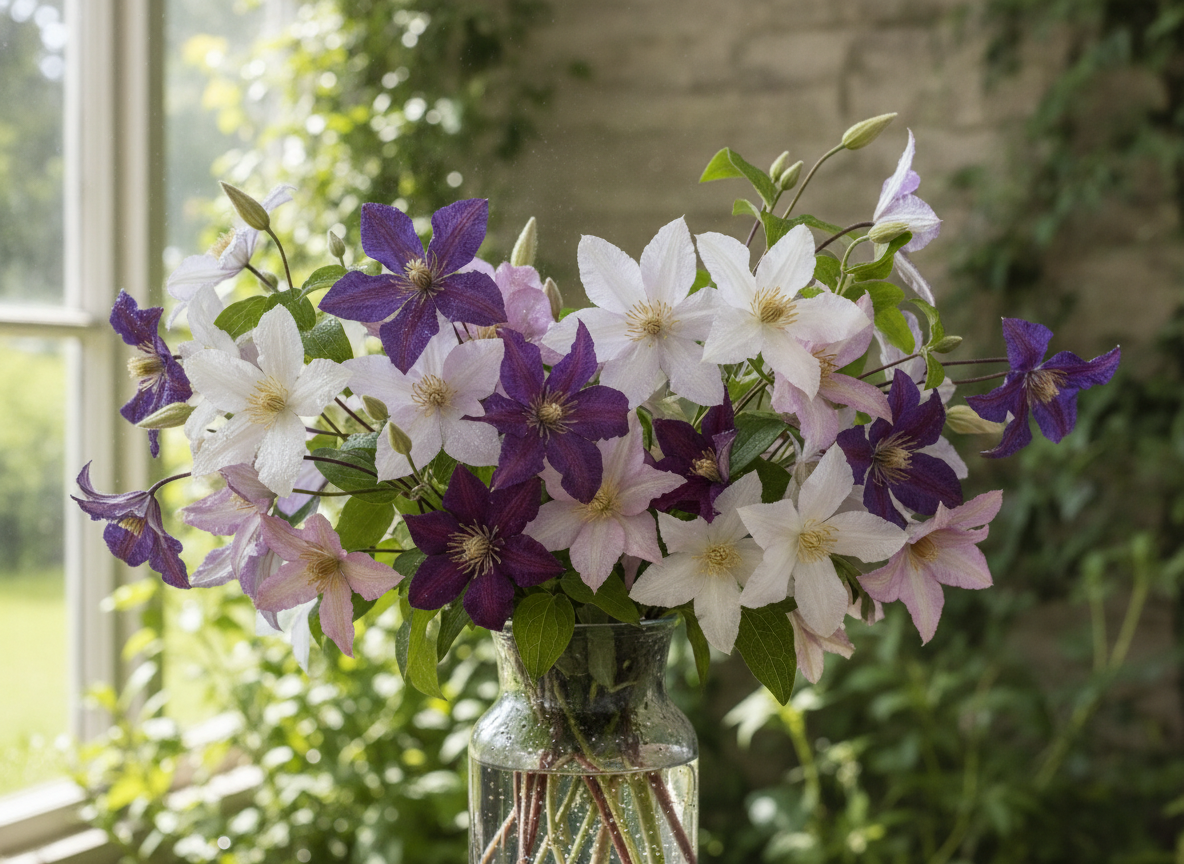 A vase holds a bouquet of purple, pink, and white clematis flowers — AI-generated illustration
Flowering right now? That’s your answer
A clematis in full flower in late summer is telling you exactly what it is. It’s blooming on stems it grew this season, from scratch, since spring. That behaviour — flowering on the current year’s growth, late in the summer — is the definition of a pruning group 3 clematis. And a plant that rebuilds itself from the base every year is one you can cut hard without a second thought, because you’re only ever removing wood it was going to replace anyway.
That’s the whole logic of the three clematis groups, and flowering time reads it off for you:
- Group 1 flowers in spring on last year’s wood — the vigorous montana and alpina types. You prune these lightly, right after they flower in May, never in autumn. (More on that window in Clematis montana: the late-May shear that saves next spring’s curtain.)
- Group 2 are the big early-summer, large-flowered hybrids that bloom in May–June on last year’s stems, often with a second flush later. These you deadhead and prune lightly — deadhead the early flowers and they repeat — but you never take them to the ground.
- Group 3 flowers late, on this year’s growth, and takes the hard cut.
If yours is in bloom now, in the first week or two of September, you’re almost certainly looking at a group 3 — and that changes when, and how far, you cut.
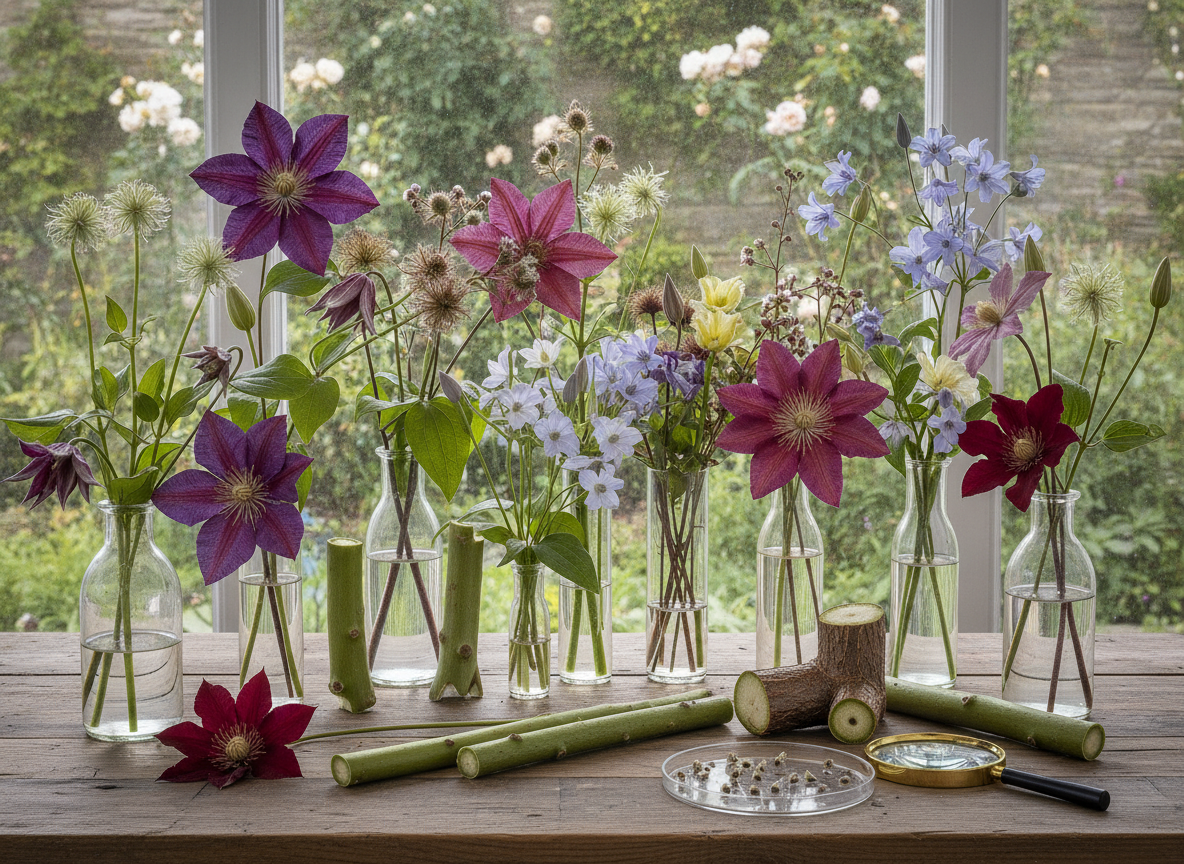 Cut clematis flowers and stems are arranged in vases on a wooden table — AI-generated illustration
The group 3 plants — and how to be sure
Flowering time is the fastest test, but it helps to recognise the usual suspects, because group 3 is where most of the reliable, easy-going garden clematis live.
The woody climbers in the group are the ones covering fences and obelisks with flower from July onward: the viticella clematis and their many cultivars (‘Étoile Violette’, ‘Polish Spirit’, ‘Madame Julia Correvon’), the ever-popular ‘Jackmanii’, ‘Rouge Cardinal’ and ‘Ville de Lyon’, and the yellow, nodding-lantern tangutica and orientalis types with their silky seedheads. The Texas clematis, C. texensis, sits here too.
Then there’s a quieter set of herbaceous clematis that behave more like a perennial than a climber — C. integrifolia, C. heracleifolia and C. recta. These die back close to the ground each winter and rarely climb at all. They belong to group 3 by flowering habit, and as you’ll see, they’re the one case where an autumn cut is genuinely fine.
The pattern to hold on to: big flush of flower in the second half of summer = group 3 = hard prune. If it flowered in May and has been quiet since, it isn’t one, and the hard cut would be a mistake.
So can you cut it back in autumn?
Here’s the honest, group-3-specific answer.
For the woody climbers — the viticellas, ‘Jackmanii’, tangutica and the rest — the textbook cut is late winter, roughly February into early March, not autumn. The plant is going to regrow entirely from low down in spring, so there’s nothing to gain by cutting in September, and one thing to lose: a hard autumn cut can push a little soft regrowth in a mild spell that the frost then kills, and the top growth left standing actually gives the crown a bit of winter protection.
There’s one sensible autumn exception even for the climbers. If your plant has made a tall, top-heavy tangle that will catch the wind and rock its roots loose over winter, a light reduction — taking the whole thing down by a third to a half, purely to cut wind resistance — does no harm. Think of it as the same wind-rock housekeeping you’d give a tall shrub, not the real prune. The proper hard cut still waits for February.
The herbaceous types are the exception that makes the “never in autumn” rule untrue. C. integrifolia, heracleifolia and recta can be cut back to near ground level either in late autumn or in early spring — take your pick. If you like a clean border going into winter, cut them now; if you value the seedheads and the frost on old stems, leave them till spring. Either way the plant doesn’t mind.
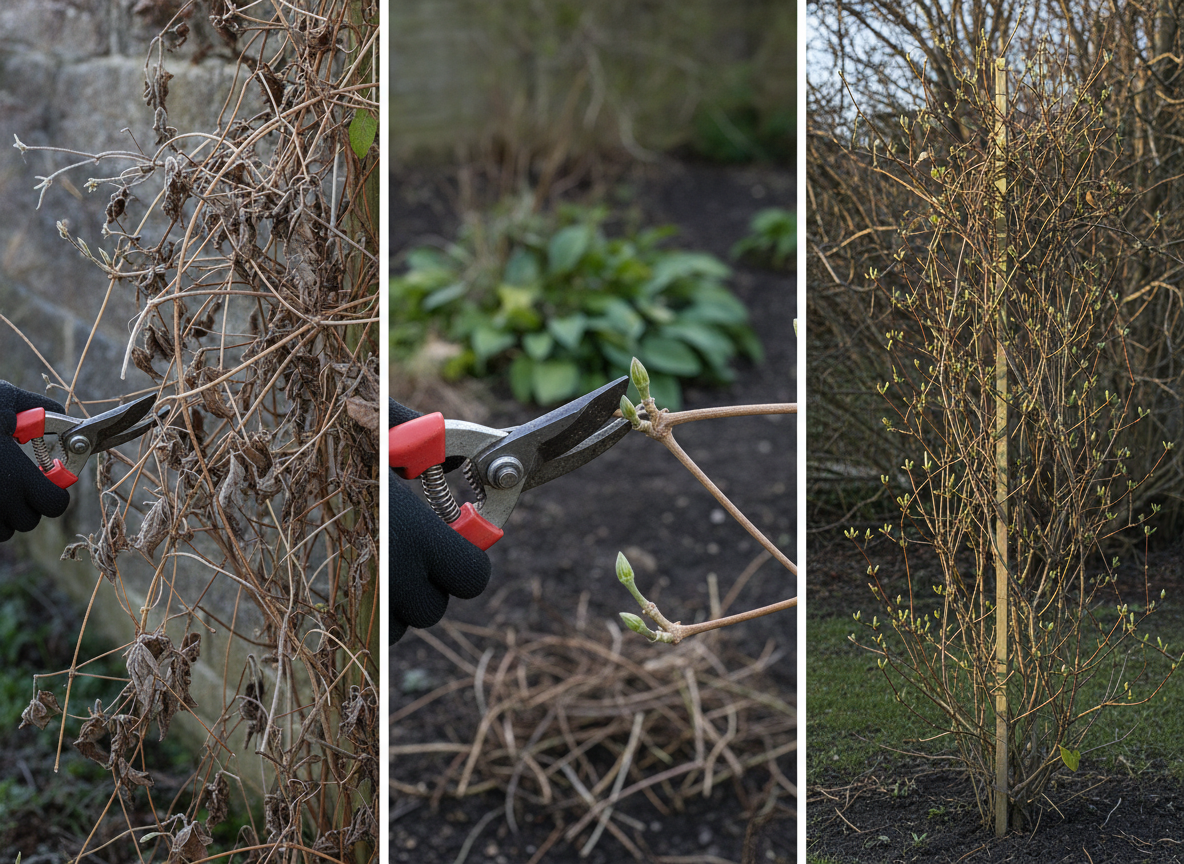 A three-panel photo shows clematis stems being cut, then a trimmed stem, then a whole trimmed plant — AI-generated illustration
The February cut, step by step
When late winter comes and the buds are just beginning to fatten, a group 3 clematis is the easiest prune in the garden. There’s no agonising over which stem is which age, because it all goes.
Work down each stem from the top until you reach the lowest strong pair of healthy buds, and cut just above them — usually somewhere between 20 and 45 cm from the ground. Take every stem back to that level. It looks brutal: you’re left with a knee-high cluster of stubs where a two-metre curtain stood. That’s correct. Within weeks the buds break, and by midsummer the plant has rebuilt itself taller and flowered harder than a plant left to sprawl on its own old wood.
Do this every year and the clematis flowers from low down, staying clothed to the base instead of climbing away and blooming only at head height. Skip it for a few years and you get the classic neglected clematis: a bare, woody, bird’s-nest tangle at the bottom with a thin scarf of flower right at the top, out of reach.
The mistake that costs a whole year
The reason group matters so much is that the same hard February cut that makes a group 3 will ruin a group 2. A large-flowered hybrid that blooms in May carries next year’s flowers on the stems it grew this year — cut those to the ground in winter and you’ve removed the entire flush before it opened. That’s the single most common clematis disappointment: a healthy plant, pruned “properly” and hard every winter, that never quite flowers.
So the rule that saves you is the one you can check right now: let the plant tell you its group by when it flowers. Blooming in your face this week, on new growth? Cut it hard in February and enjoy the reward. Flowered back in May and long finished? Leave the shears in the shed and give it only a light tidy after it next blooms.
Not sure which of your climbers is which — or when the dozen other things on the fence want cutting? That’s exactly what Cresco is built for: photograph the plant, and it tells you the group, the timing and the cut for your own garden and local weather, so the clematis gets the February hard prune and the montana next to it doesn’t.