One trim a year is all a yew hedge asks for
Most hedges make you work. Privet wants cutting two or three times over the summer, or it thickens into a shaggy mess. Leylandii runs away the moment you turn your back. Yew (Taxus baccata) is the exception: a single trim, done at the right time, keeps a formal yew hedge crisp for a full twelve months. The catch is entirely in that phrase — the right time — and for most gardens the right time is now, in the first half of September.
The reason comes down to how yew grows. It puts on the bulk of its soft new growth in a single flush through late spring and summer, then slows right down as the days shorten. Cut in June and you’re clipping a plant that’s still actively growing, so it pushes out again within weeks and the edge you cut has blurred by August. Cut in early autumn, once that growth has hardened and the plant is winding down, and there’s almost nothing left in the season to spoil the line. That clean face you cut in September is the same face you’ll look at on a frosty morning in January.
 AI-generated illustration
The August-to-October window, and where September sits in it
The workable window is roughly August to October, but the two ends of it aren’t equal.
Trim in August and the plant may still have a little growth left in the tank, so you can get a faint second flush that softens the edge before winter. Trim in late October and you run the opposite risk: any regrowth you provoke is tender, and the first hard frost blackens it, leaving scorched tips on show all winter. Worse, cut too late and too hard and yew can be slow to cover the bare patches — it won’t do it until next summer’s growth arrives.
Early to mid-September threads the needle. The summer flush has hardened off, the plant is settling down for winter rather than racing to replace what you removed, and there’s still enough mild weather for the cut surfaces to callus over cleanly. If you only get to your hedge once a year, this is the fortnight to aim for.
Cut into the soft green, not the bare wood
For a maintenance trim, the rule is simple: stay in this year’s growth. Run the blades through the soft, pale green shoots and leave the older, darker wood alone. On an established hedge that’s held its shape for years, you’re often only taking off a few centimetres — enough to bring the surface back to a flat plane, not to reshape it.
Yew is famous for one thing among conifers: it’s the one that will regrow from bare old wood, which is why it’s the go-to when a hedge has outgrown its space. But that’s a renovation job with its own timing and its own risks, not something to blunder into with a once-a-year trim. If your hedge has genuinely got too big and you need to cut back into the brown, that’s a separate operation — I’ve written it up in how far you can cut yew back, and exactly when. For everything else, keep to the green.
 A sculpted yew hedge with a wider base in a garden setting — AI-generated illustration
Cut a batter: wider at the base
The single most common mistake with any tall hedge is cutting it dead vertical, or worse, wider at the top than the bottom. A yew hedge that leans out as it rises shades its own base, and the lower growth thins and goes bare — exactly the part you least want to lose, because it’s the part at eye level.
The fix is to cut a batter: a slight inward taper so the hedge is a little wider at the base than at the top, maybe by 10–15 cm over a two-metre face. Light reaches the bottom, the base stays clothed, and as a bonus, snow slides off a battered face instead of sitting on a flat top and splaying the hedge open.
For the top and any long straight run, don’t trust your eye. Knock in a couple of canes and run a taut string line at the finished height, then cut to it. Ten minutes with a line gives you a result that looks deliberate; freehand on a long hedge always wanders.
Sharp blades, and mind the clippings
Yew clips beautifully with sharp shears or a well-maintained hedge trimmer, and blade condition matters more than you’d think. Blunt blades bruise and tear the shoots rather than slicing them, and torn tips brown off and look scruffy for weeks. Clean, sharp blades leave a cut that heals over almost invisibly.
One serious word of caution: every part of yew except the red flesh of the berry is highly toxic — foliage, bark, seeds, and the clippings. Never leave prunings where horses, cattle, sheep, or pets can reach them, and never dump them over a fence into a neighbouring paddock; wilted yew is if anything more dangerous to livestock than the fresh plant. Bag the clippings and compost them in a closed bin or take them to green waste, and wear gloves if you’re handling a lot of it.
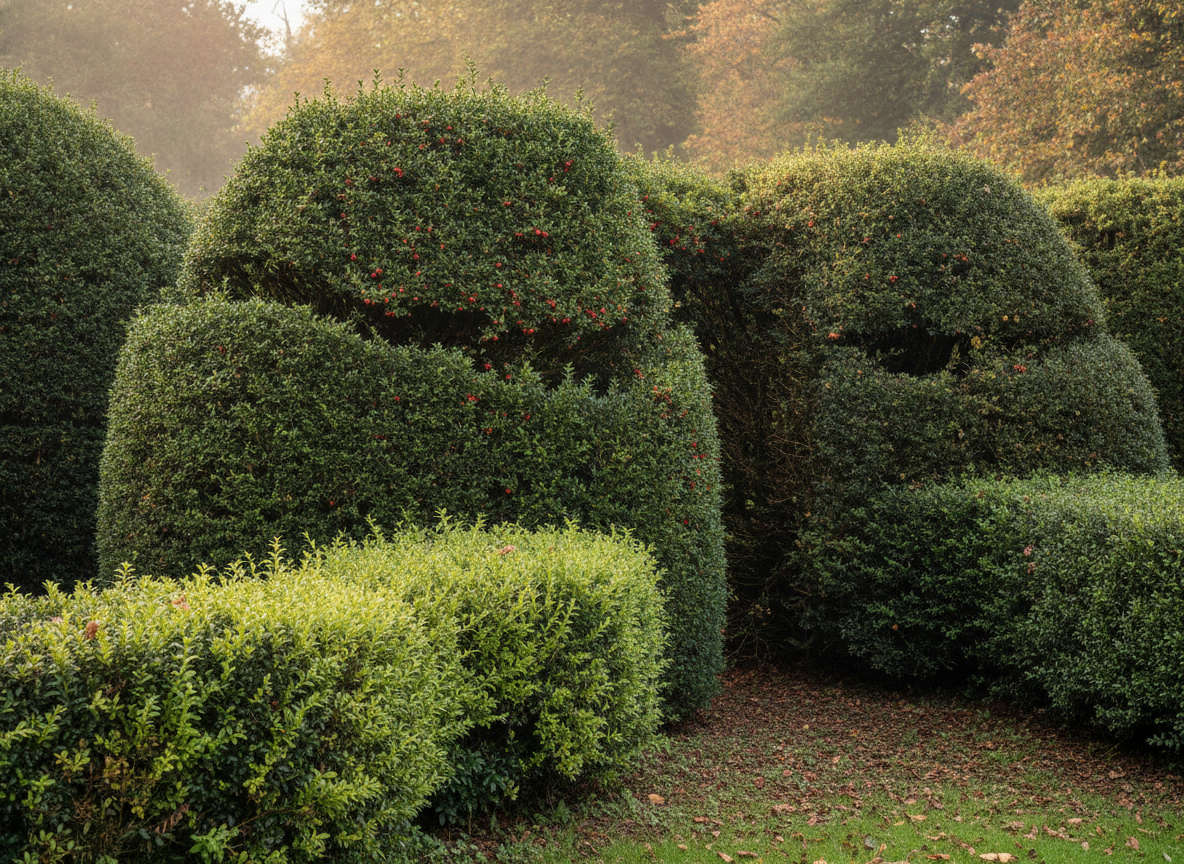
 Formally trimmed yew hedges and topiaries in a garden — AI-generated illustration
Formal edges: an optional second trim
If you’re after the mirror-smooth finish of a stately-garden yew — the kind used for topiary and crisp architectural hedging — you can trim twice: a light tidy in early summer and the main cut in early autumn. The summer trim removes the first surge of growth so the autumn cut is only a light finishing pass, and the hedge holds a sharper line year-round.
For the average garden hedge, though, this is gilding. One well-timed September cut into hardened growth, on a proper batter, with a string line and sharp blades, will keep a yew hedge looking after itself for the rest of the year.
Let the weather, not the calendar, call the exact day
“Early September” is a guide, not a fixed date — a cool, wet summer pushes the growth flush later, a hot dry one brings it forward, and a mild autumn stretches the safe window while an early cold snap slams it shut. The plant tells you more than the calendar does: trim once the new growth has firmed up and lost its floppy, bright-green softness, and before any weather that would push tender regrowth into a frost.
That “read the plant, in your garden, this year” approach is exactly what Cresco is built for. Tell it what’s growing in your garden and it factors in your local weather to tell you not just that a yew hedge wants one trim a year, but which week in your autumn to reach for the shears — and it does the same for every other plant you’re caring for. If you’d rather learn the pattern yourself, the Cresco pruning calendar is a good place to start.