The first flush is over by late June — and the next one is already waiting
By the end of June your border salvias have given you their big show. The dense violet, navy and magenta spikes that stood to attention through the month — ‘Caradonna’, ‘Mainacht’, ‘Ostfriesland’ and the rest — have started to fade from the bottom up, the colour bleaching out and the tips turning to thin brown stubs. The plant looks like it’s finishing for the year. It isn’t. It’s finishing its first flush, and if you look closely at the stems below the spent spikes you’ll see the second one already lined up.
Run a finger down a stem that’s gone over and you’ll find them: small pairs of fresh green shoots breaking from the leaf joints, each one a flower spike in waiting. That’s the whole secret of border salvias. Unlike a delphinium that flowers once from a single tall stem, Salvia nemorosa and its hybrids keep their reserves low down and break again from those side buds the moment the main spike is spent. Your only job is to take the finished spike off so the plant commits to them — and to do it without lopping the side shoots off in the process.
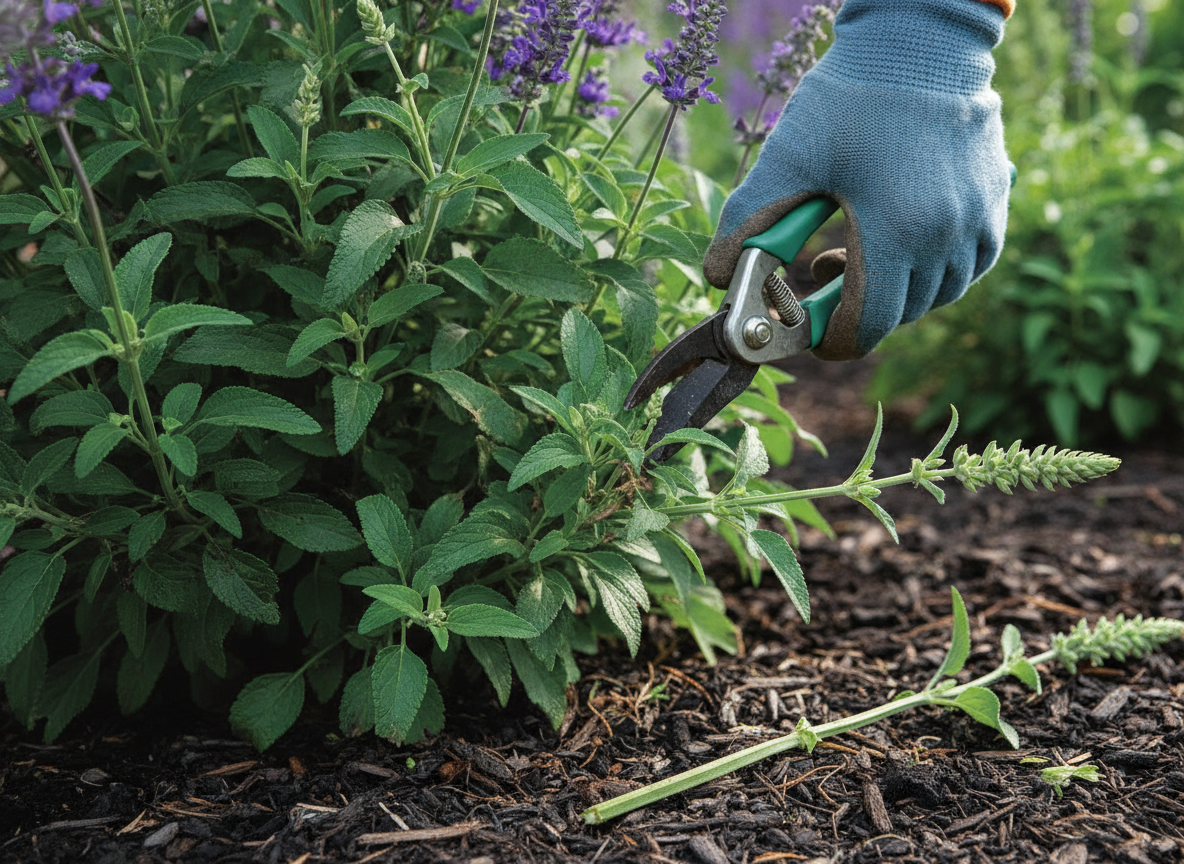 A gloved hand prunes salvias with shears, focusing on side shoots — AI-generated illustration
Cut to the side shoots, not flat to the ground
This is where salvias part company with catmint. With a flopped catmint you take the shears to the whole mound and cut it to a low stubble, because the regrowth comes from the base. Do that to a salvia and you remove exactly the side shoots that were about to give you the second flush, and you’ll wait weeks for it to rebuild from scratch — if it bothers at all.
So salvias want a precision cut, not a hedge cut. Follow each spent spike down the stem until you reach the first pair of healthy new side shoots — usually 10–20 cm below the old flower — and cut just above them. You’re taking off the brown spike and the bare length of stem above the new growth, and leaving those side shoots to elongate and bloom. Work spike by spike across the clump. It takes a few minutes longer than running shears over the top, but it’s the difference between flowers in three weeks and a plant that sulks.
If a stem shows no obvious side shoots — sometimes a young or stressed plant has nothing breaking lower down — cut it back harder, to a pair of leaves near the base, and it’ll usually push from there. And if the whole clump has gone tired, sprawling and bare in the middle by midsummer, you can treat it like a hardy geranium and shear the lot down to the basal rosette for a complete reset — you lose a few weeks but gain a fresh, tight clump. The spike-by-spike cut is the everyday method; the hard reset is the rescue.
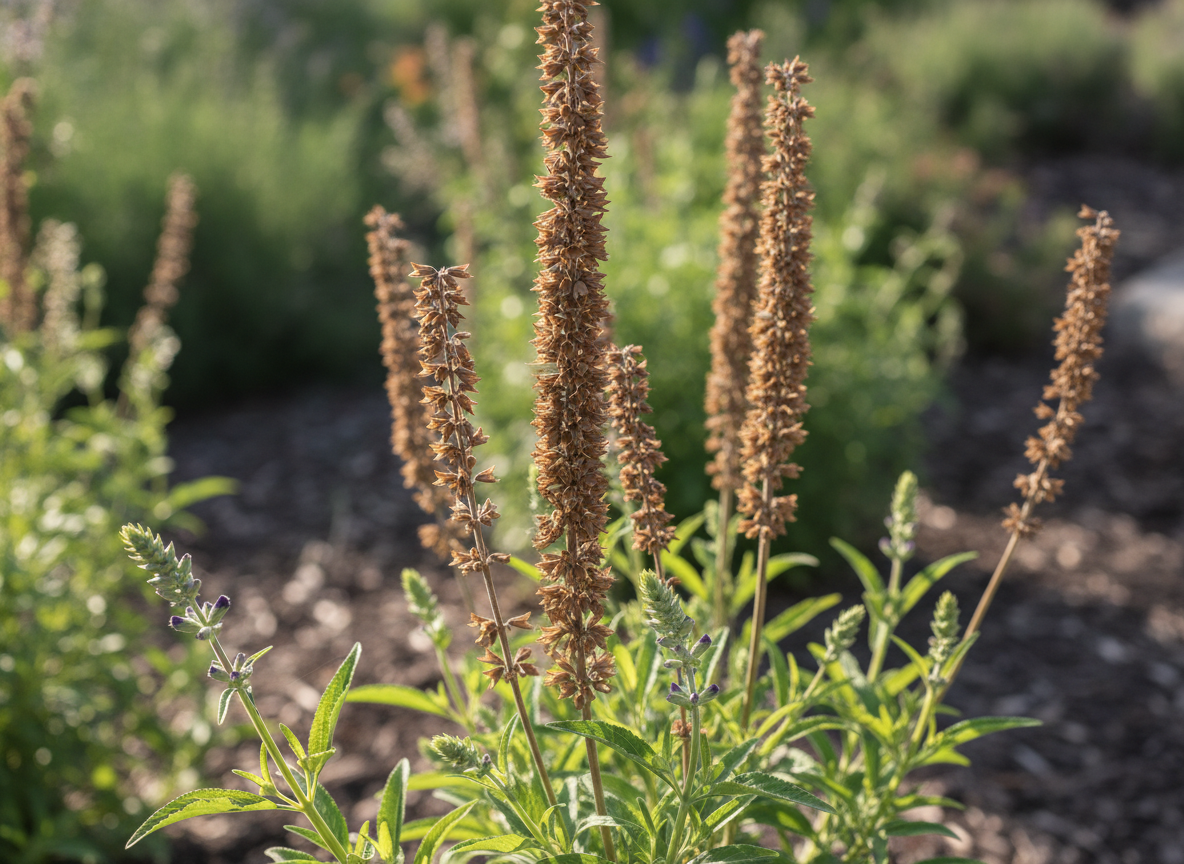 Browned salvia flower spikes among green leaves in a garden — AI-generated illustration
Time it as the spikes brown, not before
The window opens as the first flush goes over — for most border salvias in a normal year that’s the last week of June into early July, which is why some gardeners call it the “Hampton chop” after the early-July flower show, a few weeks behind the Chelsea chop. Don’t jump too early. While there’s still good colour on a spike it’s still feeding the plant and still working for the bees; cut it then and you’ve thrown away flower for no gain. Wait until a spike has faded to roughly a third of its colour and the side shoots below have visibly broken, then take it.
Cutting at that point does the same job it does on delphiniums and lupins: you interrupt the plant before it pours its energy into ripening seed, and redirect it into the waiting shoots. Leave the spent spikes standing and the salvia reads its year as done — you get a thinner second flush, or none. Take them off as they brown and the side shoots run up to flower in roughly three to four weeks, so a late-June cut blooms again through August. Keep deadheading the same way as each later wave fades and a healthy Salvia nemorosa will flower on and off right to the first frost.
Feed lightly, water once, then leave it lean
A salvia you’ve just cut back wants a drink and a modest feed to fuel the regrowth, but go easy. These are sun-loving, free-draining plants from lean soils, and the fastest way to a floppy, mildew-prone salvia is to overfeed it — soft, sappy growth flops and the second flush comes weak. Give the clump a good soak if late June is dry, scatter a light handful of a balanced or potassium-leaning feed around the crown, and stop there. Potassium drives flower; a nitrogen-heavy lawn feed just gives you leaf.
After that, the best thing you can do is nothing. No staking, no fussing — a salvia cut to its side shoots and grown hard rebuilds itself into a tidier, sturdier plant than the one you cut. The clumps that flop worst every year are almost always the overfed, over-watered, too-shaded ones.
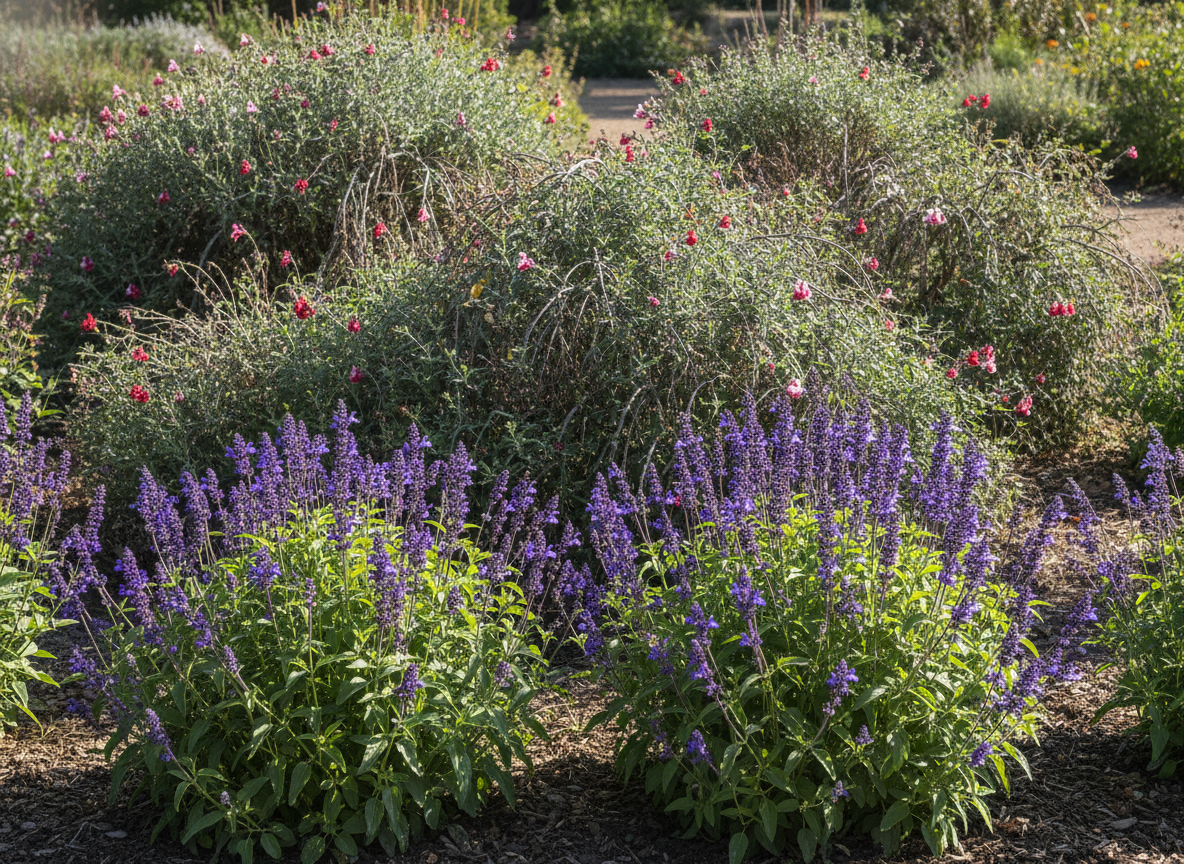 The photograph depicts two types of salvias blooming in a garden — AI-generated illustration
Border salvias yes — shrubby salvias are a different plant
One important caveat, because “salvia” covers two very different things. Everything above is for the hardy herbaceous border salvias — Salvia nemorosa, S. × sylvestris, S. × superba, the ‘Caradonna’ / ‘May Night’ / ‘East Friesland’ crowd that die back to the ground each winter. They take the cut-back-for-a-second-flush treatment perfectly.
The shrubby and tender salvias work differently. S. greggii and S. microphylla (‘Hot Lips’ and the like), and the big tender sorts such as ‘Amistad’, flower continuously on new growth all summer with nothing more than light deadheading and the odd tip-pinch — and you do not hard-prune them now. Their real prune is a tidy-up in mid-spring once frost is past. Cut a tender salvia hard in midsummer and at best you delay it; cut a shrubby one back into old bare wood and it may not break again at all. If you’re unsure which camp yours is in, the rule of thumb is simple: dies to the ground in winter and flowers in upright spikes, cut it now; stays woody above ground and flowers in loose pairs along the stem, leave it.
What the cut buys you
Done right, the late-June cut turns border salvias from a four-week June plant into one that carries colour into autumn. Spike by spike, follow each spent flower down to its new side shoots, take a soak and a light feed, and keep deadheading as each wave fades — that’s the whole job, and it’s the cheapest way to add two or three months of bloom to the front of a border.
Not sure whether the salvia in your bed is a hardy nemorosa that wants cutting now or a shrubby type to leave alone — or exactly when your clump’s window opens this year? Snap a photo in the Cresco app and it’ll tell you what you’re growing and the right moment to make the cut.