A bay tree (Laurus nobilis) is one of the few plants where the last day of the pruning window matters more than the first. Trim it in June and it pushes a flush of soft new leaves to hide the cuts. Trim it in October and those cuts just sit there, open and unhealed, all winter. Late August is the hinge — the last week or two where a shaping cut still gets a warm spell behind it to knit over before the plant slows down.
Why the window closes at the end of summer
Bay is evergreen and slow. It grows in flushes, mostly in late spring and again in mid-to-late summer, and between those flushes it does very little. When you cut into it, you’re relying on the plant to respond — to break new buds just below the cut and cover the gap. That response needs warmth and daylight.
Prune in early September in a mild year and you’ll usually get away with it. Prune much later and you’ve made a wound the tree can’t answer: no new growth, just a stub and a slightly scorched leaf edge that stays visible until next May. On a lollipop standard or a clipped ball, that’s the difference between a crisp shape and a shabby one for eight months.
So the rule is simple: finish all bay pruning by the end of summer. In practice that means the second half of August is your last comfortable slot — late enough that the summer flush has hardened and won’t flop, early enough that the cuts still close.
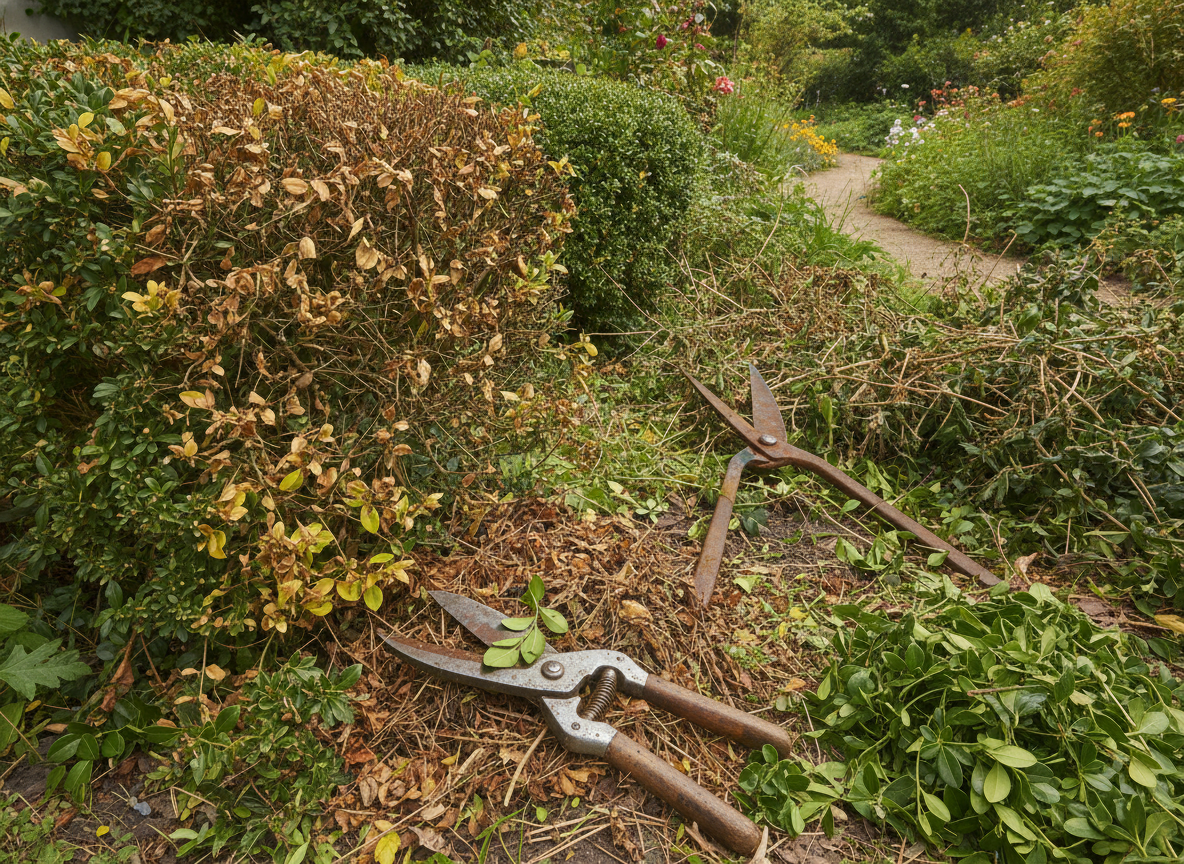 The photograph depicts secateurs and shears next to an overgrown and dying plant — AI-generated illustration
Secateurs, one leaf at a time — never shears
Here’s the mistake that turns a good bay into a brown one: reaching for the hedge shears.
Bay leaves are large, leathery and individual. A hedge trimmer or shears cuts straight through the middle of every leaf in its path, and each of those sliced half-leaves browns at the wound within a few days. A clipped bay done with shears looks tidy for a week, then develops a rash of brown, torn leaf-tips all over its surface. It’s exactly the problem cherry laurel has — I wrote about why laurel goes brown after you cut it — and the fix is the same: use secateurs.
Cut back to a leaf joint, taking out whole shoots or shortening them to just above a leaf. You remove the growth between the leaves, not through them, so there’s no cut leaf left on show. It’s slower — a formal bay ball is genuinely a job of ten or fifteen minutes with secateurs rather than two with shears — but the finish is clean and stays clean.
Wipe the blades between plants if you’ve been anywhere near box or a diseased shrub, and keep them sharp: a bruised, crushed cut on a bay heals worse than a clean one.
 Large, overgrown shrubs being shaped into balls, with wooden stakes and pruning shears nearby — AI-generated illustration
Shaping a standard or a ball
Most garden bay is grown as one of three shapes: a lollipop standard on a clear stem, a rounded ball or cone, or a loose bush. Late summer is a shaping trim, not a hard cut-back — you’re refining what’s there.
- Standards (lollipops). Trim the head back to an even dome, cutting each straggling shoot back to a leaf inside the outline you want. Then run your eye down the clear stem and rub or snip off any shoots that have broken along it, plus any suckers from the base — these steal energy and blur the shape.
- Balls and cones. Work around the plant taking off the shoots that have shot past the surface, always cutting back to a leaf just inside the line. Turn the pot as you go and step back often; it’s much easier to keep a ball round if you check it from a metre away every minute or so.
- Bushes. If you just want it smaller and denser, shorten the longest shoots by a third to a half, each cut to an outward-facing leaf. That’s it — bay doesn’t need much.
Don’t try to take a bay back to bare wood now. It can be renovated hard, but that’s a spring job (April), when it has the whole season to recover. A hard cut in late August leaves you looking at bare stems all winter.
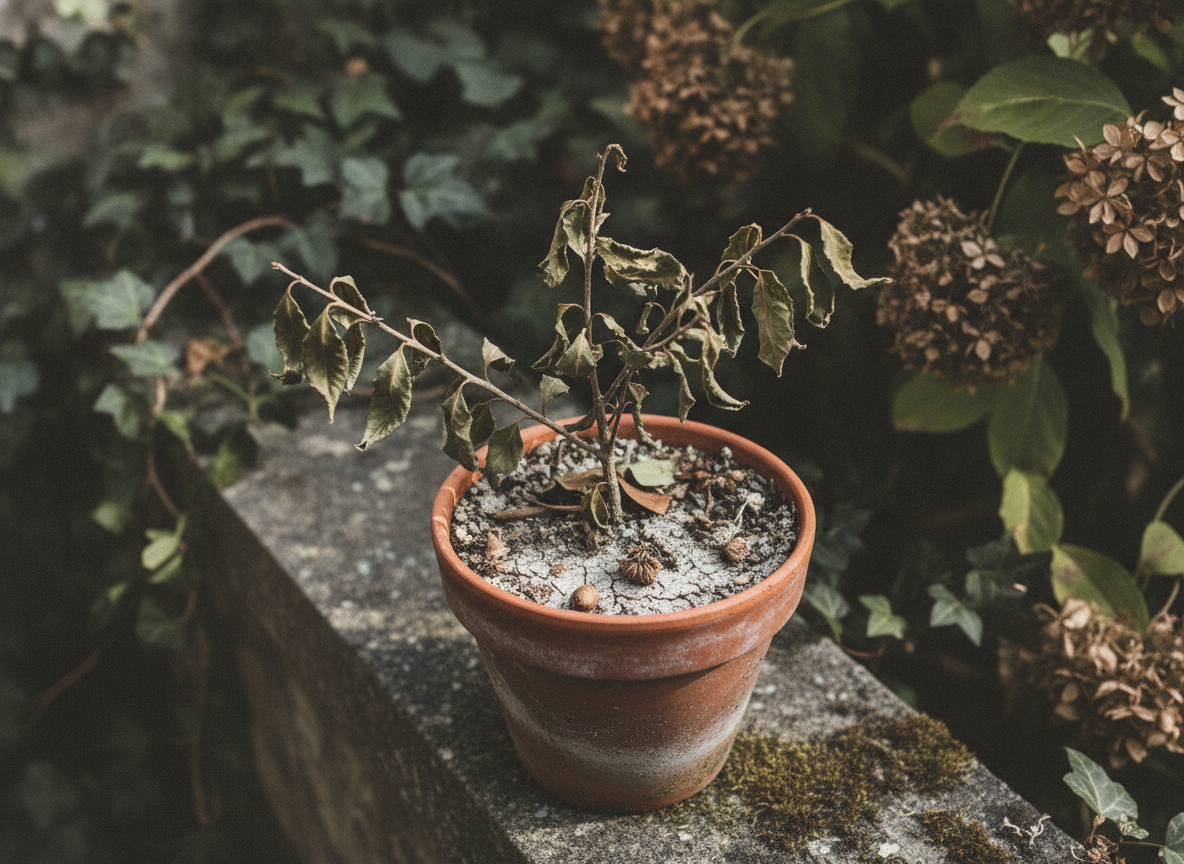 A withered bay leaf plant in a pot sits on a stone ledge — AI-generated illustration
Bay in a pot needs a little more
Most bays live in containers, and a pot changes the timing slightly. A root-bound bay in a dry August is already stressed, and pruning is another draw on it — so water it well the day before you cut, not after. If the plant is clearly pot-bound (roots circling the surface, water running straight through), note it for spring: pot it on one size in April, don’t disturb the roots now.
After you’ve shaped it, give a last weak liquid feed if you haven’t fed since midsummer, then ease off. Feeding hard into autumn pushes soft growth that won’t harden before the first frost — the same reason rosemary gets one last light trim now and no more. Bay and rosemary are both Mediterranean; both want to go into winter firm, not fleshy.
The one-minute version
- Timing: finish by the end of summer — late August is the last clean window. Cuts made now still heal; October cuts don’t.
- Tool: secateurs, never shears. Cut between the leaves, not through them, or you get a brown, torn surface.
- Cut: shape to a leaf just inside the outline; remove stem shoots and basal suckers on standards.
- Don’t: hard-renovate now (that’s April), or feed heavily afterwards.
Do this and your bay goes into autumn as a crisp, dense shape and holds it right through winter — which, for an evergreen you look at every single day, is the whole point. If you’re clipping box to a shape in the same border, the cloudy-day box trim is worth a read for the same reason: with evergreens, when and how you cut shows for months.