Walk down the border in the second week of August and the roses tell the same story every year. The flowers are still coming, but the leaves below them are speckled with sooty, purple-black blotches, ringed in yellow — and the lower stems are already half bare where the worst of it has dropped. This is black spot, the commonest rose disease in Northern Europe, and it always peaks now, in the muggy back half of summer. Most gardeners reach for a spray bottle. The spray is the least useful thing in the shed. What actually turns it around is a pair of secateurs, a bucket, and twenty minutes.
Why black spot explodes in a wet August
Black spot is a fungus, Diplocarpon rosae, and it plays a long game. It doesn’t blow in and infect a dry leaf on a warm afternoon — it needs the leaf to stay wet for about seven hours before a spore can take hold. That’s why a humid, showery August is its perfect weather: warm days, heavy dew, thunderstorms that leave the foliage dripping overnight. Each spot you can see is a spore factory, and every splash of rain lifts fresh spores off it and onto the clean leaves above. Left alone, one infected leaf in July becomes a defoliated bush by September.
Two things follow from that biology, and they’re the whole reason the spray-bottle approach fails. First, by the time a leaf shows the black blotch, the infection is already weeks old and the leaf is finished — no fungicide un-spots it. Second, the disease survives the winter not in the air but on material you can physically remove: the fallen leaves lying under the bush, and small lesions on the stems themselves. Take those away and you starve next year’s outbreak at the source. A spray only ever protects leaves that aren’t infected yet, and only until the next rain washes it off.
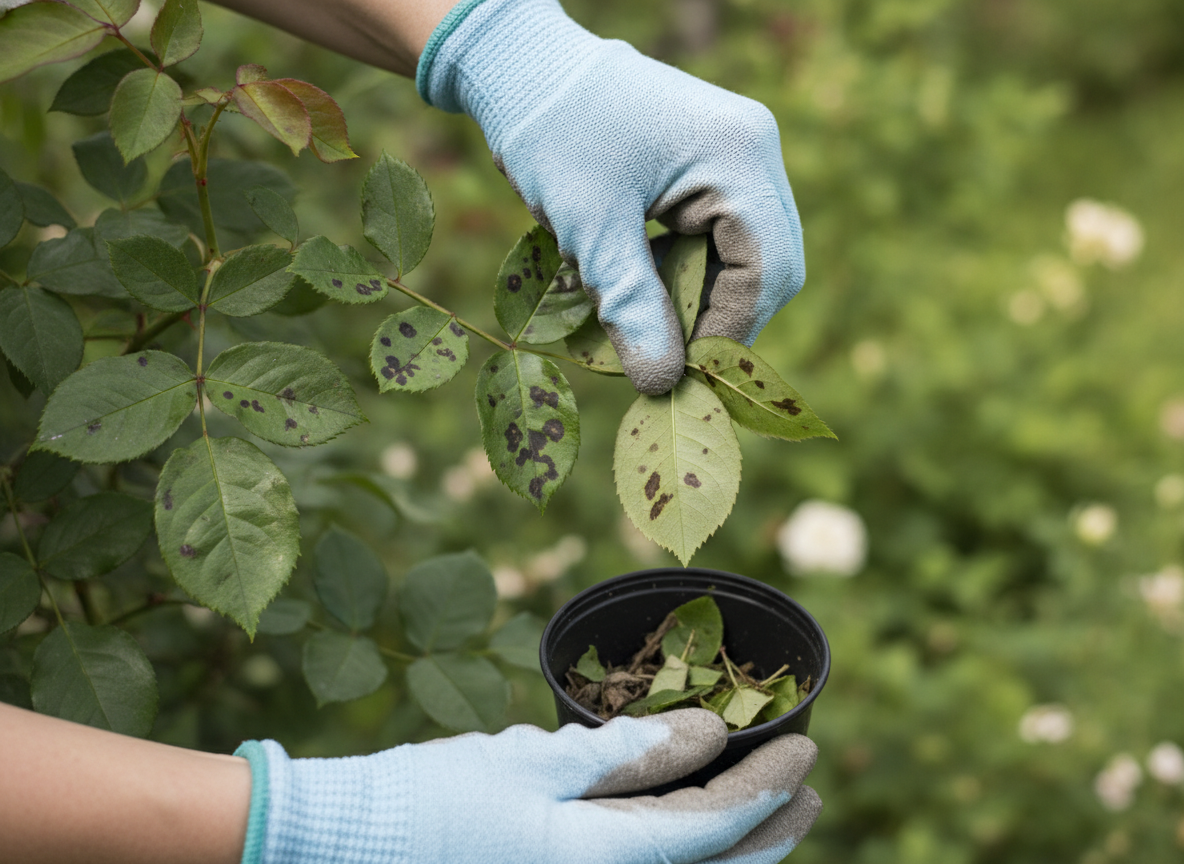 Gloved hands remove spotted leaves from a plant and place them into a small pot — AI-generated illustration
The move: strip the worst leaves and bin them
Here’s the job for this week. Go over each bush and pick off every badly spotted leaf, along with any that have already yellowed, and drop them straight into a bucket — not onto the ground, where they’ll keep shedding spores. Then clear the fallen leaves from the soil under the plant, because that carpet of infected foliage is doing exactly the same job as the spots still on the bush. This is sanitation, not surgery: you’re removing the reservoir of spores, one leaf at a time.
Two rules make the difference between clearing it and spreading it:
- Don’t compost the leaves, and don’t leave them lying. Black spot overwinters happily on dead foliage, so a compost heap or a forgotten pile by the border is next spring’s infection sitting in wait. Bag it for the council green-waste collection, or burn it.
- Wipe your blades between plants. If you’re snipping out spotted growth, a quick wipe of the secateurs stops you carrying spores from a sick bush to a healthy one.
There’s one line not to cross. Don’t strip the bush bare. A rose still needs leaves to feed itself and finish the season’s flowers, so take the clearly infected and the yellowing, and leave the clean green growth alone. If a plant is so far gone that removing the bad leaves would leave it almost naked, take off what you sensibly can, cut your losses for this year, and put your effort into the autumn clean-up and next spring’s prune instead. This is the same logic behind stripping the lower leaves off a rust-hit hollyhock rather than spraying the whole plant — you remove the diseased tissue and let clean growth carry on.
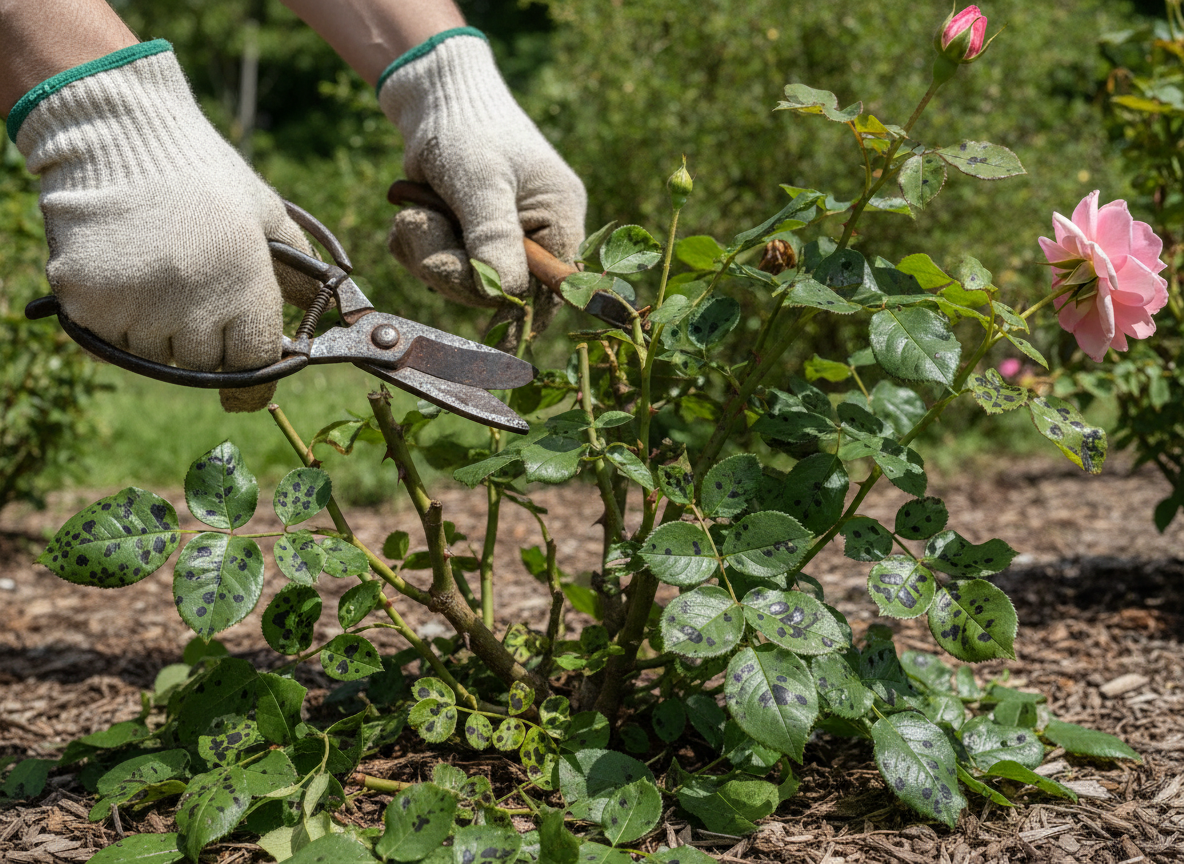 A person prunes a rose bush with black spot disease — AI-generated illustration
Thin the bush so the leaves dry faster
Sanitation clears what’s there; airflow stops it coming back through the rest of the summer. Remember the seven-hours-wet rule — anything that helps a leaf dry quickly after rain breaks the infection cycle. A congested, twiggy bush holds still, damp air in its centre for half a day after a shower; an open one dries in an hour.
So while you’ve got the secateurs out, thin the middle. Take out any thin, crossing or inward-growing stems that crowd the heart of the plant, and any dead or diseased wood you find. You’re not shaping the rose and you’re not doing its main prune — that’s a winter and early-spring job, and there’s a full guide to when and how to prune roses for that. This is just opening the centre so light and air move through it. On a repeat-flowering bush, keep deadheading spent blooms down to a strong outward bud as you go — it keeps the flowers coming and gives you a reason to look closely at the foliage every few days, which is how you catch the next flush of spots early.
Two habits reinforce the thinning:
- Water the roots, not the leaves, and do it in the morning. Overhead watering in the evening leaves foliage wet all night — precisely the condition black spot needs. Water at the base early in the day so any splash dries fast.
- Mulch the soil in spring. A layer of mulch over the ground stops rain splashing last year’s spores up onto the new leaves — one of the main ways the disease restarts each season.
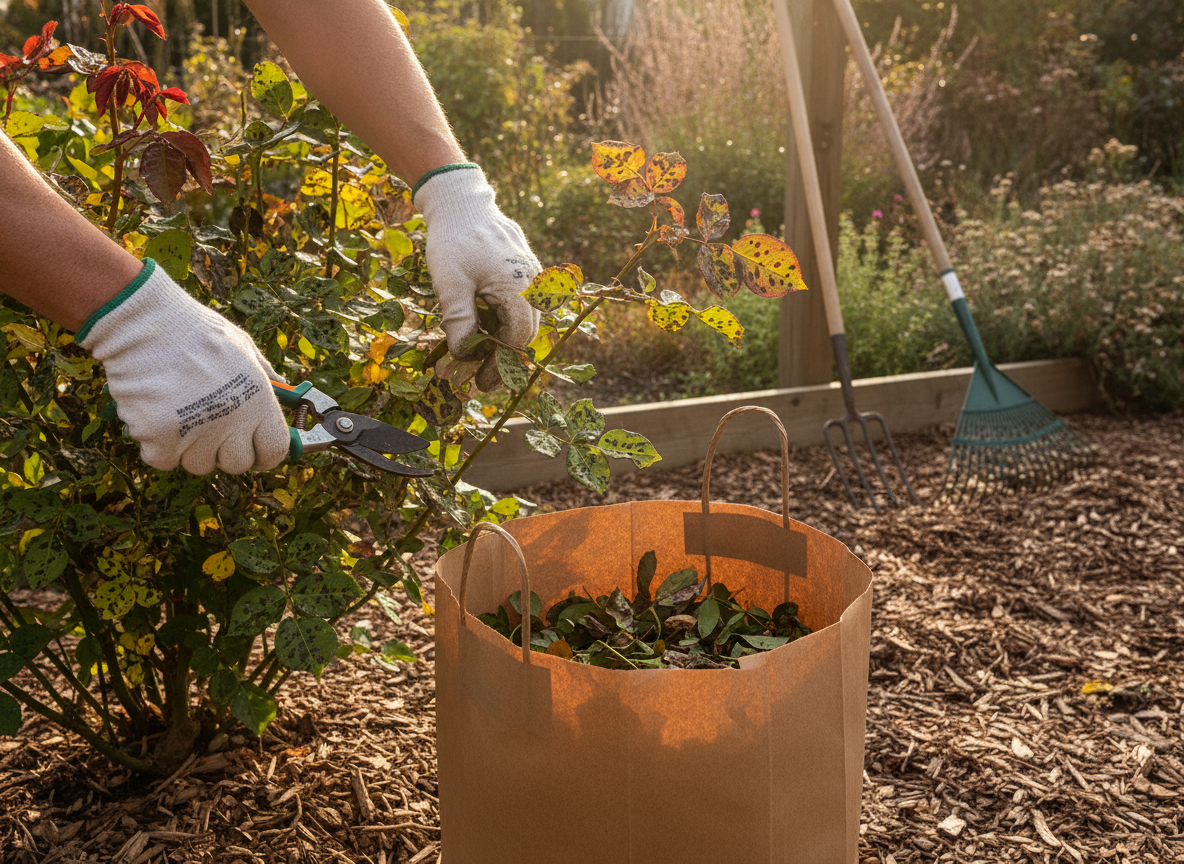 A person prunes an affected rose bush into a paper bag, with gardening tools nearby — AI-generated illustration
The autumn clean-up that actually breaks the cycle
If you do one thing all year for black spot, do this: in late autumn, when the last leaves fall, rake up and remove every one of them from around the base of the rose. That fallen litter is where the fungus overwinters, and a clean patch of soil under the bush in November does more than any summer spraying regime. Pair it with the winter or early-spring prune, when you cut back to healthy wood — this removes the small stem lesions that are the other overwintering site, the ones no amount of leaf-picking reaches while the plant is in growth.
That’s the rhythm that beats black spot: strip and bin the worst leaves through summer, keep the centre open, clear every fallen leaf in autumn, and prune out lesioned wood in spring. Do those and a rose that used to be bare by September holds clean foliage into October.
When a rose blackspots every single year
Some roses are simply martyrs to it. If yours defoliates every summer no matter how diligent you are, the problem may be the variety, not your care. Black-spot resistance varies enormously between roses: many modern shrub and landscape roses — the David Austin English roses, the Rugosas, and cultivars bred specifically for disease resistance — shrug it off, while some older Hybrid Teas catch it the moment the weather turns. If you’re fighting the same losing battle year after year, replacing a chronic sufferer with a resistant variety is a more permanent cure than anything in a bottle.
Siting matters too. A rose crammed against a wall or hedge, or hemmed in by perennials, sits in still air and stays damp — exactly what the fungus wants. One with space around it, in sun, in moving air, dries fast and shrugs off far more. When you plant or move a rose, give it room; you’re designing out the disease before it starts.
Let Cresco catch it before it spreads
The hard part of black spot isn’t the fix — it’s timing. The disease moves in warm, wet spells, and the moment to strip leaves and open the bush is the week the weather turns muggy, not three weeks later when half the foliage has already dropped. Cresco tracks every rose in your garden against your local weather and tells you when conditions favour black spot, when to do the summer sanitation, and when the autumn clean-up and spring prune are due — so you act on the plant’s schedule, not on whatever you happen to notice. See how it works in the Cresco pruning calendar that reads every plant against your local weather.
Strip the worst leaves this week, clear the ground beneath, open up the middle — and skip the spray. The roses will thank you for it well into autumn.