What those orange spots actually are
Turn a spotted hollyhock leaf over and you’ll see it: raised orange-brown pustules, packed across the underside, with matching yellow dimples on the top surface. That’s hollyhock rust, a fungus called Puccinia malvacearum, and by mid-July it’s usually well underway. Left alone it works up the plant leaf by leaf until the lower half is brown, crisp and hanging — right at the moment the flower spikes are meant to be the star of the border.
The useful thing to know is that this rust is fussy about its host. It only attacks plants in the mallow family (Malvaceae) — hollyhocks (Alcea rosea), the wild common mallow, lavatera and their relatives. It will not jump to your roses or your phlox. But it will happily come back to the same hollyhocks year after year, because the spores overwinter on dead leaves, on old stems, and on the little self-sown seedlings that pop up around the parent. Warm, damp, still air is exactly what it wants — which is why a muggy British July is peak rust season.
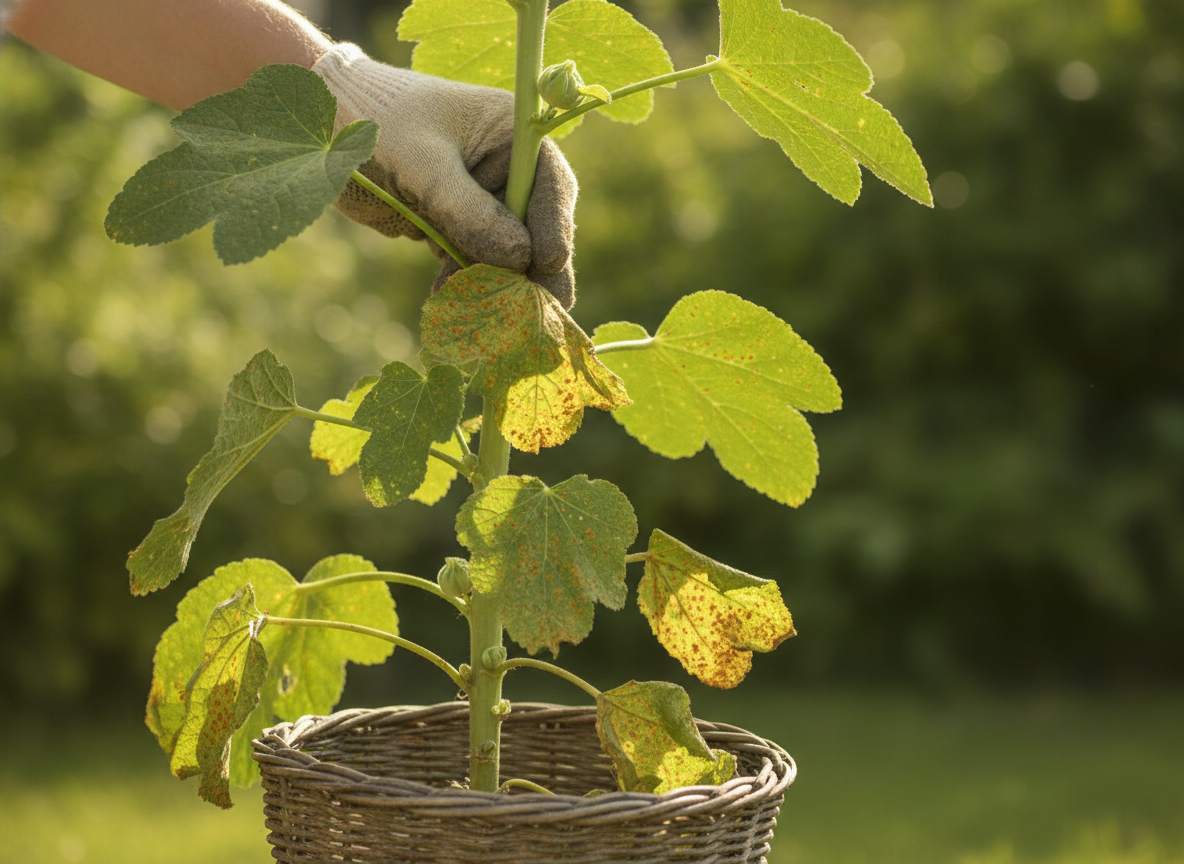 A gloved hand strips rust-infected leaves from a hollyhock plant — AI-generated illustration
Strip the worst leaves, from the bottom up
You can’t spray your way out of established rust, and by July it’s established. What actually keeps a plant standing is removing infected leaves faster than the fungus can spread from them. The bottom leaves go first and always suffer worst — they’re closest to the soil splash and last year’s spores — so that’s where you work.
Go over each plant through the month and pull or snip off the most heavily spotted lower leaves. Don’t strip it bare: a hollyhock still needs a decent skirt of healthy green to feed the roots and hold the flower spike up. Take the brown and badly pustuled ones, leave the clean ones, and repeat every week or two as the rust climbs. The single most important step is what you do with the leaves afterwards — they go in the household bin, not the compost heap. Rust spores sail straight through a normal garden compost and you’ll be spreading them back onto the plant next spring. If you’re using secateurs across several plants, wipe the blades between them so you’re not carrying spores down the row.
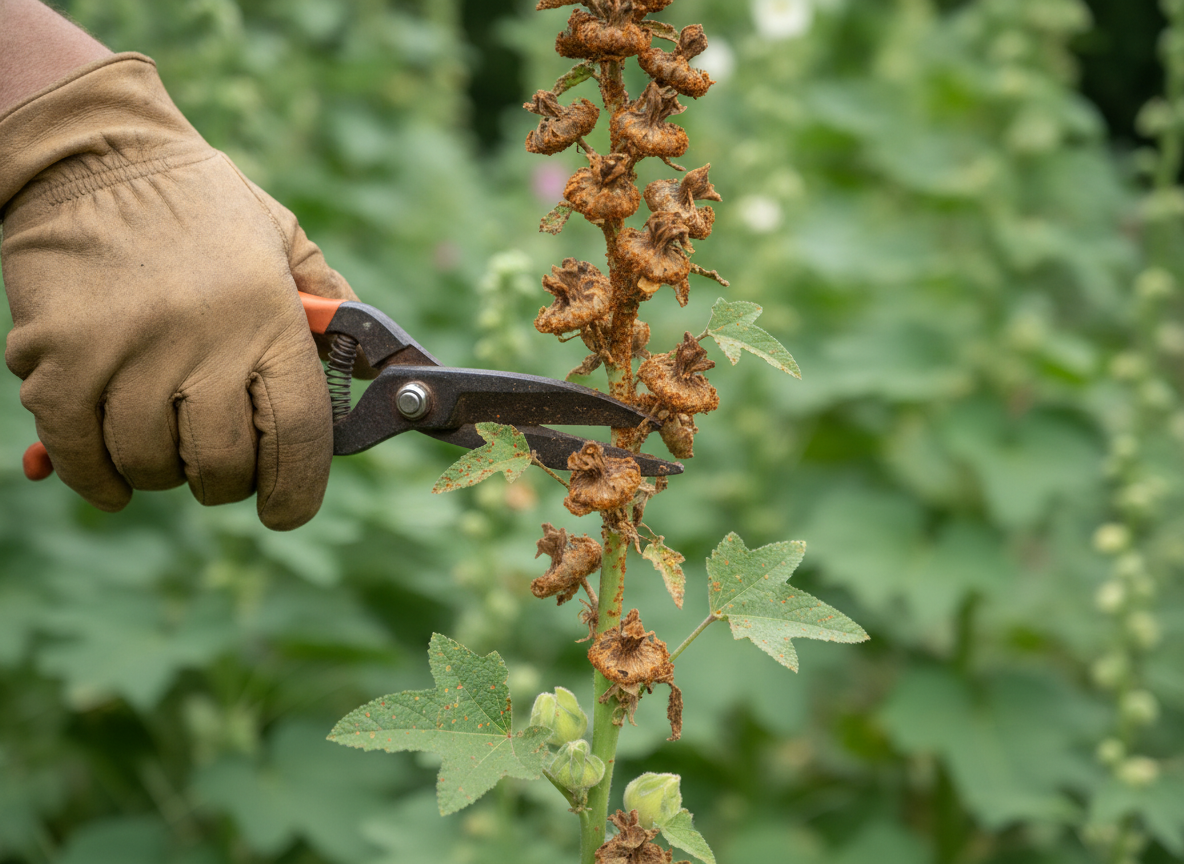 A gloved hand uses pruning shears to cut a spent hollyhock spike — AI-generated illustration
Cut the spent spike before it seeds
Once a flower spike has bloomed its way to the top and the last flowers are going over, cut the whole flowered stem down low — leaving the healthy basal rosette of leaves at the bottom. There are two payoffs, and they’re the whole reason to do this now rather than in autumn.
First, a hollyhock that’s allowed to set seed pours its energy into ripening those seed heads, on a tall stem carrying most of the season’s rust. Cutting the spike down removes a huge amount of infected leaf in one go and redirects the plant’s energy back into the crown. Second — and this is the bit most people miss — hollyhocks are short-lived. Many behave as biennials, flowering once and dying. Cut the spike before it exhausts itself on seed and a genuine perennial plant is far more likely to survive the winter and come back. It’s the same logic behind cutting biennial foxglove spikes for a second flush: take the stem off before the plant commits everything to seed.
The late-summer bonus flush
There’s a reward for cutting spikes down early. Plants that haven’t been left to seed will often push a second, lower flush of flowers from the base in late summer — not the two-metre towers of June and July, but a scatter of blooms at knee height that carries some colour into September. You won’t get it from every plant, and you won’t get it at all if you let the first spikes ripen seed. It’s a direct trade: seed now, or flowers later.
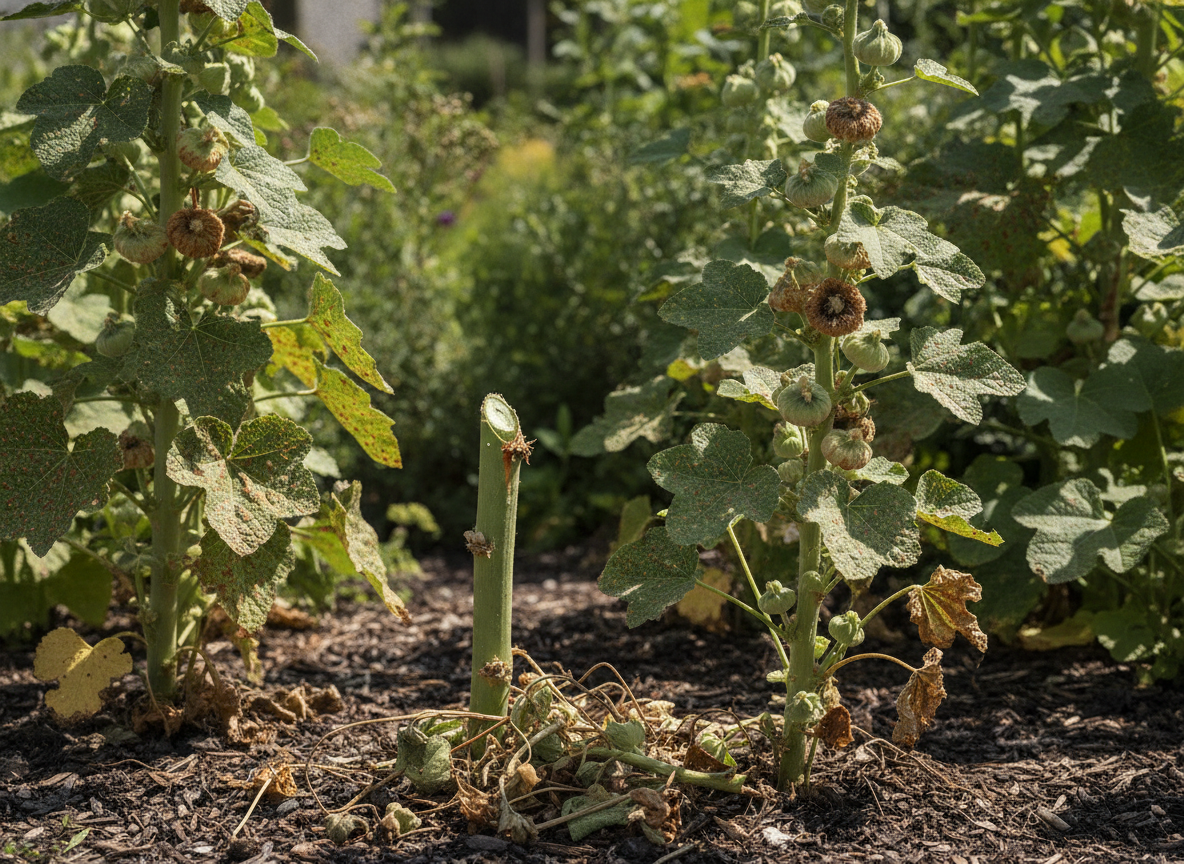 A garden with hollyhock plants, one with a cut spike — AI-generated illustration
If you want seed, sacrifice one spike
That trade-off is real, so decide deliberately. If you want to save hollyhock seed — they’re easy, and it’s the cheapest way to keep a colour you like — you have to leave a spike or two standing until the seed cases turn brown and papery. The cost is that those spikes keep their rusty leaves longer, and the seedlings they drop will carry the disease forward into next year’s plants. The tidy compromise: leave one good spike for seed, cut the rest down, and thin out the self-sown seedlings hard in spring so you’re not building a rust nursery around the parent.
Break the cycle for next year
July’s stripping-and-cutting buys you this season. A few autumn and spring habits stop the rust starting so early next time:
- Clear every fallen leaf from around the plants and cut old stems right to the ground once they’ve finished. Bare soil over winter means fewer overwintering spores.
- Give them air. Rust thrives in stagnant, crowded corners. Space plants generously and thin congested clumps so the leaves dry quickly after rain.
- Water the soil, not the plant. Overhead watering wets the foliage and hands the fungus the damp it needs. Aim the can at the base.
- Consider a tougher hollyhock. The fig-leaf or Russian hollyhock (Alcea rugosa), with its soft-yellow flowers and lobed leaves, is markedly more rust-resistant than the classic Alcea rosea — worth a spot if rust defeats you every summer.
Rust is the price of growing the plant that gives you those cottage-garden spires, and you rarely beat it outright. But strip the worst leaves through summer, cut the spikes before they seed, and clear up in autumn, and you keep the plant flowering and standing instead of browning off by August. If you’re not sure when your other border plants are due their cut, the Cresco pruning calendar times each job to your own weather rather than a fixed date.