There’s a moment every three or four years when a bearded iris quietly stops earning its keep. The clump gets bigger and leafier every season, but the flowers thin out — a couple of stems where there used to be a dozen, or a summer with almost none at all. Gardeners assume the plant is tired, or the spot’s gone wrong, and start thinking about feed. It’s neither. The iris has grown itself into a traffic jam: the rhizomes have crept outward, crossed over one another, and packed the centre so tightly that the old wood in the middle can’t flower and the young growth on the edge has nowhere to go. The fix isn’t a feed or a new position. It’s a spade, a knife, and about an hour of your time — and late July is exactly when to do it.
Why a congested clump stops flowering
A bearded iris doesn’t grow from a bulb. It grows from a rhizome — a fat, horizontal stem that lies half on top of the soil, creeping forward a few centimetres a year and throwing up a fan of leaves and, in a good year, a flower spike from its growing tip. Each rhizome flowers once from a given tip, then branches sideways into new offshoots that flower the following years. Left alone, the plant spreads outward in a slow ring while the original centre ages, hardens, and goes blind — no leaves, no flowers, just spent grey wood.
After three or four years that ring has closed into a solid, overlapping mat. The rhizomes shade each other, the crowded fans trap damp air, and — the part that matters most — the growing tips no longer have bare, sunlit soil to creep into. Bearded irises flower on rhizomes that get baked by the sun; a rhizome buried under its neighbours’ leaves, or forced to sit in the shade of the clump, simply builds foliage instead of flower buds. That’s why a congested iris looks lush and green and gives you almost nothing. Splitting the clump gives every young rhizome its own patch of sun again, and the flowers come straight back the following June.
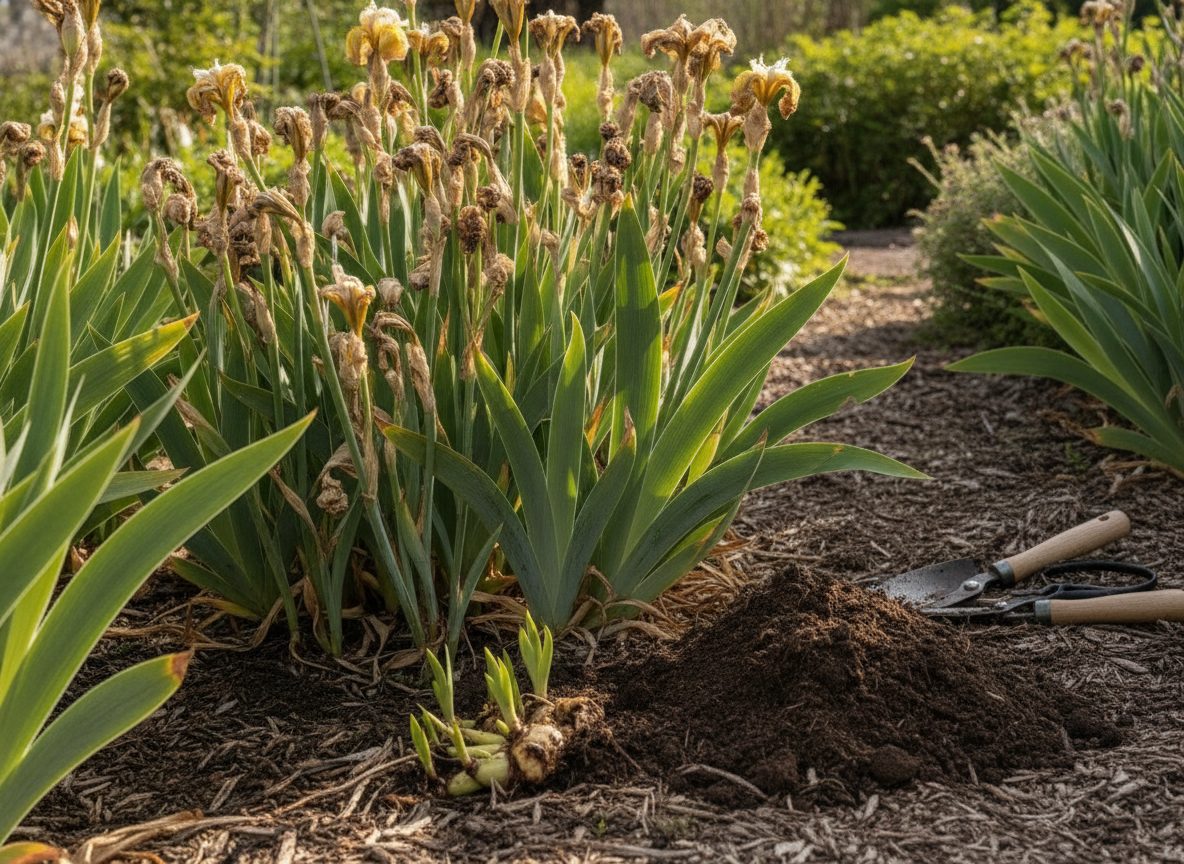 Faded bearded iris flowers, divided rhizomes, and gardening tools in a garden bed — AI-generated illustration
When to divide — six weeks after the flowers fade
The window is the six-to-eight weeks after flowering, which for most bearded irises in a Northern European garden lands squarely in late July and into August. There’s a good reason it’s not earlier and not later. Divide too soon, while the plant is still winding down from flowering, and you disturb it before it’s ready to make roots. Leave it into autumn and the divisions don’t have enough warm soil left to anchor themselves before winter — an iris that goes into the cold barely rooted heaves out of the ground in the first hard frost.
Late July hits the sweet spot: the plant has finished flowering and is entering its natural late-summer growth phase, when rhizomes push out fresh white feeding roots. Replant into warm soil now and those roots take hold within a few weeks, so the division goes into winter firmly settled and comes up next spring ready to flower. You’re working with the plant’s own rhythm, the same principle behind timing every cut to the plant rather than the calendar — Cresco’s whole approach to a pruning calendar is built on “six weeks after flowering” being a moving target that depends on your season, not a fixed date.
You don’t do this every year. Divide when the clump tells you to — when flowering drops off, when the centre’s gone bare, or when the rhizomes are visibly climbing over each other and shouldering out of the bed. For most bearded irises that’s every three to four years. A clump that’s still flowering freely and sitting flat in its space can be left well alone.
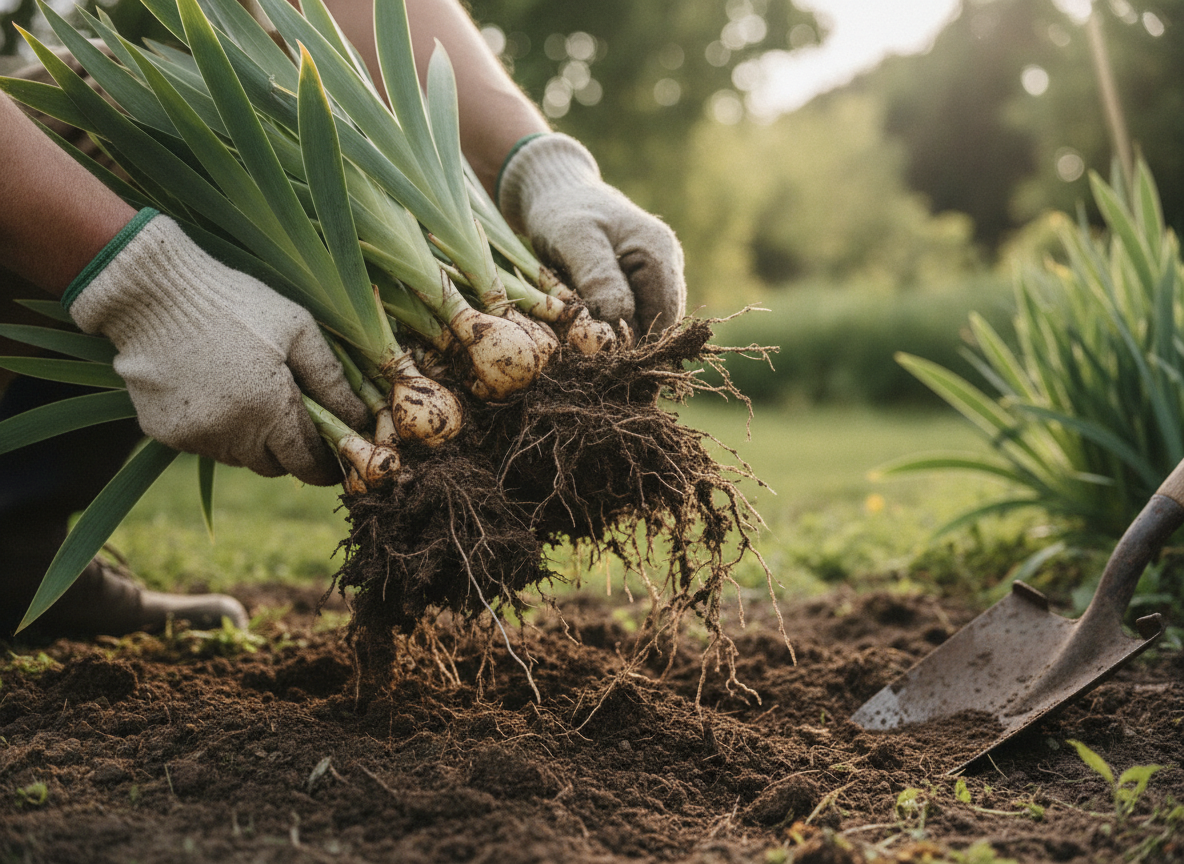 A person wearing gloves is lifting a clump of bearded iris rhizomes from the soil — AI-generated illustration
Lifting and splitting the clump
Start by cutting the leaf fans down before you dig — it makes the whole job easier to handle and cuts the wind-rock later. Then lift the entire clump with a garden fork, working in from well outside the ring of rhizomes so you don’t spear them, and lever the whole thing up in one piece. Knock and shake off as much soil as you can, then rinse the rhizomes under a hose or in a bucket so you can actually see what you’re working with — you’re about to make decisions about which pieces to keep, and you can’t judge a rhizome you can’t see.
Now read the clump. The old, thick, leafless rhizome in the middle — often several fists of grey woody stuff — is spent. It has flowered, it won’t flower again, and it goes on the compost heap. What you’re keeping is the ring of young rhizomes around the outside: firm, plump, pale, each with a healthy fan of leaves and a beard of white roots. Snap or cut these away from the old centre and from each other. Each division wants to be a single fan on a section of rhizome about the length of your thumb — 8 to 10 cm — with roots attached. Break them apart by hand where they’ll come, and use a clean knife where they won’t.
Before anything goes back in the ground, inspect every piece. A healthy rhizome is hard, like a raw potato. Anything soft, mushy, hollow, or smelling sour has rot and must be cut back to clean white flesh or thrown out entirely — replant rot and you’ll lose the lot. While you’re looking, check for the tell-tale tunnels of iris borer or any brown mush at the leaf base; bin those pieces rather than risk them. It’s the same discipline as any summer job where you’re cutting to keep disease out of the clump, the logic behind stripping rust-spotted hollyhock leaves rather than leaving them to spread.
 AI-generated illustration
Trimming the fan — the one time it’s genuinely right
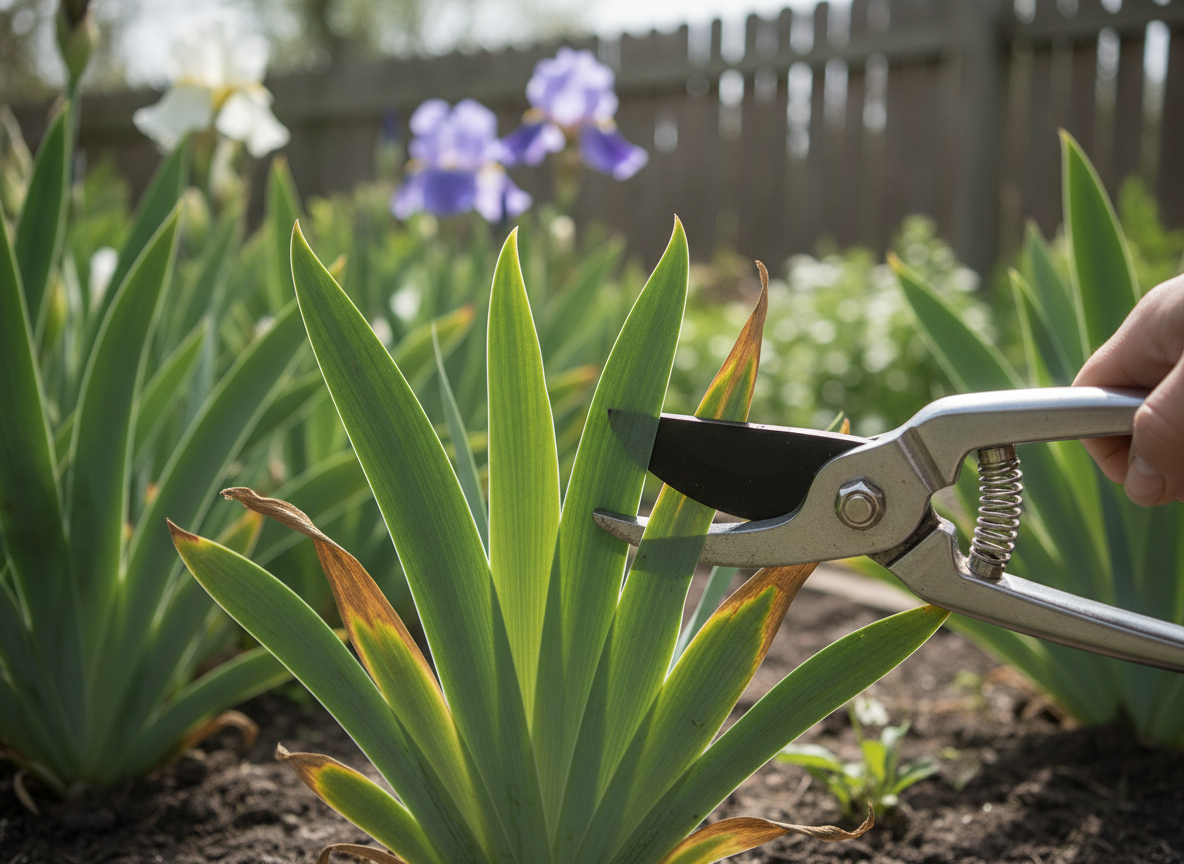
Here’s where iris advice seems to contradict itself, so it’s worth being clear. Trim each division’s leaves into a short fan — roughly 15 cm tall, cut across at an angle so it looks like a little spearhead. This is not the same as routinely hacking the leaves off an established, undisturbed plant, which is a myth worth ignoring: a settled iris needs its full fan of leaves to feed the rhizome, and I’ve made the case against that habit in the post on the bearded-iris fan-trim myth.
A freshly lifted division is a different situation entirely. It has just lost most of its roots, so it can’t support a full head of foliage — leave the leaves long and the wind catches them like a sail and rocks the poorly-anchored rhizome loose before it can root. Cutting back to a short fan balances the top against the reduced roots and lets the plant put its energy into anchoring rather than holding up leaves it can’t yet supply. Trim the long straggly roots back by about a third too, to a neat handful, which makes replanting far tidier without costing the plant anything.
Replanting: rhizome on top, sun on its back
The single most common way to kill a bearded iris is to plant the rhizome too deep. It is not a bulb and it does not want to be buried. Make a low mound or ridge of soil, sit the rhizome across the top of it so its upper surface sits at or just above soil level and exposed to the sky, and drape the roots down either side of the ridge into the hole. Firm the soil around the roots, but leave the back of the rhizome bare to the sun. A rhizome that can’t feel the sun on its back won’t set flower buds — this is the same “keep the rhizome baking” rule the May iris post is built around, and it matters just as much on replanting day.
Orientation is worth thirty seconds of thought. A rhizome grows and flowers in the direction its fan points, so face the leaf fan the way you want the plant to travel — outward into open bed, not back towards its neighbours. If you’re replanting a group, set the divisions 30 to 45 cm apart with the fans radiating outward, or plant them in threes with the rhizomes pointing inward to a tight centre for a fuller clump sooner. Water them in once to settle the soil, then hold off — a newly divided iris in warm, moist July soil is prone to rot if you keep it wet, so let it dry between waterings and don’t mulch over the rhizomes.
Let Cresco time it for your garden
Dividing bearded irises is one of those jobs that’s simple once you know it and easy to get wrong on timing — too early and the roots won’t take, too late and the frost heaves them out, and the “six weeks after flowering” window shifts by a fortnight depending on your variety and your summer. That’s exactly the kind of moving target Cresco is built to track: tell it what you grow and it tells you when each job is genuinely due for your plants and your local weather, so “lift and divide the irises” arrives as a timed nudge in late July instead of a thing you remember in October when it’s too late. Get the timing right, keep the rhizome on top and in the sun, and a tired three-year-old clump turns back into a proper June show.