Why an unpruned blueberry slowly stops cropping
A young blueberry bush feels like a plant you never have to touch. For the first three or four years it puts up strong new stems, covers itself in white bells in April, and gives you more berries every summer. Then it levels off. A few years later the berries get smaller, the crop moves to the top of the bush where the birds get it first, and the middle fills with grey, twiggy wood that flowers weakly or not at all.
That isn’t age. It’s what happens when nobody takes the old wood out. A highbush blueberry (Vaccinium corymbosum) fruits best on stems that are two to four years old. After about five or six years a stem slows down: it branches into a mass of thin twigs, each carrying a few small buds, and it shades the young growth coming up from the base. The bush still looks full, but more of it is old wood every year.
The fix takes one winter cut a year, and November is a good time to start.
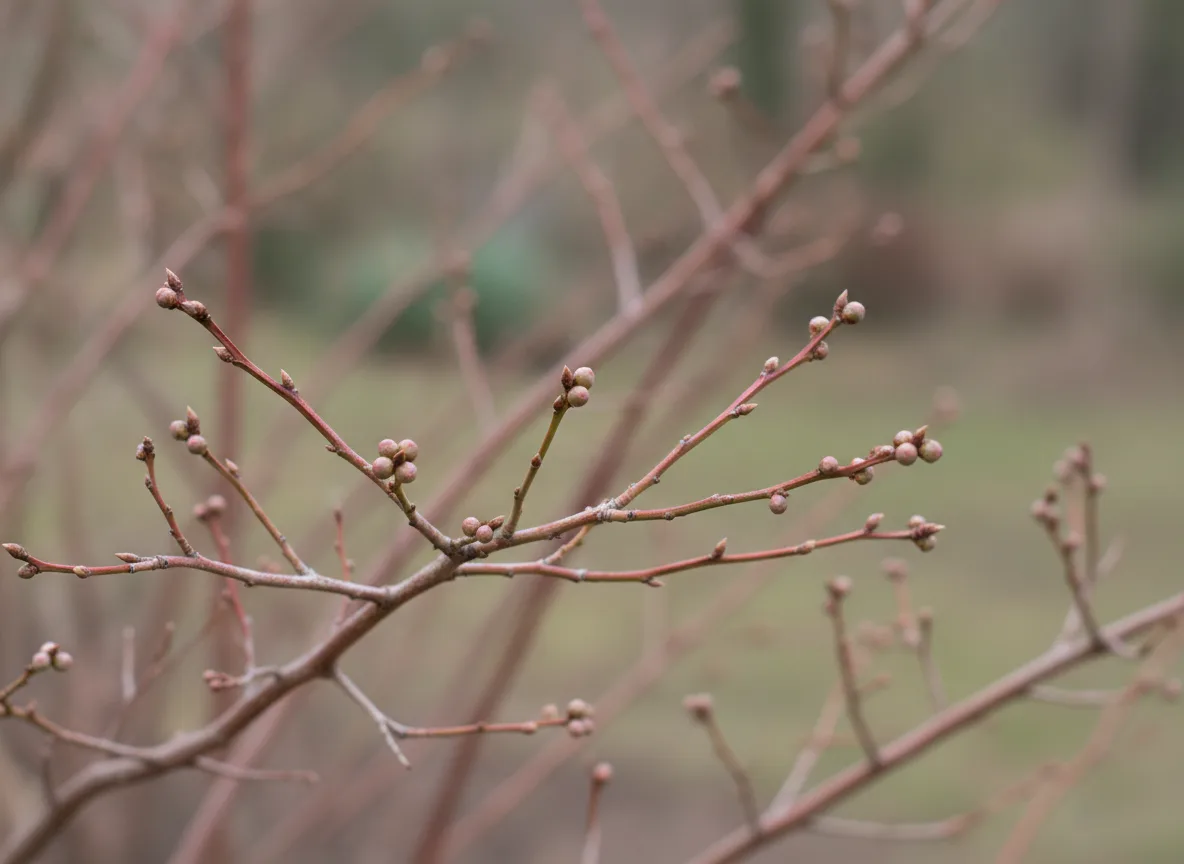 Blueberry bush branches with buds in winter light — AI-generated illustration
Read the buds before you cut
Once the leaves have dropped (and blueberry leaves turn a fine scarlet before they go) the stems are bare and you can read the buds. This is the reason to prune in winter and not in summer: you can see exactly where next year’s crop is.
Look closely at the tip of a one-year-old shoot and you’ll find two kinds of bud:
- Fruit buds are fat and round, about the size of a peppercorn, and sit near the tips of last summer’s shoots. Each one opens into a cluster of five to ten flowers, so each one is a bunch of berries.
- Leaf buds are small, flat and pointed, and sit further down the shoot. They make leaves and new shoots, not fruit.
A healthy bush has plenty of fat buds on strong, reddish young wood. An old stem has its fat buds scattered thinly over dozens of short, weak twigs. Once you can tell the two apart you can prune by eye: keep the wood with the buds and remove the wood that’s just shading it.
The rule of thirds
The aim is a bush made of roughly equal parts young, middle-aged and old wood: about a third one- and two-year-old stems, a third three- and four-year-old stems, and a third older stems that are close to being replaced. Each winter the oldest of those come out, the young ones move up a group, and fresh shoots from the base take their place. Handled this way a blueberry can crop well for decades, not just for its first ten years.
You can tell a stem’s age from its bark. Young stems are smooth and green-red to bright red. Stems in their prime are brown with some side branching. Old stems are grey, rough or flaking, thick at the base, and topped with a crowded twiggy head.
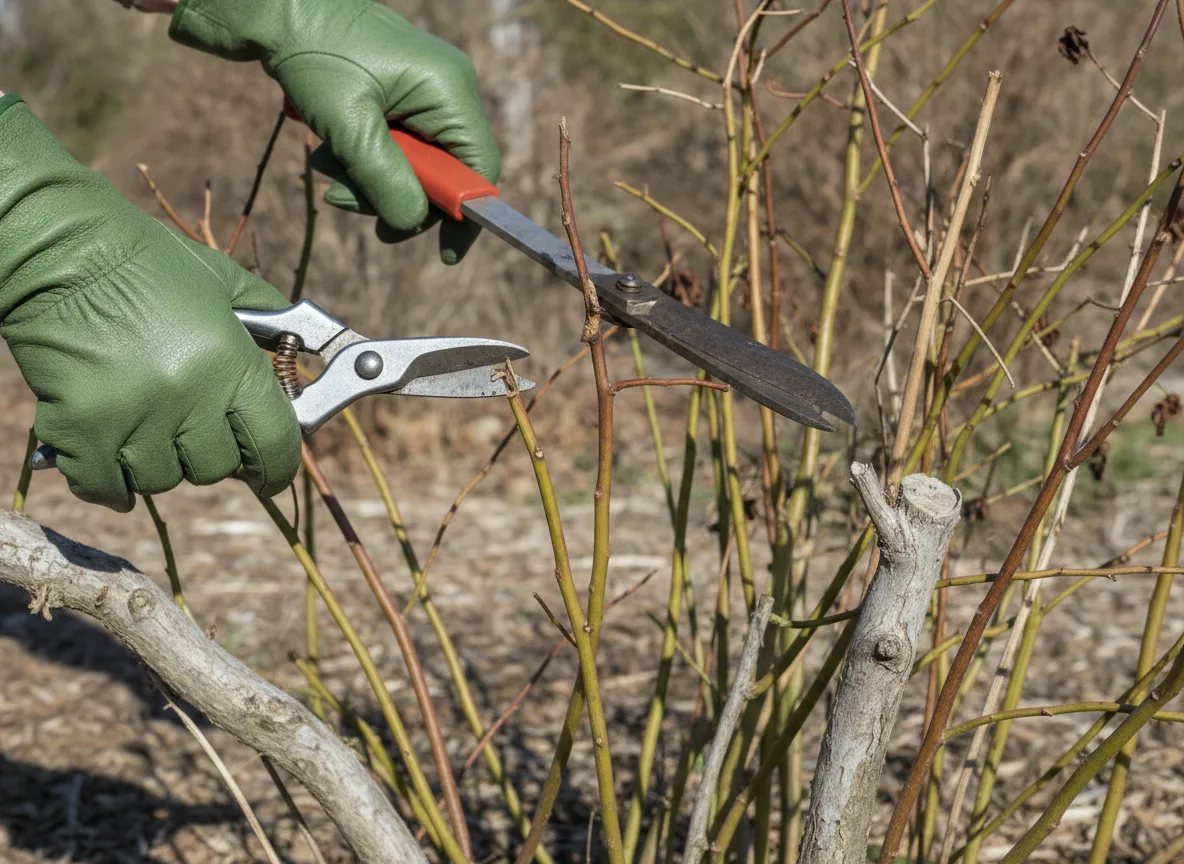 A gardener uses secateurs to prune a blueberry bush — AI-generated illustration
How to prune an established blueberry, step by step
Use clean, sharp secateurs for the thinner wood and loppers or a small pruning saw for old stems at the base. Pick a dry day without hard frost.
- Take out the dead, damaged and diseased wood first. Snapped stems, anything that’s died back, and shoot tips with sunken, discoloured patches. Cut back to healthy wood or to where the stem joins a thicker branch.
- Remove the oldest stems at ground level. On a mature bush (six years or more) that usually means one to three of the thickest, greyest stems, or roughly a fifth to a quarter of the bush. Cut them as low as you can get the saw, so they don’t leave a stub that sends up weak twigs. This is the cut that makes room for the new stems from the base.
- Thin the low, weak and crossing growth. Remove shoots that flop to the ground (their berries end up muddy and slug-eaten), thin twiggy shoots in the centre, and any branch rubbing against another. You’re aiming for an open, upright vase with light reaching the middle.
- Keep the best new shoots from the base. Strong, unbranched whips that came up last summer are your future fruiting stems. Keep the two or three best-placed ones and remove the rest if the bush is crowded.
- Tidy the twiggy tops of the stems you keep. Where a middle-aged stem ends in a mass of short twigs, cut it back to a strong, upright side shoot with fat buds. Don’t tip back the young whips: their best fruit buds are at the ends.
Stop there. A blueberry that loses more than about a third of its wood in one winter answers with a flush of leafy shoots and a thin crop. If you’re unsure, take out too little rather than too much; you can always remove one more old stem next year.
Young bushes: a different job
For the first two winters after planting, the job is roots and stems, not fruit. Remove any weak, thin or low shoots and, if you can bear it, rub off the fat flower buds so the plant puts its energy into growing. From the third winter on, prune lightly: dead wood, low and crossing shoots, nothing more. The rule of thirds only really starts around year five or six, when the first stems begin to age.
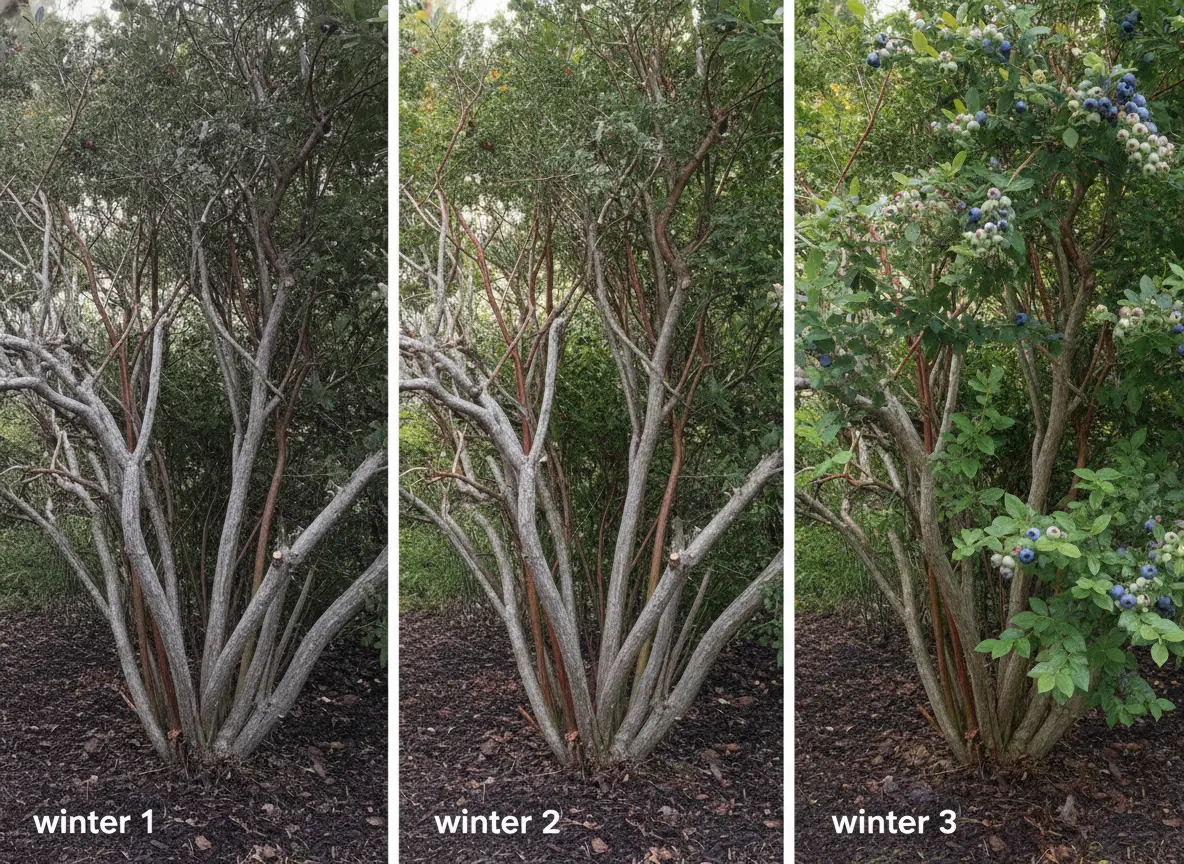 A three-panel sequence showing a blueberry bush being renovated over three winters — AI-generated illustration
Rescuing a neglected bush
An old blueberry that’s become a dense, grey thicket can be renovated, but over three winters rather than one. Each winter, cut a third of the oldest stems to the base, starting with the thickest and most unproductive. By the third winter you’ll have replaced most of the old framework with young wood, and you’ll have picked a reasonable crop every summer while it happened. Cutting the whole bush to the ground in one go usually works too, but it costs you two summers of fruit, and an old, weak plant may not recover.
Three mistakes that cost blueberries their crop
- Shearing the bush like a hedge. Running shears over the top removes the shoot tips, which is exactly where the fat fruit buds sit. You’ll get a neat bush with almost no flowers, and a top that thickens up and shades the inside even more.
- Pruning in spring or summer. By April the buds are opening and every cut removes flowers you could have counted in winter. A light summer tidy is fine, but leave the structural pruning for the dormant season.
- Only ever cutting the tops. Shortening stems without taking out any old wood at the base makes the bush denser every year. The renewal has to come from the base.
Two more things that make the cut pay off
Pruning only works if the bush can respond, and a blueberry’s demands are quite specific. It needs acid soil (pH 4.5 to 5.5) or ericaceous compost in a pot, and rainwater instead of hard tap water, which slowly raises the pH and turns the leaves yellow. A mulch of pine needles, bark or leaf mould in spring keeps the shallow roots moist and the soil acidic.
And grow at least two varieties together. Blueberries are partly self-fertile, but cross-pollination between varieties gives noticeably bigger berries and a heavier crop. That’s especially worth doing if you’ve just pruned hard and want every flower to count.
Blueberry pruning has a lot in common with the other soft fruit you prune this winter. The blackcurrant cut also removes a share of old wood at the base every year, while a gooseberry is pruned to an open goblet on a permanent framework. And if you’re not sure when each of your fruit bushes is due, add them to Cresco, which works out the pruning window for every plant in your garden and reminds you when it opens.
Sources: RHS guidance on pruning blueberries (dormant season, November to March; aim for a mix of old, middle-aged and young stems), plus university extension advice on blueberry pruning (Purdue, NC State, UConn).