Common hazel, Corylus avellana, is one of the few shrubs that gets better the harder you cut it. Take every stem down to a few centimetres above the ground and it answers with a fountain of straight, fresh rods, often a metre or more in the first summer alone. Gardeners and woodsmen have done this for centuries. It’s called coppicing, and a single hazel treated this way can supply plant supports, poles and weaving rods for the rest of your life.
The catch is timing. There’s one window for it, and it opens now.
Why November to February
Hazel should be coppiced while it’s dormant: after the leaves have fallen and before the sap rises in spring. In practice that means from November until the end of February.
Three things make early winter the best part of that window:
- The structure is visible. With the leaves gone you can see every stem, how thick it is and where it joins the stool (the low, knuckly base the stems grow from).
- The catkins are still closed. The lamb’s-tail catkins are already formed but tight and green. By late January or February they open and shed pollen. Cut before then and you’ve lost nothing yet; cut after and you’re removing the first food of the year for early bumblebees.
- Birds aren’t nesting. A dense hazel is prime nesting cover. From March onwards you risk disturbing a nest, and in the UK, damaging an active nest is an offence. Getting the work done in November or December keeps you well clear.
The stool itself copes with any date in the dormant season. Cutting in growth, in late spring or summer, weakens it and gives you soft regrowth that won’t ripen before the next winter.
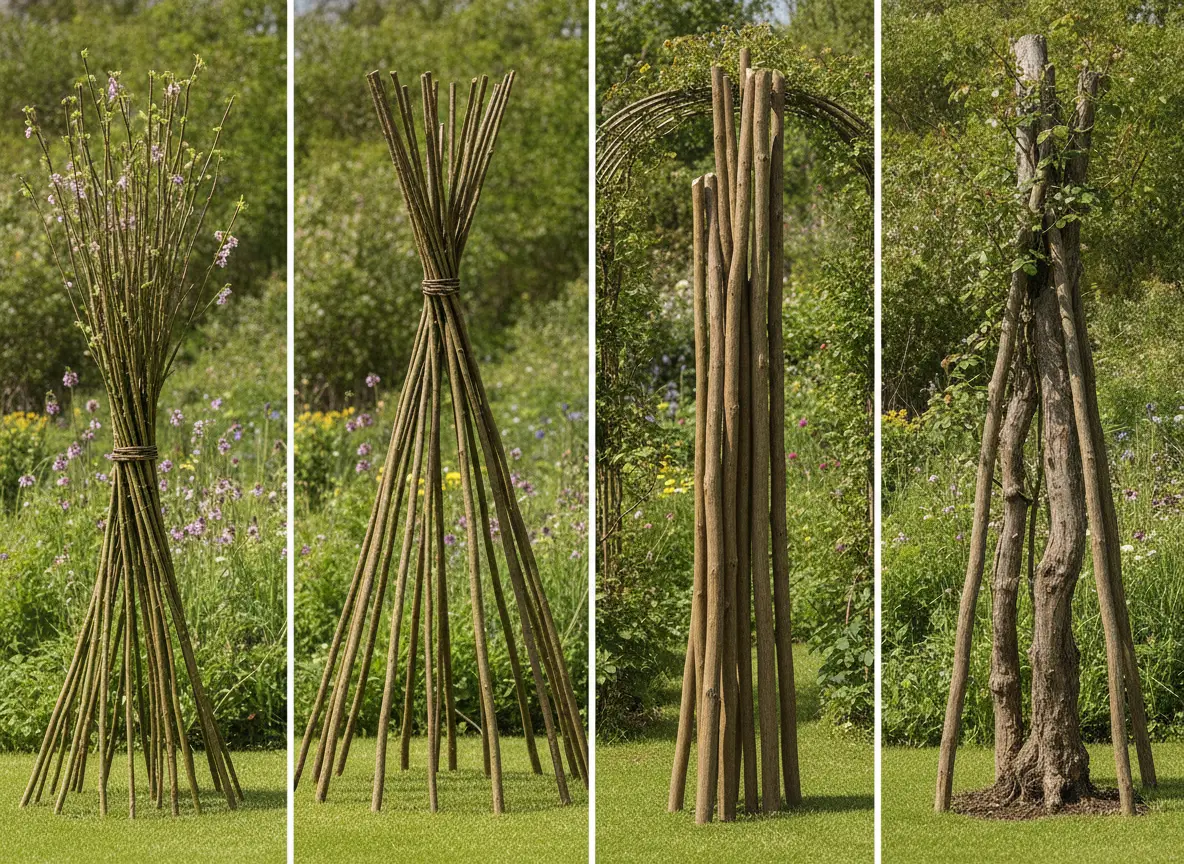 Hazel coppice stems of different ages, used as garden structures — AI-generated illustration
How often to cut
How long you leave the stems between cuts depends on what you want from them:
| Cycle | Stem size | Best used for |
|---|---|---|
| 1–2 years | Thin, twiggy, branched | Pea sticks and supports for floppy perennials |
| 2–4 years | Thumb-thick, straight, flexible | Weaving, wigwams, hurdle rods, hedge binders |
| 5–7 years | Wrist-thick, 3 m or more | Tall poles, stakes, rustic structures |
| 7–10 years | Thick, heavy | Firewood, larger stakes (traditional woodland cycle) |
In a garden you rarely need to take the whole plant down at once. A tidy way to run a single hazel is to cut a third of the stems each winter, always the oldest and thickest. That keeps the shrub at a steady size, gives you a supply of rods every year, and means two-thirds of the plant still carries catkins and some nuts. Cut the whole stool in one go and you’ll see few catkins and no nuts for a couple of years, because hazel flowers on wood that’s at least a year old.
If you have a hazel hedge or several stools, rotate them: one stool or one section per year, in turn.
Making the cut
You’ll need a sharp pruning saw and loppers. Secateurs are only good for the thinnest twigs, and a ragged, crushed cut heals badly.
- Clear the brash first. Take out the small side shoots and any dead wood around the base, so you can reach each stem cleanly.
- Cut low. Take each chosen stem off about 5–10 cm above the stool. Don’t leave tall stubs: new shoots come from the base, and a high stub just dies back and invites rot.
- Slope the cut. Angle each cut so it faces outwards, away from the centre of the stool. Rain then runs off instead of pooling on the stump, which keeps the stool healthy for decades.
- Undercut thick stems. On anything thicker than a broom handle, make a short cut on the underside first, then saw from above. That stops the weight tearing a strip of bark down the stool as the stem falls.
- Work from the outside in on a full coppice. Removing the outer stems first gives you room to swing a saw at the centre.
Don’t paint or seal the cuts. A clean, sloping cut seals itself, and wound paint only traps moisture.
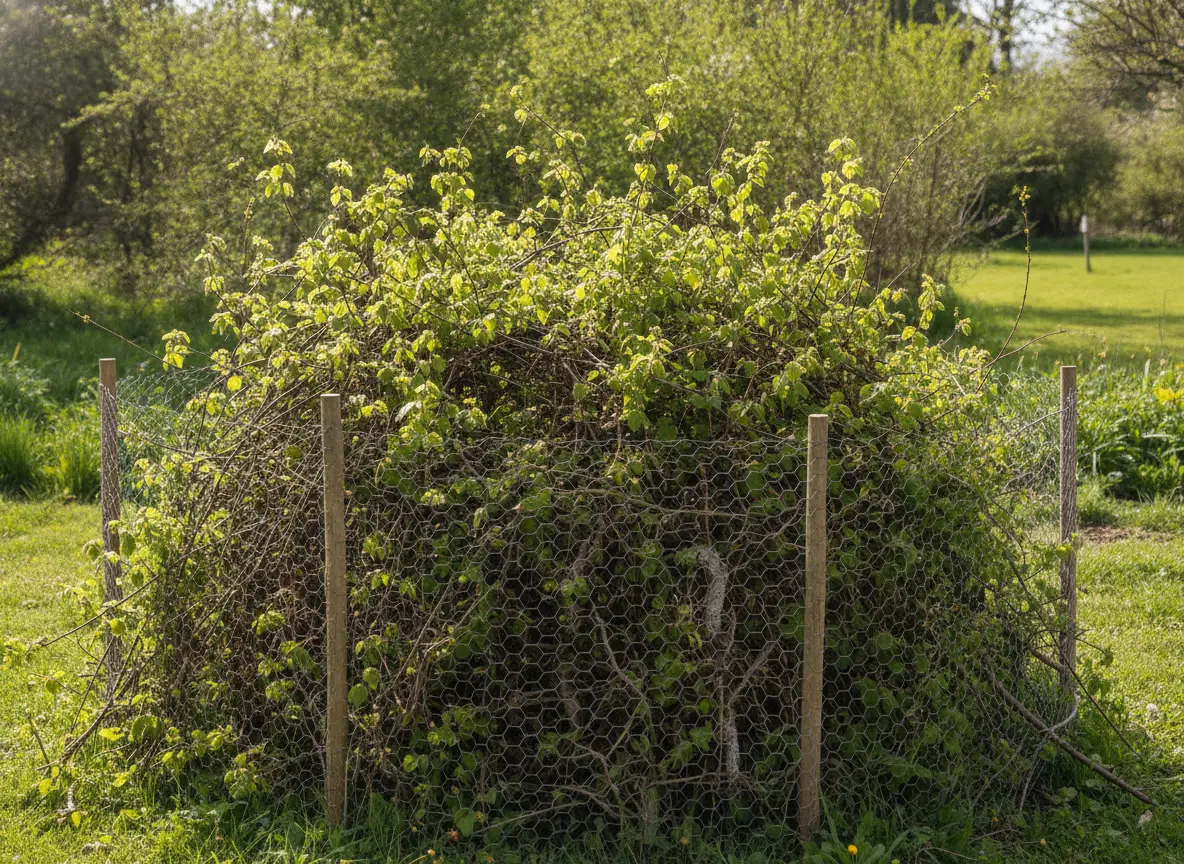 Coppiced hazel regrowth protected by a ring of chicken wire — AI-generated illustration
Protect the regrowth
The new shoots that burst from the stool in April are soft, sweet and right at nose height for deer and rabbits. In the countryside, browsing is the most common reason a coppiced hazel fails.
If you have deer or rabbits nearby, pile the twiggy brash loosely over the stool after cutting, or put a ring of chicken wire around it until the shoots are above browsing height. In an ordinary town garden you can usually skip this.
A light mulch of compost or leaf mould over the root area in late winter helps the stool push out strong shoots, especially on dry soil.
What to do with the rods
This is the part that makes coppicing worth it. Sort the stems as you cut, while you can still see what’s what:
- Pea sticks. The twiggy, fan-shaped tops are ideal for propping up sweet peas, or for pushing into a border in April so floppy perennials grow up through them. Stack them flat and weigh them down over winter, so the twigs dry in a flat fan instead of curling.
- Wigwams and climbing supports. Straight two- to three-metre rods make sturdy wigwams for sweet peas, clematis or annual climbers. Fresh hazel poles usually last two or three seasons outdoors.
- Weaving. Thin, fresh rods bend easily for edging, low woven fences or plant domes. Use them within a few weeks, before they dry and stiffen.
- Stakes. Thicker poles make stakes for young trees or a dead-hedge frame.
- Wildlife. Leave the leftovers in a quiet corner as a brash pile or a dead hedge. Beetles, hedgehogs and wrens will use it.
Hazel, unlike willow, does not root from a pushed-in stick, so don’t expect your supports to sprout. If you want willow you can grow from cuttings, see the hardwood cuttings guide.
Coppicing an old, neglected hazel
A hazel that hasn’t been cut in fifteen or twenty years is called overstood. Its stems are thick, the centre is dark and bare, and it may be leaning or splitting.
Hazel is forgiving, and most overstood stools resprout when cut to the base. But very old ones sometimes don’t, so on a hazel you care about it’s safer to spread the work over two or three winters. Take out the heaviest and the leaning stems first and let light reach the base. Then take the rest once the first cuts are sprouting. It’s the same reasoning as renovating an overgrown hedge in stages.
Not every hazel should be coppiced
Coppicing suits common hazel and the purple-leaved Corylus maxima ‘Purpurea’, which produces its largest, darkest leaves on young, coppiced stems.
It doesn’t suit grafted varieties. A corkscrew hazel cut to the ground regrows from the rootstock, so all you get back is straight, ordinary hazel. And if you grow cobnuts or filberts for the crop, prune them as a small open-centred tree instead, because coppiced stems take a few years to start bearing.
Like a willow pollard, a coppiced hazel depends on you coming back. Once you’re in the rhythm it’s an hour’s work each winter, and a stool cut this way can outlive the person who planted it.
To get a reminder when your hazel’s coppicing window opens, add it to Cresco and it’ll prompt you based on your local weather.