The hedge that crept a metre into the garden
Every hedge grows a little wider each year, even when you trim it faithfully. Each clip leaves a few centimetres of new wood behind, and after ten or fifteen summers a hedge that was planted 60 cm deep is 1.5 metres thick, two metres taller than you can reach, and bare and brown on the inside. The green is a thin shell on the outside; push your hand in and you hit a tangle of dead twigs.
Trimming harder in summer won’t fix it. Cut into that bare interior while the hedge is in full leaf and you’re left looking at sticks for the rest of the season, and the plant has to regrow just as it should be ripening its wood for winter.
The real fix is a renovation cut: taking the hedge back hard, into old wood, to a width you actually want. For most deciduous hedges the time to do that is now, from November through February, while the plant is dormant and there are no nesting birds to disturb.
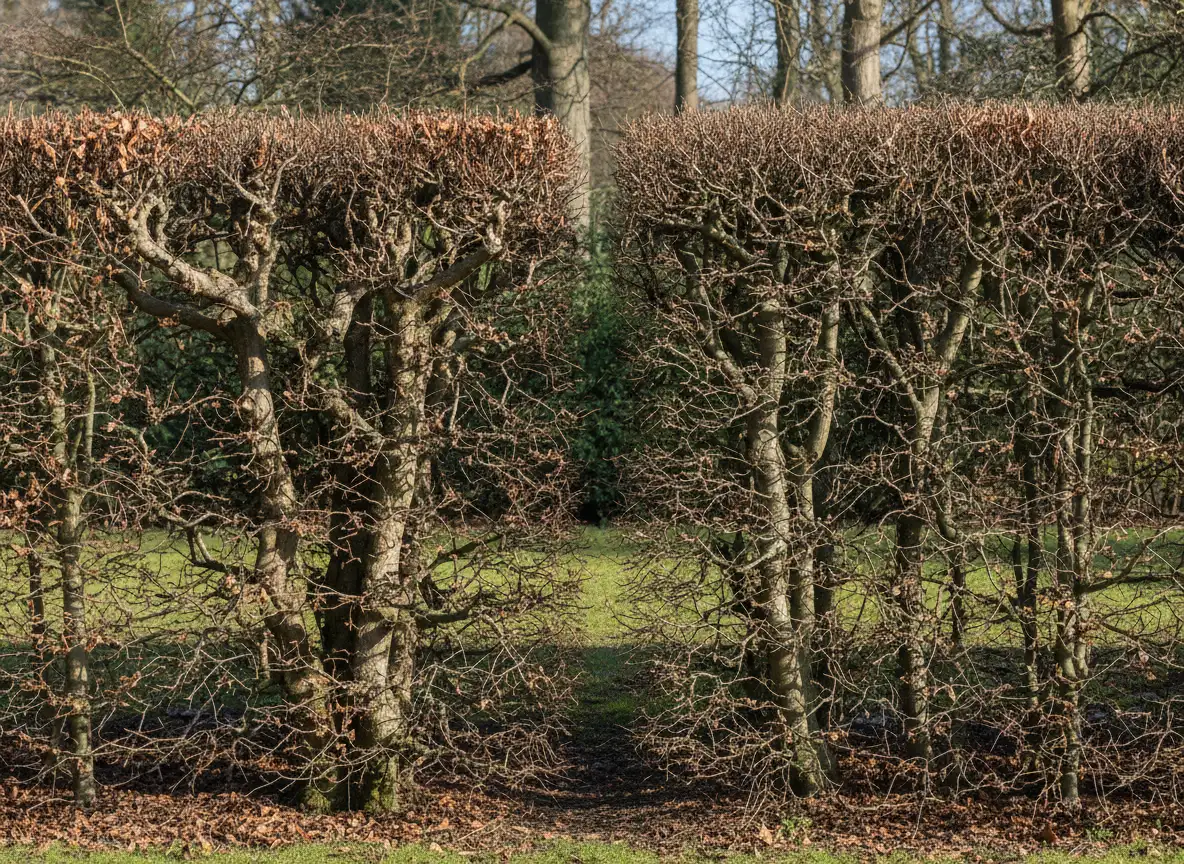 Two beech hedges stand dormant in winter, one cut back hard — AI-generated illustration
Which hedges can take it, and which can’t
Before you pick up a saw, check what your hedge is made of. Renovation works because the plant can push new shoots from dormant buds hidden in old bark. Some species are very good at that. Others have no such buds and will never green up again from bare wood.
Renovate hard in winter (deciduous, dormant now):
- Beech (Fagus sylvatica) and hornbeam (Carpinus betulus) both reshoot from old wood. Beech is slower and sulkier; do it in February rather than in a hard frost.
- Hawthorn (Crataegus monogyna), blackthorn, field maple and hazel are tough natives. They’ll come back from almost anything, even cut close to the ground.
- Deciduous privet and forsythia hedges respond quickly.
Renovate hard, but in mid-spring (evergreen):
- Yew, holly, box, cherry laurel, Portugal laurel and evergreen privet all regrow from old wood, but they should be cut in April or early May, just as growth starts. A winter cut leaves bare evergreen stems exposed to frost for months. Yew is the standout: it’s the one hedge conifer you can cut hard into bare wood.
Don’t renovate:
- Leylandii, Lawson cypress and most other conifers except yew. They have no dormant buds in the brown zone. Cut into the brown and it stays brown. An overgrown leylandii hedge can only be reduced a little, or replaced.
If you’re not sure what your hedge is, wait until spring for leaves, or ask Cresco to identify it from a photo of a twig.
Why one side at a time
You could cut the top and both sides back in one go, and a hawthorn would probably forgive you. Most hedges won’t. Strip away all of the leafy growth at once and the plant has nothing left to feed its roots through the next summer. Beech in particular can die back badly or fail to recover at all.
So spread the work over two winters, or three for a very large or slow hedge:
- Winter one: cut the top down to the height you want, and cut one side back hard. Leave the other side as it is. It keeps the hedge alive and keeps your privacy for the year.
- Winter two: if the first side has reshot well (strong new shoots along its length), cut the other side back the same way.
- If it’s slow: if winter one’s side is still thin and weak by late summer, wait an extra year before doing the second side. Beech often needs that extra year.
Pick the less visible side first, or the side facing the neighbours if they’ll put up with it. You’ll be looking at that bare face for one summer while it fills in.
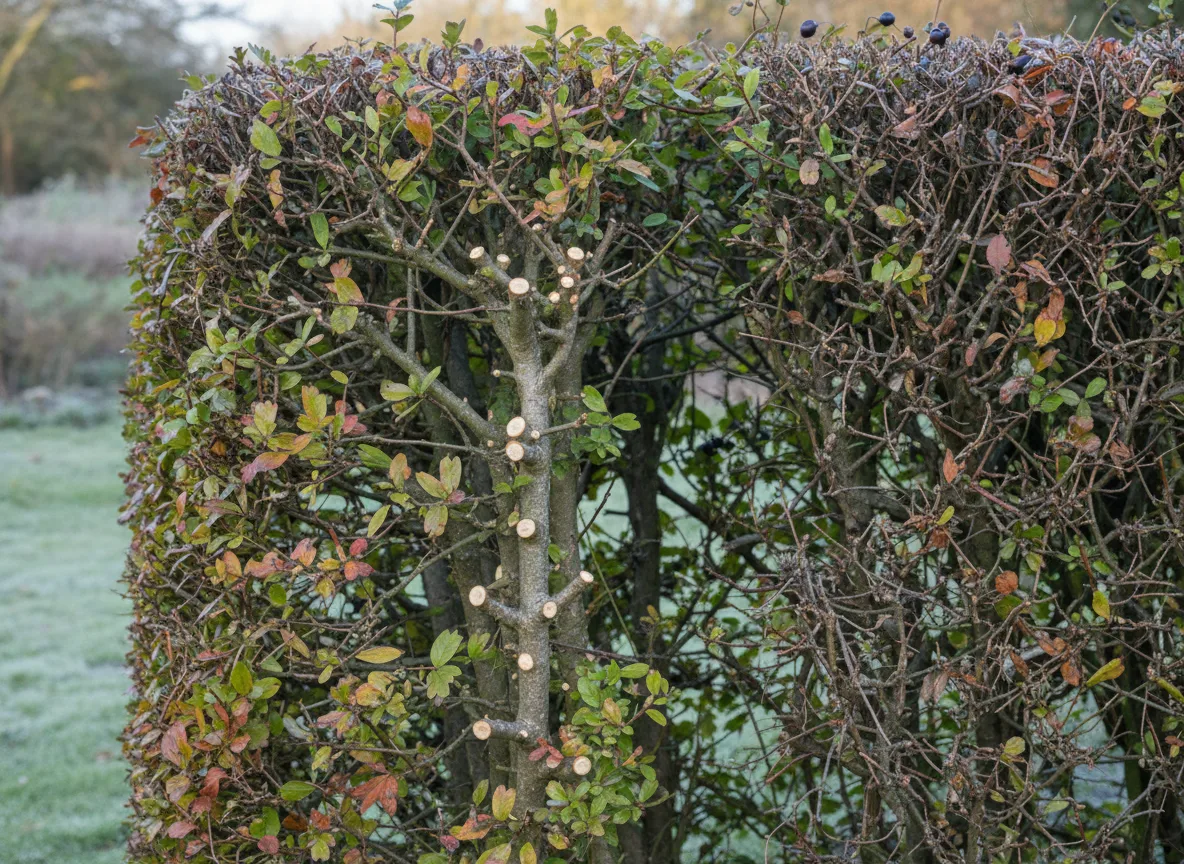 A winter-cut hedge with branches trimmed to a main framework — AI-generated illustration
How far to cut, and how
The goal isn’t to shave the hedge to the same shape it has now, just smaller. It’s to give it a better shape that’s easier to keep up.
- Cut back to the main framework. On the side you’re doing, cut every branch back to about 10–15 cm short of where you want the new face to be. The fresh shoots will grow out to fill that gap in a season. With hawthorn, hazel or privet you can go right back to the main stems; with beech, stop at stubs with some side branches on them, not bare trunk.
- Make the hedge narrower at the top. Aim for a shape that’s wider at the base than the top, sloping in by roughly 10–15 cm for every metre of height. That lets light reach the bottom, which is why the hedge went bare down there in the first place.
- Use the right tool. Hedge trimmers are for this year’s soft growth. For branches more than a finger thick use loppers, and for anything as thick as your wrist use a pruning saw. Cut cleanly just above a side branch or a bud, never leaving torn, crushed ends.
- Clear out the interior. While the side is open, remove dead wood, rubbish caught in the hedge, and any ivy or bramble climbing through it.
A hedge that has a bare gap right at the base can also be thickened up by cutting a few of the young stems hard, low down. It’s the same idea as the first hard cut you give a newly planted hawthorn hedge, just on an older plant.
Timing within the winter
Dormant season runs from leaf fall to bud break, roughly November to the end of February in the UK and the Netherlands. Within that window:
- Avoid hard frost. Don’t cut when the wood is frozen. It splinters, and fresh wounds are more likely to die back. Wait for a mild, dry spell.
- Beech and hornbeam: late winter. February is ideal, just before the buds swell, so the plant regrows quickly. Bear in mind that beech and young hornbeam hold their dead brown leaves all winter, so the hedge won’t look bare when you start; that’s normal, and it doesn’t mean the plant is in growth.
- Finish before nesting starts. Birds begin nesting in hedges from March. In the UK it’s an offence to damage an active nest, and in the Netherlands the same protection applies under the Omgevingswet. Get the big cuts done by the end of February and check carefully even then.
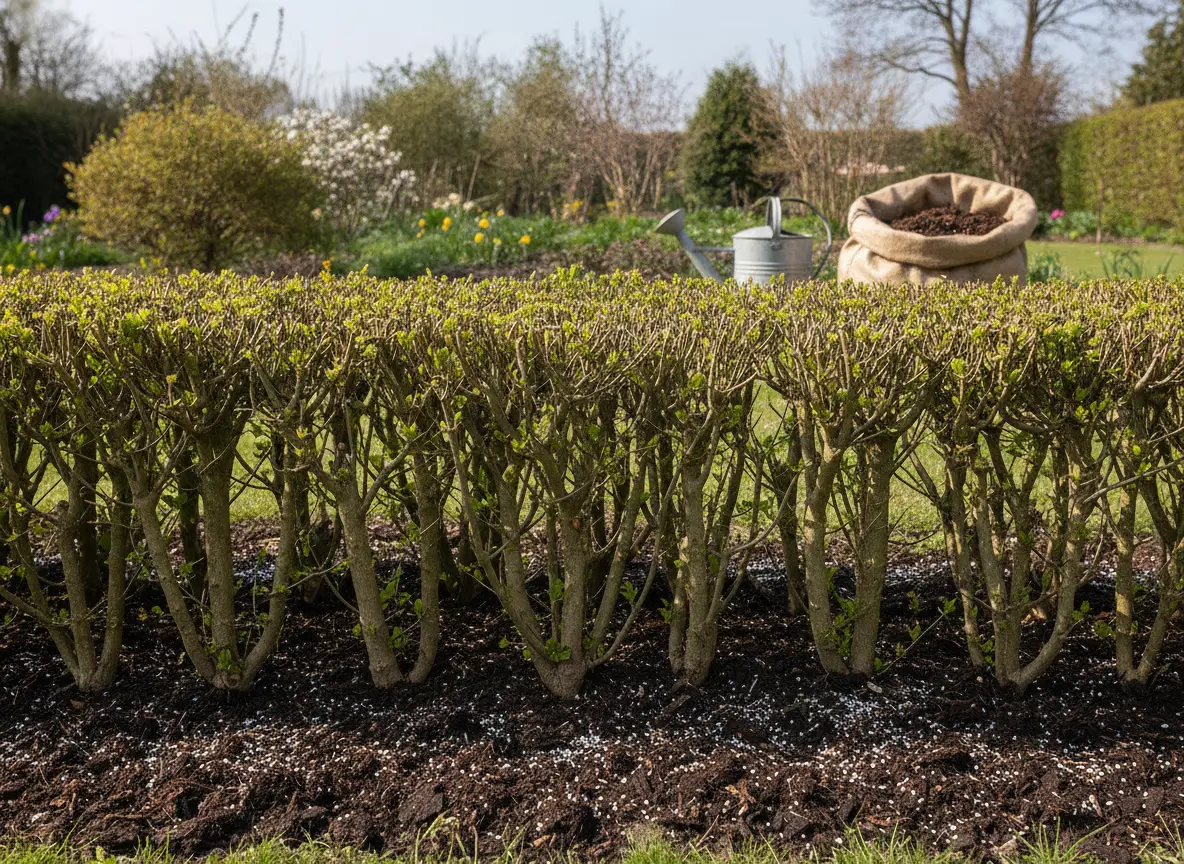 A healthy hedge with newly applied fertilizer and mulch, with a watering can in the background — AI-generated illustration
Aftercare: feed it, then leave it alone
A hard cut is a big shock, and the roots will do the work of regrowing the hedge. Help them along:
- Feed and mulch in early spring. Scatter a general fertiliser along the base in March, then lay 5–8 cm of compost or well-rotted manure over the root zone, keeping it off the stems.
- Water through dry spells. The first summer after renovation is when a hedge is most likely to fail, and drought is the usual cause. Soak the base during any dry fortnight.
- Clear weeds and grass from the base. They compete hard for water.
- Don’t trim the cut side in its first summer. Let the new shoots grow long and strong. Lightly tip them the following year to get them to branch. On the uncut side, keep to the usual summer trim: late June for beech, late August for hornbeam.
By the end of the second summer, a hedge that took up a metre and a half of your garden can be back to 60–80 cm deep, green to the ground, and quick to trim again.
The short version
- Deciduous hedges (beech, hornbeam, hawthorn, field maple, hazel): renovate hard between November and February, ideally late winter.
- Evergreens (yew, holly, laurel, box): renovate in April or May instead.
- Leylandii and most conifers: never cut into the brown.
- Stage the work: top and one side the first winter, the other side the next.
- Shape it wider at the base so light reaches the bottom.
- Feed, mulch and water the first summer, and don’t trim the regrowth until the following year.
If you add your hedge to Cresco, it will remind you when the renovation window opens and when it’s safe to do the second side.