Why the mulberry window is so short
Most fruit trees give you the whole winter. Apples and pears can be pruned any time from leaf fall to late February. A mulberry can’t. It’s one of the trees that bleeds: cut it at the wrong moment and a milky white latex runs from the wound, sometimes for weeks. It’s sticky, it stains, and it’s the tree losing sap it would rather keep.
Mulberries bleed least when the tree is fully dormant and the sap has dropped down for winter. That’s a narrow stretch. The leaves come off late, often not until the first proper frosts in November, and the sap starts moving again surprisingly early, well before you see any bud swell. So in practice the window is late November and December, maybe into early January in a cold winter. The RHS gives the same advice: prune black mulberries in late autumn to early winter while they’re dormant, because they bleed if you cut them later.
A good rule of thumb: wait until the tree has been bare for two to three weeks, then prune on a dry, frost-free day. By Christmas, you want the saw back in the shed.
Mulberries aren’t alone in this. Birch, walnut and grapevine all bleed too, and each has its own window. If you’ve got a birch as well, its timing is earlier still: birch is best pruned in autumn, before it bleeds in spring.
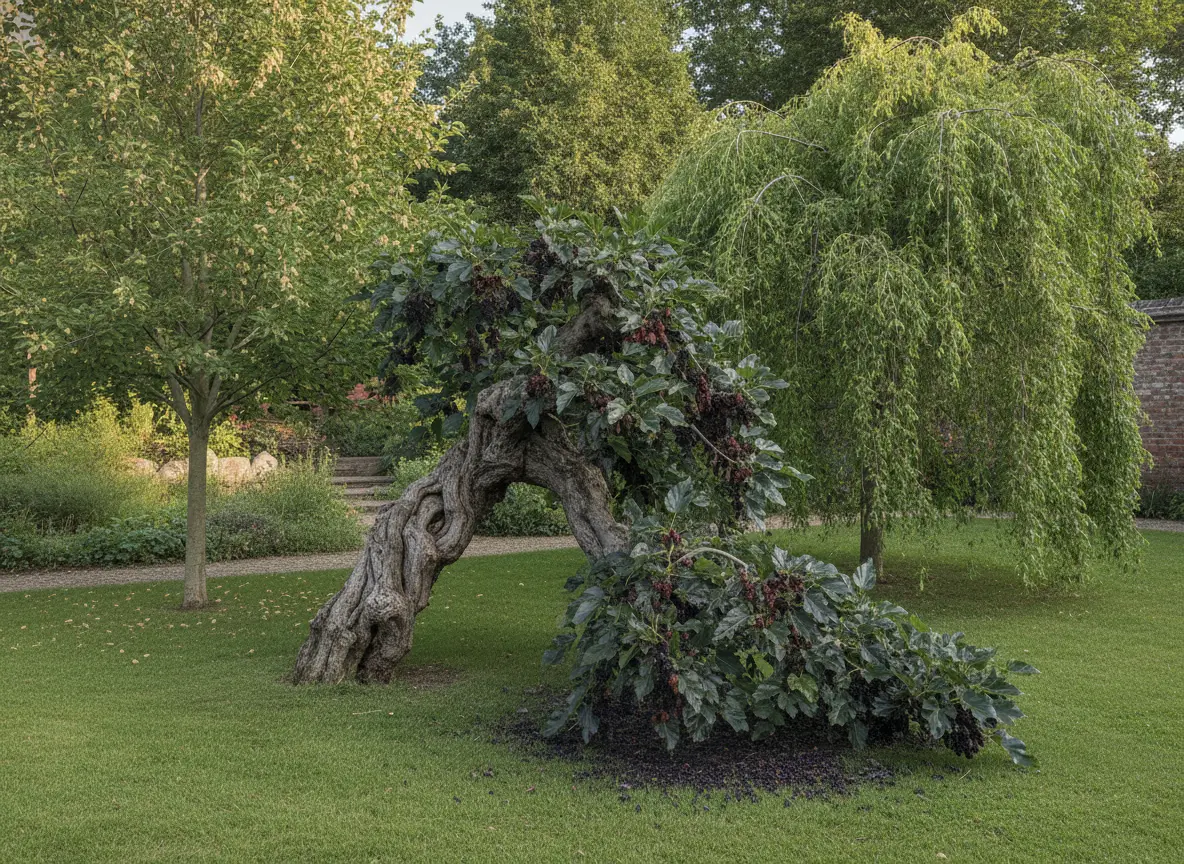 A low, wide, leaning black mulberry tree with dark berries — AI-generated illustration
Black, white, or weeping: what you’ve got
Three mulberries turn up in gardens, and they’re pruned in much the same way, with different amounts of cutting.
- Black mulberry (Morus nigra). The one grown for fruit in most British and Dutch gardens, with dark, tart-sweet berries that stain everything they touch. It grows slowly into a wide, low, leaning tree with a gnarled trunk, and it looks old long before it is. It needs the least pruning of the three.
- White mulberry (Morus alba). Faster, more upright and more vigorous, with paler fruit that’s sweeter and blander. It’s the silkworm tree. It can take a little more cutting, but it bleeds just as readily.
- Weeping mulberry (Morus alba ‘Pendula’). A white mulberry grafted on a clear stem, with branches cascading to the ground. This one actually wants an annual trim to keep the skirt off the ground and stop the head getting too dense.
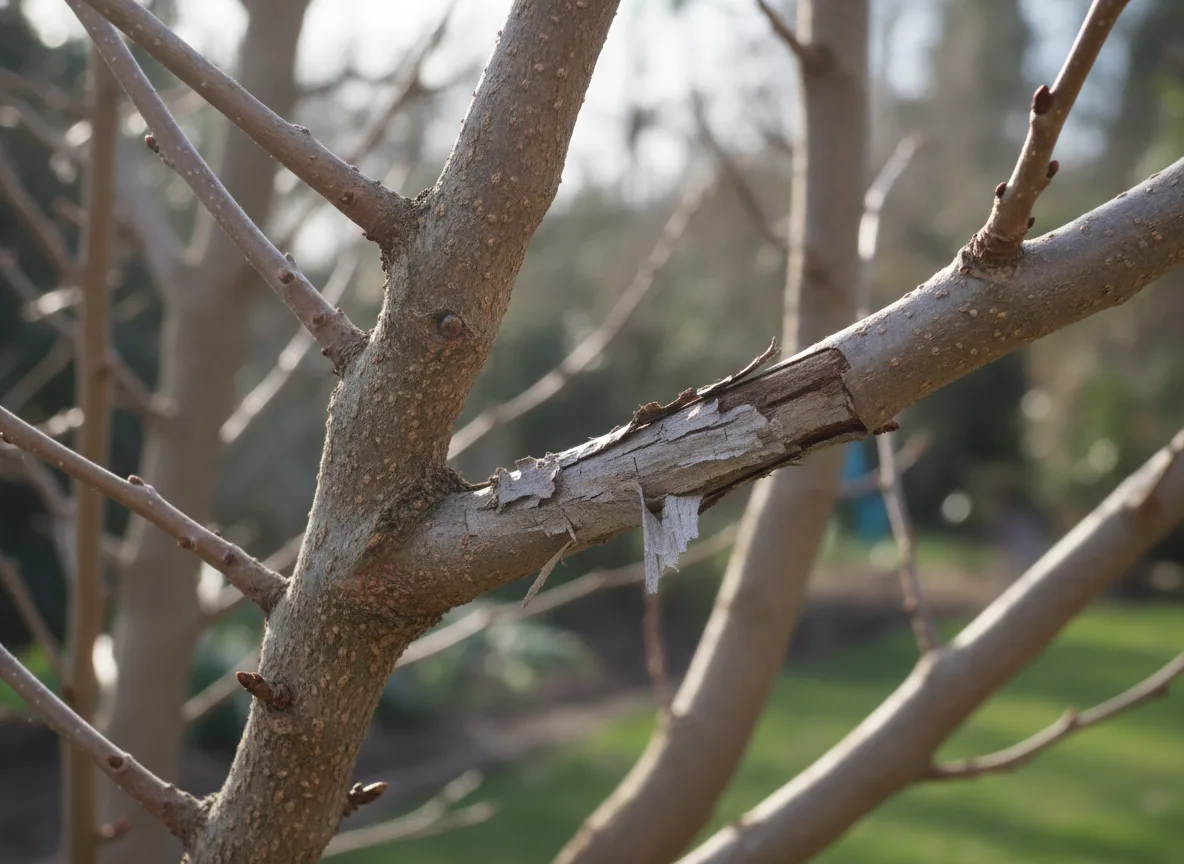 Close-up of a healthy mulberry branch with some dead wood — AI-generated illustration
What to cut on an established mulberry
The honest answer for a mature black mulberry is: very little. The fruit comes on short spurs on wood that’s two years old and older, so the more you cut, the fewer berries you get. A grown tree only needs a light going-over each winter.
- Take out dead, diseased and damaged wood. Dead mulberry wood is grey and brittle, with no green under the bark when you scratch it. Cut back to healthy wood or to the branch it came from.
- Remove crossing and rubbing branches. Where two branches chafe, keep the better-placed one and cut the other out at its base.
- Lift low branches if you need to. If a branch is in the way of the path or the mower, cut it back to a side branch, or remove it entirely at the collar. Do this a little at a time over several winters rather than all at once.
- Thin crowded shoots in the centre. Not a full open-centre like an apple, just enough that light and air reach inside the canopy, which also helps the fruit ripen.
- Shorten a few over-long shoots back to a side branch or an outward-facing bud, to keep the shape balanced.
Keep each cut as small as you can. Small wounds bleed less and seal faster. Mulberry wood is soft and doesn’t compartmentalise decay well, so a big cut is an open door. As a guide, think twice about any branch thicker than about 5 cm. If one has to go, cut just outside the swollen collar where it joins the trunk, and don’t paint the wound. The same technique applies as with any tree: find the branch collar first, then cut.
Young trees: shaping the first few winters
A newly planted mulberry is the one time you prune with intent. For the first three or four winters, in the same late-November-to-December window:
- Choose a clear trunk height. For a standard, that’s about 1.5 to 1.8 m; for a lower bush tree, 75 cm to 1 m.
- Select three to five well-spaced branches above that point to form the framework, and remove the rest.
- Shorten those framework branches by about a third, to an outward-facing bud, so they branch and thicken.
- Remove any shoots that sprout from the trunk below the framework.
After that, switch to the light, mostly-hands-off routine above. Mulberries are long-lived; the shape you set in the first few years is the shape the tree keeps for a century.
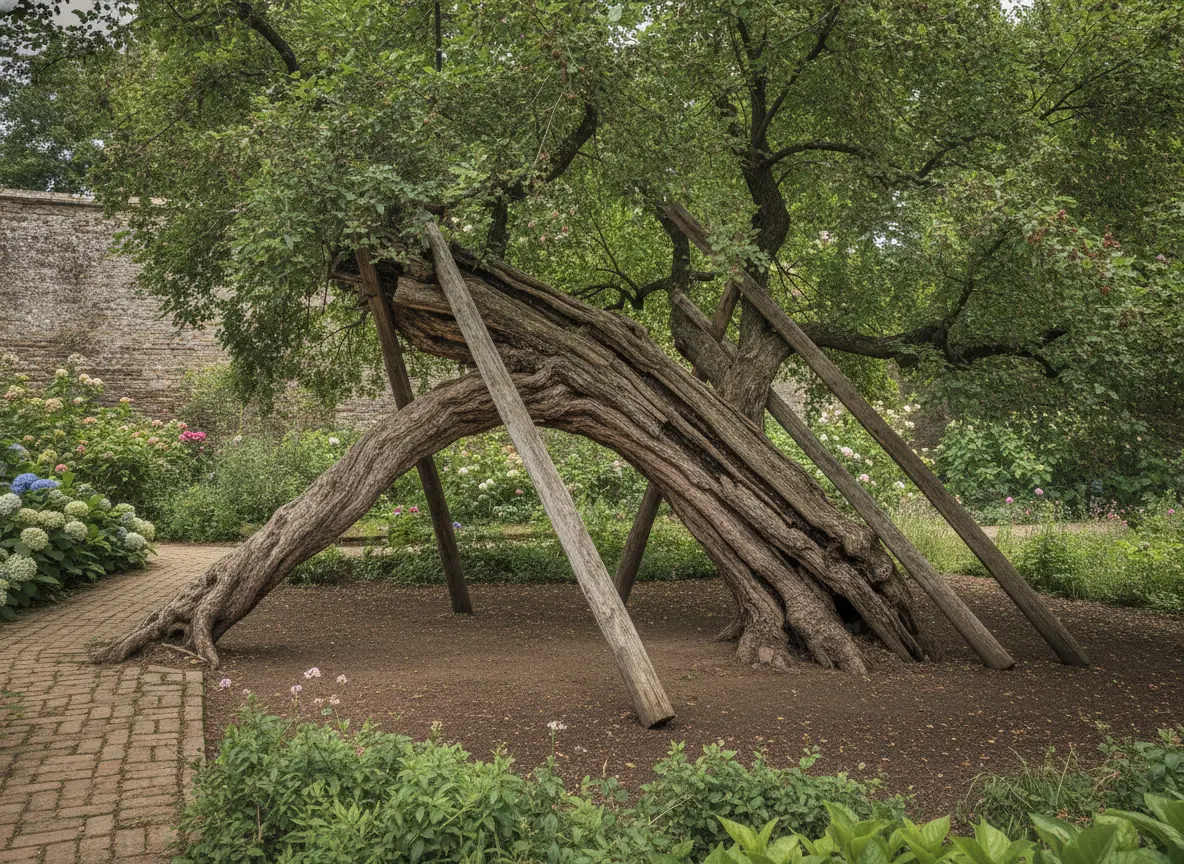 Old leaning mulberry tree propped with wooden supports in a garden — AI-generated illustration
The leaning old tree: prop it, don’t cut it
Old black mulberries lean. It’s part of their character, and many famous ones in old gardens have been lying almost flat for generations, propped on crutches, with a branch that’s rooted where it touched the ground. If yours has started to lean or a heavy limb is drooping, the instinct is to saw it off. Resist it. A big cut on an old mulberry is far more likely to start a long decline than the lean is to bring the tree down.
Put in a strong timber prop under the heavy limb instead, padded where it meets the bark, and check it each winter so it doesn’t rub. If a limb really has to come off for safety, have it done in the dormant window, ideally by a tree surgeon, and spread major work over several years.
Summer: the one other cut that’s allowed
There’s one exception to the winter-only rule. A mulberry trained against a wall, or a young tree that’s putting on too much soft growth, can have its new side shoots pinched or cut back to five or six leaves in midsummer, in July or August. That’s small, green growth, which barely bleeds, and it encourages fruiting spurs. Don’t take any bigger wood in summer. Spring is the worst time of all: the sap’s rising fast, and even a small cut can run for weeks.
Common mistakes
- Pruning in February or March. The classic one, because that’s when everything else in the fruit garden is pruned. By then the mulberry’s sap is on the move.
- Pruning too soon after leaf fall. A tree that’s only just dropped its leaves isn’t fully dormant yet. Give it a couple of weeks.
- Pruning hard to “rejuvenate” it. Mulberries don’t respond to hard pruning like an apple. You get a flush of soft water shoots, fewer fruit and big wounds that rot.
- Cutting off the leaning limb. Prop it up instead.
- Treating the weeping form like a fruit tree. A weeping mulberry is mainly ornamental; trim the skirt to about 30 cm off the ground and thin the head, and don’t worry too much about spurs.
If you’ve got a grapevine on a wall nearby, its pruning window falls at almost the same time and for the same reason: the late-November grapevine cut that won’t bleed. Do both on the same dry December afternoon.
Want a reminder when your own mulberry’s window opens? Add it to your garden in Cresco, and you’ll get a pruning schedule based on your local weather, not a generic calendar.