The July instinct that costs you next summer
By early July the first mophead hydrangeas have peaked. The blue and pink domes that looked so crisp a fortnight ago are softening at the edges, going papery, taking on that antique tea-stain colour. Everything else in the border is being deadheaded right now — the buddleia cones, the roses, the daylilies — so the hand reaches for the secateurs and starts snipping the tired hydrangea heads back to a fat pair of buds. It feels like exactly the right, tidy thing to do.
It’s the one shrub in the July border where that instinct is wrong. The common mophead and lacecap hydrangeas (Hydrangea macrophylla and H. serrata) flower on wood they grew last year, and they set next year’s flower buds in late summer — in the top few centimetres of stem, right below the head that’s fading now. Cut into that stem in July and you’re not tidying the plant. You’re removing next summer’s flowers before they’ve even been made.
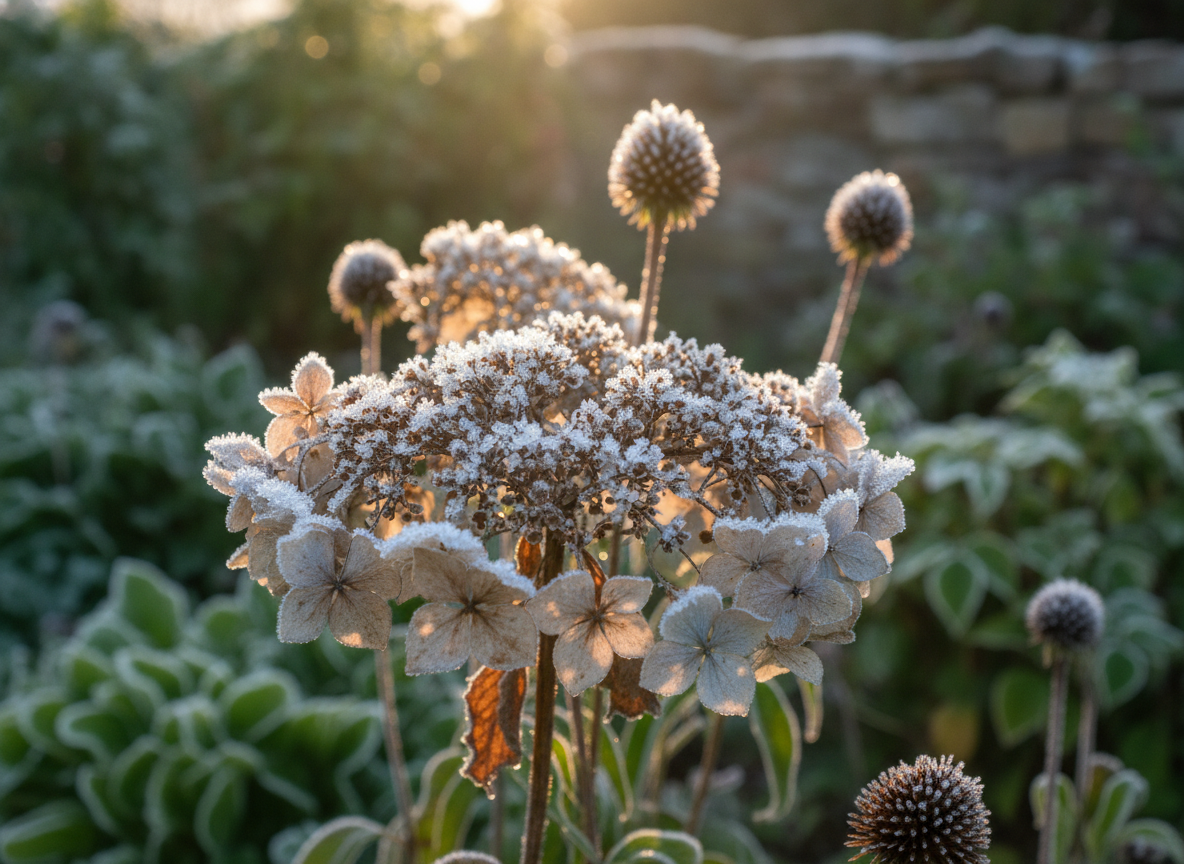 Close-up of frosted flowers in a garden at sunrise — AI-generated illustration
The faded head is next year’s frost insurance
There’s a second reason to leave the browning domes alone, and it’s the one even keen gardeners miss. Those spent flowerheads aren’t just dead weight — they’re a physical shield. The fat buds sitting just beneath each old head are the tenderest part of the whole plant, and they have to survive the winter to open next June. The dried flowerhead above them takes the worst of the frost, the wind and the wet, and the buds shelter in its lee.
This is why the RHS advice on mopheads is to leave the faded heads on right through winter and only remove them in early spring, cutting back to the first strong pair of buds below the old bloom. Strip the heads off in July and you expose those buds to five or six months of weather they were never meant to face bare. In a hard winter that’s the difference between a hydrangea that flowers and one that just makes leaves. The messy-looking plant in December is the one covered in flower next year.
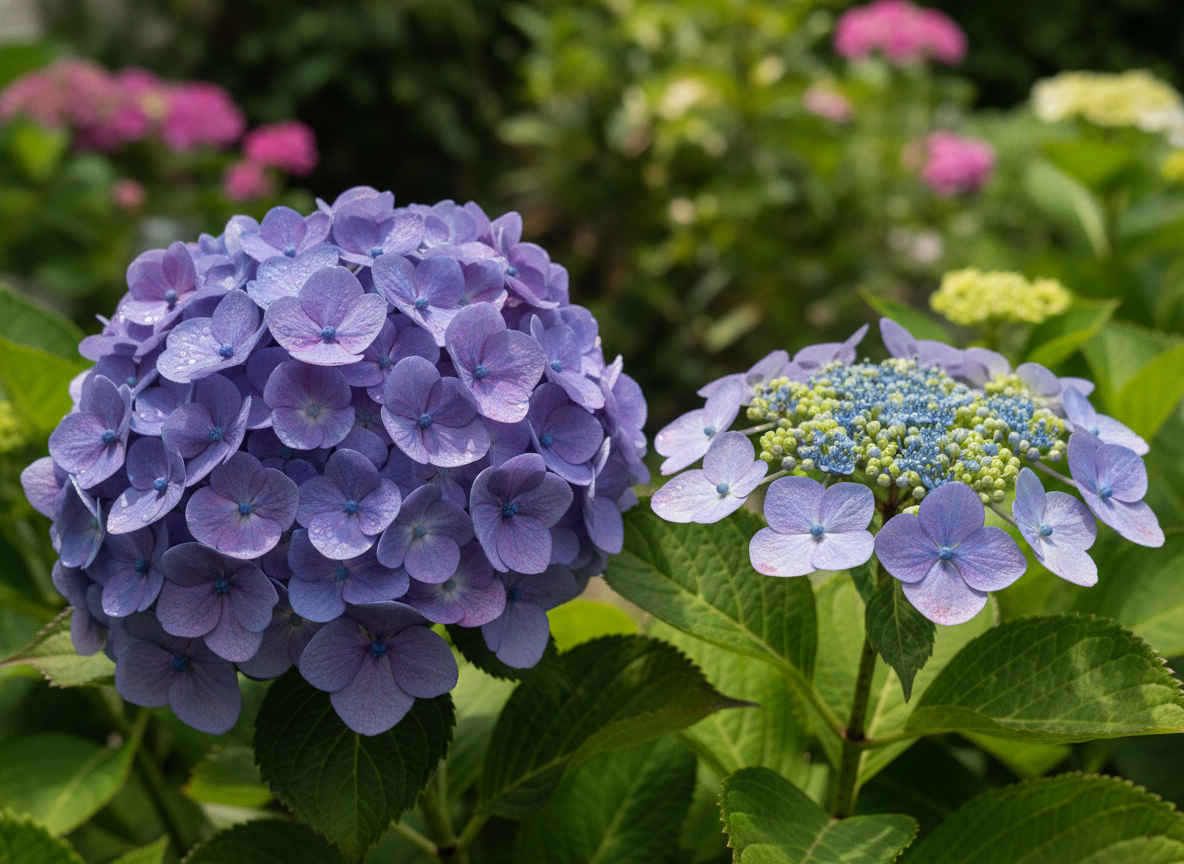 A mophead hydrangea and a lacecap hydrangea bloom side-by-side — AI-generated illustration
Mophead and lacecap: the one real difference
Not every hydrangea in this group behaves identically after flowering, and it’s worth knowing which one you’re standing in front of.
A mophead carries a solid ball of showy sterile florets. It has almost no seed to set, so there’s nothing to be gained by cutting it early — leave the whole head on until spring, full stop.
A lacecap is the flatter, prettier type: a ring of large florets around a centre of tiny fertile flowers. Those fertile flowers do set seed, and ripening seed quietly drains energy the plant would rather bank for next year. So lacecaps are the one case where a light after-flowering cut is defensible — but even then you go no lower than the second pair of leaves below the head, snipping the spent flower and nothing more. You are removing the seed, not shortening the stem. Everything below that second leaf pair is next year’s flowering wood, and it stays.
If you can’t tell which you’ve got, treat it as a mophead and leave it. Doing nothing is never the wrong answer with these two.
Annabelle and paniculata are a different plant — and still busy
Here’s where people tie themselves in knots, because “hydrangea” covers two completely opposite pruning rules. The shrubs above flower on old wood. But two of the most popular garden hydrangeas flower on wood they grow this year, and in early July they aren’t finished — they’re mid-show or just coming into it.
- Smooth hydrangea (H. arborescens, the big white ‘Annabelle’ domes) is opening now.
- Panicle hydrangea (H. paniculata — ‘Limelight’, ‘Vanille Fraise’, ‘Pinky Winky’) is building its cones and won’t peak until August.
Cut either of these in July and you’re lopping off flowers that are actively forming. They get their hard prune in early spring instead, when you can cut them back to a low framework and they’ll rush up new flowering growth. So whichever hydrangea you own, the July answer lands in the same place: hands off now, prune in spring.
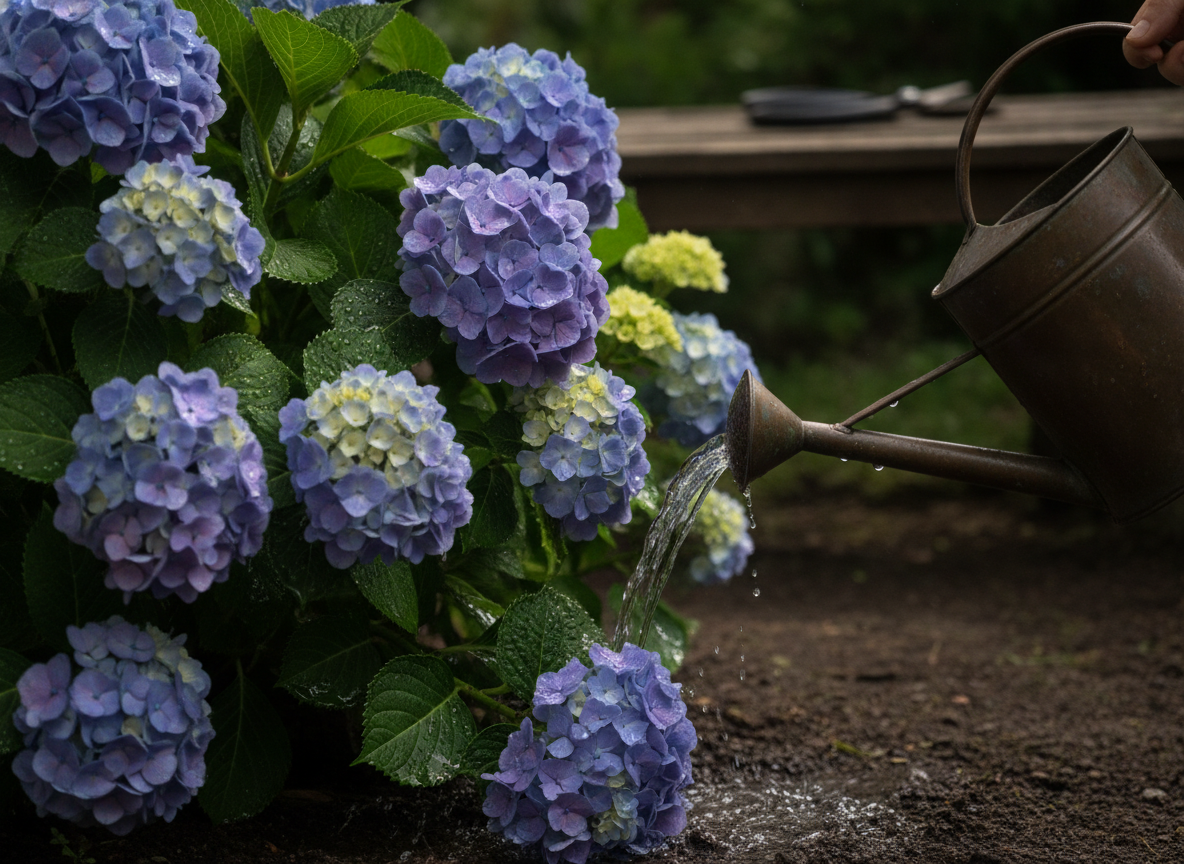 A hand waters a purple hydrangea plant in a garden — AI-generated illustration
What a July hydrangea actually wants: water, not the blade
If you’re itching to do something for the plant this month, put the secateurs down and pick up the watering can. Hydrangea comes from hydor — water — and it means it. On a hot, dry July afternoon a hydrangea is the first shrub in the garden to wilt, its big soft leaves flagging and the flowerheads drooping by mid-afternoon. That’s thirst, not damage, and it recovers overnight if the roots are wet.
The fix is a long, slow soak at the base once or twice a week in dry spells — a full can or two poured slowly over the root zone, not a daily sprinkle on the leaves. Mulch the ground around the plant with compost or bark to hold that moisture in, and keep it a hand’s width clear of the stems. A well-watered hydrangea in July builds fat, healthy buds for next year; a stressed, bone-dry one sets fewer, whatever you do with the shears.
So when do you prune? Early spring
None of this means hydrangeas never get cut — just not now. The single prune the old-wood types actually want comes at the very end of winter, once the worst frosts have passed and the buds are visibly swelling. That’s when you take last year’s spent heads off, cut back to the first strong pair of buds, and thin out any dead or crossing stems. Do it in July and you guess at where the buds are; do it in spring and the plant shows you exactly where to cut.
That spring cut is a whole job of its own, and the difference between a good one and a bloom-wrecking one comes down to knowing your type — the full walk-through is in hydrangea pruning in April: why one wrong cut can cost you a summer of blooms. Bookmark it for next March; leave the plant be until then.
Not sure whether the hydrangea in front of you is an old-wood mophead to leave alone or a new-wood paniculata that’s still building? That single question decides everything, and it’s easy to get wrong from a fading July plant. Cresco identifies your exact variety from a photo, tracks its pruning window against your own garden’s weather, and tells you the one thing to do this week — which, for most hydrangeas in July, is a pleasant nothing at all.