Right now, do one thing: deadhead
Japanese anemones (Anemone × hybrida, and the earlier A. hupehensis) are just hitting their stride. They open when almost everything else in the border is winding down — single saucers of white or pink on wiry two-foot stems, waving over a low mound of dark leaves. Left alone they will flower for a few weeks. Kept deadheaded, they will run well into October.
That is the only job for early September: snap off the flowers as they fade, and the plant keeps pushing new buds down the same branching stems. Stop deadheading and it reads the seed set as “job done” and slows.
The catch is knowing what’s a spent flower and what’s an unopened bud, because on an anemone they look alike.
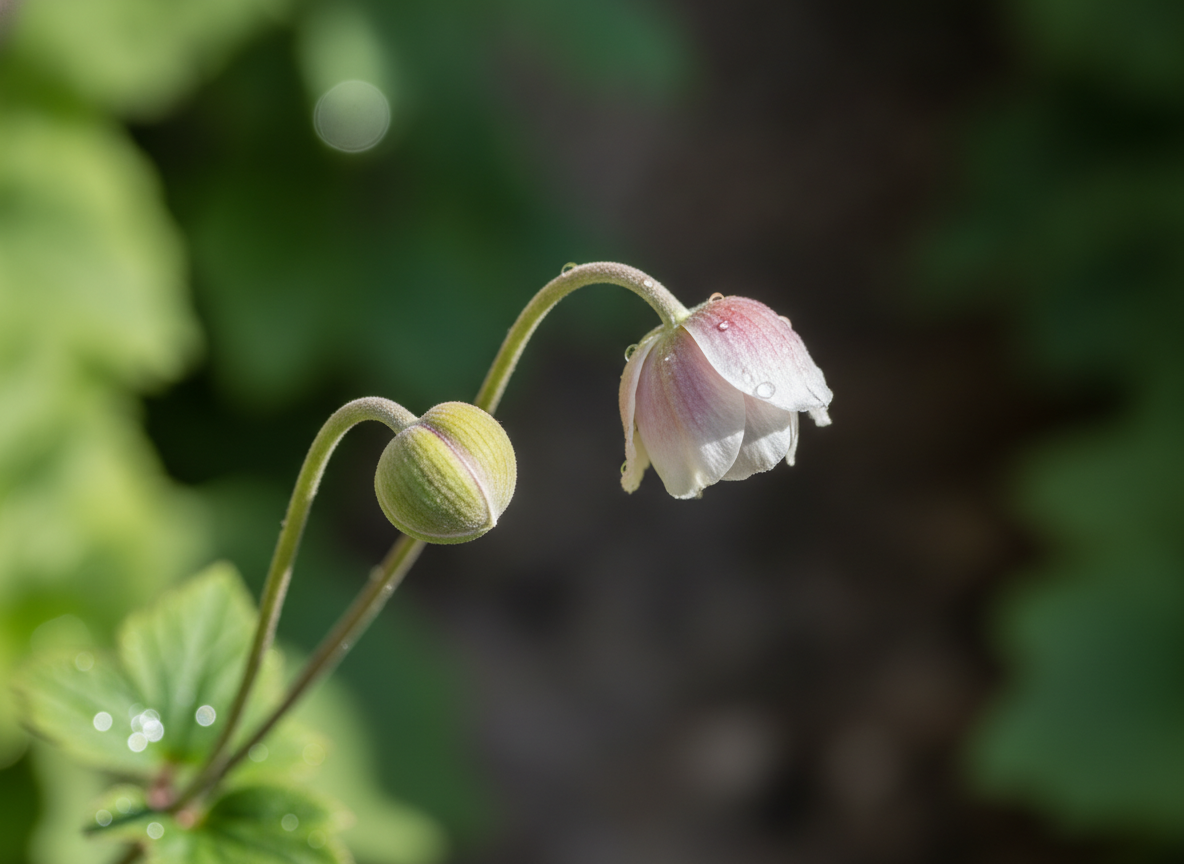 Two Japanese anemone flower buds are shown with water droplets — AI-generated illustration
The bud and the button
Every anemone stem carries a spray of rounded, pea-like buds at different stages. Before it opens, a bud is a smooth, tight, green-and-pink ball. After the petals drop, you’re left with a very similar-looking green button — the developing seedhead — sitting on its own little stalk.
Deadhead the wrong one and you remove a flower you were about to get.
The tell is the stalk and the surface. An unopened bud sits on a shorter, fatter stalk and feels firm and full. A spent one sits on a lengthening stalk, has a slightly flattened top where the petals were, and often shows the first grey fuzz of seed. When in doubt, roll it gently between finger and thumb: the future flower is solid, the spent button is starting to soften and fluff. Cut spent stalks back to the next side-bud or leaf, not to the ground.
 Brown and white Japanese anemones in a garden during autumn — AI-generated illustration
Don’t cut the plant down this autumn
When the last flowers finish and frost blackens the leaves, the urge is to cut the whole thing to the ground with the rest of the autumn tidy. Resist it.
Those spent flowers turn into the best part of the plant’s second act: silvery, cotton-wool seedheads that catch the low winter light and hold their shape through hard frost. The RHS advice is plain — leave the faded growth standing. It shelters ladybirds, lacewings and other overwintering insects at the base, and the seed feeds finches and other small birds. It’s the same logic behind leaving ornamental grasses standing until spring and leaving the last coneflower heads for the birds: the autumn “tidy” throws away structure and wildlife food for the sake of bare soil nobody looks at in January.
There’s a plant-health reason too. That crown of old stems and leaves is a frost blanket over the growing point. Anemones are fully hardy once established, but a bare, freshly cut crown going into a wet, freezing winter is the one that rots or heaves out of the ground. Leave the top growth as cover and cut it in spring, when you can already see the new shoots.
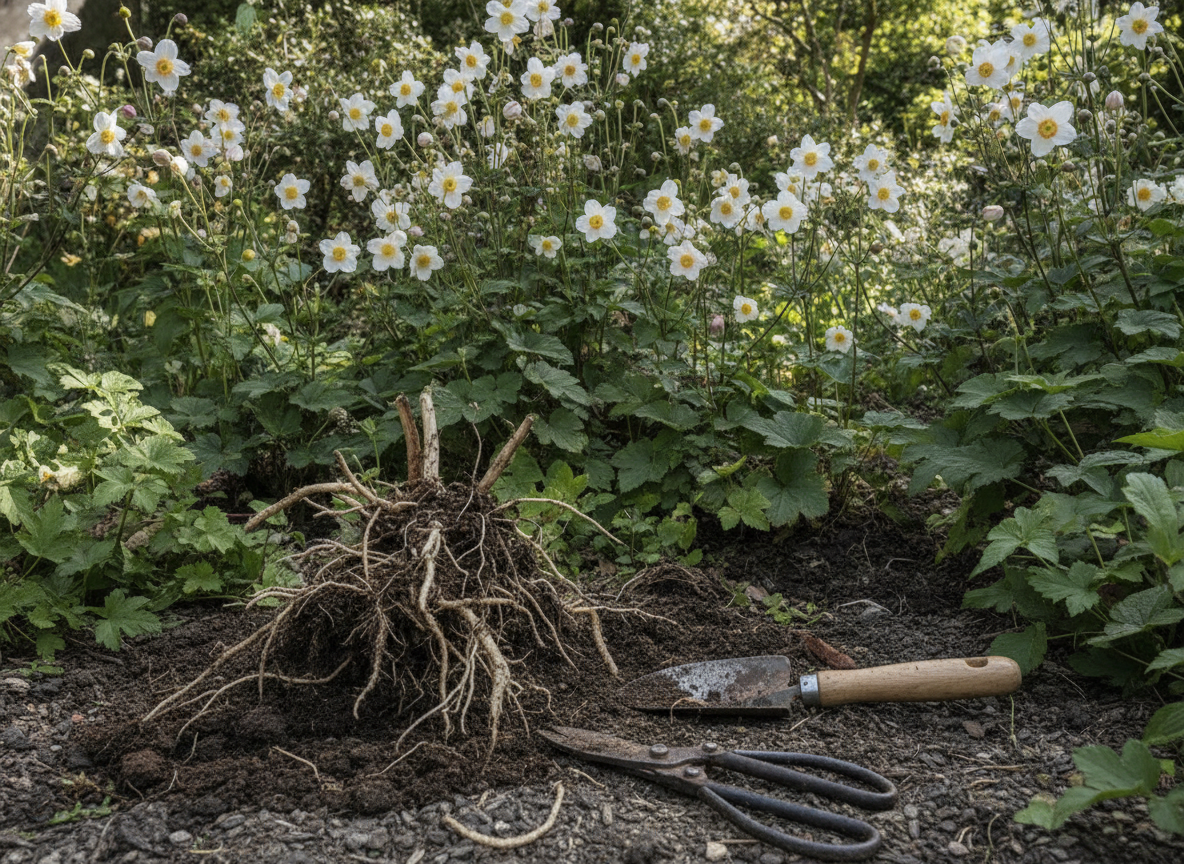 Japanese anemone roots and garden tools in a garden setting — AI-generated illustration
Never dig or chop at the roots
Here’s the mistake that turns one polite clump into a colony you’ll be pulling out of the lawn for years.
Japanese anemones spread by brittle, running roots just under the surface. Every one of those roots is a ready-made new plant. Slice through them with a spade — digging the clump, edging the border, forking over next to them, or trying to “chop it back” underground because it’s outgrowing its spot — and each severed fragment left in the soil sprouts. You don’t reduce the plant; you propagate it. This is exactly why gardeners warn that anemones are hard to move and harder to get rid of: the harder you dig, the more you plant.
So the rule is: cut the tops, never carve the roots. If a clump genuinely has to shrink or move, do it deliberately in spring — lift the whole thing, take the pieces you want with clean healthy roots, and be thorough about removing every scrap from the ground you’re clearing, because the scraps are what come back. Better still, give anemones a spot where spreading is welcome and let them get on with it: a shady back corner, the base of a hedge, a gap between shrubs.
What spring actually looks like
Come March, before the new leaves get going, cut every old flower stem and dead leaf down to the base. That’s the whole job — one clean cut-back a year, in spring, not autumn. New growth comes straight from the crown and the plant is away again by May, building to another September of flower.
So the calendar for Japanese anemones is short and easy to get wrong: deadhead through September and into October, leave everything standing over winter, cut to the ground in early spring, and keep the spade away from the roots all year.
Let Cresco track the timing for you
The tricky part isn’t the cuts — it’s remembering that this plant wants deadheading now, nothing in autumn, and a hard cut in spring, while the plant next to it wants the opposite. That’s what Cresco’s pruning planner is for: tell it what’s in your garden and it builds the schedule around each plant and your local weather, so the “cut in spring, not now” jobs land in your list at the right moment. Browse more seasonal pruning guides to get the rest of the border’s timing right.