Why an unpruned kiwi turns into a jungle
A kiwi vine (Actinidia deliciosa, or the smaller hardy kiwi, Actinidia arguta) grows faster than almost anything else you can put on a fence. Shoots of three or four metres in a single summer are normal. Left alone, those shoots twist around each other, around the wires and around anything else nearby, and within a few years you have a dense mat of stems that’s heavy, shady inside, and carries less fruit every year.
The reason is the way kiwis fruit. Flowers, and so fruit, appear on this year’s new shoots, but only on shoots that grow from last year’s wood. And each shoot carries fruit only on its first handful of buds, near the base. Once those buds have fruited, that stretch of stem won’t flower again. So every year the crop moves further out, to the ends of ever-longer stems, while the middle of the vine fills up with old, unproductive wood.
Pruning keeps the vine producing fresh fruiting wood close to the main framework, where you can reach it, the sun can ripen it and the wires can carry it. The RHS recommends two prunes a year, one in summer and one in winter. The winter one is the one that sets up the crop, and it has a deadline.
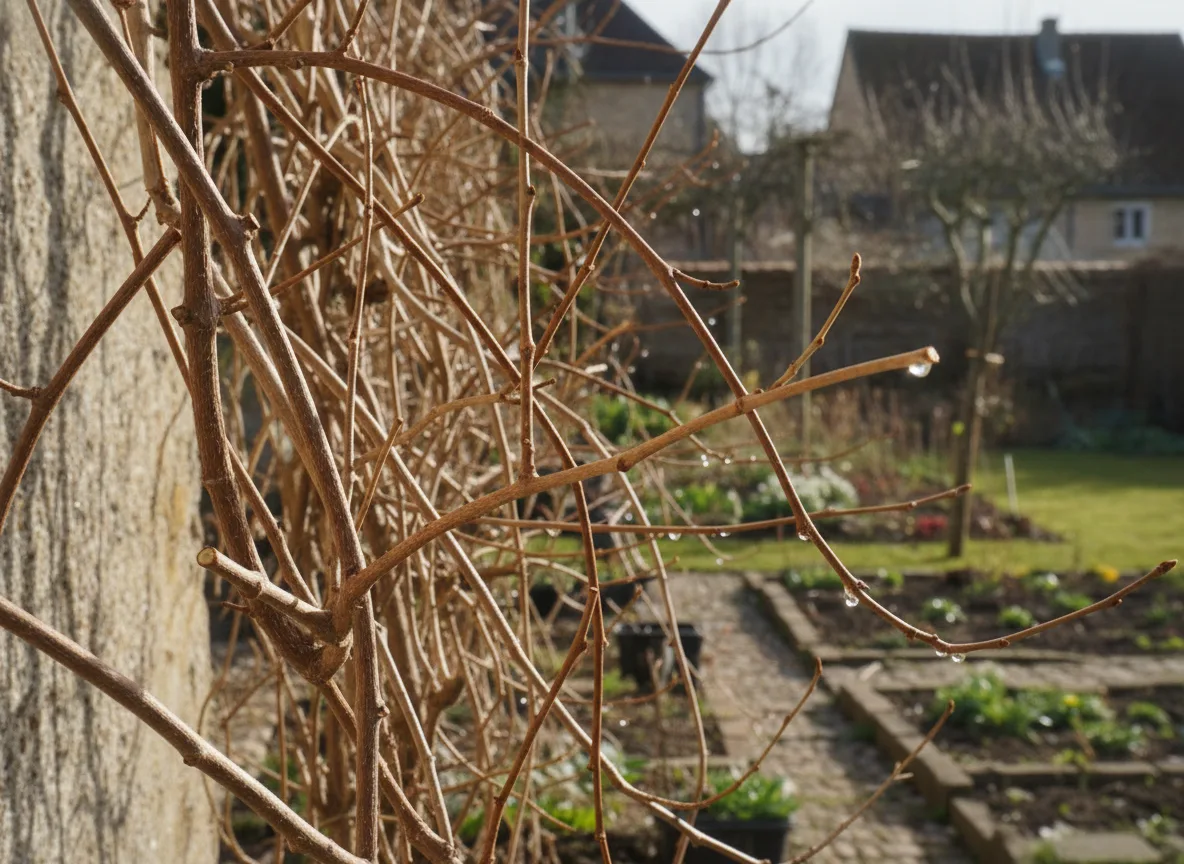 Kiwi vine branches in late winter, before sap rises, with dew drops — AI-generated illustration
The window: after leaf fall, before the sap rises
Kiwis bleed. Like grapevines and birch, they push sap up the stems in late winter, before the buds break, and a cut made then can drip for days. Experienced growers say it usually stops on its own without obvious harm, but there’s no reason to take the risk when there’s a long, easy window before it starts.
- Start once the fruit is picked and the leaves have fallen. In most of the UK and the Netherlands that’s mid-November to early December. Bare stems make the framework, and the buds, easy to see.
- Finish by the end of January. From February the sap begins to move, and the closer you get to bud break, the more a cut will bleed.
- Avoid pruning in a hard frost. Frozen stems are brittle, and fresh cuts on a vine that’s still a bit tender can die back.
December is the sweet spot: the vine is fully dormant, the weather is often mild and grey, and there’s no fruit or foliage in the way. The same logic applies to grapevines, which are best cut in late November for exactly the same reason.
Know the framework before you cut
A well-trained kiwi on a wall or fence has a simple structure, much like an espalier:
- The main stem, running up from the ground to the first wire.
- Permanent arms (cordons), running sideways along the wires. These stay for the life of the plant.
- Fruiting laterals, side branches that grow off the arms about 50 cm apart. These are the wood you prune every winter.
- This year’s shoots, which grow from the laterals in spring and carry the flowers and fruit.
If your vine is a tangle, find the main stem first and trace it upwards. Pick one or two strong stems along each wire to be your arms and treat almost everything else as laterals or surplus. You don’t have to fix it all in one winter.
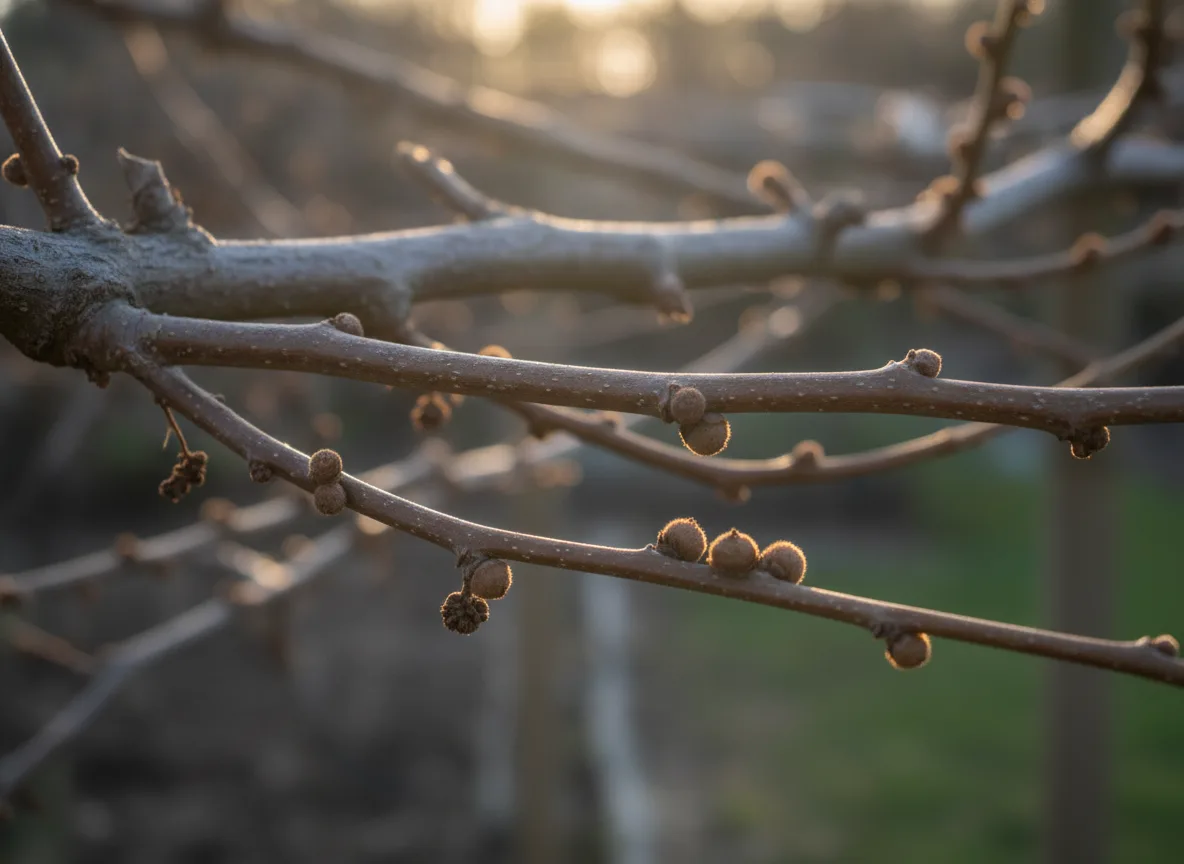 Kiwi vine branches with dormant buds in natural light — AI-generated illustration
The winter cut, step by step
Work along each arm, one lateral at a time.
- Find the shoots that fruited this year. You can often still see the little scars or stalks where the fruit hung. They sit on the lower part of each shoot.
- Cut each fruited shoot back to three or four buds beyond the last fruit. That’s the RHS guidance. The buds you leave will produce next year’s fruiting shoots, close to the lateral.
- Leave the strong one-year-old shoots that didn’t fruit. If they’re well placed, shorten them to about eight to ten buds and tie them in. They’ll fruit next summer.
- Replace old laterals. A fruiting lateral is at its best for about three years. After that it gets crowded and twiggy. Cut it back to a strong shoot or a dormant bud close to the arm, and a new lateral will grow from there.
- Take out the clutter. Remove dead wood, broken stems, weak, spindly shoots and anything that’s twisted itself around another stem. Unwind what you can; cut what you can’t.
- Cut cleanly. Use sharp secateurs and cut about 2 cm beyond a bud. Kiwi stems are pithy, and a cut right against the bud can let it dry out.
When you’re done, the vine should look open, with laterals evenly spaced along the wires and plenty of buds left on short spurs and young shoots. It will look sparse in January. By July it won’t.
The summer prune that makes winter easier
The winter cut sets the crop; the summer prune stops the vine from smothering it. In June and July, pinch or cut fruiting shoots back to five or six leaves beyond the last fruit, and shorten non-fruiting shoots that are heading off into the hedge. That lets light reach the fruit and keeps the tangle from building up again.
If you skip it, the winter prune just takes longer, because you’ll be cutting out the excess growth then instead. The same two-prune rhythm works for wisteria, which also needs its winter cut to flower.
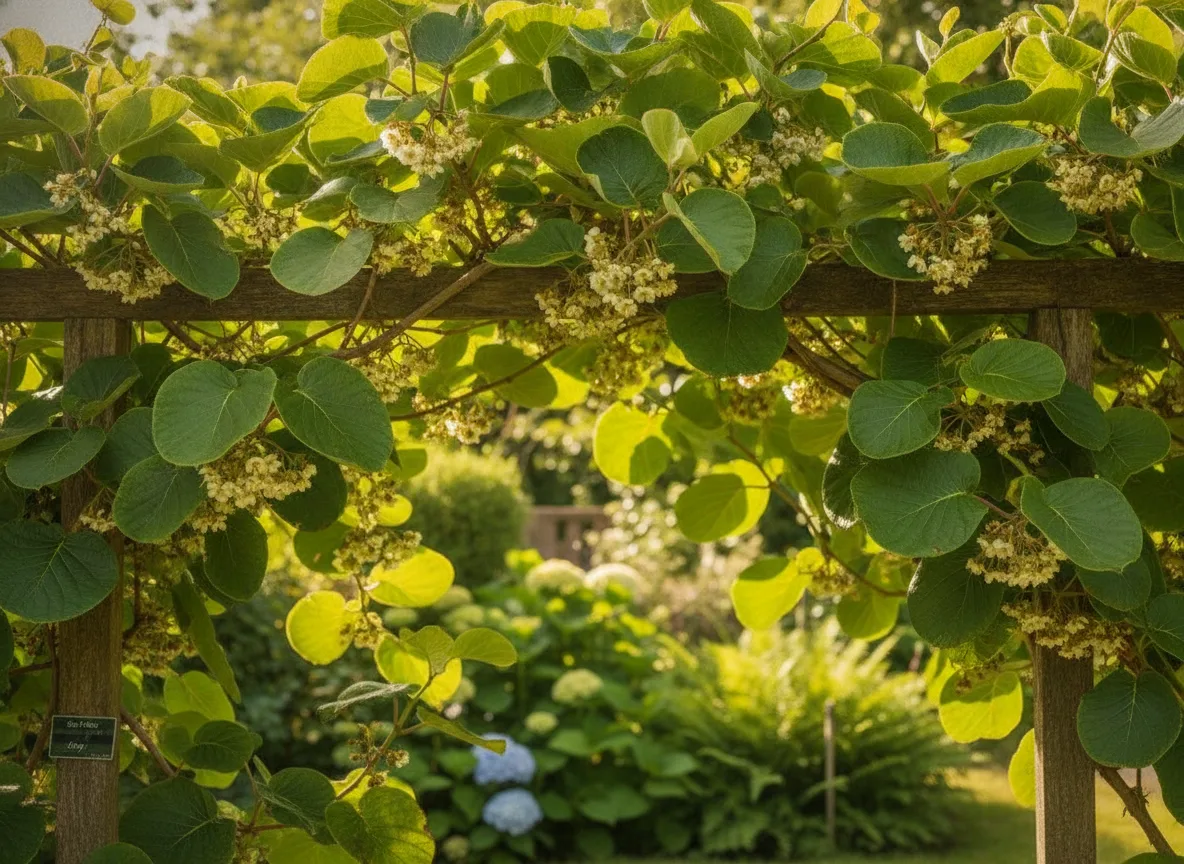 Kiwi vines with flowers growing on a wooden trellis in a garden — AI-generated illustration
Still no fruit? Check these first
Pruning fixes a vine that fruits less every year. It won’t fix one that has never fruited. If yours hasn’t, check these first:
- Male and female plants. Most kiwis have male and female flowers on separate plants. Only female plants carry fruit, and they need a male nearby to pollinate them. Self-fertile varieties such as ‘Jenny’ (A. deliciosa) and ‘Issai’ (A. arguta) are the exception.
- Age. Kiwis can take three to five years from planting before they flower properly. Hardy kiwis are often quicker.
- Frost. Young shoots and flower buds are easily killed by late spring frosts. If the shoots blacken in April or May, the flowers go with them. A sheltered, sunny wall helps.
- Too much nitrogen. A vine fed heavily with lawn feed or manure puts everything into leaves. Cut back on the feeding.
Put the date in your calendar
The window is wide, but it’s easy to miss if you wait for a dry weekend in February. Cresco tracks your plants’ pruning windows and reminds you when they open, so the kiwi gets its cut in December, before the sap starts to rise. You can start free at cresco-pruning.com.